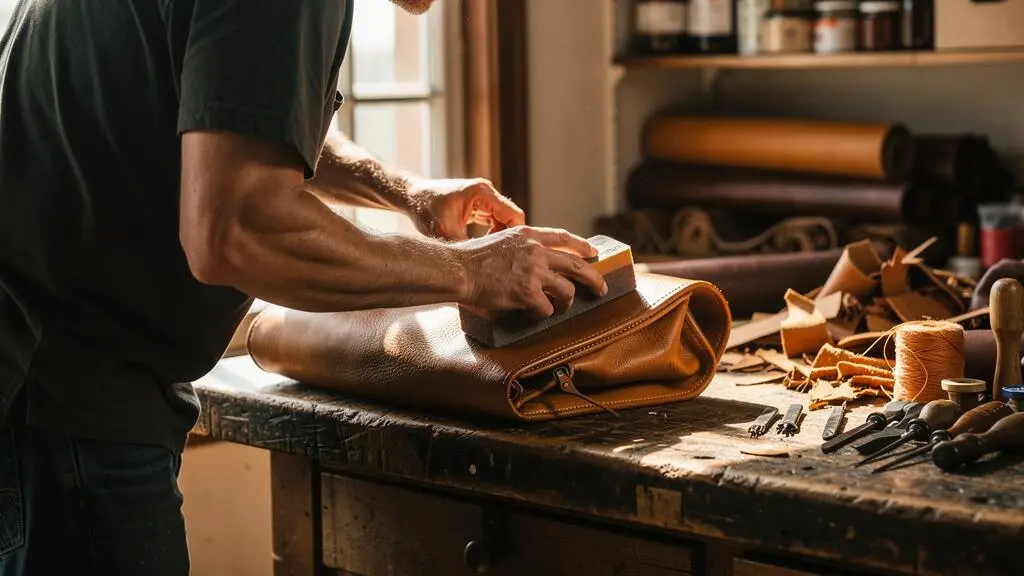
A well-made leather bag may acquire a richer colour after years of handling, while another develops peeling edges and failing seams. A carefully constructed mechanical watch can remain serviceable across generations, whereas a superficially impressive alternative may become difficult to maintain. The difference is rarely explained by price or prestige alone.
Master artisans influence longevity through material selection, controlled finishing, thoughtful construction and an understanding of how objects behave under repeated use. Yet handwork is not an automatic guarantee of quality. A poorly chosen material or inaccessible component can undermine even the most elaborate workmanship.
For collectors and quality-conscious shoppers, particularly those buying without relying on established luxury names, the practical question is whether a piece has been made to age, withstand maintenance and remain useful. Recognising that potential requires examining what is visible, questioning what is concealed and understanding the distinction between attractive wear and irreversible damage.
What makes craftsmanship last?
- Beautiful ageing depends on suitable materials, durable construction, appropriate finishes and maintenance, not handwork alone.
- Stitching, edges, linings, hardware and repair access reveal more about workmanship than artisan-themed marketing.
- Before buying, establish who can repair the object, whether replacement components exist and how its materials should be maintained.
- Why Does Handwork Create Better Patina After 2 Years of Wear?
- How to Spot Artisan-Level Work Using 7 Visual Checks in Good Lighting?
- Atelier-Made or Factory Luxury: Which Is Easier to Repair After Heavy Use?
- The Marketing Phrase That Tricks Buyers Into Thinking Something Is Handmade
- A Care Routine That Prevents 3 Common Mistakes That Destroy Fine Finishes
- Why Does Vegetable-Tanned Leather Age Beautifully While Others Peel?
- Why Does Servicing Matter More Than Specs in Luxury Watches and Jewellery?
- How Do You Judge Craftsmanship in Horology and Fine Jewellery Without Being an Expert?
Why Does Handwork Create Better Patina After 2 Years of Wear?
Handwork can encourage attractive patina when it produces carefully finished, responsive surfaces that withstand handling without losing their integrity. Hand-sanded edges, polished metal and naturally finished leather may develop subtle changes in colour and sheen as they are used. However, two years is not a universal ageing threshold, and hand-finishing alone cannot guarantee a better result.
Patina is the gradual alteration of a material’s appearance through processes such as oxidation, contact with skin oils, exposure to light and repeated gentle abrasion. It differs from deterioration because the underlying object remains structurally sound. A leather handle that darkens through regular handling may be developing character; one that cracks, becomes powdery or separates into layers is deteriorating.
Hand-finishing can create minute variations in texture and reflectivity. On leather, sanding and burnishing may produce gently rounded edges and surfaces that respond differently to light. On metal, careful polishing can leave deliberate transitions between reflective and matte areas. Subsequent handling changes these surfaces, sometimes producing an appearance that feels less uniform and more visually complex.
These effects should not be mistaken for proof that every microscopic irregularity improves patina. Material chemistry, coating thickness, finishing quality and environmental exposure are often more decisive than whether the final polishing was performed manually or mechanically.
The Canadian Conservation Institute’s guide to leather conservation explains how tanning processes influence leather properties and identifies moisture, chemical degradation and physical deterioration as important conservation concerns.
Different materials also follow different ageing patterns:
| Material | Potentially attractive change | Warning signs |
|---|---|---|
| Natural-finish leather | Gradual darkening, surface sheen and wear-related colour variation | Cracking, powdering, delamination or weakening |
| Uncoated copper alloys | Changes in tone and surface oxidation | Severe corrosion or damaged components |
| Fine textiles | Softening and subtle changes in surface texture | Broken fibres, thinning, unstable seams or persistent distortion |
These are possible observations, not guaranteed outcomes. A frequently handled wallet may change visibly within months, while a carefully stored leather case may show little alteration after several years.
Uniform industrial finishes introduce another distinction. A thick surface coating may conceal the substrate beneath it. If the coating loses adhesion, the visible result can be peeling rather than a gradual evolution of the underlying material. Nevertheless, a properly engineered industrial finish may offer excellent protection and long service life.
The most meaningful sign of beautiful ageing is therefore not visible irregularity itself, but a surface that develops character while the construction beneath it remains reliable. That distinction becomes easier to judge when the object is examined closely before purchase.
How to Spot Artisan-Level Work Using 7 Visual Checks in Good Lighting?
Artisan-level workmanship can be assessed through seven observable features: stitching, edge finishing, pattern continuity, linings, material density, hardware alignment and tactile response. Inspecting these details in natural daylight helps distinguish deliberate workmanship from cosmetic presentation. No single feature proves that an object is handmade, but consistent quality across several areas provides stronger evidence of careful construction.
Begin beside a window or in evenly diffused daylight, where shadows and reflections reveal details that flattering retail lighting may obscure. Strong spotlights can make smooth finishes appear richer while concealing uneven dye application or adhesive residue. Avoid harsh direct sunlight that produces glare and makes subtle differences harder to interpret.
Use the following seven checks:
- Stitching: Examine stitch alignment, tension and spacing. Count stitches across a measured centimetre on comparable seams if useful, but do not assume a higher count automatically means greater strength. Look for secure ends, appropriate thread and consistent construction.
- Edges: Look for cleanly cut, folded, sanded, waxed, burnished or painted edges appropriate to the material. Check for exposed adhesive, lifting coatings and irregular joins.
- Pattern continuity: Where grain, embossing or decorative patterns cross a seam, assess whether the transition appears intentional. Pattern matching is a design choice rather than a universal requirement.
- Linings: Inspect pockets, corners and concealed areas. Linings should be appropriately attached, with secure seams and no unnecessary bunching.
- Weight and density: Assess whether the structure feels appropriate for its purpose. Excessive weight is not evidence of superior craftsmanship, and light materials can be exceptionally durable.
- Hardware alignment: Open closures, check the position of rivets and examine how handles and fittings sit under gentle tension.
- Material response: Feel how the surface bends, compresses and recovers under light handling. Look for stiffness, unexpected cracking or separation, without forcing delicate materials.
Compare two similarly sized pieces made for similar uses. Concentrate on the underside of handles, internal corners, strap attachments and other places that are difficult to make visually impressive but important to long-term performance.
Some apparent imperfections are intentional, while others have been added to suggest handwork. Decorative stamps, slightly uneven stitching and rustic packaging can all be reproduced with industrial equipment. Conversely, remarkably precise workmanship may be the result of highly skilled handcraft rather than automated production.
Five actions to document craftsmanship before buying
- Inspect three structural seams in daylight and record whether their alignment and tension appear consistent.
- Photograph a handle attachment and an exposed edge to document construction details.
- Open the item and identify two concealed finishing details, noting any loose lining or adhesive residue.
- Test the closures gently and record whether hardware moves smoothly and aligns correctly.
- Ask the seller how the item is assembled and repaired, then retain the written answer alongside your inspection notes.
Visual examination identifies clues, not the complete history of manufacture. Once an object passes these basic checks, its potential for repair becomes the next important measure of quality.
Atelier-Made or Factory Luxury: Which Is Easier to Repair After Heavy Use?
Atelier-made pieces can be easier to repair when their construction allows damaged components to be removed and replaced without destroying the surrounding material. Traditional stitching, accessible fasteners and replaceable fittings can favour restoration. Factory-made luxury, however, may offer superior repair support when manufacturers maintain spare parts, technical documentation and established service networks.
A carefully stitched leather handle can sometimes be removed, remade and attached to the original body. Similarly, certain mechanically assembled components allow a repairer to work on one damaged area without dismantling the entire product.
Construction method matters, but broad categories can mislead. Adhesive bonding is not inherently inferior: properly selected adhesives serve important structural and finishing purposes. The difficulty arises when an inaccessible or inseparable bond makes component replacement impractical, especially where the material surrounding the repair is fragile.
Some factory-produced luxury pieces are engineered for long-term servicing. An established manufacturer may retain specialised components and offer trained technicians. A small independent workshop might produce exceptional work yet close without preserving repair instructions, tools or access to replacement fittings.
Compare repairability through practical questions rather than assumptions about production scale.
| Criterion | Atelier-made piece | Factory-produced luxury |
|---|---|---|
| Construction | May use accessible stitching and individually replaceable parts | May use modular components or less accessible proprietary assemblies |
| Repair expertise | May be available from the maker or an independent specialist | May depend on authorised technicians and manufacturer procedures |
| Spare components | Some can be fabricated individually | Some are manufacturer-specific but supported through service channels |
| Long-term support | Dependent on workshop continuity and transferable skills | Dependent on service policy, parts availability and business continuity |
| Main risk | Loss of the original maker or specialist knowledge | Discontinued proprietary parts or restricted repair access |
Before committing to an expensive object, ask who performs repairs, which components are replaceable, whether third-party specialists can work on it and how estimates are calculated. A written service policy is more useful than an unspecified promise of lifetime quality.
Consider a hypothetical comparison: one bag has traditionally stitched handles that a local leatherworker can replace; another uses manufacturer-specific fittings supported by a dependable restoration service. Both may be sensible long-term purchases, despite different production methods. Without information about future parts and repair access, neither can confidently be described as more durable.
Restoration also has limits. Repairs cannot necessarily reverse severe material decay, and interventions that replace original features may affect the appeal or collectible value of certain objects.
The strongest construction is not simply one that survives initial use. It is one whose likely points of failure can be addressed without sacrificing the whole object. Assessing that quality requires looking beyond the claims printed on its label.
The Marketing Phrase That Tricks Buyers Into Thinking Something Is Handmade
“Finished by hand” is one of the most easily misunderstood descriptions in luxury retail because it may refer to a single operation rather than the manufacture of the entire object. Expressions such as “handcrafted details” and “artisan-inspired” can likewise describe genuine characteristics without establishing how much work was performed manually or who carried it out.
A leather accessory may be cut and assembled using industrial equipment before a worker applies wax to its edges. A piece of jewellery may be machine-cast and subsequently polished by hand. Both can legitimately involve manual finishing, but neither process necessarily represents comprehensive artisanal production.
The important distinction is between a specific, verifiable manufacturing claim and evocative language that leaves the production process undefined.
- “Finished by hand”: Ask which finishing stages were manual and which were mechanised.
- “Handcrafted details”: Identify the particular elements made or assembled by hand.
- “Artisan-inspired”: Treat this as a description of design influence unless further evidence establishes artisanal manufacture.
- “Italian leather”: Distinguish the leather’s stated origin from the location where the finished product was manufactured.
Geographical origin claims require similar care. A manufacturing location does not establish the proportion of manual work. Equally, claims such as “Made in Italy” and “Made in France” cannot be reduced to a universal rule requiring only a minor final finishing operation. Their legal assessment depends on the applicable origin requirements and the actual production history.
The distinction is illustrated by the Federal Trade Commission’s guidance on Made in USA claims. For an unqualified American-origin claim, the FTC applies its “all or virtually all” standard, considering manufacturing and processing along with component origin. This is a US-specific origin framework, not a certification of hand craftsmanship or a rule governing European origin labels.
A buyer seeking an authentic workshop-made piece should request specific information: the workshop’s location, which operations occur there, whether the maker can be identified, how specialist skills are applied and what independent documentation is available. Production times and the number of workers may provide useful context, but neither establishes quality on its own.
Missing information should prompt further questions, not an automatic accusation of dishonesty. Smaller makers may lack formal certification, while large businesses may maintain detailed, independently verifiable manufacturing records.
Manufacturing claims become useful when they can be connected to observable processes and accountable suppliers. Once these claims are understood, preserving the workmanship already purchased becomes the next responsibility.
A Care Routine That Prevents 3 Common Mistakes That Destroy Fine Finishes
A safe care routine starts by identifying the material and finish, then limiting intervention to what the object’s condition actually requires. Three common mistakes cause avoidable problems: applying unsuitable universal products, exposing materials to damaging heat or light, and over-treating surfaces with conditioners or cleaning agents. The best routine preserves both surface appearance and structural integrity.
Universal cleaners create particular risks because an apparently similar surface may have a completely different chemical composition or finish. A treatment compatible with a robust, coated leather may stain or permanently alter a more absorbent vegetable-tanned surface.
Heat and direct sunlight introduce other risks. Repeated exposure can alter colours and accelerate deterioration in vulnerable materials. Storage near radiators or prolonged exposure through windows should therefore be considered carefully, especially for leather, fine fabrics and sensitive finishes.
The third mistake is confusing cleanliness with conditioning. Applying oils, waxes or dressings without establishing a need can change colour, affect surface feel and complicate future conservation. The Canadian Conservation Institute’s leather guidance emphasises material vulnerabilities rather than endorsing a universal conditioning schedule.
A suitable maintenance routine varies by material:
| Material or finish | Basic care | Avoid | When to reassess |
|---|---|---|---|
| Vegetable-tanned leather | Remove loose dust gently; protect from unnecessary wetting; follow maker-specific instructions | Unverified conditioners, soaking and concentrated heat | After exposure, staining or noticeable surface changes |
| Pigmented leather | Use a finish-compatible method recommended by the maker | Abrasive scrubbing and assumptions that all leather products are interchangeable | When coating wear or damage becomes visible |
| Polished metals | Remove handling marks with a suitable soft cloth when appropriate | Indiscriminate abrasive polishing, especially on plated or collectible surfaces | When tarnish, scratches or corrosion require intervention |
| Fine textiles | Handle with clean hands and store with appropriate physical support | Unnecessary washing, harsh chemicals and prolonged strong light | When soiling or fibre damage appears |
These recommendations are deliberately conservative. They are not interchangeable restoration procedures, and no fixed cleaning frequency is appropriate for every object. A bag carried daily, an heirloom garment and a museum-quality collectible have different exposure patterns and conservation priorities.
Inspect frequently used items periodically for seam movement, surface changes and loose hardware. Record changes before applying treatments. For an unfamiliar or historically important object, professional advice is safer than experimentation.
Care should also reflect intended use. Ordinary handling may produce desirable visual changes, but there is no obligation to accelerate patina through additional moisture, oils or deliberate abrasion.
Successful care does not freeze an object in its original condition. It allows normal ageing to occur without exposing materials to avoidable damage. This balance is especially important with leather, where tanning and surface finishing are frequently confused.
Why Does Vegetable-Tanned Leather Age Beautifully While Others Peel?
Vegetable-tanned leather can develop attractive colour and surface changes because its tanning chemistry and finishing characteristics may leave the natural grain responsive to handling, light and wear. Peeling, however, is not an inevitable characteristic of chrome-tanned leather. It is more closely associated with failures in particular coatings, bonded structures or other surface layers. Construction and finishing matter alongside tanning.
Vegetable tanning uses tannins derived from plant materials, including bark and leaves, to stabilise the collagen structure of animal hide. Mineral tanning commonly employs chromium salts, which interact with collagen and contribute to the material’s stability and water resistance.
These processes create different material properties, but neither is intrinsically superior in every application. Vegetable-tanned leather is often chosen for structured accessories and products intended to display natural colour development. Chrome-tanned leather may be selected for softness, flexibility and other functional requirements.
The distinction between tanning and surface quality is essential. Full-grain leather retains its original grain surface, while corrected-grain leather has undergone alterations to its appearance. Bonded or reconstituted leather products combine leather fibres or fragments with binding materials and may incorporate a separate surface layer.
These labels describe different aspects of a product and should not be treated as a simple hierarchy in which every full-grain piece outperforms every corrected-grain alternative. The term “genuine leather” alone reveals relatively little about tanning method, finishing quality or long-term performance.
Where a coating or bonded layer separates, the result may be visible peeling. That failure should not be attributed automatically to chrome tanning: well-made chrome-tanned leather can remain durable, while vegetable-tanned leather can suffer severe damage through unsuitable exposure.
A gentle bend, performed only with the seller’s permission, can reveal useful information about a leather item’s flexibility and surface behaviour. Some leathers show a temporary colour change at the crease, while strongly pigmented finishes may appear more uniform.
However, a bend test cannot reliably identify a tanning method. Colour change depends on finishing, oils, structure and other variables. The result should not be used to certify vegetable tanning or condemn a pigmented leather.
For a more dependable assessment, ask about the tanning process, grain type, surface coatings and material composition. Examine edges for layered structures and establish whether the supplier can provide technical information. Handle the object gently, since aggressive bending can damage delicate or finished leather.
Vegetable-tanned leather also requires realistic expectations. Water exposure can cause stiffness, shrinkage or tannin migration. Certain degradation processes can weaken the material despite an initially attractive appearance. The objective is not to maximise colour change but to preserve flexibility and strength while allowing normal use to shape the surface.
Material knowledge helps explain how a surface may age, but the same reasoning applies beyond leather. Mechanical and precious-metal objects introduce another requirement: the ability to service complex components long after the original purchase.
Why Does Servicing Matter More Than Specs in Luxury Watches and Jewellery?
Servicing can matter more than impressive initial specifications because the useful life of a watch or piece of jewellery depends on what happens after years of wear. Mechanical movements need appropriate maintenance, while settings, clasps and other jewellery components may require inspection or repair. A technically sophisticated object becomes a poor long-term proposition if essential parts or qualified servicing are unavailable.
Mechanical watches contain moving components that depend on lubrication and precisely controlled interactions. Lubricants can change over time, seals can deteriorate and wear may develop through operation or environmental exposure. Service needs differ by movement, condition, manufacturer guidance and usage.
A watch’s advertised precision, power reserve or movement complexity describes aspects of its initial performance and design. These specifications do not establish whether it will be practical to repair decades later.
Before buying, investigate whether the manufacturer or independent specialists can service the movement. Ask whether critical components can be obtained, whether technical documentation is accessible and what happens if a part is discontinued.
Some established manufacturers maintain long-term service arrangements, while other businesses may have limited access to older components. Yet neither brand age nor production volume guarantees future availability. An independently serviceable movement may offer advantages even when the manufacturer no longer supports a particular model.
Jewellery requires a different maintenance approach. Gemstone settings can become loose, clasps can wear and metal components can deform. Inspections may identify these problems before a stone is lost or a fastening fails. Appropriate methods depend on the metal, gemstones, construction and condition of the piece.
Service documentation has particular relevance for collectors. Invoices and records can establish what interventions have occurred and help a prospective buyer assess condition. However, a complete service history does not guarantee higher resale value. Market demand, originality, quality of work and the nature of any replaced components also influence collector preferences.
For certain collectible watches and jewellery, aggressive polishing or unnecessary replacement of original parts can reduce desirability. The objective is not simply to make an older object look new, but to maintain its function while respecting its historical and material character.
A credible service commitment should be assessed through practical details: service eligibility, access to parts, authorised or independent repair options, estimated procedures and the availability of written records.
Long-term value therefore rests partly on an ongoing network of specialist skills. Once servicing has been considered, the final challenge is learning to recognise workmanship in watches and jewellery without needing professional expertise.
Key takeaways before examining watches and jewellery
- Verify material authenticity and construction separately: precious-metal content, visual finishing and artisan involvement are different questions.
- Assess condition and future repair access alongside decorative excellence, particularly for older or mechanically complex pieces.
- Use magnification and independent documentation to identify questions worth asking, not to make unsupported claims of authenticity.
How Do You Judge Craftsmanship in Horology and Fine Jewellery Without Being an Expert?
Non-experts can judge visible craftsmanship by inspecting finishing consistency, component alignment, stone settings, engravings and material markings under good light. A phone’s macro function or a jeweller’s loupe can reveal useful details, while service records and independent verification provide essential supporting evidence. These checks help identify quality and potential concerns without substituting for professional authentication.
Begin with the exterior. Examine how polished and brushed surfaces meet, whether edges appear deliberately finished and whether joints or attachments are symmetrical where the design requires them to be. Compare similar features across the same object instead of assuming that perfect uniformity is always the defining characteristic of handwork.
For watches, inspect dial printing, the placement of hour markers, the alignment of hands and the quality of visible engravings. Distorted lettering, poorly positioned components or conspicuous finishing defects may justify further investigation, though they cannot establish authenticity or manufacturing origin by themselves.
Traditional decorative techniques can offer additional clues. Guilloché refers to precisely formed repeating patterns, while anglage describes the finishing of bevelled component edges. Such details may be appreciated where they are visible, including through a transparent case back. Printed decorative patterns and machine-assisted finishing can also be executed to a high standard, so appearance alone cannot identify the technique used.
The motion of a seconds hand requires particular caution. Its visible behaviour depends on movement architecture and operating characteristics; it is not a reliable standalone test of craftsmanship. An attractive sweep does not prove that a movement is expertly finished, and different legitimate mechanisms display different forms of motion.
For jewellery, examine how gemstones sit within their settings. Prongs should appear appropriately formed and secure, while adjacent stones should follow the intended design. Visible adhesive, pronounced misalignment or damaged settings may warrant professional examination.
The inside of a ring is often informative. Look at how surfaces transition around the shank, whether joins are cleanly finished and whether markings are legible. Appropriate comfort, sound construction and workmanship matter more than decoration hidden from ordinary view.
For precious metals sold in the UK, hallmarking offers an important independent check. According to the British Hallmarking Council’s official hallmarking guidance, a complete UK hallmark includes a sponsor’s or responsibility mark, a metal fineness mark and an assay office mark.
3 marks
The compulsory components of a complete UK hallmark: sponsor or responsibility mark, metal fineness mark and assay office mark. UK hallmarking requirements also depend on the metal and applicable weight thresholds.
British Hallmarking Council, official hallmarking guidance published on GOV.UK.
The fineness mark identifies precious-metal content in parts per thousand. For example, 375 indicates an alloy containing 375 parts gold per 1,000. These marks help establish metal composition under the UK system, but they do not certify artistic craftsmanship, establish who personally made the piece or guarantee its future resale value.
Different jurisdictions have different requirements, and the absence of a UK hallmark cannot be interpreted without considering an object’s origin, age, metal type, weight and legal context. For valuable or uncertain pieces, use a qualified independent specialist to assess authenticity and condition.
A useful final evaluation combines four dimensions: the quality of materials, the consistency of visible workmanship, the durability and repairability of construction, and the credibility of supporting documentation. A weakness in one area may outweigh excellence in another, particularly when the purchase is intended for long-term collecting.
Before your next purchase, photograph a few revealing details, ask for written information about materials and servicing, and compare the answers with what you can inspect. Choose the object whose construction and future care can be explained convincingly, rather than the one supported by the most persuasive luxury language.
Does a handmade object always last longer than a machine-made one?
No. Longevity depends on material suitability, construction, manufacturing consistency, use and maintenance. Handwork can enable highly controlled finishing and repairable construction, while well-engineered machine production can provide excellent precision and durability. Evaluate the finished object rather than treating its manufacturing method as a guarantee.
Should collectors restore every scratch or sign of wear?
Not necessarily. Minor wear may form part of an object’s history, while some interventions can alter original finishes or components. Prioritise structural stability and functional safety. For historically significant or collectible pieces, obtain specialist advice before polishing, refinishing or replacing original parts.
Can a high purchase price prove superior craftsmanship?
No. Price may reflect materials and skilled labour, but it can also incorporate distribution costs, marketing, brand positioning and scarcity. Compare verifiable construction details, material information, repair support and condition rather than using price as a substitute for inspection.
What records should accompany a valuable second-hand artisan piece?
Useful records may include purchase documentation, material descriptions, maker identification, repair invoices, service history and independent assessments. Their relevance depends on the object’s category and value. Documentation supports provenance and condition assessment, but it does not eliminate the need to examine the actual piece.
Is visible patina evidence that an object is authentic?
No. Authentic materials can age in different ways, and artificial ageing can imitate the appearance of long use. Patina may help reveal surface behaviour, but it cannot independently establish age, manufacturing origin or authenticity. Assess it alongside construction, documentation and, where appropriate, expert examination.