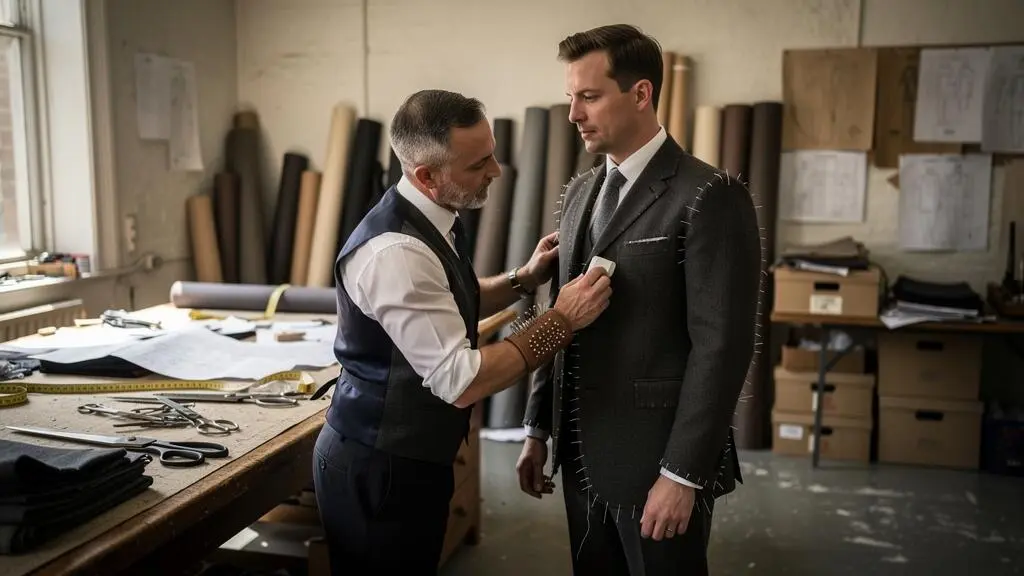
A well-chosen ready-to-wear suit can look perfectly respectable. Its shoulders sit reasonably straight, the trousers are the correct length, and nobody at the office notices anything wrong. For many men, that is sufficient. So why does Britain maintain a tradition of cutting suits individually, holding multiple fittings and building jackets around a particular person’s posture?
The answer is less about prestige than about the relationship between clothing and its wearer. Bespoke tailoring starts with the individual rather than a standard size. It allows a cutter to consider how someone stands, sits, moves and intends to use the garment. Those differences can be almost invisible in a fitting-room mirror but become noticeable during a working day.
That does not make bespoke essential, or made-to-measure an inferior choice for everyone. British tailoring traditions are most useful when treated as practical methods rather than social rules: understand the construction, identify the limitations of ordinary clothing, and spend money where an individual fit genuinely improves the experience.
Bespoke tailoring: what actually matters
- Bespoke earns its place through individual pattern cutting, iterative fittings and attention to posture, not simply through heritage or handwork.
- Made-to-measure and good ready-to-wear are sensible alternatives when proportions are relatively standard and the required adjustments are modest.
- Fabric resilience, comfort on a commute, appropriate formality and realistic delivery times can matter more than the reputation of a tailoring house.
- Why Does Bespoke Craft Often Feel More Comfortable After 3 Wears Than Day One?
- How to Prepare for Your First Bespoke Consultation Without Sounding Clueless?
- Bespoke or Made-to-Measure: Which Fixes Posture and Asymmetry Better?
- The Fabric Mistake That Makes a Suit Feel Miserable on the Tube
- When Should You Commission Bespoke If You Need It for a Major Event?
- Navy or Charcoal: Which Suit Colour Is Safer for 3 Different Formal Occasions?
- Performance Wool Blend or Synthetic: Which Smells Less After a Long Commute?
- Can Performance Formal Wear Look Truly Formal or Will It Always Look ‘Off’?
Why Does Bespoke Craft Often Feel More Comfortable After 3 Wears Than Day One?
A bespoke suit may feel more natural after several wears because its construction can settle slightly and the wearer becomes accustomed to its cut. However, three wears is a useful observation period, not a proven break-in threshold. A properly fitted suit should already be comfortable on collection; persistent pulling or restriction requires attention rather than patience.
Traditional British tailoring often uses a canvas structure between the outer cloth and lining. In a floating-canvas jacket, this internal layer helps establish the chest shape and allows the garment to respond to movement. The cloth, canvas and other components may relax modestly through wear, although the amount depends on the materials and construction.
That is different from expecting the jacket to stretch into a new shape. A shoulder cut too narrowly, a collar standing away from the neck or a jacket with incorrect front-to-back balance will not reliably correct itself. Mechanical settling is not a substitute for accurate fitting.
The more fundamental advantage of bespoke is dimensional: the garment can be constructed for the wearer’s existing proportions and posture before it is finished. A floating canvas does not itself correct anatomical asymmetry; the individual pattern and subsequent alterations do that work.
A practical test is to wear the completed suit on three separate occasions: one involving prolonged sitting, another with substantial walking, and a third reflecting its intended daily use. Record whether the collar remains in contact with the neck, the jacket pulls when seated and the trousers allow a comfortable stride.
Ordinary creases around the elbows and hips are not necessarily defects. Persistent pressure, restricted arm movement or a hem that continually shifts out of balance deserves a conversation with the tailor.
In the British tradition, a suit is intended to work in ordinary life, not remain immaculate on a mannequin. The valuable distinction is between a garment settling naturally and one concealing a fit problem.
Comfort begins with the cut, but achieving that cut depends on what the client tells the tailor before the first measurement.
How to Prepare for Your First Bespoke Consultation Without Sounding Clueless?
Prepare for a first bespoke consultation by describing where the suit will be worn, how often you need it and what has felt uncomfortable in previous clothing. You do not need tailoring terminology. A skilled cutter can translate practical complaints into questions about cloth, proportions, construction and fit far more effectively than a client reciting unfamiliar technical terms.
The most useful preparation is a short account of your working life. Do you spend six hours sitting at a desk? Travel regularly between offices? Wear a jacket throughout the day or remove it when seated? Need the suit for occasional weddings rather than everyday business?
These details can affect the choice of fabric weight, trouser cut, jacket ease and pockets. They also establish whether a commission should prioritise durability, seasonal comfort or formal appearance.
Be specific about past problems. Perhaps ready-to-wear jackets lift at the collar, shirt cuffs disappear beneath the sleeves, or trousers feel restrictive when seated. Such observations give a cutter something tangible to investigate.
Technical vocabulary is useful when understood, but unnecessary as a performance. A client need not demand a particular canvas construction or decorative stitching without knowing its implications.
For an illustration of the professional process, Savile Row’s guide to the bespoke tailoring process describes how preferences, intended occasions, fabric selection, pattern cutting and fittings contribute to a commission.
The tailor may ask which wrist carries your watch, where you keep your phone or whether your weight tends to fluctuate. The significance varies: a frequently used trouser pocket might justify reconsidering its placement, while changing measurements could affect when a commission should begin.
Photographs can help communicate a preference for a softer shoulder or a more restrained silhouette. They should be starting points, not instructions to reproduce another man’s proportions exactly.
Your five-step preparation for a first tailoring appointment
- Write down three situations in which the suit will be worn; leave with a clear statement of its intended use.
- Identify three recurring fit complaints from existing clothes; bring a short written list to the consultation.
- Try on a jacket and trousers you already own; note one feature that works well in each garment.
- Choose two reference photographs and annotate precisely what appeals to you about the cut or overall appearance.
- Prepare questions about fittings, expected completion, alterations and cloth maintenance; keep the answers in a consultation notebook.
The consultation should be a conversation about trade-offs rather than a test of expertise. Asking why a cutter recommends a particular solution is entirely reasonable.
Once those requirements are understood, the next decision is whether they genuinely demand an individual pattern or can be addressed through made-to-measure.
Bespoke or Made-to-Measure: Which Fixes Posture and Asymmetry Better?
Bespoke generally offers greater flexibility for pronounced posture differences and body asymmetry because the cutter develops an individual pattern and can revise it during intermediate fittings. Made-to-measure adapts an existing pattern and may correct many minor irregularities, depending on the maker’s system. The decisive question is how much control the process provides over balance, shoulder shape and proportions.
Consider a man whose right shoulder sits noticeably lower than his left. A standard-sized jacket may produce a diagonal crease across the back or appear uneven at the hem, even when the chest measurement is correct.
Made-to-measure can often change sleeve length, jacket length and other measurements, with some systems accommodating shoulder slope or posture adjustments. Its flexibility, however, depends on the available pattern modifications and the manufacturer’s production method.
Bespoke begins differently. A cutter develops a personal pattern, taking the client’s stance and proportions into account. The unfinished garment can then be examined on the body before construction is completed.
Huntsman‘s explanation of its bespoke tailoring process describes an assessment of posture and stance, more than 28 measurements and an individual paper pattern. It also explains the role of the baste fitting in checking balance, shape and proportions. These details describe Huntsman’s own service rather than a compulsory standard for every tailor.
The following comparison provides a practical starting point.
| Fit requirement | Made-to-measure | Bespoke |
|---|---|---|
| Mostly standard proportions | Often sufficient | Additional personalisation, but not always necessary |
| Minor differences in shoulder height | May be accommodated by advanced systems | Can be assessed and refined on the individual pattern |
| Pronounced forward or uneven posture | Correction depends on pattern flexibility | Greater scope to adjust garment balance during fittings |
| Complex asymmetry involving several areas | May be constrained by the base pattern | Usually offers broader opportunities for individual correction |
| Need for iterative adjustments before completion | Depends on the service offered | Intermediate fittings are integral to traditional practice |
A bespoke cutter cannot change a person’s anatomy. The achievement is to create clothing that hangs more comfortably and appears balanced around it. Even a good result involves choices about where to accommodate an irregularity and where to maintain the garment’s intended silhouette.
For someone wearing a suit five days a week, resolving a small but persistent discomfort may have considerable practical value. Conversely, a man with straightforward proportions who wears formal clothing occasionally might obtain everything he needs from competent made-to-measure.
Neither choice guarantees a superior result independently of the cutter, factory, cloth or fittings. Process flexibility matters more than the label on the receipt.
With the pattern decision settled, fabric becomes the next major factor in whether the suit succeeds outside the fitting room.
The Fabric Mistake That Makes a Suit Feel Miserable on the Tube
The common mistake is choosing suit cloth purely for softness, fineness or how light it feels in the showroom. A crowded London Underground journey introduces warmth, humidity, friction and repeated movement. A delicate, tightly woven cloth may be less forgiving of that routine than a resilient, breathable fabric chosen specifically for frequent urban wear.
Super numbers describe aspects of wool fibre fineness; a higher designation does not automatically mean a better commuting suit. Neither does it prove that a fabric will trap heat or crease excessively. Actual performance depends on the weave, weight, finishing and overall garment construction.
For everyday British tailoring, cloth around 9–11 oz per square yard is one useful mid-weight starting point to discuss. It is not a universal optimum. Season, the temperature of your workplace, how heavily the jacket is lined and your personal tolerance for warmth can shift the choice substantially.
A high-twist wool is worth considering because its yarn construction can support crease recovery and a relatively open, breathable weave. Lightweight tweed may offer robustness and texture, while flannel supplies a softer, traditionally British appearance but can feel warmer in crowded transport.
To evaluate cloth, think beyond the journey itself. Will the jacket spend most of the day on your shoulders or hanging behind a desk? Does your commute involve a long walk before entering the station? Is the office heated throughout winter?
A commuter who regularly overheats might favour an open-weave high-twist wool rather than a brushed flannel, irrespective of the traditional appeal of either material. Someone travelling in colder conditions may reasonably choose otherwise.
The important British tailoring principle is not loyalty to one historic cloth. It is selecting a textile for a known working environment. Traditional woollen and worsted fabrics remain relevant because they offer different practical responses to movement, weather and regular use.
A suit should also be assessed after hanging overnight. Observe whether creases relax and whether the material returns to its intended shape. Handle sample cloth in daylight rather than judging it solely from a small swatch under shop lighting.
Once a suitable cloth has been chosen, the remaining practical constraint may be the time required to produce the garment properly.
When Should You Commission Bespoke If You Need It for a Major Event?
Commission bespoke as early as your chosen tailor’s production calendar requires, allowing for consultations, intermediate fittings, final adjustments and at least one comfortable trial wear before the event. There is no reliable universal lead time. A wedding or formal occasion should be planned backwards from its fixed date, with the cutter confirming availability before an order is placed.
Traditional bespoke is a sequence rather than a single appointment. After consultation and pattern cutting, an unfinished garment is assembled for a baste fitting. Further work refines its balance, construction and finish before collection.
Huntsman’s published process, for example, describes the possibility of up to three fittings. That is a useful illustration of why a commission needs space in the calendar, not a guarantee that another tailoring house will follow the same timetable.
Begin by providing the event date, location and dress code. Ask the tailor to identify the latest realistic date for commissioning the suit, the intended fitting stages and the point at which major design choices can no longer be changed easily.
Then include room for a final alteration. A suit can look satisfactory at its last fitting yet reveal a problem after an extended period of sitting or walking. Delivery should precede the occasion by enough time to test the garment.
A useful backward-planning sequence is:
- Confirm the event date and required level of formality.
- Agree a collection date that leaves time for a trial wear and any necessary corrections.
- Schedule the final fitting before that collection date.
- Allow for earlier fittings and any required reconstruction between them.
- Confirm cloth availability and the production start date with the tailor.
This sequence describes a planning method, not a fixed number of weeks. Availability can change during popular wedding periods and around the end of the year, while particular cloths may need to be ordered.
For a hypothetical client who discovers that an important event falls before a tailor can complete the normal fitting sequence, the sensible options are to discuss an alternative cloth already available, consider made-to-measure or commission bespoke for later use instead.
Skipping fittings simply to meet an immovable date can remove part of the very advantage for which bespoke was chosen. The appropriate compromise should be explicit.
Before the event, wear the completed suit at home or during an ordinary, low-pressure outing. Check comfort while sitting, moving and putting your hands into the pockets. A final fitting concern is easier to resolve before photographs, travel and ceremony schedules become involved.
Timing protects the quality of the commission; choosing an appropriate colour protects its usefulness across the occasions that follow.
Navy or Charcoal: Which Suit Colour Is Safer for 3 Different Formal Occasions?
Charcoal is a conservative choice for professional and institutional settings, while navy often works particularly well for weddings and social occasions. For an evening dinner, either can be appropriate depending on the dress code, fabric and styling. Neither colour is universally safest, and occasions requiring black tie call for a different approach altogether.
British tailoring conventions communicate through restraint. A deep charcoal business suit usually draws little attention to itself, making it useful where authority, discretion and a neutral appearance are priorities.
Navy has a similarly established place in British menswear but often appears slightly more approachable, particularly with a white or pale-blue shirt. A dark, understated navy can still be highly conservative. The difference is one of visual impression, not an enforceable social rule.
Consider three typical occasions:
| Occasion | Safer starting point | What may change the decision |
|---|---|---|
| Professional interview or formal daytime meeting | Charcoal | Deep navy is also appropriate in most business environments; industry expectations matter |
| Wedding or formal social gathering | Navy | Invitation wording, season and the couple’s dress expectations take precedence |
| Formal dinner or evening reception | Either | Darkness, texture and actual dress code matter more than colour alone; black tie requires suitable eveningwear |
Texture changes how each colour reads. A charcoal flannel has a soft, understated surface; smooth navy worsted can look sharper and more polished. A highly textured or noticeably bright version of either shade may be less appropriate in conservative surroundings.
Funerals deserve particular care because they do not follow a simplistic navy-versus-charcoal rule. Dignity‘s guidance on what to wear to a funeral identifies dark, muted clothing as generally appropriate for traditional UK services while emphasising that the bereaved family’s wishes take priority.
A deep navy suit can therefore be suitable for a funeral, although a more restrained dark ensemble may be preferable in particular circumstances. If black clothing or another colour has been requested, follow the request.
The bespoke advantage here is modest but useful. A tailor can discuss the exact shade, texture and intended contexts rather than selling a colour simply because it is available in standard stock.
If this is a first serious suit, choose the colour in which you can realistically imagine attending several events without feeling conspicuous. The confidence of an appropriate choice matters more than a supposed universal hierarchy of formality.
Appearance is only part of the decision: a frequently worn suit must also remain pleasant to wear after crowded journeys and repeated exposure to perspiration.
Performance Wool Blend or Synthetic: Which Smells Less After a Long Commute?
Wool-containing fabrics can retain less noticeable body odour than polyester under comparable conditions, although performance depends on the precise blend and garment. Wool can absorb moisture vapour and interact with odour compounds differently from synthetic fibres. A fabric marketed as high-performance is not necessarily superior at controlling smells, even if it dries quickly.
The chemistry is more complicated than simply saying synthetic fibres produce bacteria. Sweat, skin microorganisms, retained odour compounds and textile characteristics all influence the smell of clothing after use.
Polyester is relatively hydrophobic and can retain certain oily compounds associated with body odour. Wool has a more moisture-responsive fibre structure, but moisture absorption alone does not establish how any finished suit will smell after a commute.
A peer-reviewed 2019 investigation in Textile Research Journal provides relevant evidence. The researchers examined odour retention in wool, polyester and blended fabrics, including sensory assessment and a wear trial.
20% wool
In the study’s wear trial, a fabric containing 20% wool and 80% polyester produced lower body-odour intensity than the tested 100% polyester fabric. This result concerns the specific materials and experimental conditions, not every commercial suit blend.
2019 experimental research reported in Textile Research Journal.
The finding is particularly relevant because it challenges the idea that odour performance always requires pure natural fibre. A carefully selected wool blend can offer useful characteristics, although the study did not directly test tailored business suits on the London Underground.
Nor should the result be turned into a claim that every wool garment dries faster, keeps its wearer cooler or can be worn indefinitely without cleaning.
When comparing potential suit fabrics, inspect the fibre composition rather than relying on names such as travel, active or performance. Ask what each added fibre is intended to achieve: stretch, abrasion resistance, crease recovery or ease of care.
A practical assessment uses several wears under comparable conditions, with garments aired and rested according to their care instructions. Note whether odours persist, how creases recover and whether the cloth feels comfortable during the journey. Avoid treating a single sweaty day as a controlled test of textile performance.
For someone alternating suits throughout the working week, a wool-rich fabric may be a sensible option. For frequent travel with limited time for drying and care, particular blends may offer other advantages worth prioritising.
The lesson from British tailoring is that material performance must be judged against the wearer’s circumstances. Wool has a long-standing place in formal clothing for practical reasons, but its suitability still depends on construction and use.
Those same material choices lead to a broader question: whether technical comfort can coexist with the visual language of genuinely formal clothing.
What to remember before choosing modern formalwear
- Start with the required level of formality: a daily business suit and clothing for a black-tie event solve different problems.
- Judge fabric by surface appearance, drape, comfort and recovery, not by performance claims alone.
- Preserve the details that make tailoring coherent, then introduce technical features only where they serve a genuine need.
Can Performance Formal Wear Look Truly Formal or Will It Always Look ‘Off’?
Performance formalwear can look convincingly formal when its cloth, cut and construction preserve the proportions and restrained appearance associated with tailoring. Technical fibres do not automatically undermine elegance. Problems arise when excessive shine, conspicuous stretch, sportswear finishing or weak garment structure make an otherwise conventional suit look more like travel clothing.
The useful distinction is between fabric technology and visual identity. A suit may incorporate stretch or improved crease resistance while retaining a conventional lapel, balanced jacket front and well-proportioned trousers.
Conversely, a garment made from traditional wool can still look unsuitable if the cut is excessively tight, the jacket hangs poorly or the fabric clashes with the occasion.
Three visual tests are particularly useful when assessing performance tailoring.
- Surface and reflectivity: look at the cloth under natural and artificial light. A relatively matte fabric usually integrates more easily into conservative business dress than a visibly shiny one.
- Drape and structure: assess how the jacket hangs while standing and sitting. Shoulder construction, chest shape and cloth behaviour should work together rather than fight each other.
- Proportions and detailing: examine lapel width, pocket treatment, jacket length, button placement and trouser shape. Conventional proportions help technical garments remain visually coherent.
None of these tests requires a suit to be entirely hand-sewn. A well-made garment can combine contemporary manufacturing with an established tailoring silhouette. Likewise, a floating canvas is one method of achieving structure, not the sole condition for looking formal.
The degree of formality sets the limits. For a demanding daily commute, a discreet technical suit may be a reasonable compromise between appearance, movement and maintenance.
At a traditional wedding, a quality wool or wool-blend suit with suitable construction may offer both comfort and an appropriate appearance. For a black-tie occasion, however, a performance business suit does not replace the expected dinner jacket and associated eveningwear merely because it is dark and expensive.
This is where the deeper logic of bespoke survives without requiring anyone to imitate an earlier generation. The tradition is not fundamentally about dressing like a historic Savile Row customer. It is about making deliberate choices for a specific person, purpose and setting.
Sometimes that means choosing traditional canvas construction, classic wool and repeated fittings. Sometimes it means discussing a more practical cloth, reducing unnecessary weight or recognising that a good made-to-measure garment will accomplish the job.
The principle of thoughtful adaptation is more durable than any fixed rule about how a modern British man ought to dress.
Before commissioning another suit, examine the garment you already wear most often. Identify where it restricts movement, when its fabric becomes uncomfortable and which occasions require a different appearance. Take those observations to a competent tailor and ask which problems justify a new pattern, a different cloth or a simpler alteration. That conversation is a practical way to use bespoke tradition without becoming old-fashioned.
Does a bespoke suit have to be made on Savile Row?
No. Savile Row is an important centre of British tailoring, but bespoke work is not confined to one London street. The relevant questions are whether an individual pattern is created, how fittings are conducted and who is responsible for cutting and adjusting the garment. The practices of a particular tailoring house should be established directly rather than assumed from its location.
Can an existing ready-to-wear suit be altered instead of commissioning bespoke?
Often, yes. Sleeve length, trouser length and certain waist adjustments can be relatively straightforward, depending on construction and available seam allowances. Major changes to shoulder shape, jacket balance or armhole geometry are more complicated and may be impractical. Have an alterations tailor assess the specific garment before replacing it.
Is hand stitching essential for a suit to qualify as bespoke?
Traditional Savile Row bespoke involves substantial handwork, but hand stitching alone does not establish that a garment was individually patterned and fitted. When comparing services, ask how the pattern is developed, whether intermediate fittings are included and which construction operations are completed by hand. These answers explain more than a broad marketing label.
Should a first-time customer commission a two-piece or three-piece suit?
A two-piece suit is generally the simpler starting point for someone prioritising everyday versatility. A waistcoat can be useful for particular formal settings and adds another styling option, but it also introduces an additional fitted layer. The decision should follow how frequently the waistcoat will actually be worn, the client’s comfort preferences and the occasions for which the suit is intended.
Will a bespoke pattern still fit if your weight changes?
Not necessarily. A retained personal pattern provides a reference for future work, but it does not automatically accommodate changes in weight, muscle distribution or posture. Some alterations may be possible if the garment has adequate allowances. Significant physical changes can require new measurements and pattern adjustments, so an old bespoke commission should not be treated as a permanently accurate template.