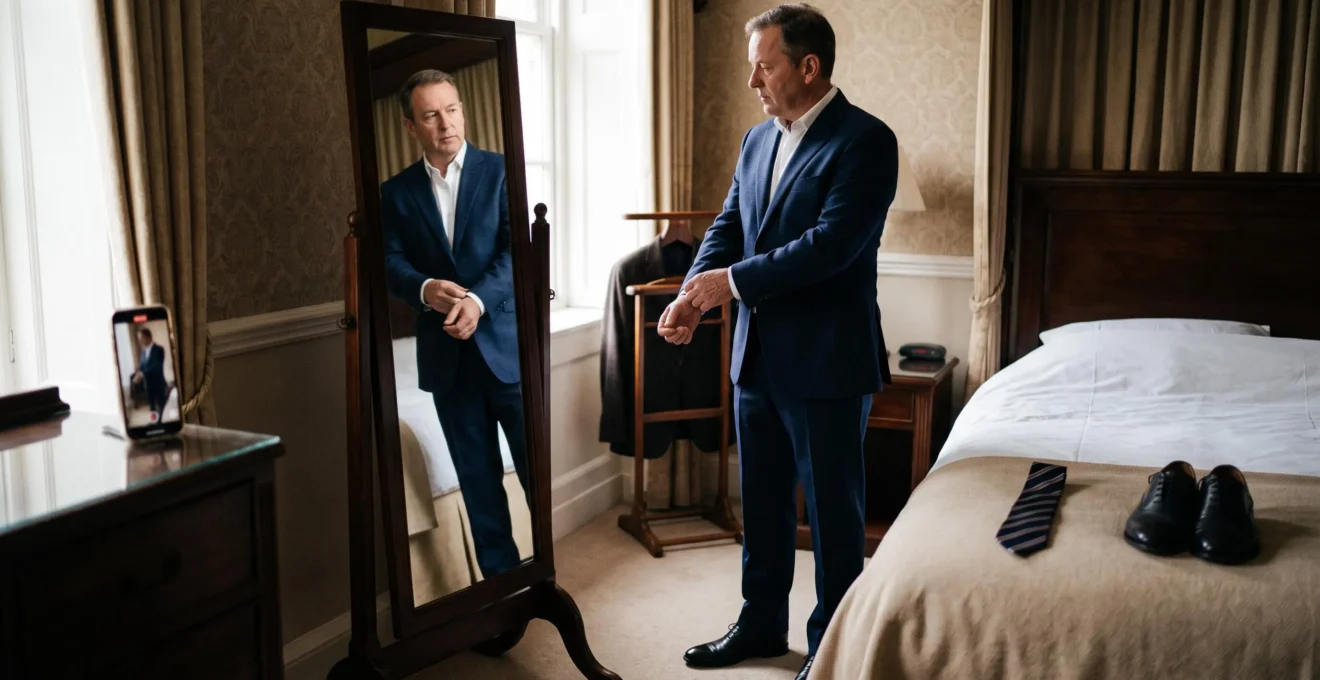
Formal suiting in the UK is less about looking exceptionally smart than understanding what an occasion expects. A well-fitting navy or charcoal suit, appropriate shirt, restrained tie and polished leather shoes will cover many weddings, ceremonies and formal gatherings. But the invitation, venue and your relationship to the hosts determine whether that combination is sufficient.
The difficulty is that British dress codes often leave important details unstated. A lounge suit is not evening dress. A countryside wedding may call for a different approach from a London reception, even when both invitations use similar wording. And an outfit that looks impeccable in a shop can feel conspicuous if its shoes, accessories or overall formality are wrong for the setting.
The most reliable approach is to identify the dress code first, check the fit second and adjust only the details that need changing. Often, a different tie or pair of shoes does more than buying another suit.
Formal suiting in the UK: the essentials
- Follow the stated dress code before interpreting the venue. Traditional black tie and morning dress require different clothing from a lounge suit.
- Prioritise fit, matching tailoring and appropriate shoes over expensive accessories or fashionable details.
- When uncertain, choose restrained colours and finishes, then check expectations with the organiser rather than guessing.
- Why Can the Same Suit Be “Right” in London but Wrong at a Country Wedding?
- How to Build a Formal Suiting Look From What You Already Own in 20 Minutes?
- Navy or Charcoal: Which Suit Colour Is Safer for 3 Different Formal Occasions?
- The Shoe Mismatch That Makes a Formal Suit Look Instantly Off
- When Should You Buy a Suit Before an Event to Avoid Last-Minute Alterations?
- Why Does Bespoke Craft Often Feel More Comfortable After 3 Wears Than Day One?
- How to Check Luxury Accessory Quality in 8 Points Before You Leave the Shop?
- What Actually Defines Luxury in Accessories When Logos Don’t Impress Anyone Anymore?
Why Can the Same Suit Be “Right” in London but Wrong at a Country Wedding?
The same navy suit can look perfectly appropriate at a London business reception but slightly misplaced at a relaxed country wedding because dress codes communicate social context as well as formality. Urban events often favour restrained business tailoring, while country celebrations may accommodate softer fabrics and less corporate styling. The invitation still takes precedence over either convention.
British etiquette distinguishes between different dress codes rather than treating every smart occasion as simply formal. The Debrett’s guide to event dress codes describes a lounge suit as a suit worn with a shirt and tie and recognises that appropriate dress can vary with the occasion and setting.
That distinction matters when a familiar business suit is your only option. It may be entirely acceptable for a wedding, but the styling can change how naturally it fits the celebration.
Consider these hypothetical situations where the invitation requests a lounge suit or comparable smart tailoring.
| Setting | Likely expectation | One useful adjustment |
|---|---|---|
| Weekday Mayfair reception | Conventional, polished city tailoring | Choose a plain silk tie rather than a relaxed knitted one. |
| Afternoon marquee wedding | Smart celebratory clothing, possibly less corporate | Consider a subtly textured tie instead of a strict business stripe. |
| Church ceremony followed by a garden reception | Respectful ceremony dress that works outdoors afterwards | Keep the formal shoes, but choose a shirt and tie suitable for both settings. |
These examples are styling judgements, not universal regional rules. A country wedding can be more formal than a city reception, particularly when the hosts specify morning dress.
Use a quiet-read test before leaving: would the shoes, tie and jacket structure look naturally suited to the gathering, or does one element dominate? A broad, glossy business tie might make a softer wedding outfit feel unnecessarily corporate. Casual shoes can have the opposite effect.
Invitation wording needs particular care. “Lounge suit” normally means conventional matching tailoring with a shirt and tie. “Black tie optional” should not be read as identical to lounge suit: it generally signals a preference for evening dress while allowing a suitably formal dark suit, subject to the hosts’ intentions. Traditional black tie calls for a dinner jacket and appropriate evening trousers, not an ordinary business suit.
If the wording is unclear, ask whether the hosts expect morning dress, dinner jackets or ordinary suits. This is more dependable than inferring everything from the location.
The goal is not to imitate the most formally dressed guest. It is to respect the hosts’ expectations while looking comfortable in the setting. Once that is established, most men can work with clothing they already own.
How to Build a Formal Suiting Look From What You Already Own in 20 Minutes?
A presentable formal outfit can often be assembled in 20 minutes by checking five existing pieces: jacket, trousers, shirt, shoes and tie. Start with the matching suit, identify the least appropriate element and change only that item. The priority is a coherent level of formality, not the number of accessories or the cost of the clothes.
Lay everything out together in good light. Ask three questions:
- Do the jacket and trousers genuinely match in fabric, colour and weight?
- Do the shoes and belt belong to the same general leather-colour family, if a belt is worn?
- Does the shirt match the formality of the tailoring and footwear?
A crisp white or pale-blue shirt offers a dependable starting point for many lounge-suit events. A dark silk tie generally looks more conventional than a knitted one, while a textured shirt or knitted tie can soften an outfit where the occasion permits. Dark leather loafers may work for some social events, but lace-up shoes are usually the less risky choice for traditional formal occasions.
Trainers, even expensive minimalist ones, are not a reliable substitution when a formal dress code is specified.
Next, put on the complete outfit and take one full-length mirror photo and one phone photo from behind. Check for a gap between the jacket collar and your neck, shoulders that extend excessively beyond your natural shoulder line, sleeves that expose a modest amount of shirt cuff, and trousers that fall cleanly over the shoes.
Trouser fit deserves more attention than simply checking the waist. As explained in Permanent Style‘s trouser fit and proportions article, the rise, thigh, knee, seat and hem dimensions all influence how trousers fit and move. A slight break can work well, but the ideal length depends on the cut.
Finally, avoid pairing almost-matching separates and pretending they are a suit. Two different navy fabrics may look identical in artificial light but noticeably different beside a window. If the colour or texture mismatch is obvious in daylight, wear them as intentional separates only when the dress code permits.
Your 20-minute formal outfit check
- Minutes 0–4: Lay out the complete outfit and confirm that the jacket and trousers match. Result: one coherent base outfit.
- Minutes 4–8: Compare shoes, belt, shirt and tie for colour and formality. Result: identify the single weakest item.
- Minutes 8–12: Replace that item with the most appropriate alternative you own. Result: a complete outfit without unnecessary purchases.
- Minutes 12–17: Try everything on and photograph the front and back. Result: two images showing fit, length and proportions.
- Minutes 17–20: Check the outfit in daylight and walk, sit and reach naturally. Result: a final outfit decision and a short note of any alteration needed.
If the suit fits and the overall appearance feels consistent, stop adjusting. An unnecessary accessory is more likely to complicate a successful outfit than improve it. The next important decision is whether the suit’s colour suits the occasion.
Navy or Charcoal: Which Suit Colour Is Safer for 3 Different Formal Occasions?
Navy is often an approachable choice for weddings and daytime professional events, while charcoal is particularly useful for solemn occasions and restrained evening dressing. Neither is universally safer. The better choice depends on the invitation, lighting and your role, with darker, less conspicuous tailoring generally preferable when you need to avoid attracting attention.
The difference is partly visual. Navy can appear more colourful and relaxed in daylight, particularly alongside a lighter shirt. Charcoal tends to present a more neutral, subdued appearance, especially under indoor evening lighting. Fabric texture and lighting can change both impressions considerably.
Use the following comparison as a practical convention rather than an absolute rule.
| Occasion | Navy | Charcoal |
|---|---|---|
| Professional formal reception | Appropriate for most conventional business settings; approachable without being casual. | Equally appropriate; especially restrained for senior or ceremonial roles. |
| Evening wedding requesting a lounge suit | Good choice, preferably in a dark, understated shade. | Very dependable when the atmosphere is particularly formal. |
| Funeral or memorial | Dark navy can be suitable where black is not specifically requested. | Often the more subdued alternative to black, worn with a restrained shirt and tie. |
For daytime celebrations, dark navy is a useful default when the invitation offers no more specific guidance. For solemn or conservative evening settings, charcoal often recedes more naturally. These preferences are not evidence that one colour is objectively correct in every UK venue.
Your role can override the general recommendation. Someone speaking at a memorial or attending as a close family member should give greater weight to family expectations than to personal style. Wedding-party members may be asked to coordinate with a particular colour palette.
There are occasions when neither ordinary navy nor charcoal suiting answers the question. Traditional black tie requires eveningwear, while morning dress has its own established combination of formal garments. A plain black business suit should not be treated as interchangeable with a dinner suit merely because both are dark.
Lighter blue and pale grey suits can be attractive at relaxed summer celebrations, but their suitability depends on the stated code. They are less useful as universal formalwear.
Once the colour is right, the shoes become the most revealing detail. Even an excellent suit can lose its formal coherence when the footwear belongs to a different dress category.
The Shoe Mismatch That Makes a Formal Suit Look Instantly Off
The most noticeable formal-shoe mismatch is often a difference in formality rather than a simple colour error. Sleek tailored trousers can look awkward above chunky casual soles, heavily distressed leather or trainers. For traditional UK formal occasions, polished, understated leather shoes with a refined silhouette are generally the safest option.
Footwear matters because it completes the visual line from the trouser leg to the floor. The shoe’s shape, sole thickness and finish either continue the tailoring’s clean appearance or interrupt it.
Begin with a straightforward colour convention:
- Charcoal suits: black leather lace-ups are a particularly safe choice for conservative events.
- Navy suits: black, dark brown and oxblood leather shoes may all work, although black is often preferable at more formal or solemn occasions.
- Black tailoring: polished black shoes are the conventional choice, especially for mourning and traditional evening dress.
Brown shoes with navy tailoring are widely accepted in modern UK business and social dressing. The combination becomes less dependable when the invitation calls for highly traditional eveningwear or unusually conservative ceremonial dress.
The belt should usually coordinate with the shoes in colour family and finish. Exact matching is less important than avoiding a conspicuous contrast between, for example, very dark formal shoes and a pale casual belt.
Sole construction deserves a closer look. A slim leather sole or restrained rubber sole can support a smart silhouette. A thick, aggressively treaded sole usually gives the same upper a more casual appearance. Rubber itself is not the problem; visual bulk and overall construction matter more.
For a guest without dedicated formal shoes, choose the cleanest, darkest and most streamlined leather pair available. A simple Derby or Oxford with minimal decorative detailing is usually more adaptable than a fashion trainer or heavy boot.
Wear dark socks that maintain a consistent line between trousers and shoes. Check that the trouser hem does not bunch excessively over the footwear. These adjustments cannot make casual shoes formally correct, but they can reduce visual inconsistency.
For a strictly formal ceremony, borrowing an appropriate pair may be wiser than trying to disguise unsuitable footwear. Shoe hire is another possibility, provided the fit and condition can be checked beforehand.
Good footwear need not be expensive, but it must be appropriate and comfortable enough to wear throughout the occasion. The same principle of planning ahead applies to the suit itself.
When Should You Buy a Suit Before an Event to Avoid Last-Minute Alterations?
Buy a suit early enough to allow for fitting, alterations, a full wear-test and a possible second adjustment. The correct lead time depends on whether the suit is ready-made, made-to-measure or bespoke, as well as your tailor’s availability. Count backwards from the event date rather than relying on a universal purchasing deadline.
A ready-made suit may be available immediately, but its delivery or collection date is not necessarily the date it becomes wearable. Sleeve and trouser alterations, or more substantial fitting work, may still be required.
Made-to-measure clothing adds measurements, production and a final fit assessment. Bespoke adds a more extensive fitting process, often involving multiple appointments.
For a concrete provider-specific example, Anderson & Sheppard‘s bespoke tailoring FAQs explain that first-time customers require at least three visits and that completion generally takes eight to twelve weeks, depending on availability and the time of year.
8–12 weeks
The completion period stated by Anderson & Sheppard for its own bespoke garments, subject to customer availability and seasonal factors. It is not a standard deadline for every UK tailor.
Anderson & Sheppard, Popular Questions.
Each buying route has a different sequence of dependencies.
| Buying route | What determines the schedule? | Essential checkpoint |
|---|---|---|
| Ready-made | Stock availability, exchange policy and alterations | Confirm alteration turnaround before paying or removing labels. |
| Made-to-measure | Measurement appointment, production and final adjustments | Request a written expected delivery date with fitting contingency. |
| Bespoke | Cloth selection, cutting, multiple fittings and finishing | Confirm the entire appointment sequence and realistic completion window. |
Buying many months ahead is not automatically safer. Weight changes can affect the waist, seat and jacket balance. Where practical, secure the correct jacket fit early but schedule final minor adjustments when your measurements are more representative of the event date.
There is also a commercial consideration: alterations may make a garment ineligible for ordinary shop returns. Before committing, check the retailer’s exchange terms, the tailor’s adjustment policy and the point at which alterations become irreversible.
Allow time for a final home wear-test with the actual shoes and shirt. Sit down, walk, raise your arms naturally and check the outfit in daylight. If something is uncomfortable, there should still be an opportunity to correct it.
The final fitting should leave room for small corrections, not rescue a fundamentally unsuitable suit. This becomes especially important with bespoke garments, where early wear can change how a carefully constructed suit feels.
Why Does Bespoke Craft Often Feel More Comfortable After 3 Wears Than Day One?
A bespoke suit may feel more comfortable after several wears because the wearer becomes accustomed to its structure and some fabrics and interlinings settle with movement. Three wears is a useful observation, not a guaranteed breaking-in period. Persistent pulling, restricted movement or pressure should be treated as possible fitting problems rather than something that will inevitably disappear.
Traditional bespoke tailoring can involve layered construction, shaped canvas and carefully worked fabric. These elements help the jacket hold its form while accommodating the wearer’s posture. Wool may soften modestly through use, and the wearer can become more familiar with how the garment moves.
However, comfort depends on construction and fit. A softly structured jacket in lighter cloth may feel natural immediately. A heavier, more structured jacket may feel unfamiliar for longer without necessarily being badly made.
It is important not to confuse adjustment to a new garment with a structural change in its fit. Wearing a suit does not reliably correct a tight armhole, insufficient room across the back or trousers that restrict movement when sitting.
Before the event, wear the suit at home for several hours in a clean environment. Button and unbutton the jacket, sit at a table, reach forward and walk around. If driving is relevant, check whether the trousers remain comfortable in a seated position, without unnecessarily stressing the jacket.
Observe the difference between normal unfamiliarity and a genuine fit issue:
- A structured shoulder that feels unfamiliar but allows natural movement may simply require acclimatisation.
- A jacket that repeatedly pulls across the chest or prevents comfortable reaching deserves a fitting review.
- Trousers that feel restrictive around the seat or thighs when sitting may need adjustment rather than additional wear.
- Persistent collar movement or pronounced fabric strain should be assessed by the tailor.
Keep brief notes after each wear. If the same pressure point remains, document when it occurs and show the tailor rather than requesting a vague overall loosening.
The appropriate final fitting date should be agreed with the maker. A short wear-test before that appointment can help distinguish minor unfamiliarity from a problem requiring adjustment.
Bespoke craftsmanship should make a suit wearable, not demand that the owner endure discomfort. Once the clothes themselves work properly, attention can turn to accessories and whether their quality justifies their cost.
How to Check Luxury Accessory Quality in 8 Points Before You Leave the Shop?
Luxury accessory quality is best assessed by examining materials, construction and working details rather than relying on a logo or price. Eight practical checks can reveal visible weaknesses in leather goods, ties, belts and cufflinks. None is conclusive alone: material type, intended design, craftsmanship and expected use must be considered together.
Start with the parts that will experience regular handling and wear. The Guardian’s leather-care reporting distinguishes leather grades and recommends inspecting vulnerable areas such as seams, straps, zips and creases, particularly when assessing used leather items.
The following eight checks are a practical in-store inspection framework, not a certification standard.
- Leather grain: Look for consistent finishing appropriate to the leather type, without unexplained cracking, flaking or damage. Natural variation is not automatically a defect.
- Edges: Examine belt edges, bag handles and leather joins. Finishing should be reasonably even, with no obvious peeling or exposed damage.
- Stitching: Check for secure seams, loose threads and skipped stitches. Regularity matters, but stitch density alone does not establish quality.
- Linings: Inspect accessible interior surfaces. Look for secure attachment, appropriate materials and finishing that will withstand normal use.
- Hardware: Test buckles, clasps and zips. They should operate reliably, with no obvious plating damage or excessive looseness.
- Silk construction: On a tie or pocket square, assess the weave, finish and edges. Hand-rolled edges can indicate a particular method of construction, but machine-finished edges are not automatically poor quality.
- Weight and function: Judge weight against the item’s purpose. Test cufflink mechanisms and inspect a tie’s rear construction and slip stitch, where accessible. Heavier does not necessarily mean better.
- Maker information: Look for clear material descriptions, care instructions and useful information about construction or origin. A label is informative, but it does not prove workmanship by itself.
A useful comparison is to place two accessories of similar purpose but different prices side by side. Compare edge finishing, stitching, working parts and material feel. This makes differences easier to identify without treating price as evidence.
For leather goods, remember that durability depends on maintenance as well as construction. Full-grain or top-grain leather may offer desirable properties, but leather grade alone cannot establish whether a finished accessory is well made.
If a shop inspection reveals an apparent defect, ask about the retailer’s return procedure before paying. Distinguish an observable manufacturing problem from a personal dislike of the design. Your rights and available remedies depend on the circumstances, and the shop’s change-of-mind policy is not necessarily the same as rights relating to faulty goods.
The purpose of inspecting an accessory is not to find the most elaborate or expensive version. It is to identify construction and materials suitable for repeated use. That leads to a more useful definition of luxury than prominent branding.
Key takeaways before investing in accessories
- Spend where fit, construction, maintenance and frequency of use justify the difference, rather than treating every accessory as an investment piece.
- Judge craftsmanship through observable details and functional performance, not through weight, packaging or a prestigious label alone.
- Keep the event’s formality in view: even an exceptionally made accessory can be inappropriate for the dress code.
What Actually Defines Luxury in Accessories When Logos Don’t Impress Anyone Anymore?
Luxury in formal accessories is most meaningfully defined by material suitability, considered construction, durability, finishing and the ability to maintain or repair the item. A conspicuous logo cannot establish these qualities. For many traditional UK formal settings, understated accessories are also a practical styling choice because they support the outfit without drawing attention away from the occasion.
There is no single objective test that separates all luxury accessories from ordinary ones. A meticulously made silk tie and a durable leather belt achieve different things, while a prestigious name can reflect design, heritage and brand positioning as well as construction.
Four questions provide a useful buying framework:
- Can the maker explain the materials used, including their properties and care requirements?
- Does the construction suit the item’s purpose, whether that involves stitching, rolling, weaving or fastening?
- Are the edges, interior surfaces and working parts finished with appropriate care?
- Can the item be maintained, repaired or used repeatedly without unreasonable difficulty?
Quiet quality is a styling strategy, not proof of superior manufacture. In conservative ceremonies, weddings and solemn gatherings, highly visible branding may compete with the occasion’s expected restraint. That is a matter of etiquette and aesthetic judgement rather than a measurable rule about all British consumers.
Spending should follow practical value. Well-fitting, repairable shoes may justify more budget for someone who frequently attends formal events. A quality silk tie can improve an outfit’s appearance, but a moderately priced, well-made tie can be entirely sufficient. A watch is optional at many events and does not have to be luxurious to accompany formal tailoring.
For pocket squares, cufflinks and belts, understated mid-range examples may meet the occasion’s needs without an expensive upgrade. The difference worth paying for is one you can identify through materials, construction, comfort or longevity.
The same applies to accessories bought for a single wedding. A premium item is difficult to justify purely as a formalwear requirement if a simpler piece is appropriate and well made.
Before purchasing anything, assess the complete outfit. A polished pair of shoes, correctly proportioned tie and restrained belt should work together, not compete to become the most noticeable feature.
For your next invitation, check the stated dress code, try on the suit you own and identify the one element that genuinely needs attention. If the tailoring fits, the shoes are appropriate and the accessories are restrained, there is rarely a reason to add more simply to look formal.
Does a formal dress code always mean wearing a tie in the UK?
No. The required neckwear depends on the stated dress code. A traditional lounge suit normally includes a conventional tie, while black tie calls for a black bow tie. Some modern invitations allow open-necked shirts, but that should not be assumed when the wording specifies a traditional formal code.
Can you wear the same suit to a wedding and a funeral?
Yes, a plain dark navy or charcoal lounge suit may be appropriate for both, provided neither event requires a different dress code. For a funeral, use a restrained shirt, dark tie and conservative shoes. For a wedding, the tie and other details can be adjusted to suit the hosts’ expectations.
Is a three-piece suit necessary for a formal UK ceremony?
Not ordinarily when the invitation calls for a lounge suit. A matching two-piece suit with a shirt, tie and appropriate shoes may be sufficient. A waistcoat can add visual formality, but it does not turn an ordinary lounge suit into traditional morning dress or black tie.
Should a suit jacket stay buttoned throughout a formal event?
With a conventional single-breasted lounge suit, it is customary to button the jacket while standing and unbutton it when sitting. The bottom button is traditionally left undone on a standard two- or three-button jacket. Double-breasted jackets follow different conventions and are generally kept fastened while standing.
What should you do if a formal invitation gives no dress code?
Consider the venue, time and type of ceremony, then ask the organiser when uncertainty remains. A dark lounge suit with a shirt, tie and polished leather shoes is a practical starting point for many occasions, but it cannot replace specific instructions for eveningwear, morning dress or another established code.