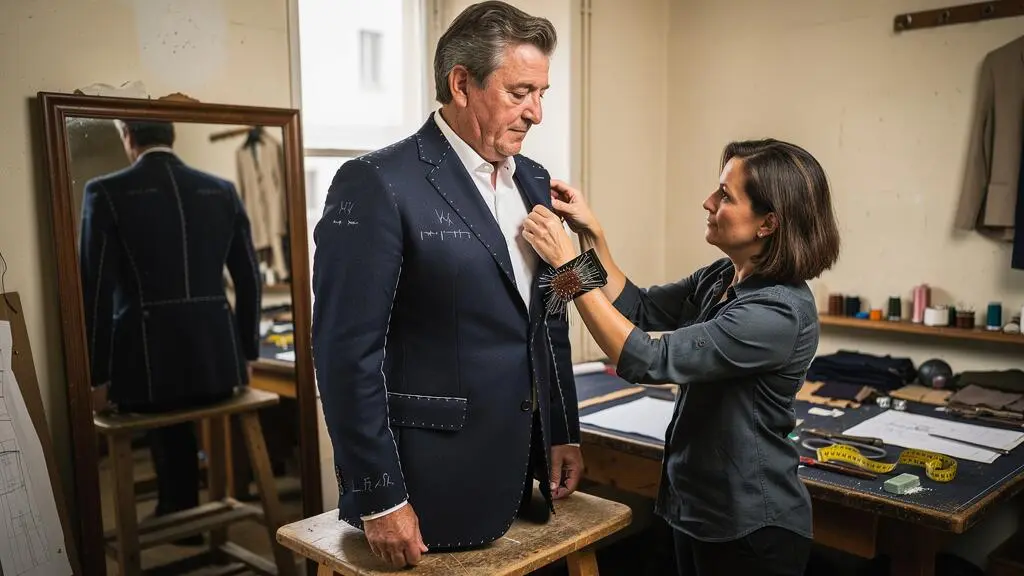
A jacket fits your chest but pulls across your back. The waist has been altered twice, yet the collar still lifts away from your neck. Your trousers feel comfortable standing up but restrict movement when you sit. These are not necessarily problems with the size you selected. They may indicate that the garment’s underlying proportions do not match your body.
Bespoke fit addresses the relationship between body shape, posture, garment balance and movement, rather than treating a size label as a complete description of the wearer. Unlike conventional ready-to-wear alterations, a genuine bespoke process can develop an individual pattern around those relationships before the garment is permanently constructed.
That distinction matters for UK men and women who repeatedly pay for alterations without achieving lasting comfort. Understanding the visible symptoms of poor fit, knowing how to communicate them and testing garments during ordinary activities can make tailoring decisions considerably more informed.
The objective is not to eliminate every fold or create the narrowest silhouette. It is to establish a garment that hangs coherently, accommodates movement and remains comfortable in the situations where it will actually be worn.
Bespoke fit: the essential principles
- Standard sizes cannot independently accommodate every variation in shoulder slope, torso length, posture and body proportions. Bespoke patterns can address these relationships individually.
- Evaluate fit both standing and moving. Collar gaps, diagonal wrinkles, button strain and restricted arm movement provide more useful evidence than the size label.
- Prioritise structural balance before cosmetic alterations, document discomfort precisely and assess fabric recovery when choosing performance formalwear.
- Why Do Standard Sizes Fail If You Have Sloped Shoulders or a Long Torso?
- How to Describe Fit Problems to a Tailor So They Fix the Right Thing First?
- Comfort or Clean Lines: Which Fit Priority Matters Most for All-Day Wear?
- The Alteration Mistake That Warps a Jacket’s Balance Permanently
- A Fitting Schedule That Cuts “Back-and-Forth” Appointments by 30%
- The “Too Slim” Tailoring Mistake That Makes You Look Tense and Boxy
- How to Test Performance Formalwear Stretch So It Doesn’t Bag Out by Lunch?
- Can Performance Formal Wear Look Truly Formal or Will It Always Look “Off”?
Why Do Standard Sizes Fail If You Have Sloped Shoulders or a Long Torso?
Standard sizes fail when body proportions differ from the assumptions built into a garment’s pattern. A jacket may accommodate your chest circumference while positioning its shoulders, collar, waist or hem incorrectly. Sloped shoulders and longer torsos expose these mismatches because conventional sizing cannot always adjust vertical dimensions, horizontal dimensions and posture independently.
Ready-to-wear sizing begins with a base pattern and uses grading rules to produce neighbouring sizes. Grading adjusts several dimensions according to predetermined increments, but real bodies do not necessarily change in those same proportions.
A study by Nancy A. Schofield and Karen L. LaBat examined 40 women’s clothing size charts and identified discrepancies between garment grading rules and anthropometric measurements. The findings, published in 2005, concern the sizing systems examined rather than every contemporary UK clothing brand. Nevertheless, the research on clothing grading and anthropometric data demonstrates why size progression should not be confused with individual anatomical fit.
Consider two people with identical chest measurements. One has relatively square shoulders and a shorter torso; the other has sloped shoulders and a longer torso. A jacket in the same nominal size may behave very differently on each wearer.
| Body characteristic | Visible symptom | Potential fitting implication |
|---|---|---|
| Sloped shoulders | Collar gap, uneven shoulder contact or diagonal sleeve wrinkles | Shoulder angle, collar position and sleeve setting may need assessment |
| Long torso | Jacket hem appears high, waist shaping sits too high or button position feels awkward | Body length and vertical proportions may need independent adjustment |
| Prominent or rounded upper back | Pulling across the shoulder blades or fabric lifting at the back | Back shaping and posture allowances may need attention |
| Uneven shoulder heights | One side hangs differently or the hem appears tilted | Asymmetric pattern corrections may be appropriate |
These signs are diagnostic clues, not conclusive proof of a particular anatomical cause. A collar gap, for example, can also arise from posture, jacket balance or the relationship between the collar and back neck.
The important distinction is between vertical measurements, such as body and sleeve length, and horizontal measurements, such as chest and waist circumference. A longer body does not necessarily require a larger chest; a different shoulder slope does not automatically require wider shoulders.
In the Savile Row tradition, garments are developed using individual patterns rather than simply selecting a graded size. The Savile Row Bespoke Association’s construction standards describe handmade individual patterns, hand-shaped shoulder components and allowances for subsequent adjustments.
Such construction gives the tailor opportunities to accommodate proportions that a standard block may not represent. It does not guarantee an ideal result without accurate fitting and skilled execution.
Once the source of the mismatch is clearer, the next challenge is explaining precisely what happens when the garment is worn.
How to Describe Fit Problems to a Tailor So They Fix the Right Thing First?
Describe the visible defect, the exact location of discomfort and the movement that triggers it, rather than immediately prescribing an alteration. Telling a tailor that your collar lifts when you reach forward is more informative than requesting a tighter collar. Begin with structural concerns, then identify secondary adjustments once the garment’s balance has been assessed.
Statements such as “it feels wrong” or “make it slimmer” do not distinguish between insufficient ease, incorrect proportions and an unsuitable sleeve angle. A precise description allows the cutter or alterations specialist to investigate the cause rather than follow an assumed solution.
The following vocabulary provides a useful starting point:
- Collar gap: the jacket collar separates from the neck instead of sitting consistently against it.
- Sleeve pitch: the orientation at which a sleeve is attached relative to the wearer’s natural arm position. A mismatch can contribute to twisting or diagonal folds.
- Bicep restriction: pressure or limited movement around the upper arm, particularly during bending or reaching.
- Seat pulling: horizontal tension or excess fabric across the seat of trousers, requiring assessment of shaping and ease. Descriptive terms such as “seat echo” should be explained rather than assumed to be universally recognised tailoring terminology.
- Button strain: tension lines spreading from a fastened button, potentially indicating insufficient ease or incorrect balance.
Prioritise the issue that most affects how the garment hangs. For a structured jacket, the shoulders, collar and front-to-back balance often need examination before minor waist or sleeve-width adjustments. These are interconnected areas, so adjusting one may change the appearance of another.
For example, reducing the waist may temporarily make a jacket look more shaped while leaving the underlying shoulder problem untouched. In some cases, it can make the original pulling more obvious.
A simple photographic assessment can make this communication more reliable. Wear the intended shirt or base layer, fasten the garment normally and photograph its front, side and back while standing naturally. Then repeat a relevant movement, such as reaching forward or sitting down, to capture the problem as it occurs.
Do not force an unnaturally upright posture simply to make the garment look better. The fitting needs to reflect how your body normally behaves.
Bring the images to the appointment and explain what changed between positions. Ask the tailor to identify the likely cause, the proposed correction and any limitations imposed by the existing construction.
With the problem identified, the next decision is how much priority to give to a sharp standing silhouette versus comfort during an ordinary day.
Comfort or Clean Lines: Which Fit Priority Matters Most for All-Day Wear?
For garments worn throughout a working day, comfortable movement should generally take priority over achieving perfectly smooth lines while standing still. A well-fitting jacket should retain a coherent silhouette without restricting ordinary activities. The appropriate compromise depends on how often you sit, walk, reach and move, as well as the garment’s intended formality.
Static fit describes how clothing looks when the body is relatively still. Dynamic fit describes how it responds to movement. The two assessments are related but not interchangeable.
A jacket that photographs beautifully with the wearer’s arms relaxed may pull sharply across the back when they reach for a keyboard. Trousers that fall cleanly in a fitting-room mirror may become uncomfortable around the thighs and seat during a long meeting.
Clothing-design research discusses ease allowance as an important part of accommodating movement. The academic article research on clothing fit and comfort during body movement examines how garment design interacts with body motion and wearing comfort. It does not prescribe one universal amount of ease suitable for every garment or wearer.
For a practical assessment, compare how the garment performs across several ordinary activities:
| Assessment | What to observe | What a problem may indicate |
|---|---|---|
| Standing naturally | Collar contact, lapel position, hem level and fabric tension | Potential balance or shaping issues |
| Sitting upright | Pressure at the waist, thighs, seat and jacket front | Insufficient ease or unsuitable proportions |
| Reaching forward | Pull across the upper back and resistance at the armhole | Sleeve, back or armhole-fit problems |
| Walking and turning | Whether the garment twists, rides up or restricts natural movement | Potential interaction between balance and movement allowances |
A seated-workday simulation can help reveal problems that a brief fitting misses. Sit for a meaningful interval, stand, reach and repeat the movements that represent your routine. Note where discomfort begins and whether the garment returns to its normal position afterwards.
Temporary folds during movement are not automatically defects. Fabric must change shape as the body moves. The concern is persistent strain, painful pressure or a garment that repeatedly shifts out of position.
For particularly formal occasions, a wearer may accept a slightly more controlled silhouette. For regular office wear, dynamic comfort deserves greater weight.
Once the desired balance is established, alterations must preserve the garment’s structure rather than solve one visible problem by creating another.
The Alteration Mistake That Warps a Jacket’s Balance Permanently
The most consequential alteration mistake is changing a jacket’s structural elements without first assessing its overall balance. Aggressive shoulder reconstruction, collar repositioning or changes affecting the front-to-back relationship can disturb how the entire garment hangs. Such alterations may be difficult, expensive or impractical to reverse, particularly when original material has been removed.
Jacket balance refers to how the front and back lengths, shoulder position and body shaping interact when the jacket is worn. A balanced garment sits coherently on the wearer rather than being pulled into place by tension elsewhere.
Suppose a jacket appears too long at the back. Shortening the hem immediately might seem reasonable, but the apparent excess length could partly reflect how the jacket is positioned on the shoulders. Removing fabric before identifying the cause risks producing an uneven silhouette after the original fitting issue is corrected.
Similarly, a prominent collar gap does not necessarily mean the collar alone should be reduced. The back length, shoulder angle and posture of the wearer may all need consideration.
Structural shoulder alterations deserve particular caution. A tailored jacket can contain pads, canvas, sleeve-head construction and other internal elements that influence its shape. Changing these may require substantial dismantling and reconstruction.
The difficulty is not that every shoulder or collar alteration is inherently irreversible. Skilled tailors can sometimes rebuild structural components successfully. Rather, reversibility depends on the construction, available seam allowances, fabric condition and amount of material removed.
For that reason, side-seam adjustments and hems are often more straightforward than major shoulder reconstruction, but even apparently simple changes may become irreversible if excess fabric is cut away.
Before authorising structural work, ask four questions:
- Which seams and internal components will need to be opened?
- Will the shoulder pad, canvas, collar structure or sleeve setting be changed?
- How will the proposed alteration affect the jacket’s front-to-back balance?
- What material will remain available if further correction becomes necessary?
If a proposed change requires extensive reconstruction, compare its likely result with the option of selecting a better-fitting base garment or commissioning a new pattern. The economically sensible decision may be to avoid altering a jacket whose fundamental proportions are unsuitable.
Preventing unnecessary reconstruction begins well before the final fitting: it depends on preparing each appointment and agreeing on the important corrections in a sensible order.
A Fitting Schedule That Cuts “Back-and-Forth” Appointments by 30%
A structured fitting schedule may reduce unnecessary return appointments by consolidating measurements, movement tests and alteration decisions. However, a 30% reduction is an illustrative target, not a demonstrated industry average or guaranteed outcome. The actual number of fittings depends on garment complexity, fabric behaviour, construction methods and the extent of individual pattern adjustments.
Repeated appointments often arise when wearers notice discomfort only after leaving the fitting room. The tailor corrects one problem, then discovers another at the next visit because the first session did not capture the complete wearing experience.
Preparation reduces this fragmentation. Arrive wearing the shirt, shoes and appropriate undergarments you intend to use with the finished outfit. These choices influence how the garment sits and how its proportions are judged.
Identify your two principal concerns before the first appointment. For example, a jacket that lifts at the collar and restricts reaching presents a clearer starting point than a general request for a slimmer fit.
Huntsman’s documented bespoke process provides an example of structured fitting stages. According to Huntsman’s bespoke tailoring process, the house takes more than 28 measurements, considers posture and stance, and uses a temporarily assembled baste garment to evaluate fit before subsequent construction. Its process may involve as many as three fittings; that is a description of one tailoring house, not a universal rule.
A practical appointment sequence can follow the same broad principle: diagnose the structure first, assess movement before final decisions and review the completed garment against the original requirements.
Rather than approving isolated changes immediately, ask the tailor to explain how the proposed corrections interact. Shoulder, sleeve, waist and length decisions should be considered together where possible, with the sequence of actual construction determined by the professional.
Your five-step fitting preparation checklist
- Photograph the current fit: capture front, side and back views while standing naturally. Deliverable: three labelled reference photographs.
- Record movement restrictions: test sitting, reaching forward and raising your arms. Deliverable: a short note identifying the location and movement associated with each problem.
- Rank your priorities: select the two issues most affecting comfort or garment balance. Deliverable: a written priority list.
- Prepare the intended outfit: bring the relevant shirt, footwear and underlayers. Deliverable: a complete fitting outfit ready for assessment.
- Confirm the alteration plan: review proposed changes, their order and any limitations with the tailor. Deliverable: an agreed list of corrections and a planned next fitting.
These steps do not eliminate the need for intermediate fittings. Complex bespoke work may require several rounds of adjustment, especially where changes must be evaluated before permanent stitching.
They do, however, help distinguish necessary construction stages from appointments caused by incomplete feedback. If appointment efficiency is important, record the actual number of visits rather than assuming a particular percentage saving.
Efficient appointments are only worthwhile if they lead to a comfortable result, which is why requests for aggressive slimming require particular scrutiny.
The “Too Slim” Tailoring Mistake That Makes You Look Tense and Boxy
Over-slimming a tailored garment can make the wearer appear tense rather than streamlined. Removing too much ease from the chest, waist or upper arms creates pulling, distorted lapels and restricted movement. A successful close fit follows the body’s proportions while leaving sufficient space for normal activity; a restricted fit forces the garment into an unnaturally narrow shape.
The distinction matters because a fitted silhouette is not defined by the smallest possible waist measurement. It depends on how the shoulders, chest, waist and hips relate to one another.
When excessive fabric is removed at the waist, the jacket front may pull into horizontal creases around the fastening point. The lapels may lift away from the chest, while the back develops tension that makes the entire silhouette appear rigid.
Paradoxically, this can produce a boxy appearance. The garment no longer falls smoothly from the shoulder through the waist, so areas of compression sit beside abrupt folds or distorted panels.
Several warning signs are worth checking:
- Horizontal or radiating tension lines around the closed button.
- Lapel edges that lift or refuse to lie naturally against the chest.
- A collar that presses uncomfortably against the neck or changes position noticeably during ordinary movement.
- Strong pulling across the upper back when reaching forward.
- Fabric that remains under visible strain even when standing naturally.
Not every wrinkle indicates excessive suppression. Creases can also result from inappropriate sleeve pitch, posture mismatch, fabric properties or poor balance. The pattern of wrinkles needs interpretation alongside the wearer’s measurements and movement.
A useful test is to compare the garment fastened and unfastened. If strain largely disappears when the front is opened, insufficient ease or unsuitable front balance deserves investigation. This observation alone does not establish which seam should be altered.
Close fit should be controlled, not compressed. The aim is to create a silhouette that follows the wearer without requiring them to restrict their posture or breathing.
Ask the tailor to assess the garment with the arms relaxed, then during gentle reaching and sitting. Evaluate whether a proposed reduction improves the silhouette without introducing new restrictions.
Where additional flexibility is needed, fabric choice may help, but stretch cannot compensate for every flaw in the underlying pattern.
How to Test Performance Formalwear Stretch So It Doesn’t Bag Out by Lunch?
To assess performance formalwear, check how well the fabric returns to its original shape after being stretched, rather than judging stretchiness alone. A material that extends easily but recovers poorly may develop bagging around the knees, elbows or seat. Recovery, drape and garment construction must all be evaluated before assuming stretch will improve all-day comfort.
Two fabric properties are particularly important: stretch capacity and elastic recovery.
Stretch capacity describes how much a material can extend under tension. Elastic recovery describes its ability to return towards its initial dimensions after that tension is removed. A highly extensible material does not necessarily have superior recovery.
For formalwear, this distinction affects both comfort and appearance. Trouser knees experience repeated bending, while jacket elbows and seat panels experience changes in tension during sitting and reaching.
A practical in-store assessment can offer preliminary clues:
- Identify a representative fabric area, such as the trouser knee or jacket elbow, without pulling against delicate seams.
- Gently stretch the material in its intended direction of give, avoiding excessive force.
- Release the fabric and observe whether it returns smoothly or retains visible distortion.
- Check the area under consistent lighting for residual rippling or changes in surface appearance.
- Compare how the garment drapes when relaxed and after the test, provided the retailer permits handling.
This is an informal screening method, not a standardised laboratory test. A quick stretch-and-release cannot reliably predict how a particular fabric will behave after hours of wear, repeated laundering or prolonged loading.
For a more useful decision, assess the garment during sitting and standing, while considering the fabric composition, weave, finish and care instructions. If available, ask the retailer about documented dimensional stability or recovery testing.
More stretch is not always better. A very flexible fabric may accommodate movement but lack the body needed for a sharply structured trouser or jacket. Conversely, a relatively firm tailored cloth may drape well while relying on correct pattern shaping and ease for comfort.
Do not assume that adding elastane automatically produces permanent knee bagging or prevents it. The result depends on the complete textile construction, processing, wear conditions and care.
Once material behaviour has been assessed, the remaining question is whether technical comfort features can coexist with the visual discipline expected of formal tailoring.
Key takeaways before choosing performance formalwear
- Prioritise a pattern that fits your proportions; flexible fabric should support good fit, not conceal an unsuitable cut.
- Evaluate fabric recovery and surface appearance alongside movement comfort, especially for garments worn repeatedly through a working day.
- Inspect the garment’s structure, finish and drape before judging formality from its fibre composition or stretch percentage alone.
Can Performance Formal Wear Look Truly Formal or Will It Always Look “Off”?
Performance formalwear can look convincingly formal when its fabric, construction and finishing are designed for tailored clothing. Stretch fibres and technical treatments do not automatically undermine formality. Problems arise when excessive shine, insufficient structure or an overly fluid drape create visual characteristics associated with sportswear rather than traditional suiting.
Formal appearance is produced by several interacting features. The fabric contributes surface texture, weight, resilience and drape, while the garment’s pattern and internal construction establish its shape.
A jacket made from a technically sophisticated cloth can still look inappropriate for formal occasions if its lapels collapse, its shoulders lack the intended definition or its fabric reflects light in a way that clashes with the design.
Equally, a conventional wool garment can look poorly tailored if its proportions and construction are unsuitable. Fibre content alone cannot establish visual quality.
Three cues are particularly useful when assessing performance tailoring:
- Surface finish: an excessively glossy or synthetic-looking sheen may make the cloth appear less traditionally formal. A controlled matte finish can help preserve a conventional tailored appearance.
- Drape and body: fabric should fall smoothly while maintaining the structure appropriate to the design. Excessively fluid materials may struggle to hold sharp-looking lines.
- Construction details: collars, lapels, shoulders, seams and pressing contribute substantially to whether the garment reads as formal.
Performance fabrics engineered specifically for tailoring are generally more relevant to formalwear than materials developed primarily for sportswear. However, product labels such as “technical”, “performance” or “stretch” are not sufficient evidence of quality.
Compare garments under natural light as well as shop lighting. Examine the lapel roll, trouser crease, fabric surface and the way the garment moves when you walk or sit. A heavier, matte stretch-wool blend may offer an appearance closer to conventional suiting than a lightweight, shiny technical fabric, but weight alone does not guarantee that outcome.
For an office wardrobe, modest stretch combined with suitable structure may provide a practical compromise. For ceremonies or particularly formal settings, the desired finish, drape and garment conventions should guide fabric selection.
The central principle remains unchanged: material innovation cannot replace accurate fit diagnosis. Stretch can help accommodate movement, but it cannot independently correct a wrongly positioned shoulder, unsuitable body length or incorrect jacket balance.
At your next fitting, bring photographs of the garment standing and moving, identify the two most disruptive symptoms and ask the tailor to explain their underlying causes. Use that diagnosis to determine whether an alteration, an individual bespoke pattern or a different fabric is the most appropriate next step.
Is bespoke tailoring always more comfortable than ready-to-wear clothing?
No. Bespoke tailoring offers the opportunity to create an individual pattern that accounts for proportions and posture, but the outcome depends on the cutter’s assessment, construction quality, fabric and fitting process. A well-designed ready-to-wear garment may already fit some people comfortably, whereas poorly executed bespoke work can still create restrictions.
Can a tailor fix a jacket that fits the chest but not the shoulders?
Sometimes. The feasibility depends on whether the problem involves shoulder width, slope, padding, sleeve attachment, posture or another structural relationship. Minor corrections may be achievable, but substantial shoulder reconstruction can be technically demanding. An experienced tailor should inspect the jacket before recommending the work or estimating its likely effectiveness.
How can you tell whether discomfort comes from the cut or the fabric?
Observe where and when the discomfort occurs. Localised tension, twisting or repeated pulling may indicate a pattern or balance problem. Poor breathability, rough texture or unwanted fabric stiffness may contribute to discomfort even when the dimensions are appropriate. Both factors can operate simultaneously, so compare fit during movement and consider the fabric’s physical properties before deciding on an alteration.
Do men and women need different bespoke fitting methods?
The underlying principles are shared: evaluate individual proportions, posture, garment balance, movement and ease. Pattern shaping and construction requirements vary according to the wearer’s anatomy and the garment’s design, not simply the gender category on a size label. A competent fitting process should assess the individual body rather than assume a standard set of proportions.
Should you choose made-to-measure or fully bespoke tailoring for persistent fit problems?
Made-to-measure generally adapts an existing pattern, while traditional bespoke tailoring develops an individual pattern and includes fitting stages that can accommodate more extensive structural adjustments. If persistent problems involve shoulder slope, asymmetry, posture or garment balance, ask how much the provider can change the underlying pattern. Service definitions and available adjustments vary, so the process matters more than the label alone.