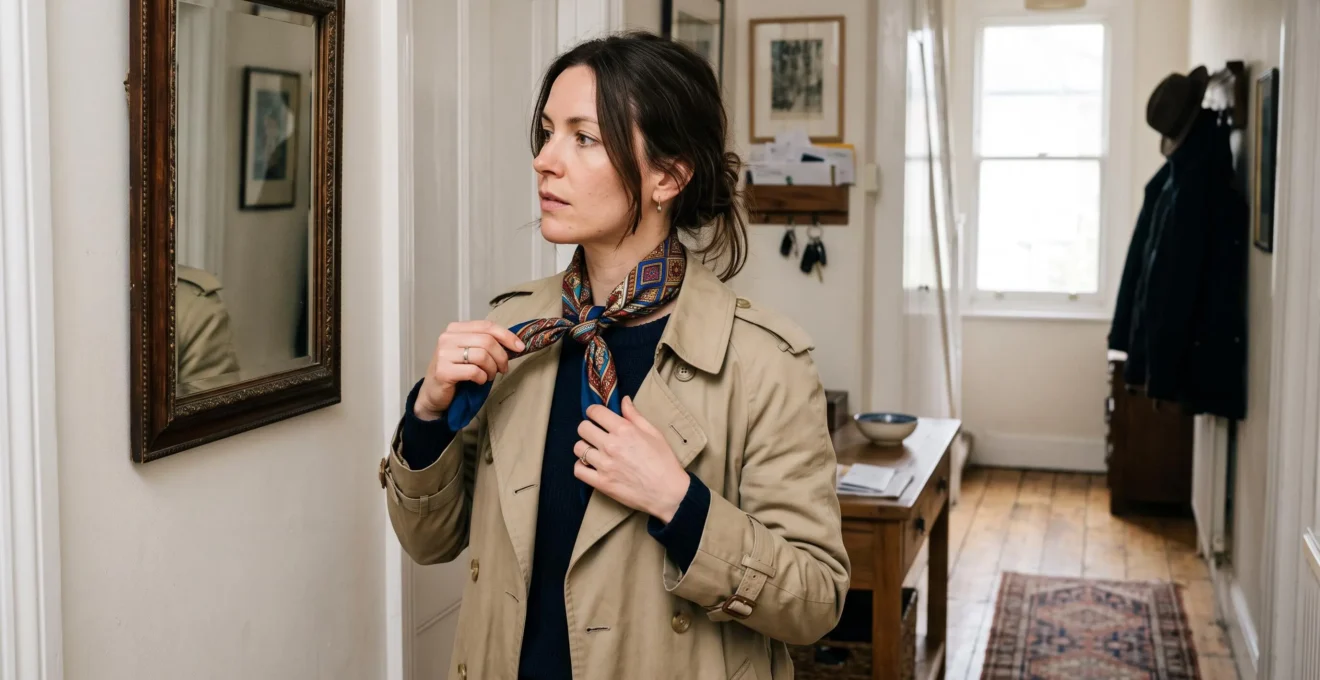
A silk scarf can make a simple outfit look considered in less than two minutes. The trick is not an elaborate knot. It is choosing one placement that works with your neckline, coat and hairstyle, then allowing the silk to provide the colour, texture or movement your outfit needs.
For a UK professional moving between meetings, trains, heated offices and evening plans, this is particularly useful. A silk square under a trench collar can sharpen ordinary tailoring. A loosely draped scarf can soften a structured coat. A narrow strip of patterned silk tied around a handbag handle adds interest without creating extra warmth around the neck.
The difference between effortless and constantly adjusting your scarf comes down to fabric behaviour, proportion and a few reliable styling decisions. Understanding these makes it easier to buy well, care for what you own and coordinate silk with jewellery without overcomplicating your morning.
Silk scarf styling in a nutshell
- Choose one simple placement: a low neck knot, a relaxed shoulder drape or a narrow band on your bag.
- Match the scarf’s shape and weight to your outfit: structured squares suit collars, while longer scarves drape naturally over knitwear.
- Preserve the finish with appropriate care and let either the scarf or your jewellery be the main focal point.
- Why Does One Silk Scarf Tie Neatly While Another Always Slips?
- How to Wear a Silk Scarf in 3 Modern Ways Without Looking Old-Fashioned?
- Square or Long Silk Scarf: Which Works Better With Trench Coats and Knitwear?
- The Washing Mistake That Leaves Silk Looking Dull After One Clean
- When Should You Wear a Silk Scarf in the UK to Avoid Overheating Indoors?
- How to Choose One Statement Accessory Based on Neckline and Hairstyle?
- A 6-Piece Minimal Gold Set That Works for Workdays and Dinners
- How Do Minimalist Gold Pieces Look Luxurious Instead of Plain?
Why Does One Silk Scarf Tie Neatly While Another Always Slips?
One silk scarf stays neatly tied while another slips because silk fabrics differ in weave, weight, surface finish and flexibility. These properties influence how easily folded layers move against one another. The knot itself matters too: a loose decorative knot behaves differently from one anchored beneath a collar or passed through a loop.
Silk twill has a distinctive diagonal weave that can give a scarf a more structured feel. A lightweight, smooth silk may fall beautifully but offer less resistance when its layers slide against each other. Satin’s smooth surface can also affect knot security, although the exact behaviour depends on the fabric’s construction and finish.
Momme weight describes silk fabric weight rather than directly measuring grip. A heavier fabric may produce fuller folds, while a lighter one may collapse into a softer drape. Neither automatically guarantees that a knot will stay in place.
Hand-rolled edges are another detail worth inspecting. They can provide a rounded, substantial finish and indicate attention to construction. However, a hand-rolled hem is not proof of superior knot retention, and a well-made machine-finished scarf can still be excellent.
When examining a scarf in a shop, try three simple checks:
- Fold it into a band: observe whether the fabric forms a defined shape or immediately falls into soft folds.
- Feel the material: gently compress a corner between your fingers to assess thickness, flexibility and surface smoothness.
- Inspect the hem: look for even stitching, a consistent edge and no loose threads, whether the finish is rolled or flat.
These are practical buying observations rather than scientifically validated tests. Where possible, tie the scarf over a similar collar or neckline to the one you usually wear.
Already own a slippery scarf? Change the method before replacing the accessory. Let very fluid silk hang in a relaxed drape, or pass the ends through a folded loop to create more security. Tucking a knot beneath a coat collar can also limit movement without pulling the fabric tight.
The most useful scarf is not necessarily the stiffest or most expensive. It is the one whose fabric behaviour suits how you intend to wear it. Once that is clear, choosing a modern knot becomes considerably easier.
How to Wear a Silk Scarf in 3 Modern Ways Without Looking Old-Fashioned?
To wear a silk scarf in a modern way, keep the styling simple, slightly asymmetric and proportionate to your outfit. Three dependable options are a narrow rolled band, a loose shoulder drape and a low knot beneath a collar. Each creates a distinct effect without requiring elaborate folding or vintage-inspired styling.
The aim is to make silk look like a natural part of contemporary workwear, rather than an accessory added for formality.
1. The small rolled band
Fold a small square diagonally, then roll it into a narrow strip. Tie it loosely around a handbag handle or wrist. A compact silk format is easiest to manage because it avoids long ends hanging over the bag.
This works especially well with monochrome tailoring, where a small amount of colour provides contrast without competing with a blazer’s lines.
2. The loose half-drape
Place a longer silk scarf around the neck with one end noticeably longer than the other. Bring the longer end over one shoulder or let it fall across the coat front, keeping the arrangement relaxed.
The result suits trench coats, wool outerwear and simple knitwear. A long rectangular scarf usually makes this easier than a compact square.
3. The low front knot
Fold a medium or 90 cm square into a band, bring the ends forward and tie one loose knot below the collar opening. Position it lower than a traditional tight neck knot and leave one end slightly longer.
This arrangement sits comfortably with an open shirt or trench coat and avoids creating a crowded neckline.
The manufacturer’s Hermès scarf-tying tutorial demonstrates how square formats can be folded and worn in different ways, including placements beyond the neck. These techniques provide useful inspiration, although the styling choices here are practical recommendations rather than proven rules about what looks modern.
Use the following comparison when getting dressed:
| Styling method | Best outfit pairing | Suitable scarf format |
|---|---|---|
| Small rolled band | Tailoring, simple dresses, minimalist separates | Small square or narrow silk scarf |
| Loose half-drape | Trench coats, wool coats, knitwear | Long rectangular scarf |
| Low front knot | Open collars, shirts, structured jackets | Medium or 90 cm square |
A scarf can feel dated when several deliberately formal elements appear together: a perfectly centred neck knot, matching jewellery and a coordinated handbag. This is a matter of visual style rather than age. Breaking the symmetry or introducing contrast often gives the outfit a more relaxed appearance.
Practise your preferred method once with the clothes you wear most. After that, the fastest styling decision is usually choosing the right scarf format, rather than learning another technique.
Square or Long Silk Scarf: Which Works Better With Trench Coats and Knitwear?
A 90 cm square silk scarf is generally the more practical option for structured trench coats because it can be folded into tidy bands and positioned neatly beneath a collar. A long rectangular scarf usually works better over chunky knitwear because its length creates visible drape without requiring a bulky knot near the neck.
The distinction is about proportion and fabric placement, not an absolute rule. A lightweight long scarf can look beautiful with a trench, while a thin square can complement fine knitwear. The shape becomes important when the surrounding clothes already have substantial structure or volume.
With a classic beige trench, a folded square introduces a controlled diagonal or vertical line. The collar provides a natural boundary, keeping the scarf visually contained. A patterned square can also introduce colour without covering much of the coat.
Over a chunky jumper, the challenge changes. Heavy ribbing, a thick roll-neck or an oversized silhouette may overwhelm a small scarf. A longer rectangle can remain visible through its falling ends, offering movement rather than another concentrated layer.
Volume is the frequently overlooked trade-off. A substantial silk square tied tightly over a roll-neck may create an uncomfortable-looking cluster at the jaw and collar seam. Moving the knot lower, choosing a thinner fabric or leaving the scarf loose can resolve the proportion issue.
| Consideration | 90 cm silk square | Long silk scarf |
|---|---|---|
| Trench coat collar | Easy to fold into a defined band | Better when worn as a relaxed drape |
| Chunky knitwear | Can appear small or create bulk if tightly tied | Offers length and visible movement |
| Neck knots | Versatile folding and knotting options | Depends on width and fabric weight |
| Bag or wrist styling | Possible, especially with smaller squares | Usually less convenient unless narrow |
| Storage | Easy to fold flat | Easy to roll or fold, but may need more length |
For a first silk scarf purchase in a typical UK workwear wardrobe, a 90 cm square is a sensible starting point. It can be styled beneath shirts and coats, folded in several ways and stored without occupying much space. Its versatility is particularly helpful for people who regularly wear tailored clothing.
However, someone who spends most days in oversized jumpers and relaxed outerwear may get more use from a long, lightweight silk scarf. The best purchase is the format compatible with the clothes already in rotation.
Whichever shape you select, inspect the care label before committing. A scarf that works beautifully with your wardrobe should also be practical to maintain.
The Washing Mistake That Leaves Silk Looking Dull After One Clean
The most avoidable silk-care mistake is washing a scarf without first checking whether its fabric and dyes are suitable for water. An unsuitable detergent, excessive agitation or wringing can contribute to colour changes, distortion or a less attractive surface. Some damage occurs through the cleaning process itself rather than ordinary wear.
Silk is a protein fibre, and its appearance depends on the fibre surface, fabric construction, finishing treatments and dyes. Not every silk scarf responds to moisture or detergent in the same way.
Ordinary laundry detergents may contain enzymes, brighteners, fragrances and other additives that are unnecessary or potentially unsuitable for delicate textiles. Some enzyme formulations can be particularly inappropriate for protein fibres. Optical brighteners may also affect perceived colour or appearance, but it would be inaccurate to claim that every brightener strips silk’s natural lustre after one wash.
The Canadian Conservation Institute guidance on textile detergents recommends careful assessment before wet cleaning historic textiles and discusses neutral-pH detergents without potentially problematic additives. Its conservation guidance is useful background, not a universal home-washing instruction for modern scarves.
The garment’s own care label takes priority. If the label specifies dry cleaning, particularly for a heavily printed, structured or specially finished scarf, do not assume that gentle hand-washing is safe. Colour bleeding, water marks and changes to the finish are possible.
For a scarf explicitly suitable for hand-washing, a conservative routine is:
- Fill a clean basin with cool water and add the recommended amount of a detergent labelled suitable for washable silk.
- Immerse the scarf briefly and move it gently through the water without rubbing or vigorous agitation.
- Rinse carefully in cool water, following the detergent instructions.
- Lift the scarf without twisting, then roll it in a clean towel to absorb excess moisture.
- Lay it flat to dry away from direct sunlight, radiators and other concentrated heat sources.
This is general domestic care advice for washable silk, not a substitute for specific manufacturer instructions. Avoid prolonged soaking unless the care directions expressly allow it.
Care is also an economic decision. A scarf with a distorted hem, uneven colour or permanently creased surface is less likely to look polished, regardless of how carefully it is tied. Maintaining the original fabric appearance helps extend its useful life.
Your five-point silk scarf care check
- Read the care label and record whether the scarf permits hand-washing or requires professional cleaning.
- Check the detergent packaging and identify one product explicitly suitable for washable silk.
- Inspect the scarf in daylight and note any existing stains, colour changes or loose stitching before cleaning.
- Prepare a clean towel and suitable drying surface before wetting the scarf, leaving a complete drying setup ready.
- After cleaning and drying, compare the scarf’s shape, colour and surface with your initial observations, creating a simple condition check for future care.
Good care protects the scarf’s appearance, but everyday practicality also depends on when and where it is worn. In the UK, changing temperatures can matter as much as the styling itself.
When Should You Wear a Silk Scarf in the UK to Avoid Overheating Indoors?
In the UK, a silk scarf is most comfortable when treated as a removable accessory rather than a tightly secured extra layer. Lightweight silk worn loosely can complement spring and autumn outfits, while a warmer arrangement may be useful in winter. Heated offices, shops and public transport often make easy removal more valuable than an elaborate knot.
A cold walk to the station followed by a warm Tube carriage is a familiar example. If the scarf is tightly wrapped around the neck, taking it off may disturb the collar, hairstyle or entire outfit.
Instead, favour a single drape beneath a coat or a loosely tied scarf that can be removed without pulling it over your head. On commuting days, tying the scarf to a handbag can preserve its visual contribution without adding warmth around the neck.
Fabric weight matters alongside the knot. A thin silk twill may feel less insulating than a substantial, densely constructed silk satin, but temperature comfort depends on thickness, layering, fit, activity and individual preference. Silk’s fibre content alone does not determine whether a scarf will feel cool.
The following seasonal guide helps make the decision more predictable.
| Season or setting | Suggested approach | Comfort consideration |
|---|---|---|
| Spring | Light square loosely tied beneath a jacket | Easy removal as daytime temperatures rise |
| Autumn | Square under a trench or relaxed shoulder drape | Adaptable to variable weather |
| Winter | Silk beneath wool outerwear or used decoratively | Silk alone may not provide enough warmth outdoors |
| Summer | Small scarf on a bag or lightweight indoor drape | Useful when air-conditioning feels cool, but removable |
| Heated transport and offices | Loose drape or bag placement | Avoid restrictive neck knots |
On especially cold days, a silk scarf should not be mistaken for a substitute for suitable winter protection. Its advantage is that it introduces colour and refinement without necessarily adding the bulk of another heavy wool layer.
The commuter-friendly rule is simple: if you expect to remove your coat more than once, choose a scarf arrangement that comes away in one movement.
Temperature is only one part of everyday comfort. Neckline and hairstyle determine whether the placement looks balanced and stays convenient throughout the day.
How to Choose One Statement Accessory Based on Neckline and Hairstyle?
Choose a statement accessory by looking at the space around your neckline and the volume of your hairstyle. High collars and loose hair often suit a scarf worn lower or away from the neck, while open necklines and tied-back hair can accommodate a fuller knot. The goal is one clear visual focal point rather than several accessories competing for attention.
A silk scarf is particularly sensitive to proportion because even a small square can create significant visual volume once folded and tied.
For example, a crew-neck jumper already creates a continuous line across the upper chest. Adding a bulky knot immediately above it can make the area appear crowded. A lower drape or scarf tied to a handbag keeps the outfit lighter.
A V-neck, by contrast, leaves an open shape that can accommodate a soft knot or vertical scarf ends. The scarf introduces texture without concealing the neckline entirely.
Hair placement matters as well. Long hair resting over a silk knot can move the scarf, catch against folded fabric or create friction. A bun or ponytail exposes the knot and makes it easier to adjust. With hair worn down, bag or wrist styling is often less troublesome.
| Neckline | Hair up | Hair down |
|---|---|---|
| Crew neck | Small, low front knot | Bag handle or wrist band |
| V-neck | Soft neck knot or vertical drape | Low, loose drape |
| Shirt collar | Folded band beneath an open collar | Low knot or bag placement |
| Boat neck | Narrow scarf tied loosely to one side | Bag or wrist placement |
| Roll-neck | Long, low drape | Scarf away from the neck |
These combinations are starting points rather than rules for particular body types. Someone with a shorter visible neck or a high, structured collar may simply prefer to place the scarf lower to preserve space around the face.
There is also a useful one-accessory principle: decide where you want the attention to land. If a vividly patterned scarf sits at your neckline, simple earrings may be enough. If statement earrings frame your face, move the scarf to your bag or omit it from that outfit.
This approach makes accessories feel intentional instead of accumulated. It also simplifies packing for work trips because one scarf can complement several looks without requiring a matching jewellery set.
Once the scarf has a clear place in the outfit, a small jewellery collection can cover the remaining needs without introducing unnecessary choices.
A 6-Piece Minimal Gold Set That Works for Workdays and Dinners
A practical six-piece minimal gold jewellery set should cover different styling functions rather than consist of six similar accessories. Include everyday earrings, a dressier earring option, a fine chain, a cuff or bangle, a ring and a watch or bracelet. This creates enough flexibility for workdays and evenings without requiring an extensive jewellery collection.
The objective is not to wear all six pieces together. Each item provides a specific option depending on your neckline, clothing and scarf placement.
A balanced collection might contain:
- Everyday studs or small hoops: understated earrings suitable for video meetings, office days and outfits featuring a silk scarf at the neck.
- Dressier earrings: slightly larger hoops or refined drop earrings that can change the character of an outfit after work.
- A fine chain necklace: a simple piece for open necklines and days when the scarf is worn on a bag.
- A bangle or cuff: a subtle highlight for rolled-up sleeves, dresses and evening looks.
- A simple ring: an everyday accent that works independently of the neckline.
- A watch or bracelet: a useful finishing element, especially with tailored sleeves.
Consider a hypothetical transition from an afternoon meeting to dinner. You are wearing navy tailoring, a cream shirt and a patterned silk square tied beneath the collar. For work, small gold studs and a ring keep the focus on the scarf.
Before dinner, move the scarf to your handbag, replace the studs with the dressier earrings and add the cuff. The outfit changes emphasis without requiring different clothing or a complete restyle.
Consistency also helps a small collection feel coherent. Gold jewellery varies in colour according to alloy composition, plating and finish. Buying six pieces without considering these differences can produce an accidental mixture of very yellow, pale and rose-toned metals.
A practical guideline is to select a dominant gold tone and combine polished and brushed finishes deliberately. Keeping one strongly textured piece as the main accent can help preserve a quiet, refined appearance, although mixing textures remains a personal styling choice.
The scarf creates additional flexibility. A busy patterned square can take the place of a necklace, while small earrings and a watch maintain a finished appearance. When the scarf moves away from the neckline, the fine chain becomes useful again.
A compact collection becomes more useful when every item is comfortable, durable enough for its intended use and proportionate to the wearer. That makes construction and material quality the next buying decision.
What to consider before buying
- Judge an accessory by how comfortably it works with your existing clothes, not simply how attractive it looks on display.
- Check material composition and construction separately: a convincing gold colour does not reveal what lies beneath the surface.
- Choose fewer pieces with dependable clasps, appropriate proportions and finishes you genuinely enjoy wearing.
How Do Minimalist Gold Pieces Look Luxurious Instead of Plain?
Minimalist gold jewellery looks luxurious when its proportions, materials and finishing are carefully considered. Smooth edges, reliable fastenings, balanced shapes and appropriate scale can make a simple design feel refined. The difference is not necessarily price or weight: it is how well each visible detail works, particularly when the design has little decoration to conceal imperfections.
Minimal jewellery attracts close attention to construction. A fine chain with an awkward clasp or uneven links may look less polished than a straightforward, well-finished alternative. Small hoops should close securely, and rings should feel smooth against the skin.
Weight can provide a clue about construction, but it should not be treated as a universal quality test. Hollow gold jewellery may be intentionally lightweight, while solid construction can offer different durability characteristics. Actual suitability depends on design, material, thickness and how the item is worn.
When comparing jewellery, examine three distinct qualities:
- Material: determine whether the item is a gold alloy, gold vermeil or gold-plated base metal.
- Construction: inspect the clasp, joins, hinges, links and surface finish for visible irregularities.
- Proportion: assess whether the size complements your features, clothing and other accessories.
Material descriptions deserve particular attention. The Federal Trade Commission advice on precious-metal jewellery explains the distinction between gold alloys, plated products and vermeil. Vermeil uses a sterling-silver base with a gold coating, whereas ordinary gold plating can be applied to other underlying metals. This US consumer guidance explains material terminology but does not define UK legal obligations.
Gold plating may wear with use, so a seller’s description should identify the construction rather than relying on words such as luxurious or premium. A gold-coloured finish alone cannot establish the underlying metal.
For UK buyers, hallmarking provides another important check. The UK government’s precious-metal guidance states that qualifying gold articles above the relevant exemption threshold generally require hallmarking. The stated gold threshold is 1 gram, subject to the applicable rules and exemptions.
A hallmark independently verifies precious-metal fineness. It does not certify the strength of a clasp, the quality of a design or how long a piece will last. For a qualifying gold item, ask the retailer to explain the hallmark and material description before purchase.
Proportion completes the assessment. Very thin jewellery can disappear against a substantial jumper, while oversized earrings may compete with a patterned silk scarf. The right scale should create a visible but controlled accent.
The same reasoning applies to silk. A carefully chosen scarf with a pleasing fabric finish and a reliable knot can offer more visual impact than several unrelated accessories. Both depend on material, construction, proportion and thoughtful placement.
Start with one scarf you already own and one outfit you regularly wear. Find the placement that feels natural, add only the jewellery that improves the balance, and check the result in a mirror. A repeatable combination is more valuable than a complicated styling routine.
Can a silk scarf work with a business-casual dress code?
Yes. A silk scarf can complement business-casual outfits when its scale and placement suit the clothing. Try a folded square beneath an open shirt collar, a loose drape with a blazer or a small scarf tied around a handbag handle. Keep the rest of the outfit relatively simple if the scarf has a bold print.
How can you stop a silk scarf catching on jewellery?
Avoid placing delicate silk directly against sharp settings, rough chains or poorly finished clasps. Inspect jewellery for protruding edges and choose smooth earrings when wearing a scarf close to the face. If snagging remains a problem, move the scarf to your handbag or wrist rather than risking damage to the fabric.
Is a patterned silk scarf suitable for a minimalist wardrobe?
Yes. A patterned scarf can act as the single expressive accessory in an otherwise restrained outfit. Choose a print containing one or two colours already present in your wardrobe, then pair it with neutral tailoring or knitwear. The pattern creates interest without requiring additional statement pieces.
How should a silk scarf be packed for a business trip?
Fold or loosely roll a clean, dry scarf and place it in a smooth protective pouch or an uncluttered section of your luggage. Avoid compressing it beneath heavy items or allowing it to rub against zips and sharp accessories. Follow the manufacturer’s storage instructions, especially for delicate finishes or embellished designs.
Can you wear the same silk scarf from the office to an evening event?
Yes. Wear a square beneath your shirt or trench collar during the working day, then change it to a looser drape or tie it around your handbag for the evening. Switching earrings or adding a cuff can shift the outfit’s emphasis without requiring another scarf or a complete change of clothes.