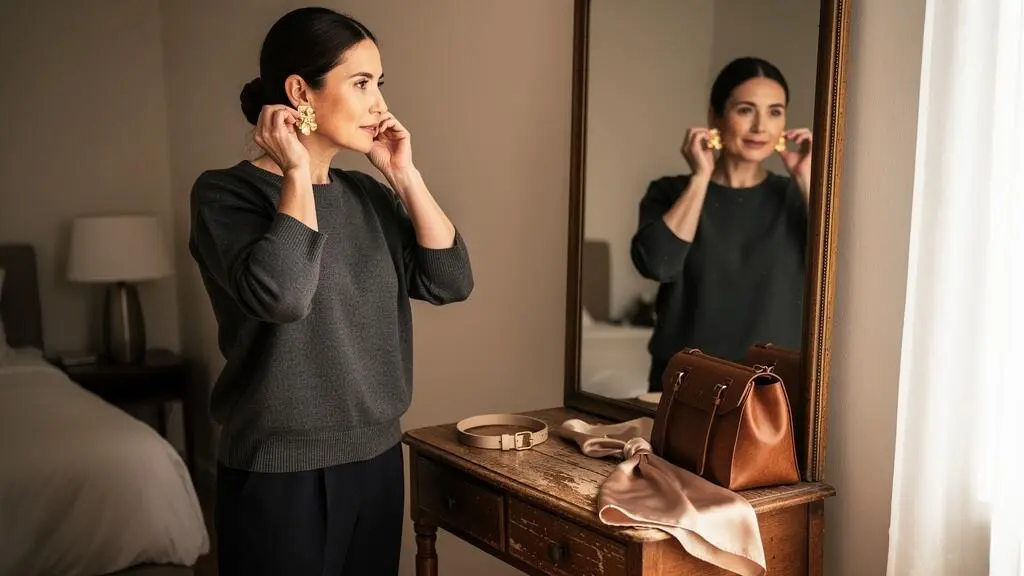
A plain outfit does not need more clothing to become more interesting. Sometimes, the difference between an ordinary combination and a distinctive personal style is one carefully chosen accessory.
Think of a charcoal jumper with straight-leg trousers, a white shirt with dark jeans, or a simple black dress. Each creates a neutral foundation. Add sculptural earrings, a striking bag or a patterned silk scarf, and the same clothes can communicate a completely different mood.
The secret is controlled visual emphasis, not maximum decoration. A statement accessory works best when it gives the eye somewhere intentional to land without competing with everything else in the outfit.
That approach also makes sense for anyone building a practical wardrobe. Rather than buying separate looks for work, weekends and evenings, a small rotation of well-chosen accessories can give existing clothes more range. The challenge is knowing which piece to use, where to position it and when to stop.
Statement accessories: the essential styling rules
- Choose one focal point. Let a standout accessory lead while the remaining pieces support it.
- Work with your neckline, hairstyle and setting. The same accessory can look balanced in one outfit and excessive in another.
- Prioritise comfort and versatility. A considered rotation of jewellery, bags, belts and scarves can refresh clothes you already own.
- Why Do Two Statement Pieces Often Cancel Each Other Out in Photos?
- How to Choose One Statement Accessory Based on Neckline and Hairstyle?
- Statement Earrings or a Statement Bag: Which Is Safer for Conservative Offices?
- The Comfort Mistake That Makes You Remove Your Accessories After 1 Hour
- A 5-Accessory Rotation That Makes 20 Outfits Feel New
- How to Make One Cocktail Dress Work for Dinner, Theatre, and a Work Party?
- How to Wear a Silk Scarf in 3 Modern Ways Without Looking Old-Fashioned?
- How Can a Silk Scarf Make You Look More Put-Together in Under 2 Minutes?
Why Do Two Statement Pieces Often Cancel Each Other Out in Photos?
Two statement accessories can weaken each other’s impact when they compete for attention instead of creating a clear visual hierarchy. In a photograph, a chunky necklace and an equally striking pair of earrings may pull the eye towards different areas. Neither becomes the obvious focal point, making the outfit appear more complicated than intended.
This is a question of visual dominance. A successful statement piece establishes a leading feature, while other details reinforce the overall composition.
The University of Kentucky‘s guide to clothing accessories and visual balance explains how proportion, texture, colour and the relationship between dominant and supporting elements influence outfit composition. It also warns that excessive visual weight in one area can undermine balance.
Imagine pairing oversized gold earrings with an elaborate multicoloured necklace. Both demand attention around the face. Replace the necklace with a fine chain, and the earrings immediately gain a clearer role.
The effect can be especially noticeable in photographs, where a single viewpoint compresses an outfit into one composition. In person, movement, posture and changing angles may distribute attention differently. Neither view is inherently more accurate; they simply reveal different aspects of the same styling decision.
A useful styling exercise is to photograph your outfit and view the image in black and white. Removing colour makes differences in brightness, shape and contrast easier to inspect. If two accessories appear equally dominant, try reducing the scale of one or removing it entirely. This is a practical visual check, not a scientifically validated test.
However, competition is not the same as coordination. Two bold pieces can work together when they share a recognisable design element, such as a metal finish, colour family or pattern scale.
Research published in PLOS ONE on colour coordination in fashion found that moderately coordinated outfits were perceived more favourably than outfits at either extreme of matching. The study examined colour relationships, not the ideal number of accessories, but its findings provide a useful reason to avoid both rigid matching and uncontrolled contrast.
As a styling guideline, look for at least one shared design element when combining two prominent accessories. If they have no apparent connection, allowing just one to lead is usually the easier approach.
The goal is not to make every accessory discreet. It is to make the intended statement unmistakable. Once that focal point is clear, the next consideration is where it should sit on your body.
How to Choose One Statement Accessory Based on Neckline and Hairstyle?
Choose your statement accessory by identifying which area of your outfit has room for emphasis. High necklines often suit prominent earrings or a striking bag, while V-necks and square necklines can frame necklaces effectively. Hairstyles matter just as much: loose hair may conceal earrings, whereas an updo makes them more visible.
Choose the focal area before choosing the accessory. This reverses the common habit of selecting a favourite piece first and then struggling to make the outfit accommodate it.
Three practical zones can guide the decision:
| Outfit feature | Suggested statement accessory | Styling consideration |
|---|---|---|
| High-neck jumper or roll-neck | Sculptural earrings or a statement bag | Move emphasis away from an already covered neckline. |
| V-neck or square neckline | Distinctive pendant or sculptural necklace | Use the open neckline to frame the jewellery. |
| Hair tied back | Statement earrings | Exposed ears allow shape and detail to remain visible. |
| Long hair worn loose | Visible earrings, necklace or bag | Check whether the accessory disappears beneath the hair. |
Scale also matters. A substantial roll-neck or a full hairstyle creates more visual volume around the face. A tiny earring may disappear against that background, while a larger design can remain visible. Conversely, an open neckline may allow a delicate but distinctive pendant to provide enough interest without additional decoration.
Try a simple 60-second mirror experiment. First, lift your hair away from your neck and assess the accessory. Then release your hair into the style you intend to wear. Look at whether the piece remains visible and whether the outfit still feels proportionate.
If the effect changes dramatically, your hairstyle is part of the styling decision rather than an afterthought. Either adjust the hair or choose an accessory that works with its natural position.
These are flexible composition guidelines, not rules about which body shapes or hairstyles are permitted to wear particular jewellery. Your intended effect and comfort remain more important than perfect proportions.
Once the accessory works visually, consider the environment in which it will be worn. A dramatic choice for an evening out may need a more restrained interpretation at work.
Statement Earrings or a Statement Bag: Which Is Safer for Conservative Offices?
A statement bag is often the more discreet choice for a conservative office because it remains away from the face during most conversations. Statement earrings are more continuously visible, particularly in meetings and video calls. However, neither option is automatically inappropriate: workplace expectations, accessory scale and the outfit itself determine what feels suitable.
Consider a straightforward combination of tailored trousers, a plain shirt and a structured blazer.
Large, brightly coloured earrings introduce expression directly beside the face. A distinctive leather bag, by contrast, can introduce personality while remaining outside the immediate conversational focal area.
This makes a bag a practical starting point when navigating unfamiliar workplace expectations, especially during a first week in a new role or an important client meeting. It is a cautious styling recommendation, not evidence that colleagues systematically judge earrings more negatively.
Workplace context matters more than a universal accessory rule. A historical UK government publication, GOV.UK guidance on workplace dress codes, recommends considering actual professional requirements and checking the applicable workplace policy. Published in 2010 for a particular Civil Service context, it should not be treated as a rule governing all UK offices.
Where expectations are uncertain, compare the options through three practical lenses:
| Consideration | Statement earrings | Statement bag |
|---|---|---|
| Visibility during meetings | Usually remain close to the face and highly visible. | Often placed beside or away from the wearer. |
| Degree of expression | Can create an immediate personal-style signature. | Can signal distinctive taste more subtly. |
| Understated option | Medium sculptural earrings in one metal finish. | A structured bag in a restrained colour with a distinctive shape. |
| Practical consideration | Weight, movement and compatibility with headphones. | Capacity, carrying comfort and suitability for commuting. |
A restrained starting point is usually easier to adjust than an outfit you feel compelled to tone down after arriving. For example, medium-sized silver earrings can provide character without relying on chandelier proportions or several vivid colours.
Already wearing a patterned blazer or strongly coloured tailoring? Choose an accessory that contrasts through simplicity: a plain sculptural bag or uncomplicated metal jewellery rather than another elaborate decorative element.
As workplace conventions become clearer, the statement can become bolder or remain deliberately understated. Either way, the piece must be practical enough to wear throughout the working day.
The Comfort Mistake That Makes You Remove Your Accessories After 1 Hour
The biggest comfort mistake is choosing accessories solely for how they look while standing still in front of a mirror. Heavy earrings may pull at the earlobes, rigid necklaces can shift against the neck, and oversized cuffs may interfere with typing. An accessory that feels irritating during ordinary movement is unlikely to remain part of the outfit all day.
A striking piece loses much of its styling value when you remove it as soon as discomfort starts. The original outfit remains, but the focal detail disappears.
This is particularly relevant to statement jewellery because size does not always reveal weight, flexibility or how a fastening behaves.
Wearability is part of successful styling, not a compromise that comes after appearance.
Before committing to an accessory, perform a short movement test at home:
- Wear it while standing and turning your head or shoulders naturally.
- Sit down and check whether the piece presses, twists or slips.
- Walk around and notice any pulling, swinging or irritation.
- Repeat ordinary gestures such as reaching for a bag or using a keyboard.
- Check whether the accessory remains comfortably in position without constant adjustment.
As a personal guideline, treat repeated adjustments as a warning sign. If you find yourself correcting an accessory more than twice during an hour, reconsider the fit. That threshold is a practical self-check, not a clinically established comfort limit.
Materials and construction can make a substantial difference. Hollow or lightweight designs may provide visual volume with less weight. Smooth interior surfaces can make necklaces more comfortable, while secure, suitable earring fastenings can improve stability. Heavy earrings should not rely on a fastening alone to compensate for excessive pulling.
Your five-step statement accessory wearability check
- Choose your focal piece: lay it beside the complete outfit and identify the accessory you intend to emphasise.
- Check the fit: put it on and note any immediate pressure, pinching or pulling.
- Test movement: walk, sit and perform everyday gestures, identifying any action that causes discomfort.
- Check stability: record whether the piece slips, rotates or needs adjustment during the test.
- Make the final decision: keep the accessory if it remains comfortable, or select a lighter or better-fitting alternative before leaving.
An attractive piece that cannot survive your normal activities is better reserved for a suitable occasion, altered where possible, or replaced with a more wearable design.
Comfortable accessories are also easier to wear repeatedly. That reliability becomes especially valuable when building a small rotation capable of refreshing an entire wardrobe.
A 5-Accessory Rotation That Makes 20 Outfits Feel New
Five carefully selected accessories can make twenty existing outfits feel different by changing their focal points, colours, textures and degree of formality. The key is to select pieces with distinct functions rather than buying five versions of the same accessory. This creates multiple styling options without requiring new clothing for every occasion.
Start with functional variety. A useful five-piece rotation could include:
- One neutral metallic piece: sculptural silver or gold jewellery that works with several colour combinations.
- One colourful piece: a patterned scarf, vivid bag or distinctive belt that changes the palette of a neutral outfit.
- One textural piece: an accessory featuring wood, resin, cord or another material that adds surface contrast.
- One face-framing piece: statement earrings or a necklace chosen to complement your usual hairstyles and necklines.
- One accessory away from the face: a structured bag or prominent belt that creates a focal point elsewhere.
These categories may overlap, but their styling roles should remain distinct. For example, a gold necklace and gold earrings can belong to the same general metallic family while performing different visual functions.
Consider a hypothetical wardrobe of four everyday foundations: a white shirt with jeans, a black knit with tailored trousers, a simple midi dress, and a plain top with a skirt.
Pairing each foundation individually with five different accessories creates 20 possible outfit-and-accessory combinations: four foundations multiplied by five accessory choices. This is a planning illustration, not proof that every pairing will look successful or feel entirely new.
The same method becomes even more flexible if you already have twenty base outfits. Each accessory gives you another potential styling route, provided its colours, proportions and practical purpose work with the clothing.
To avoid buying pieces that only look attractive in isolation, test a potential addition against several outfits you already wear. If it complements only one rarely used garment, its usefulness may be limited.
A simple rotation review can also prevent accumulation. After a period you choose, identify accessories you have not worn. An unused piece may duplicate something else, clash with your real wardrobe or simply fail your comfort test.
Rather than automatically adding a sixth piece, consider replacing the least useful one. A small, coherent collection is often easier to style than a large, disconnected one.
Once those distinct accessory roles are established, a single dress can shift between occasions with surprisingly few changes.
How to Make One Cocktail Dress Work for Dinner, Theatre, and a Work Party?
One cocktail dress can work for dinner, the theatre and a work party when accessories adjust its level of formality and visual emphasis. Keep the dress as the foundation, then change the leading accessory to suit the occasion. Jewellery near the face creates a different impression from a structured bag, restrained shoes or a carefully placed scarf.
Imagine a simple, well-fitting dark cocktail dress with a relatively clean silhouette. The clothing remains constant across three occasions, but the styling message changes.
| Occasion | Main statement piece | Supporting choices |
|---|---|---|
| Dinner | Bold sculptural earrings or a distinctive necklace. | Simple bag and understated shoes to keep the focus on jewellery. |
| Theatre | Graphic silk scarf or sculptural accessory. | Refined outerwear and comfortable shoes suited to the venue. |
| Work party | Restrained metallic or pearl-detail accessory. | Structured bag and shoes consistent with workplace expectations. |
For dinner, jewellery close to the face can introduce warmth, personality or drama. If the earrings are substantial, leave the neckline relatively quiet rather than adding another equally expressive piece.
For the theatre or a cultural evening, a distinctive scarf or sculptural accessory can supply the finishing detail. A carefully arranged silk scarf, for example, may give a plain dress more character without requiring a completely different wardrobe.
For a work party, consider how the outfit relates to the professional environment. A medium-sized metallic accessory, understated pearls or a structured bag may offer a more measured statement than elaborate evening jewellery. This is a context-sensitive styling choice, not a universal workplace requirement.
Change the main signal rather than rebuilding the entire outfit. If the dress already fits the occasion, one accessory replacement may be enough to shift the overall impression.
There are limits to this flexibility. A dress with an extremely revealing cut, a particularly dramatic silhouette or an unsuitable length may not become workplace-appropriate simply because its jewellery changes. Venue guidance, your role and personal comfort still matter.
Even so, the basic principle remains useful: accessories can change the mood of familiar clothing without demanding an entirely new look.
A silk scarf is especially versatile here because it can move between different positions on the body or the bag, producing distinct effects from the same piece.
How to Wear a Silk Scarf in 3 Modern Ways Without Looking Old-Fashioned?
A silk scarf can look contemporary when its placement, knot and pattern feel intentional rather than overly formal. Try wearing it at the waist, tying it to a bag or incorporating it into your hairstyle. These alternatives create different focal points and allow a scarf to update simple clothes without relying on a traditional neck knot.
A tightly centred neck knot can sometimes suggest a more formal or vintage aesthetic, particularly when paired with a traditional print and conservative tailoring. That does not make the style inherently outdated. It simply produces a different visual reference from a relaxed, asymmetric or unexpected placement.
For a contemporary interpretation, change either the position of the scarf or the structure of the knot.
1. Wear it at the waist. Thread a suitably sized scarf through a few belt loops or tie it loosely around the waist of jeans, trousers or a straight-cut jacket. Position the knot slightly off-centre so the fabric introduces movement rather than forming a rigid, symmetrical shape.
This works particularly well with simple separates because the scarf becomes a defined colour accent. Check that the knot stays secure and does not interfere with walking or sitting.
2. Tie it to your bag. Fold the scarf into a narrow strip and secure it around one handle of a plain tote or shoulder bag. Allow the ends to hang naturally, or wrap a suitable length of fabric around the handle for a more compact result.
This placement is useful when the outfit already contains a prominent neckline or jewellery detail. The scarf adds interest away from the face without creating another competing centre of attention.
3. Incorporate it into your hairstyle. Fold the scarf into a band and tie it around your head, or use it to accent a ponytail or bun. For greater coverage, a larger scarf may be arranged as a headwrap. Choose a method that stays comfortable and secure with your hair texture and intended activity.
Pattern selection matters alongside placement. Graphic designs, dark backgrounds and distinctive colour combinations can give a scarf a sharper visual character. Traditional florals and pastel palettes can also look modern; their effect depends on the clothing and styling around them.
For additional contemporary examples, PORTER‘s editorial on five ways to wear a silk scarf, published in August 2025, illustrates several placements, including the waist, hair, neck and bag. It is an editorial styling reference rather than evidence that one method is universally more fashionable.
Choose the placement that changes the outfit in the direction you want. A scarf at the waist creates structure; on the bag, it adds a peripheral accent; in the hair, it moves attention towards the face.
Once one placement feels natural, repeating it becomes an efficient dressing habit rather than a complicated styling exercise.
Key styling takeaways
- Choose the area you want to emphasise before deciding how to wear a scarf.
- Keep one familiar tying technique ready so the accessory does not become another morning decision.
- Use a scarf to introduce intention into clothes you already wear, rather than treating it as an excuse to rebuild the outfit.
How Can a Silk Scarf Make You Look More Put-Together in Under 2 Minutes?
A silk scarf can make a simple outfit appear more considered in under two minutes when you already know where and how to wear it. A quick knot at the neck or a tie around a bag handle adds a deliberate colour, pattern or texture detail. The effect comes from visible styling intention rather than the price of the accessory.
Consider a familiar combination: a plain white T-shirt, straight-leg jeans and simple trainers. These pieces are practical, but the outfit may feel visually unfinished if you want a stronger personal style signature.
A silk scarf tied loosely at the side of the neck can introduce a clear point of interest. If the neckline already feels busy, tying the same scarf around a bag handle creates a more discreet alternative.
The advantage is particularly noticeable in three everyday situations:
- Monochrome dressing: a patterned scarf introduces contrast without disrupting the simplicity of the outfit.
- Basic casual combinations: a scarf gives a T-shirt-and-jeans look an additional layer of visual intention.
- Low-effort mornings: a familiar knot provides a repeatable styling detail when you do not want to rethink your clothes.
The quickest method is not necessarily the most elaborate. It is the one you can repeat comfortably without checking instructions or experimenting with several alternatives.
For a simple side-neck knot, fold the scarf into a manageable band, place it loosely around your neck and tie a small knot to one side. Adjust the ends until they sit naturally, keeping the fabric comfortable and away from anything it could catch on.
Alternatively, fold the scarf and tie it securely around your bag handle. This requires no change to your hairstyle, neckline or jewellery. Either technique may be completed in less than two minutes once practised, although the timing is a practical goal rather than a guaranteed result.
The distinction is between adding a purposeful finishing detail and adding decoration for its own sake. If your outfit already has strong colours, prints or jewellery, the scarf may be unnecessary. If everything is visually quiet, the same scarf can provide precisely the missing point of emphasis.
Tomorrow, choose one outfit you already wear regularly, add a scarf using a knot you have practised, and assess the result in the mirror before leaving. Keep the combination if it feels natural, comfortable and recognisably yours. Personal style develops through repeatable choices, not through buying a new outfit every time you want a different impression.
Can statement accessories work with a minimalist wardrobe?
Yes. Minimalist clothing provides a relatively quiet foundation for a distinctive accessory. A sculptural necklace, coloured bag or patterned scarf can establish a clear focal point without changing the simplicity of the underlying outfit. Choose a piece that complements your usual colours and proportions rather than one that requires several new garments to work.
Do statement accessories have to be large or brightly coloured?
No. An accessory can make a statement through shape, texture, contrast, material or an unexpected design detail. A small but architectural silver pendant may stand out against a plain dark top, while a large neutral leather bag can create emphasis without vivid colour. Visibility depends on the surrounding outfit as much as the accessory itself.
Should shoes and bags always match?
Exact matching is optional. Shoes and bags can complement each other through related colours, textures or levels of formality without being identical. Moderate coordination often feels more flexible than perfectly matched sets. Consider the entire outfit and keep the intended focal accessory visually clear.
How can you tell whether a statement accessory is worth keeping?
Assess how often it works with clothes you actually wear, whether it remains comfortable during normal activities and whether it serves a distinct styling purpose. If a piece repeatedly stays unused because it clashes, duplicates another accessory or feels uncomfortable, it may not deserve a permanent place in your rotation.
Is expensive jewellery necessary to make a plain outfit look polished?
No. An accessory’s styling impact depends on how its shape, colour, texture and scale interact with the clothing. A comfortable, well-maintained piece that creates a clear focal point can work effectively regardless of its price. Prioritise suitable materials, secure construction and compatibility with your wardrobe over a luxury label.