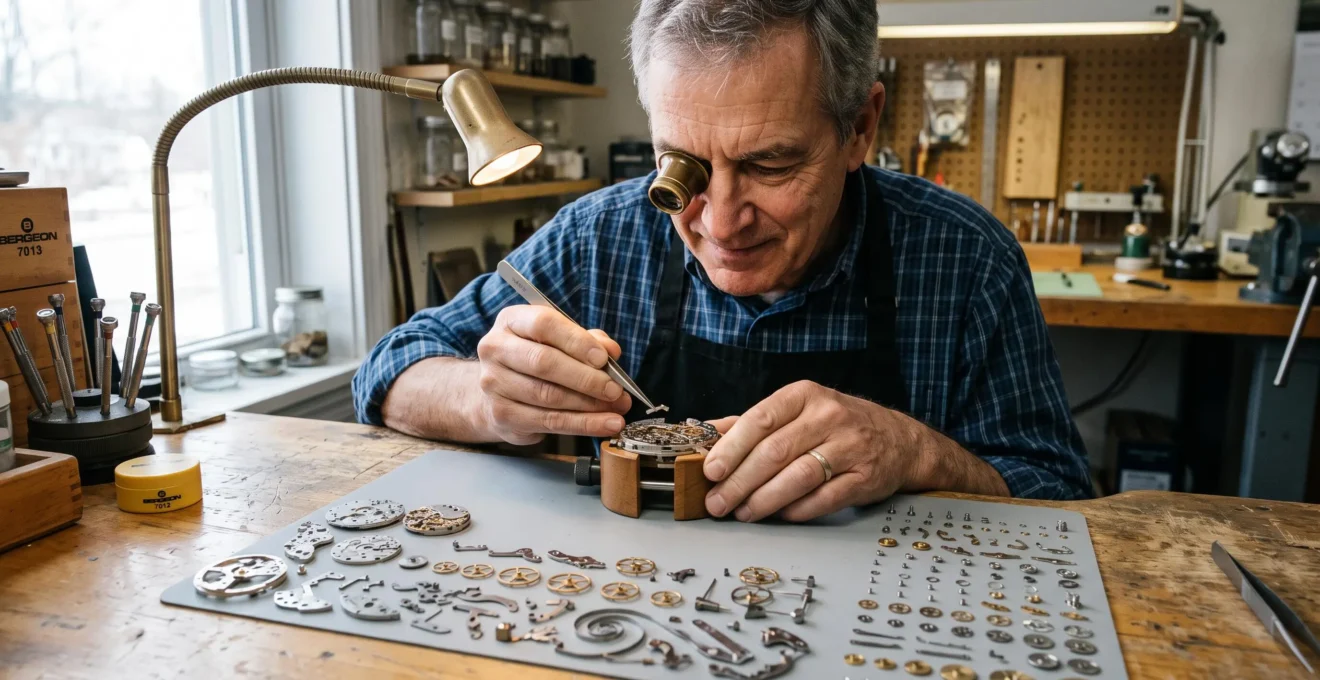
A mechanical chronograph costs more to maintain because its stopwatch mechanism introduces additional components, adjustment points and potential faults. Those components remain part of the movement whether you time something every morning or press the start button twice a year. Avoiding the function does not eliminate the complexity a watchmaker must assess during servicing.
The difference is measurable in the UK. TAG Heuer‘s March 2026 suggested service prices distinguish between ordinary mechanical watches and mechanical chronographs, with the latter attracting a higher complete-service charge. That does not mean chronographs are inherently unreliable. It means their maintenance requirements are different.
For someone choosing a first serious chronograph, the important questions concern movement architecture, operating habits, water resistance, service history and access to competent repairers. Understanding these factors makes it easier to distinguish a durable everyday watch from one whose attractive purchase price conceals expensive long-term maintenance.
Chronograph maintenance: the essentials
- Extra complexity has a cost. Chronograph mechanisms contain additional clutches, levers, counters and reset components that require inspection and adjustment.
- Rare use does not stop ageing. Lubricants, seals and other materials can deteriorate even when the stopwatch remains idle.
- Movement design and service history matter. A recognised, properly maintained calibre with accessible parts can be a more predictable ownership proposition than a poorly documented complication.
- Why Does Adding a Chronograph Create More Failure Points Than a Simple Watch?
- How to Test a Chronograph in 60 Seconds Without Looking Like You’re Fiddling?
- Column Wheel or Cam Chronograph: Which Makes More Sense for Daily Wear?
- The Chronograph Habit That Can Damage a Movement Faster Than You Think
- When Should You Service a Chronograph If You Wear It Every Day?
- How to Judge Movement Quality Without Opening the Caseback?
- A Fine Watch or Fine Jewellery: Which Is Easier to Wear Every Day?
- How Do You Judge Craftsmanship in Horology and Fine Jewellery Without Being an Expert?
Why Does Adding a Chronograph Create More Failure Points Than a Simple Watch?
A chronograph introduces additional mechanical failure points because it must start, stop, measure and reset elapsed time while the ordinary timekeeping system continues operating. These functions require extra moving components and precise adjustment. Even when the stopwatch is seldom activated, those components increase the inspection, lubrication and potential repair work involved in maintaining the watch.
A conventional mechanical watch already contains a mainspring, gear train, escapement and regulating system. A chronograph adds a mechanism that connects the stopwatch to the movement’s power supply, records elapsed time and returns its hands to defined starting positions.
Depending on the calibre, this can involve additional wheels, springs, operating levers, hammers, heart-shaped reset cams and clutch components. Every additional interface represents another location where friction, wear, poor lubrication or incorrect adjustment may affect operation.
Servicing complexity exists even when usage is minimal. Lubricants can migrate, deteriorate or lose their intended properties with age. Case gaskets also deteriorate independently of stopwatch usage. A chronograph left unused in a drawer is therefore not automatically exempt from future servicing.
Architecture makes a difference. A modular chronograph adds a separate timing mechanism to a base movement, whereas an integrated calibre incorporates the chronograph functions into the movement’s overall design.
Neither architecture guarantees cheaper servicing. A modular construction may allow certain repairs to be addressed separately, but access to its components can complicate dismantling. An integrated movement may be straightforward for a suitably equipped specialist, yet difficult to repair economically if proprietary parts are restricted.
Movement identification is consequently more useful than assuming that one architecture is universally superior.
£85
Difference between TAG Heuer’s suggested UK complete-service prices for Group 3 mechanical watches (£410) and Group 4 mechanical chronographs (£495), equivalent to approximately 20.7%. These are manufacturer-specific, non-binding category prices, not UK market averages.
A further distinction concerns accuracy. A watch may keep satisfactory time while its chronograph fails to engage reliably, hesitates during operation or returns slightly away from zero. The ordinary seconds display and the elapsed-time mechanism test different aspects of the movement.
Conversely, a chronograph hand that does not reset correctly is not proof that its clutch is worn. Hand positioning, reset adjustment and other faults can produce similar symptoms. Diagnosis requires inspection.
That distinction explains the price difference, but it also gives buyers a practical opportunity: several chronograph functions can be checked before committing to a purchase.
How to Test a Chronograph in 60 Seconds Without Looking Like You’re Fiddling?
A discreet chronograph test takes about a minute: confirm that the watch is running, start the stopwatch, observe its seconds hand, stop it and check that it returns precisely to zero. Use deliberate presses and avoid forcing any control. This simple routine cannot certify the movement’s condition, but it can reveal obvious operational defects before purchase.
At a UK independent retailer or pre-owned watch dealer, ask permission to operate the complication. Place the watch securely on your wrist or on a suitable surface, then identify the start-stop and reset pushers.
On many conventional chronographs, the upper pusher starts and stops timing while the lower pusher resets it. However, control arrangements and operating restrictions differ between movements. The manufacturer’s instructions should take precedence.
Seiko‘s official instructions for calibres 8R46 and 8R48, for example, identify separate start-stop and reset controls and specify that the central chronograph seconds hand should be at zero before measurement begins.
As the central chronograph hand moves, watch for hesitation, unexpected stopping or irregular behaviour. Some movements may exhibit a small initial hand movement as their clutch engages, so a slight jump does not independently establish a fault.
When stopping and resetting the watch, pay particular attention to whether the hand returns consistently to its reference marker. A persistent misalignment deserves an explanation and, ideally, an independent assessment.
Pushers should operate in a manner consistent with the calibre. Distinct mechanical resistance is normal on some designs; grinding, sticking or unusually inconsistent feedback deserves investigation. Pusher feel alone cannot establish the condition of the seals or confirm water resistance.
In a quiet shop, a clearly audible abnormal noise is worth mentioning, but ordinary mechanical clicks are not necessarily problematic. A brief test also cannot establish long-duration timing accuracy or reveal every intermittent fault.
Your five-point pre-purchase chronograph check
- Identify the calibre. Ask the retailer for the exact movement reference and record it alongside the model.
- Confirm the controls. Check the movement’s operating instructions and make a note of any restrictions.
- Test start and stop. Run the chronograph briefly and record whether its engagement and stopping appear consistent.
- Check zero return. Reset the stopped chronograph and note whether every relevant hand aligns with its starting marker.
- Request servicing evidence. Obtain dated service information and written confirmation of what a warranty or return policy covers.
A dealer who can explain a minor irregularity, identify the movement and provide appropriate documentation offers more useful reassurance than one who simply describes the watch as running perfectly.
Once basic function is established, the next decision concerns the mechanism controlling those functions, which can influence both everyday feel and future repair options.
Column Wheel or Cam Chronograph: Which Makes More Sense for Daily Wear?
Neither a column-wheel nor a cam-operated chronograph is automatically better for daily wear. Column-wheel mechanisms are often valued for refined pusher operation and traditional prestige, while cam systems are commonly associated with practical, established movement designs. Reliability and servicing costs depend more on the particular calibre, its condition and repair support than on the switching mechanism alone.
A column wheel is a rotating control component with raised pillars that coordinate the chronograph’s operating levers. A cam-operated system achieves comparable start, stop and reset coordination through a different arrangement of shaped control surfaces and levers.
The distinction concerns how the complication is switched between operating states. It does not, by itself, determine the type of clutch that connects the chronograph to the movement.
That second distinction matters because chronographs may use horizontal or vertical clutch arrangements. The switching system and clutch architecture are related parts of the overall design, but they are not interchangeable terms.
For a daily wearer, the practical differences can be organised as follows.
| Buyer consideration | Column wheel | Cam-operated system |
|---|---|---|
| Operating principle | Rotating pillar wheel coordinates chronograph controls | Shaped cam and levers coordinate chronograph controls |
| Pusher experience | Often designed for a refined, clearly defined action | May feel firmer, depending on the calibre |
| Servicing | Requires a watchmaker familiar with the specific mechanism | Requires the same calibre-specific expertise |
| Repair cost | Cannot be determined from the column wheel alone | Cannot be assumed cheaper without a quotation |
| Buying priority | Control feel, movement design and horological interest | Proven operation, parts availability and practical ownership |
The Valjoux 7750 family is a familiar example of a cam-operated automatic chronograph architecture. Rolex’s calibre 4130 illustrates a column-wheel chronograph design. These examples demonstrate different engineering approaches, not a universal ranking of performance or servicing expense.
It is tempting to assume that cam-operated movements always withstand shocks better or that column wheels invariably produce smoother pushers. Neither generalisation is reliable without considering the complete movement and its adjustment.
Clutch construction is particularly relevant to continuous timing. A correctly designed vertical clutch may permit prolonged chronograph operation with relatively little engagement-related wear. Horizontal-clutch mechanisms can introduce different contact and friction considerations.
However, continuous running can still influence power consumption, amplitude or lubrication requirements, depending on the calibre. A vertical clutch does not make a movement maintenance-free.
For a buyer comparing two watches, the most useful question is therefore not simply whether one has a column wheel. Ask which movement each uses, how its clutch operates, whether replacement components remain available and who can service it locally.
Whatever mechanism you choose, correct operating habits are essential because external controls and case seals introduce risks that movement specifications alone cannot eliminate.
The Chronograph Habit That Can Damage a Movement Faster Than You Think
Operating ordinary chronograph pushers while the watch is wet or underwater is an avoidable risk. Water resistance depends on the condition and design of the case seals, including those around the pushers. Pressing a control under unsuitable conditions can compromise protection and allow moisture to reach the movement, potentially causing corrosion and extensive repair work.
A chronograph case has more external control interfaces than a conventional three-hand watch without additional pushers. Each control needs to function mechanically while preserving the case’s intended environmental protection.
Breitling specifically advises owners not to activate conventional chronograph pushers underwater or when the watch is wet. Its guidance also recognises specialised exceptions, including certain magnetic-pusher designs engineered for underwater operation.
The sensible rule is therefore follow the instructions for the exact watch, rather than assuming that a particular depth rating authorises underwater pusher operation.
Water resistance also changes over time. Exposure to perspiration, heat, temperature fluctuations, cosmetics and environmental contaminants can affect gasket materials. A watch that passed a pressure test when new should not automatically be assumed to retain identical protection indefinitely.
“Never activate the chronograph pushers underwater or when the watch is wet.”
Before exposure to water, confirm that any screw-locked crown or pusher is secured as instructed. If condensation appears beneath the crystal, arrange prompt professional attention rather than waiting for the moisture to disappear.
Another debated habit is leaving the stopwatch running continuously. With some horizontal-clutch movements, keeping the mechanism engaged changes the loading and wear conditions of the chronograph train. Certain vertical-clutch designs are better suited to sustained engagement, although their behaviour still depends on movement engineering and condition.
There is no dependable rule that every chronograph must be stopped immediately after use. Equally, no owner should assume continuous operation is harmless merely because the watch has a prestigious calibre.
Resetting the chronograph while it is running also requires caution. Some movements support flyback operation, which deliberately combines stopping, resetting and restarting. Others expect the owner to stop the mechanism before resetting.
Forcing a reset against the manufacturer’s intended operating sequence is unnecessary and may damage or disturb mechanical components. Seiko’s instructions for the 8R46 and 8R48 also warn against adjusting the time or date with the stopwatch operating, illustrating how restrictions can be movement-specific.
Accidental impacts while operating controls are another reason to handle a chronograph deliberately. A watch bumped against a desk or doorframe does not automatically suffer internal damage, but unnecessary shock exposure is best avoided.
Even careful use cannot eliminate natural ageing, which raises the more important ownership question: when should a chronograph actually be serviced?
When Should You Service a Chronograph If You Wear It Every Day?
A daily-worn chronograph should be serviced according to the manufacturer’s guidance, its documented maintenance history and its actual mechanical condition. Warning signs include unreliable resetting, abnormal timing behaviour, unusual resistance or deterioration in timekeeping. These symptoms can justify earlier inspection, while apparently normal performance does not eliminate the need for periodic maintenance and water-resistance checks.
A fixed servicing interval is convenient, but it cannot capture every difference between movements, working environments and wearing habits. Some manufacturers specify recommended maintenance periods, while others place greater emphasis on inspection and condition.
A mechanical chronograph worn daily experiences repeated changes in temperature, position and environmental exposure. Depending on the owner’s activities, the case may also encounter sweat, water, dust and shocks.
These conditions make seal integrity particularly important. They do not establish that every daily-worn watch inevitably needs a full overhaul sooner than every occasionally worn example.
Watchmakers can assess timekeeping rate, amplitude, beat error and behaviour in different positions. Where appropriate, testing with the chronograph alternately disengaged and engaged may help identify performance changes associated with the complication.
A falling amplitude or a new operational irregularity deserves investigation, but neither should be treated as a standalone diagnosis. Testing conditions, power reserve and the movement’s specifications affect interpretation.
For UK owners, the choice is commonly between a manufacturer’s service network and an appropriately qualified independent watchmaker. The manufacturer may offer direct access to proprietary components and established model-specific procedures. An independent specialist may offer different pricing, repair options or turnaround arrangements.
Neither route is categorically cheaper or better. The comparison depends on the calibre, parts access, service scope and condition of the watch. An independent repair may also affect an existing manufacturer’s warranty, so warranty terms should be checked before authorising work.
The service estimate is more important than the headline price. Ask whether it includes complete chronograph dismantling where required, replacement of worn parts, lubrication, timing adjustments, resetting checks, case seals and pressure testing.
Rolex‘s documented servicing process illustrates what a comprehensive manufacturer procedure can involve: movement assessment, servicing and adjustment, seal replacement, water-resistance testing and further performance checks after reassembly.
According to Rolex’s official servicing procedure, the company also provides a two-year international service guarantee covering replacement parts and labour under its service terms. This is specific to Rolex and should not be assumed to apply to other manufacturers or independents.
A buyer considering a pre-owned chronograph should request a dated invoice identifying the work performed. A receipt for regulation, inspection or partial maintenance is not necessarily evidence of a complete movement overhaul.
The distinction is particularly important where a watch keeps reasonable time but the chronograph mechanism has not been fully examined. Ask whether the elapsed-time function was specifically tested following service.
Before requesting an overhaul, owners can also learn to recognise useful external signs of movement quality, although those signs have important diagnostic limitations.
How to Judge Movement Quality Without Opening the Caseback?
You can form a preliminary judgement about a chronograph movement without opening the case by identifying its calibre, checking how its controls operate, observing timekeeping consistency and reviewing its service documentation. These indicators reveal aspects of construction and condition, but they cannot establish internal wear, lubrication quality or hidden damage with the certainty of a professional inspection.
Begin with the crown. On a properly functioning mechanical watch, winding should feel reasonably consistent and appropriate for its design. Unexpected slipping, grinding or sticking can justify investigation, although crown feel alone does not identify the cause.
Next, examine the chronograph pushers. Their action should be repeatable, without unexplained sticking or failure to activate the intended function. Do not compare the amount of force required across unrelated calibres as though they share identical specifications.
Observe the ordinary seconds indication and the chronograph seconds hand separately. A sweeping chronograph hand can look smooth while the movement keeps poor time; conversely, a healthy mechanical movement may display a visibly stepped sweep because of its operating frequency.
For a more meaningful timekeeping assessment, monitor the watch over several days in comparable conditions. A timing app can help organise observations, but results obtained from casual measurements are not equivalent to a professional assessment using calibrated equipment.
Calibre identity is another useful indicator. Recognised movements, such as members of the Valjoux 7750 family, have an established technical history. That familiarity may help a repairer evaluate servicing options, but it does not guarantee access to every replacement part or establish the condition of an individual example.
For proprietary movements, obtain the manufacturer’s exact calibre designation and ask how future repairs are supported. The term “in-house” describes an aspect of movement development or production; it is not an independent quality certification.
A display caseback can reveal certain finishing details, including decorative patterns, surface treatment and component presentation. However, visible decoration does not demonstrate the condition of hidden pivots, bearings, lubricants or chronograph controls.
Similarly, a solid caseback is not evidence of inferior engineering. It may reflect design choices concerning case construction, appearance or durability.
For a significant pre-owned purchase in the UK, an independent watchmaker’s inspection can be more informative than relying on retailer descriptions or marketing terminology. Ask for findings covering both ordinary timekeeping and chronograph operation, together with any limitations arising from the inspection method.
These considerations become especially relevant when deciding whether the additional responsibilities of owning a complex mechanical watch suit everyday life better than other forms of fine craftsmanship.
A Fine Watch or Fine Jewellery: Which Is Easier to Wear Every Day?
Fine jewellery is generally simpler to live with mechanically because it has no powered movement requiring lubrication, regulation or periodic overhaul. A fine watch provides practical timekeeping but introduces additional maintenance responsibilities. Neither category is completely carefree: jewellery needs protection from damage and setting wear, while watches require attention to seals, mechanical condition and operating instructions.
For a UK commuter moving between the office, public transport and evening activities, the distinction is not merely aesthetic. A mechanical chronograph combines an instrument with a wearable object, while jewellery is primarily valued for its materials, design and craftsmanship.
A chronograph introduces several everyday considerations: whether the crown is secured, whether the pushers may safely be operated in wet conditions and whether the watch is behaving normally. Its owner may also monitor accuracy and preserve service documentation.
Jewellery avoids those mechanical questions but presents different vulnerabilities. Precious metals can scratch or deform, gemstones may loosen as settings wear, and some materials or metal alloys may irritate sensitive skin.
Water and impact exposure matter in both categories. A watch’s stated water resistance offers information about intended protection, subject to the manufacturer’s restrictions and the condition of its seals. Jewellery has no directly comparable universal water-resistance rating.
Similarly, a ring with raised stones may be more vulnerable to knocks than a plain band, just as a watch with protruding controls may require more care during physical activity than a simple, protected timepiece.
Long-term spending follows different patterns. A mechanical chronograph may require periodic servicing even in the absence of an obvious fault. Jewellery expenditure may be more closely linked to cleaning, inspection, restoration, resizing, damaged settings or other work appropriate to the piece.
Those differences do not establish that jewellery is always cheaper to own. Materials, construction, frequency of wear and the nature of any necessary repair can substantially change the outcome.
For everyday practicality, assess the specific object rather than its category. A durable, properly maintained chronograph can be straightforward to wear, while a delicate jewellery design may demand constant caution.
Once those practical differences are understood, craftsmanship offers a common way to judge whether either purchase is likely to reward long-term ownership.
Key takeaways before choosing a piece
- Check construction and repair support rather than relying on prestige, decoration or movement terminology alone.
- Assess finishing consistency and the precision of functional components, especially controls, hands, joints and settings.
- Request documented maintenance and warranty information before assuming that an expensive object will also be inexpensive to maintain.
How Do You Judge Craftsmanship in Horology and Fine Jewellery Without Being an Expert?
You can assess craftsmanship without specialist training by looking for consistency, precision and evidence that the object performs its intended function reliably. On watches, examine case finishing, hand alignment, controls and movement documentation. On jewellery, inspect setting symmetry, joints and surface transitions. Fine decoration matters, but construction quality and future repairability are more useful indicators of long-term ownership value.
Start with surfaces. On a watch case, brushed sections should appear reasonably uniform, while transitions between brushed and polished areas should be deliberate and appropriately defined. On jewellery, comparable attention can be given to polishing consistency, edges and the finishing of less conspicuous areas.
These observations should be interpreted against the maker’s intended design. Hand-finishing can introduce subtle variation, and not every intentionally soft edge indicates poor workmanship.
A modest magnifying loupe or a carefully focused phone macro photograph can help reveal uneven finishing, damaged components or inconsistencies that are difficult to see unaided. The same close inspection may also reveal superficial marks that have little bearing on mechanical performance.
Decorative movement finishing requires particular caution. Perlage, Côtes de Genève and polished surfaces may be executed using different combinations of machinery and manual techniques. Their presence does not independently prove exceptional internal engineering.
More revealing questions concern the consistency of bevels, the treatment of visible edges, component alignment and the care applied to functional details. Even these observations do not establish the condition of internal bearings, wheels or lubricants.
On a chronograph dial, examine the alignment of central hands, subdial hands and applied markers. Make sure the chronograph returns correctly to its reference positions, while remembering that a positioning fault can arise from adjustment rather than the overall quality of manufacture.
In fine jewellery, assess the apparent symmetry of stone settings, whether stones seem securely positioned and whether clasps or hinges operate consistently. A trained jeweller should verify structural security where significant value or delicate construction is involved.
Reference photographs of the exact model can help identify discrepancies, but lighting, manufacturing variations and previous repairs may affect comparisons. A difference from a marketing photograph is a reason to investigate, not immediate proof of counterfeiting or poor craftsmanship.
Questions for the retailer should be specific: What is the precise calibre or material specification? Who performed the most recent service or repair? Which components were replaced? What does the warranty cover, and who can undertake future work?
For a mechanical chronograph, craftsmanship and maintainability overlap. Sound engineering, accurate assembly, appropriate lubrication and effective sealing support reliable operation. Yet elaborate finishing does not guarantee economical repairs, particularly where specialist components or manufacturer-controlled parts are involved.
Before buying, identify the movement, test the complication as instructed, request its service history and obtain a realistic servicing quotation from an appropriate UK repairer. Those steps provide a stronger foundation for a confident purchase than appearance or prestige alone.
Does an unused chronograph need servicing?
Yes, an unused mechanical chronograph can still need maintenance. Lubricants and sealing materials age even when the stopwatch remains inactive. However, an idle watch does not necessarily require immediate overhaul solely because it has not been used. Follow manufacturer guidance and assess its condition and service history.
Is a chronograph more expensive to repair than a normal automatic watch?
It can be. The chronograph mechanism adds components and adjustment requirements. TAG Heuer’s March 2026 UK suggested prices, for example, list £410 for a Group 3 mechanical-watch complete service and £495 for a Group 4 mechanical-chronograph complete service. Individual repair costs depend on the calibre, fault and work required.
Can a chronograph keep accurate time while its stopwatch mechanism is faulty?
Yes. Ordinary timekeeping and elapsed-time measurement involve different functional requirements. A watch may maintain satisfactory daily accuracy while its chronograph starts inconsistently, stops unexpectedly or fails to reset correctly. Both functions should be checked independently before a pre-owned purchase.
Should you avoid buying a second-hand chronograph without service records?
Missing service records increase uncertainty but do not automatically make a watch unsuitable. Consider arranging an independent inspection, confirming the movement reference and requesting a servicing estimate. The absence of documentation should be reflected in the assessment of financial risk rather than treated as proof of a fault.
Does a chronograph require a specialist watchmaker for every repair?
Not every external repair involves the chronograph mechanism, but work on its internal controls and timing components requires suitable expertise, tools and parts. Before choosing a UK repairer, confirm experience with the exact calibre and ask which operations and tests are included in the estimate.