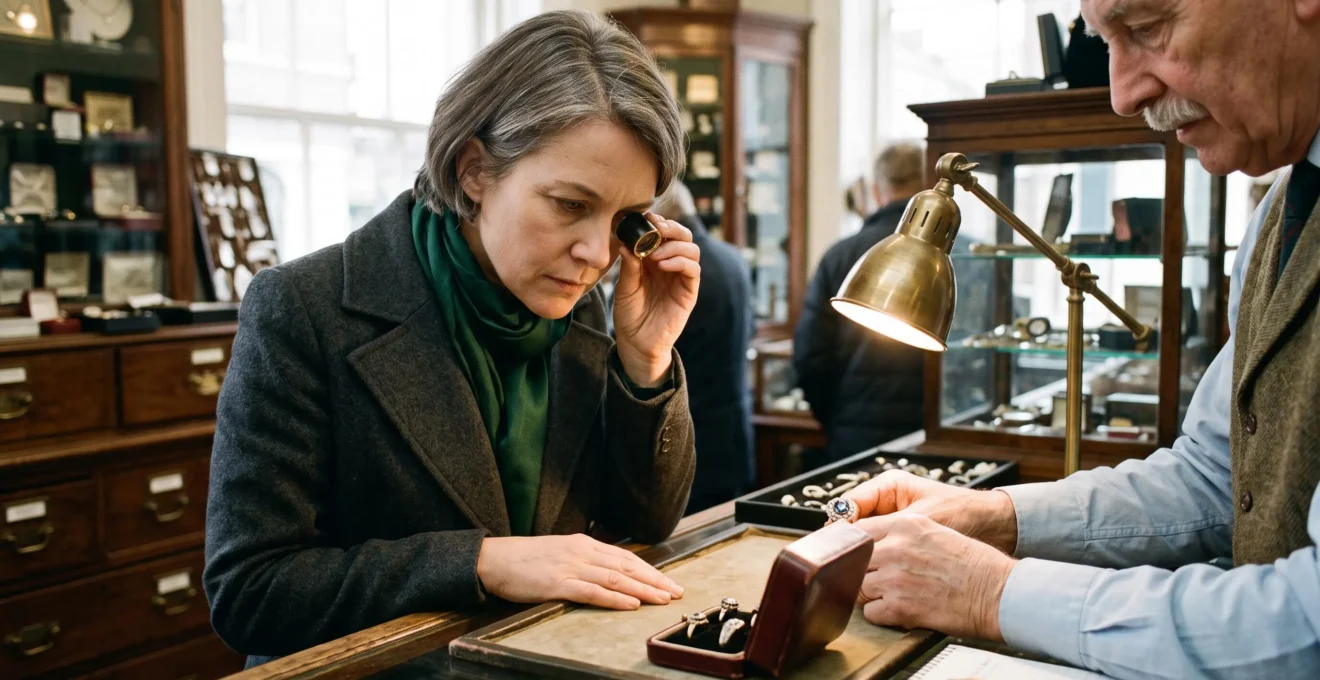
A Victorian ring can look immaculate beneath a dealer’s display lights and still conceal a weakened shank, an unstable gemstone or a repair that will fail during ordinary wear. Buying antique jewellery safely in the UK means investigating more than appearance, age and price. The critical questions concern structural condition, period authenticity, previous alterations and the seller’s responsibility if something goes wrong.
Begin by examining the reverse and joints, asking what has been repaired, and checking whether the item is suitable for the way it will actually be worn. A reputable dealer should be willing to discuss uncertainty rather than describe every imperfection as desirable patina. At auction or through a marketplace, the buyer may need to arrange more independent verification.
Ethical considerations matter too. A period jewel can be an appealing alternative to newly manufactured jewellery, but its age alone does not prove responsible provenance or lawful ownership. Acquisition history, replacement gemstones and undisclosed alterations deserve attention alongside condition.
Buying antique jewellery safely: the essentials
- Inspect settings, solder joints, clasps and previous repairs before judging a piece by its front-facing appearance.
- Establish whether the seller is a trader, an auction house or a private individual; legal protections and practical recourse differ.
- Compare realistic resale evidence and anticipated repairs, not simply the asking price against an insurance valuation.
- Why Do Antique Pieces Look Fine Until You Wear Them for a Week?
- How to Spot Period-Consistent Details in Antique Jewellery Without Being an Expert?
- Dealer, Auction, or Online Marketplace: Where Is Antique Jewellery Safest to Buy?
- The Valuation Mistake That Makes Antique Jewellery Seem Like a Bargain When It Isn’t
- A Slow-Build Strategy for Antique Jewellery That You’ll Actually Wear
- How to Assess an Heirloom Piece Before Restoration So You Don’t Regret It?
- Diamond Art Deco or Onyx Art Deco: Which Holds Up Better for Weekly Wear?
- Why Does Art Deco Jewellery Still Look Modern While Other Vintage Looks Dated?
Why Do Antique Pieces Look Fine Until You Wear Them for a Week?
Antique jewellery can appear sound during a brief inspection because many defects become noticeable only when a piece moves, encounters moisture or experiences repeated pressure. A weakened solder joint, loose claw or existing hairline fracture may escape a static examination. Damage appearing during the first week does not necessarily mean it developed during that week.
Consider a ring with a thin, previously repaired shank. Under display lighting, the repair may be barely visible. During ordinary hand movements, however, repeated stress can expose weakness at the joint. Similarly, an old clasp may close convincingly once yet release unexpectedly after repeated operation.
Gemstones present another difficulty. A fracture may be difficult to distinguish from an internal inclusion, while deteriorated foil backing on certain historic closed-back settings can alter a stone’s appearance when moisture reaches vulnerable areas. Such pieces require particularly careful handling; deliberately wetting them to test durability can cause damage.
Inspection should therefore distinguish appearance from structural security. Look for movement around claws, deformation in thin metal sections, gaps at solder joints and evidence of previous repairs. Do not squeeze settings or force hinges to test them.
A cautious first-week observation routine is useful after a professional pre-wear check. It is not a substitute for the seller’s disclosure or permission to return the piece.
- On receipt, photograph the front, reverse, clasp, hallmarks and any existing imperfections before wearing the item.
- Begin with a short, low-impact outing only if the settings and structure have been assessed as secure.
- After each use, inspect the piece under consistent lighting without pressing or manipulating fragile components.
- Compare photographs for changes in alignment, apparent stone movement, clasp closure or visible cracks.
- If a structural concern emerges, stop wearing the jewellery, document the observation and contact the seller before arranging repairs.
This is an observation protocol, not a recommendation to expose an antique to progressively harsher conditions. Normal patina and minor superficial marks are different from an insecure stone, failing clasp or splitting shank. Even cosmetic changes deserve attention if they contradict a specific condition statement made at purchase.
The Consumer Rights Act 2015 can provide remedies for goods sold by traders, but the assessment takes account of relevant descriptions and disclosed defects. A general statement that an item is antique does not automatically excuse every fault. Conversely, an accurately disclosed defect may affect whether the buyer can subsequently complain about that specific condition.
The safest first week begins before money changes hands: obtain written confirmation of the item’s known weaknesses and whether it is suitable for the intended use. Authenticity is the next question, because a structurally sound jewel is not necessarily what its period description claims.
How to Spot Period-Consistent Details in Antique Jewellery Without Being an Expert?
Non-experts can assess an antique jewel’s period consistency by comparing its gemstone cuts, metalwork, clasp construction, hallmarks and visible repairs. No single feature proves authenticity. The strongest preliminary evidence comes from several details agreeing with the claimed date, while unexplained differences between components should trigger further investigation rather than an immediate accusation of forgery.
A jeweller’s loupe provides a useful starting point, particularly when examining stone edges, the reverse of settings and junctions between components.
- Gemstone cuts: Old mine and old European diamond cuts can be consistent with earlier jewellery, while transitional cuts may fit pieces from later manufacturing periods. Stones can be reused, so cut style alone cannot establish the date of the mounting.
- Finishing: Slightly irregular hand engraving and tool marks may support period construction. Extremely uniform finishing is worth investigating, although historic machinery and modern handwork complicate simple comparisons.
- Clasps and catches: Their form and attachment can offer chronological clues. Replacements are common enough that an apparently later clasp does not automatically discredit the entire jewel.
- Surface treatment: Modern-looking plating, laser-drilled gemstones or contemporary repairs may be inconsistent with a claim that every component is original. They are evidence to investigate, not automatic proof that the underlying piece is modern.
Hallmarks provide a separate line of evidence. The Sheffield Assay Office‘s explanation of UK hallmarks identifies sponsor, fineness and assay office marks as compulsory components of a conventional UK hallmark, while date letters are voluntary. Date letters became voluntary in 1999, and historic lettering, shield shapes and assay-office systems must be interpreted together.
A genuine hallmark supports the metal identification and potentially the date of marking. It does not authenticate every gemstone, prove a setting is original or exclude later assembly. Older and imported jewellery also requires consideration of the hallmarking rules applicable to its circumstances.
The composite-piece problem requires particular attention. A genuine Victorian ring head might have been joined to a later shank, or an old diamond placed in a modern mounting. Different gold colours, incompatible wear patterns and prominent solder lines can expose these combinations. Equally, legitimate repairs can produce similar clues. The crucial question is whether the seller has described the object accurately.
Arrange an independent inspection when an unexplained feature could materially affect the amount being paid, when an important period attribution drives the price, or when the seller cannot substantiate significant claims. For a modestly priced piece, the inspection fee may be disproportionate; for an expensive or potentially composite jewel, it can be essential. There is no universal monetary threshold that makes verification worthwhile.
Five checks to complete before committing to a purchase
- Request close photographs of the front, reverse and sides; save a dated image set.
- Record all visible hallmarks and compare them with a recognised assay-office reference; produce a short identification note.
- Ask for a written list of replaced components, treatments and repairs; retain the seller’s response.
- Obtain a written condition assessment or independent inspection where the financial risk justifies it; keep the findings with the listing.
- Confirm the total payable amount and applicable return conditions; save a complete purchase-cost and seller-terms record.
The aim is not to become an instant jewellery historian. It is to recognise uncertainty early enough to ask better questions, especially when deciding which type of seller can provide credible answers.
Dealer, Auction, or Online Marketplace: Where Is Antique Jewellery Safest to Buy?
An established specialist dealer is often the most manageable buying channel for someone who values detailed condition explanations and straightforward after-sales contact. Auctions can offer interesting pieces and transparent bidding histories but require more preparation. Online marketplaces provide breadth, yet buyer protection depends heavily on the actual seller, platform arrangements and transaction terms.
Each channel concentrates a different type of risk. A dealer’s retail price may reflect inspection, overheads and service, although none of these automatically guarantees authenticity. An auction may present a valuable provenance record while offering limited opportunity to reverse a purchase. A marketplace listing may contain attractive photographs without clearly identifying who is legally responsible for the goods.
The differences can be organised around the questions a buyer should resolve before paying.
| Buying consideration | Specialist dealer | Auction house | Online marketplace |
|---|---|---|---|
| Condition information | Request detailed written disclosure and an inspection | Study the lot description and request a condition report | Request close photographs and direct answers from the seller |
| Main uncertainty | Whether the attribution and retail premium are justified | Undetected defects and additional bidding charges | Seller identity, incomplete descriptions and fragmented accountability |
| Legal position | Trader consumer-sale protections generally apply | Depends on the transaction and statutory auction conditions | Depends on trader or private-seller status and applicable terms |
| Before payment | Check repairs, credentials and return arrangements | Calculate total charges and inspect the lot | Verify seller history, delivery cover and return terms |
UK consumer law makes the distinction between a trader and a private seller especially important. The Consumer Rights Act 2015, section 2 defines these categories and sets out a conditional exception affecting certain second-hand goods sold at public auction where individuals have an opportunity to attend in person.
Not every auction transaction qualifies for that exception. Nor does every online purchase involve a private seller. A trader selling through a marketplace generally remains subject to relevant consumer obligations. Distance-selling cancellation provisions may also apply to qualifying transactions, separately from remedies for faulty goods.
Even where statutory rights exist, enforcing them may become more complicated when the seller is difficult to identify or operates outside the buyer’s jurisdiction. Confirm the contracting party and the applicable terms before purchasing, rather than relying solely on the marketplace’s branding.
For dealers, investigate specialist experience, consistent descriptions and professional affiliations such as membership of the National Association of Jewellers. Membership is a useful due-diligence signal, not a substitute for an independent assessment or a promise of compensation.
At auction, inspect the reverse of the piece, request images of joins and moving parts, and read any condition-report qualifications carefully. A report may describe observable faults without guaranteeing the absence of concealed damage.
Marketplace buyers should additionally check whether the seller regularly deals in antique jewellery, insist on photographs with measurable scale, and clarify insured delivery and the returns procedure. An advertised insurance arrangement should be checked for exclusions and the point at which delivery risk transfers.
Finally, compare total costs rather than hammer prices or listing prices alone. Auction premiums, applicable VAT, international import charges, shipping and insurance can make an apparent saving disappear. The precise tax treatment depends on the transaction, so obtain an itemised calculation from the seller or auction house.
Choosing a credible seller reduces uncertainty, but it does not resolve the valuation problem. A well-described antique can still be priced against an inappropriate benchmark.
The Valuation Mistake That Makes Antique Jewellery Seem Like a Bargain When It Isn’t
The most misleading comparison is between an antique jewel’s asking price and a much higher insurance replacement valuation. Insurance valuations concern replacing an item under a particular policy basis, not necessarily what a buyer would receive upon resale. A large apparent discount therefore says little about whether the purchase represents fair market value.
Insurance documentation serves a different purpose from a resale appraisal. The National Association of Jewellers’ insurance valuation guidance explains that valuations can involve new replacement or second-hand replacement bases, and that conventional new-for-old replacement may not suit antique jewellery.
Replacement value, retail asking price and likely resale proceeds are separate measures. They should not be treated as interchangeable simply because each is expressed in pounds.
Imagine a hypothetical antique ring advertised at £1,200 alongside an insurance replacement valuation of £2,400. The seller might present the difference as a substantial saving. Yet the valuation alone cannot establish that £1,200 is a bargain. The relevant comparison would involve similar rings actually sold, their condition and what a dealer or auction buyer would pay for this particular example.
Previous restoration creates another valuation complication. Re-cut gemstones, replaced claws, altered engraving or a later shank may make a piece perfectly wearable but less attractive to collectors seeking original construction. The effect is not universal: discreet, necessary repairs can preserve usability, and the importance of originality varies by object and market.
To check an asking price, begin with recent completed UK auction sales for reasonably comparable pieces. Compare period, material, gemstone characteristics, size, maker attribution and condition. Auction hammer prices are not equivalent to dealer retail asking prices, so keep the channels separate when estimating value.
Then identify specific differences. A documented, largely original jewel may justify a different price from an assembled or heavily altered example. An unexplained price below both dealer listings and comparable auction results should prompt questions about authenticity, provenance or defects, not automatic enthusiasm.
Maintenance deserves its own budget. Re-shanking, securing stones, repairing hinges and addressing worn catches may introduce costs soon after purchase. Obtain a jeweller’s assessment before making a binding commitment where possible, especially when a repair could affect historic fabric.
A useful comparison is the total acquisition and necessary repair cost against the price of a similar piece already fit for the intended purpose. That calculation does not predict resale profit; it identifies whether an apparent discount compensates for known liabilities.
Once price and condition have been assessed together, the longer-term decision becomes simpler: whether this jewel deserves a place in a collection built around actual use rather than the excitement of acquiring it.
A Slow-Build Strategy for Antique Jewellery That You’ll Actually Wear
A wearable antique jewellery collection develops most reliably through gradual, deliberate purchases rather than opportunistic bargain hunting. Start with what already works in your wardrobe, identify the materials and forms you wear comfortably, and purchase increasingly demanding pieces only after understanding their construction and care requirements. Collection size matters less than sustained use.
Begin with a wardrobe audit. Look at the jewellery worn during an ordinary working week, not only for celebrations. Does a yellow-gold chain appear repeatedly? Are rings inconvenient during work? Are dangling earrings rarely worn despite looking attractive in photographs?
These observations should determine the search criteria. Someone who rarely wears bracelets has little practical reason to acquire a fragile hinged bangle simply because its price seems favourable.
A staged approach limits expensive mistakes. An initial purchase could be a modestly priced, securely constructed piece with a clear condition history. Experience with its fastening, weight, maintenance and frequency of wear helps establish which antique constructions fit daily life.
Higher-value purchases can follow once those habits are understood. However, the cost of a jewel does not reliably indicate its structural resilience: expensive period work may be exceptionally delicate.
Match construction to activity. Robust shanks, secure bezel settings and appropriately durable gemstones may be better candidates for frequent wear than fine filigree, delicate hinges or exposed stone edges. Even a sturdy antique should be removed for activities likely to cause impact, snagging or chemical exposure.
The aesthetic should be considered alongside durability. A dramatic piece might complement evening clothing but remain unused during the working week. If its intended role is occasional wear, that is not a problem provided the buyer recognises it before purchasing.
At the end of a complete seasonal cycle, review what has actually been worn. An unused piece could be retained for sentimental or collecting reasons, but otherwise reselling, gifting or passing it on may free resources for jewellery that better suits its owner.
This review also has an ethical dimension. Keeping useful existing objects in circulation can extend their service life, but buying antiques does not automatically establish an environmentally or socially responsible transaction. Provenance, past repairs and any newly supplied gemstones still merit scrutiny.
Careful curation becomes even more important when a jewel is inherited rather than bought. Emotional value may justify preservation, while an unnecessary restoration can permanently diminish the physical evidence of its history.
How to Assess an Heirloom Piece Before Restoration So You Don’t Regret It?
Assess an heirloom before restoration by documenting its present condition, identifying which components are original and obtaining a written proposal for any intervention. Separate the need to make it structurally safe from the desire to make it look new. Polishing or replacing historic elements can permanently remove detail and evidence that cannot be recreated.
Preservation and restoration answer different questions. Preservation aims to retain significant original material and stabilise deterioration. Restoration may seek to recover a previous appearance or function. Both can be appropriate, but their consequences differ.
A ring with an insecure stone may require intervention before it can be worn. A brooch with darkened silver, however, may need only appropriate conservation and careful storage rather than aggressive polishing. Removing oxidation indiscriminately can erase contrast, soften engraved detail or change the appearance collectors associate with an old object.
Begin by photographing every surface, including the reverse, maker’s marks, old repairs and visible wear. An independent jeweller or appropriately qualified valuer should examine metal condition, gemstone security and structural weaknesses. Seek written findings that distinguish observed defects from uncertain attributions.
Next, ask the restorer to specify the intended work. The proposal should identify which settings, joints or decorative elements will be touched; which original components will remain; and whether added materials or replacement stones will be distinguishable in future documentation.
Reversibility is a valuable conservation principle, but not every jewellery repair can be completely reversed. The practical objective is often to minimise irreversible changes and avoid replacing sound historic fabric. A sympathetic repair may involve retaining an original component while addressing a limited structural weakness, whereas wholesale remodelling can destroy the very attributes that make the piece historically interesting.
Material compatibility also matters. A proposed modern technique or alloy should be evaluated for its effect on the existing object, not accepted merely because it offers a convenient repair. In some cases, choosing not to make a jewel wearable is the best way to preserve it.
Keep the original photographs, assessment, written quotation, consent for the agreed work and final images together. These records may help explain the item’s history to later owners, support future valuation and clarify what happened if a dispute arises over the intervention.
For inherited jewellery, record any known family history separately from verified provenance. A remembered account of ownership may be meaningful without establishing a complete documentary chain. Avoid presenting family tradition as proven fact in a future sale description.
A conservative approach protects both personal meaning and potential collector interest. The same thinking applies when evaluating period pieces that look durable but combine gemstones and settings with very different vulnerabilities.
Diamond Art Deco or Onyx Art Deco: Which Holds Up Better for Weekly Wear?
Diamond Art Deco jewellery generally offers greater resistance to gemstone scratching, while onyx requires particular care against chipping and impact. However, the durability of a complete jewel depends heavily on its setting and construction. A diamond in fragile period metalwork may be less suitable for weekly wear than a well-protected onyx piece in a sound mounting.
Diamond is exceptionally hard, which helps it resist ordinary surface abrasion. Hardness does not mean it cannot chip under impact, nor does it protect surrounding platinum or gold from bending, fatigue or wear.
Many Art Deco diamond designs use fine milgrain edges, small stones, openwork details and delicate geometric settings. These features can be attractive but require close inspection for worn claws, distorted edges and previous repairs. Tiny stones may become insecure even where the central diamond remains firmly mounted.
Onyx presents a different risk profile. Its polished surface can perform well in low-impact use, but sharp corners, thin carved areas and projecting geometric elements are vulnerable to chips. A damaged period onyx panel may be difficult to replace convincingly because its exact dimensions, finish and appearance can be challenging to reproduce.
The maintenance differences influence which piece is sensible for a particular routine.
| Factor | Diamond Art Deco | Onyx Art Deco |
|---|---|---|
| Surface abrasion | Diamond is highly scratch-resistant | Onyx is more vulnerable to scratching and abrasion |
| Impact risk | Diamond can chip; fine settings may deform | Exposed edges and thin sections may chip or fracture |
| Maintenance focus | Stone security, worn claws and dirt around small settings | Protection of polished surfaces, edges and historic components |
| More suitable use | Regular low-impact wear when construction is secure | Controlled low-impact wear with particular care around hard surfaces |
| Replacement challenge | Some small stones may be replaceable, though exact matching can be difficult | Period-cut panels or carved elements may be difficult to match |
Cleaning requires restraint in both cases. The Gemological Institute of America‘s technical guidance on ultrasonic cleaners warns that vibrations may loosen gemstones and that some gemstone treatments or fragile materials can be damaged by cleaning procedures. This is not a blanket prohibition covering every diamond, but it argues against assuming that ultrasonic cleaning is safe for an unidentified antique assembly.
For onyx, avoid ultrasonic treatment unless a qualified specialist has positively assessed the complete piece. Rapid temperature changes, harsh chemicals and aggressive scrubbing are also unnecessary risks. An appropriately selected gentle cleaning method should take account of the metal, attachments, adhesives and any other gemstones.
A diamond Art Deco ring with a sound mounting may tolerate more routine abrasion than an exposed onyx ring. Yet neither should be worn casually during sports, heavy household tasks or activities involving repeated knocks.
Choose the complete construction, not only the gemstone. Have an independent jeweller check vulnerable period settings, and ask about the availability and visual consequences of possible replacement materials before treating a rare decorative component as expendable.
Durability determines whether a jewel can be worn repeatedly. The remaining question is whether its design will still feel appropriate when tastes and wardrobes change.
Key takeaways for choosing a lasting antique
- Judge a jewel’s long-term usefulness through construction, comfort and actual wearing habits, not age or fashion appeal alone.
- Recognise that historic originality and everyday practicality sometimes require different compromises.
- Prefer a design you would still wear without its antique label, while treating authenticity and condition as separate tests.
Why Does Art Deco Jewellery Still Look Modern While Other Vintage Looks Dated?
Art Deco jewellery often feels contemporary because its geometric forms, strong symmetry and restrained colour contrasts resemble visual principles used in modern design. Diamond-and-onyx combinations, architectural settings and clean outlines can integrate easily into current wardrobes. That perceived modernity may improve personal wearability, but it does not establish superior authenticity, condition or future resale performance.
Art Deco design frequently relies on repeated geometry rather than detailed naturalistic ornament. Rectangles, stepped forms, circles and contrasting dark and light surfaces create a visual language that remains recognisable in contemporary accessories.
Earlier Victorian jewellery often uses floral motifs, symbolic decoration and richly detailed metalwork. Mid-century designs may emphasise volume, curves and sculptural arrangements. These characteristics are not inherently less attractive, but they can communicate a more visibly historical fashion identity to some modern buyers.
That distinction is subjective. Ornate antique jewellery can complement contemporary clothing, and streamlined designs can also fall out of favour. There is no dependable rule that an Art Deco piece will retain demand or resale value simply because it currently appears modern.
Instead, treat aesthetic longevity as an additional selection criterion. Look at a prospective purchase without considering its advertised age, maker attribution or supposed collectability. Would its size, colour, weight and shape suit clothing already worn regularly? Would it be comfortable enough to use beyond special occasions?
For example, a geometric diamond brooch may work beautifully with a tailored coat, while an elaborate period necklace may suit a narrower range of outfits. Yet a useful brooch with weak fastening remains a poor choice for frequent wear until its structural problem has been properly assessed.
The market dimension should be approached just as cautiously. A broad design language may attract buyers across different tastes, but individual resale outcomes still depend on materials, originality, provenance, condition and the selling channel. An attractive modern-looking reproduction should not command an antique premium without convincing period evidence.
Ultimately, visual timelessness is a preference filter, not an authenticity test. A piece must pass the physical and commercial checks regardless of how naturally it fits contemporary style.
The practical next step is to shortlist pieces that suit your wardrobe, obtain written condition disclosures and compare the complete cost of ownership. Buy only when the seller’s evidence, the object’s physical condition and your expectations of wear agree.
Can antique jewellery be authentic without a hallmark?
Yes. An absent hallmark does not automatically mean a jewel is inauthentic. Marking practices, exemptions, age, origin and previous alterations may help explain its absence. However, metal content and period attribution should be assessed independently when they materially influence the purchase price. A genuine hallmark, when present, is also not proof that every component is original.
Does a UK antique dealer have to accept a return if hidden damage is discovered?
A consumer buying from a trader may have statutory remedies if the jewellery fails to meet applicable legal requirements, including satisfactory quality and conformity with its description. The circumstances, disclosed condition, nature of the defect and timing of the complaint matter. A change of mind is different from a claim about faulty goods, and the right to cancel a qualifying distance purchase is a separate issue.
Should an antique engagement ring be inspected before everyday wear?
Yes. An independent jeweller should assess gemstone security, shank thickness, existing repairs and wear around the settings before the ring enters regular use. Ask whether maintenance can be performed without unnecessarily removing original detail. Repeated inspections may be appropriate when delicate settings are worn frequently.
How can a buyer investigate the ethical provenance of an antique jewel?
Request available records of previous ownership, invoices, maker attribution and any documented changes to gemstones or components. Ask the seller to distinguish established provenance from family stories or stylistic assumptions. An antique’s age does not establish lawful ownership, ethical mineral sourcing or a fully traceable history. Missing documentation should be treated as uncertainty rather than replaced with an invented narrative.
Is it better to insure antique jewellery for its purchase price or replacement value?
The appropriate basis depends on the policy and the nature of the piece. A professionally documented replacement valuation may differ from the purchase price and expected resale proceeds. For unusual antiques, clarify whether the policy uses a suitable second-hand replacement approach, how an equivalent object would be identified and whether settlement may take the form of replacement rather than cash.