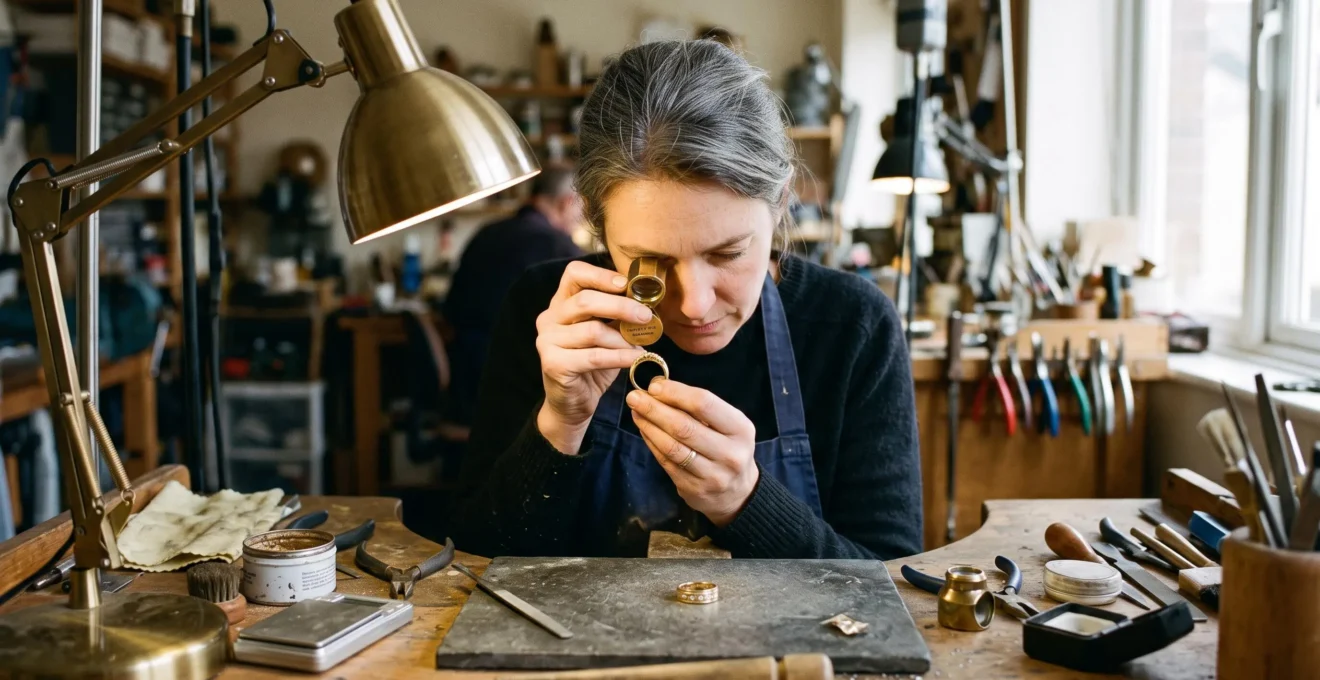
The best precious metal for everyday jewellery is not necessarily the purest, most expensive or shiniest. A ring worn through commuting, handwashing and household tasks faces different demands from earrings worn for a few hours. Gold fineness, alloy composition, construction and surface finish all influence how a piece looks and feels after repeated wear.
For many UK buyers, solid 9ct, 14ct or 18ct gold offers a practical balance of longevity and appearance, although each has trade-offs. Platinum is another strong candidate, particularly for people concerned about certain metal allergies, while sterling silver requires more attention to tarnishing. Gold-plated jewellery can deliver an attractive appearance at a lower initial cost, but its finish is inherently more vulnerable to wear.
Buying intelligently also means understanding what a hallmark proves, recognising skin reactions, avoiding damaging cleaning methods and knowing when professional refinishing is worthwhile. These details matter more to long-term satisfaction than a jewellery counter’s lighting or an impressive product description.
Everyday precious metals: the essentials
- Choose the construction, not just the carat. Solid, well-made gold generally offers greater long-term serviceability than thinly plated or fragile hollow pieces.
- Check the metal and the hallmark. UK hallmarking helps verify precious-metal fineness, but does not guarantee craftsmanship or an allergy-free alloy.
- Maintain gently. Appropriate cleaning and occasional professional inspection preserve appearance without unnecessary polishing or repeated removal of metal.
- Why Does Jewellery Turn Your Skin Green Even When It Looks Like Gold?
- How to Read UK Hallmarks in 60 Seconds So You Don’t Overpay?
- 9ct, 14ct, or 18ct Gold: Which Holds Up Best for Daily Wear?
- The Cleaning Mistake That Dulls Precious Metals After a Few Weeks
- When Should You Re-Polish or Re-Plate Jewellery to Keep It Looking Sharp?
- A Fine Watch or Fine Jewellery: Which Is Easier to Wear Every Day?
- Polished or Brushed Gold: Which Shows Fewer Scratches in Daily Wear?
- How Do Minimalist Gold Pieces Look Luxurious Instead of Plain?
Why Does Jewellery Turn Your Skin Green Even When It Looks Like Gold?
Jewellery usually turns skin green because copper-containing metal reacts with moisture, sweat or substances on the skin, leaving coloured compounds behind. A gold-coloured surface does not necessarily mean the entire piece is gold. Green staining is different from an allergic rash, and distinguishing the two determines whether cleaning, avoiding the material or seeking medical advice is appropriate.
Pure gold is comparatively resistant to corrosion, but jewellery is rarely made from pure gold. Gold alloys contain other metals to modify colour, hardness and workability. Lower-purity gold contains a larger proportion of these additional metals, while inexpensive gold-coloured pieces may consist of a copper-rich base covered by a thin decorative coating.
When copper compounds form on the surface, they can transfer to skin. Moisture, perspiration, cosmetics and repeated friction may make the effect more noticeable. It does not automatically mean a piece is counterfeit: the actual metal composition and the condition of any coating matter.
Green staining and metal allergy are not the same problem. A superficial green mark that washes away without irritation suggests staining. Itching, redness, swelling, blisters or a persistent rash suggest a possible skin reaction, including allergic contact dermatitis.
Nickel is a recognised cause of jewellery-related allergic contact dermatitis. The American Academy of Dermatology advice on nickel allergy identifies jewellery and watches as potential exposure sources and recommends suitable alternatives for sensitive wearers.
Marketing descriptions also deserve scrutiny. Their meanings are not interchangeable:
- Gold tone: describes appearance rather than a verified quantity of gold.
- Gold plated: indicates a gold coating over another material, whose durability depends on the coating and construction.
- Gold vermeil: generally refers to gold-plated sterling silver, although precise product requirements differ between jurisdictions.
- Gold filled: describes a mechanically bonded gold layer, rather than solid gold throughout; its technical specifications should be checked.
- Solid gold: typically means a gold alloy throughout the relevant component, not necessarily pure 24ct gold.
A practical home observation is to wear a piece briefly under normal conditions, then inspect the skin and high-contact points such as the underside of a ring, clasp or pendant bail. Discolouration, coating loss or irritation can prompt further investigation. A few hours without symptoms does not rule out an allergy, however, and an informal wear test cannot establish plating thickness or metal composition.
For sensitive skin, ask the seller about the actual alloy and exposed components, including clasps and earring backs. Stop wearing an irritating item, and seek dermatological assessment for persistent or recurring reactions. The next safeguard is verifying that the precious-metal content matches the sales description.
How to Read UK Hallmarks in 60 Seconds So You Don’t Overpay?
To read a UK hallmark, identify the sponsor’s mark, the metal and fineness mark, and the Assay Office mark. The fineness number tells you the minimum precious-metal content in parts per thousand: 375 means 9ct gold, 585 means 14ct and 750 means 18ct. A complete recognised hallmark offers independent assurance of metal fineness, not overall jewellery quality.
Under the UK’s hallmarking framework, a qualifying precious-metal article generally carries three compulsory marks. The sponsor’s mark identifies the registered person or business responsible for submitting the item. The fineness mark identifies the precious metal and its minimum purity, while the Assay Office mark identifies the office that tested it. Additional marks, including certain convention marks, may appear depending on the article.
The UK government guidance on precious-metal hallmarking explains the compulsory marks, legal exemptions and obligations for qualifying items sold in the UK, including online.
1 gram
The UK hallmarking weight exemption threshold for gold. Qualifying gold articles above this threshold generally require hallmarking, subject to applicable statutory exceptions.
British Hallmarking Council guidance published on GOV.UK.
Here is a quick reference for common fineness marks:
| Fineness mark | Gold designation | Minimum gold content |
|---|---|---|
| 375 | 9ct | 37.5% |
| 585 | 14ct | 58.5% |
| 750 | 18ct | 75% |
| 916 | 22ct | 91.6% |
| 999 | Fine gold | 99.9% |
The corresponding UK weight exemption thresholds are 7.78 grams for silver, 0.5 gram for platinum and 1 gram for palladium. An unhallmarked article below an applicable threshold may therefore be entirely legitimate. Older items and certain other categories can also fall under special provisions.
Do not confuse a standalone stamp with a complete independently tested hallmark. Abbreviations such as GP, GF or HGE may describe plating or bonded-gold construction, but they are not substitutes for the compulsory UK hallmark components. An isolated number, including 800, should not be treated as proof of a UK-assayed gold article.
When uncertain, compare the marks with official Assay Office identification guidance and ask the retailer to explain the article’s status. An unexplained missing hallmark on a non-exempt item advertised as solid precious metal is a reason to withhold payment until the description is verified.
A five-step check before buying gold jewellery
- Identify the construction. Ask whether the item is solid, hollow, plated or bonded gold, and record the seller’s description.
- Find the marks. Inspect the item with a loupe or magnifier and note the symbols or obtain a clear photograph.
- Decode the fineness. Match the number to the declared carat rating and record the corresponding gold percentage.
- Check hallmark requirements. Confirm the item’s weight, relevant exemption status and whether a recognised complete hallmark is present.
- Compare the actual purchase. Request the weight, price and construction details in writing, then compare equivalent pieces before committing.
To avoid overpaying, compare actual gold content rather than retail price alone. For an explicitly hypothetical example, a 4-gram 9ct ring contains a nominal 1.5 grams of gold, while a 4-gram 18ct ring contains 3 grams. Dividing a price by the nominal fine-gold weight provides a rough comparison, but it is not a resale valuation.
Design, labour, gemstones, branding, condition and retail margins can account for substantial differences. A higher price per gram of gold is not necessarily unreasonable when the craftsmanship is demonstrably better.
A hallmark establishes minimum precious-metal fineness within the applicable legal system. It cannot tell you whether a clasp is reliable, a setting is robust or a ring will resist scratches. Those questions require a closer look at alloy choice and construction.
9ct, 14ct, or 18ct Gold: Which Holds Up Best for Daily Wear?
For everyday gold jewellery, 9ct can be practical and relatively affordable, 14ct offers an appealing middle ground, and 18ct provides higher gold content with less room for other alloying metals. None is automatically the most durable. Scratch resistance, deformation, corrosion behaviour and skin compatibility depend on the specific alloy, manufacturing method and design as well as carat rating.
Higher-carat gold contains more gold and less alloying metal. Because pure gold is comparatively soft, alloying can increase strength and hardness. But a 9ct piece is not guaranteed to outperform every 14ct or 18ct piece: the proportions and types of additional metals, as well as processing and heat treatment, influence how it behaves.
The GIA’s comparison of ring materials for everyday wear emphasises that both carat and alloy composition affect gold durability. It identifies 14ct and 18ct as suitable options for many everyday rings while recognising that lifestyle and maintenance requirements vary.
UK buyers also encounter 9ct gold frequently, especially in accessible everyday designs. Its lower gold content can reduce the metal-related component of the initial price. That does not establish superior scratch resistance across all possible alloy formulations.
| Consideration | 9ct gold | 14ct gold | 18ct gold |
|---|---|---|---|
| Gold content | 37.5% | 58.5% | 75% |
| Alloying proportion | Highest of the three | Intermediate | Lowest of the three |
| Everyday suitability | Practical with sound construction | Versatile balance | Suitable with thoughtful design |
| Skin considerations | Check alloy carefully | Check alloy carefully | Check alloy; fewer non-gold metals overall |
| Buying priority | Construction and price | Balance and alloy quality | Gold content and craftsmanship |
Construction matters especially for rings and bracelets, where surfaces regularly touch desks, handles and other hard objects. A substantial, well-finished band is generally easier to maintain than a delicate hollow structure vulnerable to localised dents. However, hollow construction alone is not proof of poor quality: wall thickness, shape and intended use all matter.
Necklaces and earrings usually experience different kinds of strain. A pendant may have relatively little surface friction, but the chain and bail can face repeated pulling. Earrings place greater emphasis on weight, fastening security and the composition of posts or backs.
For sensitive wearers, higher gold content may reduce exposure to certain alloying metals, but 18ct does not automatically mean nickel-free. Ask for a precise alloy description rather than relying on the carat label.
Resale value introduces another trade-off. Higher fineness means greater nominal gold content at the same jewellery weight, yet a resale offer can reflect many factors beyond the metal itself. Condition, demand and whether a piece is sold as jewellery or for its metal content all matter.
Choosing an item solely for theoretical gold recovery value may also produce an inconvenient daily-wear choice. A piece that frequently bends, catches or needs repair may be less useful than a simpler, sturdier alternative.
For rings and bracelets, prioritise comfortable construction, appropriate alloy properties and a reliable maker. For less exposed pieces, colour and gold content may carry more weight. Whatever the fineness, preserving its surface begins with avoiding harmful cleaning habits.
The Cleaning Mistake That Dulls Precious Metals After a Few Weeks
The cleaning mistake most likely to spoil everyday jewellery is treating every metal and finish as though it can withstand aggressive polishing or chemical dips. Abrasive products create fine surface scratches, while unsuitable cleaners can damage coatings, alloys and gemstones. The safest routine starts by identifying the materials, then using the gentlest cleaning method appropriate to them.
A polished metal surface reflects light in a relatively organised way. Repeated rubbing with abrasive material can produce tiny marks that scatter light and make the finish appear less brilliant. For plated jewellery, aggressive treatment may also accelerate the loss of a thin decorative layer.
Strong household chemicals present different risks. The Gemological Institute of America‘s jewellery-care guidance identifies potential damage from substances including chlorine bleach and warns that treatments suitable for one material may be harmful to another.
Particularly cautious handling is appropriate for:
- Gold-plated and vermeil jewellery with potentially vulnerable coatings.
- Opals, pearls and other sensitive or organic gem materials.
- Emeralds or other stones that may have undergone filling or treatment.
- Antique jewellery with unknown adhesives, finishes or earlier repairs.
- Pieces with enamel, deliberate oxidation or delicate surface decoration.
These items should not be placed indiscriminately into chemical dips or ultrasonic cleaners. For an uncertain material, ask the retailer or qualified jeweller for a compatible care method rather than experimenting.
For suitable, securely set, uncoated jewellery, a conservative cleaning sequence is straightforward:
- Check for loose stones, damaged clasps or vulnerable surfaces before applying water.
- Prepare lukewarm water with a small amount of mild washing-up liquid.
- Use a very soft brush gently around accessible surfaces and the underside of sound settings.
- Rinse in a separate container where appropriate for the materials, rather than over an open drain.
- Dry carefully using a soft, lint-free cloth, paying attention to moisture trapped in links and settings.
This method is not universal. Some plated, porous, treated or composite pieces should not be soaked or brushed, even gently. A jewellery polishing cloth may also contain abrasives or chemical treatments, making it inappropriate for some finishes. Use a product specifically compatible with the piece, and avoid polishing plated surfaces unless the manufacturer recommends it.
Sometimes dullness is not tarnish or scratching at all. Sunscreen, hand cream, soap residue and hairspray can accumulate in chain links or around settings, reducing sparkle. Putting jewellery on after cosmetics have dried and removing it before washing or applying products can reduce this build-up.
Gentle maintenance should remove ordinary dirt without repeatedly sacrificing finish material. If cleaning no longer restores the desired appearance, the real issue may be accumulated scratches or worn plating rather than dirt.
When Should You Re-Polish or Re-Plate Jewellery to Keep It Looking Sharp?
Re-polish solid precious-metal jewellery when surface damage is noticeable enough to justify removing a small amount of material. Re-plate jewellery when its coating has worn through or lost its intended appearance. Neither treatment needs a universal calendar schedule. The correct timing depends on the piece’s construction, finish, wear pattern and whether restoration can be performed safely.
Fine scratches on a frequently worn solid-gold ring are ordinary signs of use. They may form a relatively even patina that some owners prefer to a newly polished finish. Restoring a mirror surface can improve appearance, but mechanical polishing removes material and may gradually soften sharp edges, engraving or precise decorative features.
Re-plating addresses a different problem. White-gold jewellery with a rhodium finish can gradually reveal the underlying alloy colour as the coating wears. Gold-plated silver or base-metal pieces may expose a contrasting substrate at clasps, edges and other high-friction areas.
Applying a new compatible coating can restore the intended appearance, provided the underlying item is structurally sound and suitable for treatment. The new layer will also be subject to wear. How long it lasts depends on factors including coating characteristics, surface preparation and use.
Professional polishing is not automatically suitable for all designs. Oxidised recesses, blackened surfaces, enamel, distinctive brushed textures and delicate gemstone settings may require specialist techniques or deliberate preservation of the original finish.
Before authorising work, ask the jeweller to inspect the item and clarify:
- Whether the proposed treatment removes base metal or applies a coating.
- Which surface details and original finishes will be preserved.
- Whether gemstones, adhesives or existing repairs create treatment risks.
- Whether the service addresses appearance alone or also includes necessary structural repairs.
Consider restoration before purchasing, too. A well-made solid-gold piece may tolerate repeated careful maintenance, while a heavily detailed plated item may be difficult to restore economically or consistently. Re-plating can be worthwhile, but treating it as permanently renewing the jewellery would be misleading.
Costs cannot be judged from metal type alone. Surface area, preparation, coating requirements, stone protection and the jeweller’s assessment all influence the quote. Compare the proposed work with the remaining usefulness and personal significance of the piece.
Preserving a good piece often means intervening less, but choosing the right intervention when needed. This balance becomes especially apparent when comparing fine jewellery with another accessory intended for years of regular use: a mechanical watch.
A Fine Watch or Fine Jewellery: Which Is Easier to Wear Every Day?
Well-constructed solid-gold jewellery is generally simpler to maintain mechanically than a fine watch because it contains no movement requiring periodic servicing. A watch offers timekeeping and functionality, but its movement, seals, crown and bracelet introduce additional maintenance considerations. Neither is automatically easier to wear: physical activity, water exposure, skin sensitivity and design can change the practical answer.
A straightforward solid-gold band or pendant has no internal mechanism, although clasps, hinges, links and gemstone settings can still fail or wear. A mechanical watch contains numerous interacting components, while electronic watches have different maintenance and power requirements.
Water resistance also requires context. A watch’s stated rating is not a permanent guarantee against every kind of exposure. Seal condition, age, impacts and servicing history matter, so the manufacturer’s instructions should govern activities involving water.
A watch typically stays pressed against the wrist for extended periods. Sweat, warmth and limited airflow under the case or bracelet can aggravate discomfort, particularly where a wearer is sensitive to exposed metals. Coated components may also wear at contact points.
The following comparison helps distinguish ownership needs:
| Daily factor | Fine watch | Fine jewellery |
|---|---|---|
| Mechanical upkeep | Depends on movement and manufacturer guidance | Usually limited to clasps, links and settings |
| Skin contact | Prolonged wrist contact | Varies with the piece and its fit |
| Water exposure | Depends on the maintained resistance rating | Depends on metal, coating and gemstones |
| Impact risks | Case, crystal, movement and bracelet | Deformation, scratches and fastening damage |
| Typical maintenance | Cleaning, inspection and possible servicing | Cleaning, inspection and occasional repair or refinishing |
For desk-based routines, a simple pendant or small earrings may experience relatively little abrasion, while a watch bracelet or case can repeatedly contact a desk. But a dangling necklace could be inconvenient during certain physical tasks, whereas a securely fitted watch might be easier to manage.
Manual work, sport and other activities introduce both impact and entanglement risks. Removing jewellery or watches when the activity demands it is often more sensible than expecting a luxury material to survive every environment.
The total cost of ownership therefore matters more than purchase price alone. Jewellery may need fastening repairs, resizing or refinishing. Watches may need servicing, battery replacement, seal checks or component repairs, depending on their design and use.
A useful comparison is the effort and expense realistically expected over the ownership period, rather than an unsupported assumption that one category always costs less. Manufacturer information and an item-specific service estimate provide a sounder basis for that decision.
Once the form of accessory is settled, appearance becomes a practical consideration. Even within the same gold alloy, surface finishing can dramatically change how visible ordinary wear becomes.
Polished or Brushed Gold: Which Shows Fewer Scratches in Daily Wear?
Brushed gold often makes fine everyday scratches less noticeable because its directional texture visually blends minor marks into the existing surface. Mirror-polished gold reflects light more evenly, so hairline scratches can stand out. The finish does not itself change the underlying alloy’s hardness; it changes how wear is seen and how the surface can be restored.
A mirror finish requires a comparatively smooth surface. When minor scratches interrupt that surface, they reflect or scatter light differently from the surrounding metal. This contrast makes them conspicuous under direct lighting, especially on broad ring bands or bangles.
A brushed or satin finish already contains a controlled pattern of small lines. New scratches running in a similar direction may be less obvious, but deeper marks or scratches crossing the original grain can still stand out.
The difference is optical, not an assurance that brushed gold physically resists damage better. A sharp impact can dent either finish, and a heavily abraded satin surface can lose its original uniformity.
Maintenance is the important compromise. A suitable polished solid-metal surface may be refreshed professionally, while recreating a consistent brushed texture requires the correct direction, abrasive technique and treatment of adjacent edges. Attempts to re-brush at home can leave uneven patches or alter the original design.
Some pieces deliberately combine brushed and polished zones. A bracelet might use satin finishing on broad contact surfaces and polished accents along protected edges. This approach creates visual contrast while potentially making everyday wear less conspicuous in areas most likely to touch other objects.
Brushed surfaces may also retain oils or cosmetic residue within their texture. This does not mean they inevitably become dirty faster, but some finishes benefit from careful cleaning to maintain their intended appearance. Avoid scrubbing against the grain or using household abrasives.
When comparing similar rings, inspect the finishes under both diffuse light and directional lighting. Imagine where the jewellery will contact desks, door handles or other items, and consider whether future restoration would preserve the design.
The most useful finish is one whose appearance and maintenance demands match actual wear. This principle also helps explain why the simplest gold designs can sometimes appear more refined than elaborate jewellery.
Key takeaways before choosing a minimalist piece
- Assess proportions, edge finishing and fastening quality rather than relying on sparkle or the apparent size of the item.
- Check whether the construction provides sufficient substance for its intended use, particularly where a piece looks substantial but feels unusually light.
- Consider whether the metal, surface finish and design will remain attractive without frequent specialist intervention.
How Do Minimalist Gold Pieces Look Luxurious Instead of Plain?
Minimalist gold jewellery looks luxurious when its proportions, finish and construction are deliberately refined. Even surfaces, clean transitions, precise joins and a comfortable sense of substance distinguish a considered design from a merely simple shape. For everyday wear, restrained detailing can also reduce snagging and make cleaning easier, provided the underlying piece is well constructed.
Minimalism places unusual emphasis on execution. A heavily ornamented piece can divert attention from small manufacturing imperfections, while a plain band or pendant exposes its edges, symmetry and polish. Minor inconsistencies become easier to notice when there are few other features competing for attention.
At the counter, inspect the piece from several angles. Look for consistent surface finishing, neat joins and a clasp that operates smoothly. Check whether decorative elements are secure and whether the jewellery sits naturally against the body.
Weight should be assessed alongside construction, not mistaken for an absolute quality score. Hollow pieces can achieve a substantial appearance with less material, which may make larger designs more comfortable or affordable. But thin-walled construction can also introduce vulnerability to dents, especially in exposed bracelets and rings.
Two pieces can look almost identical in a photograph while differing in metal thickness, internal construction and repairability. Handling the jewellery and asking how it is made provide information that online product images cannot.
A hallmark helps establish precious-metal fineness where applicable, but not whether the piece is hollow or solid throughout. Confirm both the hallmark and the seller’s construction description before comparing prices.
Styling also affects perceived quality. A fine chain with one carefully proportioned pendant creates a clear focal point. A restrained collection of rings can achieve a coherent look through related dimensions and surface treatments.
Mixing metal tones or finishes is not inherently unattractive. However, combinations appear more deliberate when there is a consistent relationship between scale, spacing and texture. A small number of considered contrasts can be more convincing than many unrelated details competing for attention.
For longevity, simple forms can have practical advantages. A smooth band has fewer recesses than an elaborate setting, and a straightforward pendant may be easier to inspect and clean. Yet a minimalist design with an excessively thin chain or weak fastening can still be fragile.
Solid gold offers the additional advantage of not relying on a thin decorative gold coating for its fundamental colour. High-quality vermeil may be an appealing alternative for someone comfortable with eventual coating maintenance, but frequent friction and continuous exposure will still influence how the finish ages.
Luxury and practicality are therefore not opposing goals. A carefully made piece can look refined precisely because its design accommodates ordinary use, rather than requiring its owner to protect every detail continuously.
Choose a piece you can inspect, understand and realistically maintain. Check its hallmark where required, ask about alloy and construction, examine the fastening and consider your actual daily activities. A lasting purchase is one whose appearance, comfort and maintenance requirements remain convincing after the initial shine has faded.
Is platinum better than gold for sensitive skin?
Platinum jewellery may be a suitable alternative for people with certain metal sensitivities, including nickel allergy, but suitability depends on the complete alloy and every component touching the skin. Gold can also be appropriate, particularly when its composition is known. Neither material should be described as universally allergy-proof.
Can sterling silver be worn every day?
Yes, sterling silver can be suitable for regular wear, particularly in sturdy designs. It may tarnish through surface reactions with substances in the environment, so some maintenance is likely. Remove it when an activity risks impact, chemical exposure or damage, and use cleaning methods compatible with any stones or coatings.
Does a UK hallmark mean jewellery is solid rather than hollow?
No. A recognised hallmark certifies the relevant precious-metal fineness under the applicable hallmarking framework. It does not guarantee a particular wall thickness, solid-filled construction, mechanical strength or craftsmanship. Ask separately whether a piece is hollow, solid throughout the relevant component or made using another construction method.
Is white gold naturally white, or does it always need rhodium plating?
White gold is an alloy whose colour depends on its composition. Some white-gold jewellery receives rhodium plating for a brighter, more reflective white finish, but plating is not a universal requirement. If a piece is rhodium-plated, the coating may eventually wear and professional re-plating may be needed to restore the original appearance.
Should everyday jewellery be removed before showering or swimming?
Removing jewellery is generally prudent, especially if it is plated, contains sensitive gemstones or has vulnerable settings. Soap residues can accumulate, while pool chemicals may damage certain gold alloys and other materials. Water activities also increase the risk of losing loosely fitted jewellery. Solid precious metal does not make every attached stone, coating or fastening water-resistant.