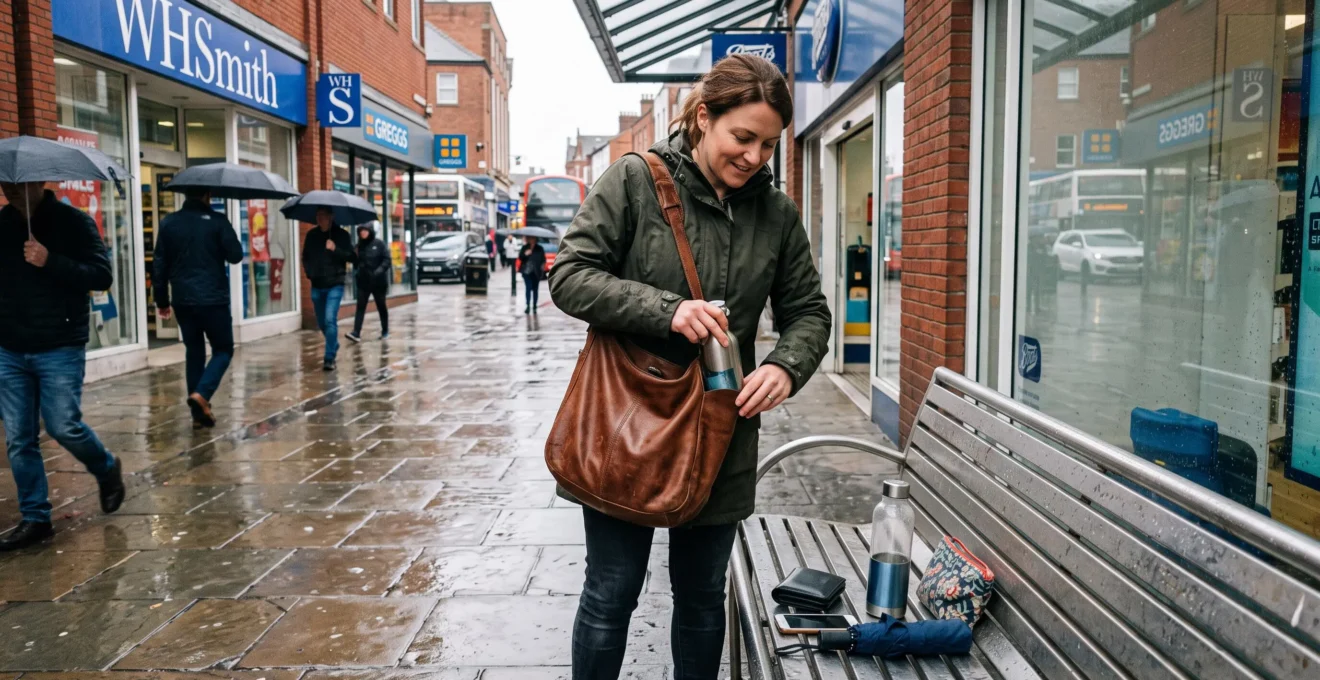
A handbag can look perfectly proportioned in a shop mirror yet become uncomfortable halfway through a commute. The difference usually emerges when the bag is filled with a laptop, charger, water bottle, umbrella and everything else required for an ordinary working day.
For UK professionals, choosing an everyday handbag involves more than matching leather colours or following seasonal silhouettes. It means considering how the bag behaves on crowded trains, whether its closure protects valuables, how securely it holds a laptop and whether its materials can withstand repeated use and unpredictable weather.
The most useful buying criteria are therefore practical: loaded carrying comfort, usable internal capacity, secure access, reliable construction and realistic maintenance requirements. These features are interconnected. A larger bag encourages extra packing; extra packing increases carried weight; an unsuitable strap can make that weight uncomfortable.
Evaluating a handbag against an actual weekly routine, rather than an imagined ideal day, makes it easier to distinguish a useful investment from an attractive purchase that rarely leaves the wardrobe.
What matters most when choosing an everyday handbag
- Test the loaded bag: Shoulder comfort depends on the contents, carrying method, strap design and individual fit, not merely the empty weight.
- Buy for your real essentials: Measure what you carry, especially laptops, and choose an accessible, secure interior instead of unnecessary capacity.
- Judge quality over appearance: Inspect stitching, closures, stress points, repairability and storage requirements before paying a premium.
- Why Can a “Light” Handbag Still Hurt Your Shoulder After 20 Minutes?
- How to Choose the Right Handbag Size Using a 10-Item Carry List?
- Zip-Top or Open-Top: Which Is Safer on the Tube Without Being Annoying?
- The Trendy Handbag Shape That Becomes Useless After 2 Weeks
- A 3-Bag Rotation That Cuts Visible Wear and Tear by 50%
- How to Choose a Tote That Fits a 13-Inch or 15-Inch Laptop Without Shoulder Pain?
- How to Check Luxury Accessory Quality in 8 Points Before You Leave the Shop?
- What Actually Defines Luxury in Accessories When Logos Don’t Impress Anyone Anymore?
Why Can a “Light” Handbag Still Hurt Your Shoulder After 20 Minutes?
A handbag that feels light when empty can become uncomfortable during a commute because the weight of its contents is concentrated through its strap and carried for a prolonged period. Narrow straps, uneven loading, poor fit and limited opportunities to change carrying positions may contribute to discomfort. The twenty-minute mark is illustrative, not a scientifically established threshold.
Consider two handbags carrying identical everyday essentials. One has a narrow chain strap resting on a small area of the shoulder. The other has a wider, padded strap that remains comfortably positioned while walking. The total load may be identical, but the pressure at the contact point and the way each person responds to it can feel very different.
Weight distribution does not make total weight irrelevant. A wide strap may reduce concentrated pressure, but it cannot remove the load imposed by a heavy laptop and other belongings.
Leeds Community Healthcare identifies carrying heavy bags as one possible contributor to discomfort in the upper and middle back, alongside factors such as prolonged desk work and inactivity. Its NHS information on mid and upper back problems also describes symptoms around the shoulders and neck. This does not establish a handbag-specific weight limit or prove that a particular strap design prevents pain.
A rigid leather body can keep belongings organised but may press awkwardly against the torso. A soft, slouchy construction can conform more easily to the body yet allow heavy objects to collect at one end. Neither structure guarantees comfort: the position of the contents and the strap attachment points matter.
For a meaningful shop-floor comparison, weigh the empty bag first, then fill it with the objects normally carried to work. Walk around for ten to fifteen minutes where practical, switching between a shoulder carry and a crossbody option if the design permits. This is a personal comfort assessment, not a validated clinical test.
Pay attention to slipping straps, pressure marks, tension in the neck and whether the bag swings excessively. Test it over the coat or jacket normally worn during colder UK months; an apparently suitable strap drop may become restrictive over winter clothing.
Decorative hardware also deserves scrutiny. Heavy clasps, chain handles, metal feet and thick structural components can add weight before the bag contains anything useful.
Persistent or significant shoulder pain deserves individual assessment rather than assuming that changing handbags will resolve it. For an ordinary buying decision, the next priority is determining how much space daily essentials genuinely require.
How to Choose the Right Handbag Size Using a 10-Item Carry List?
The most reliable way to choose handbag size is to lay out ten items regularly carried, measure their actual dimensions and compare them with the bag’s usable interior. This prevents choosing by external width alone, which can exaggerate capacity. A well-sized handbag accommodates everyday essentials without creating unnecessary space that encourages additional weight.
Start with a representative working day rather than a holiday, shopping trip or unusually demanding Monday. A practical UK commuter’s sample list might contain:
- Phone.
- Wallet or card holder.
- Keys.
- Laptop or tablet.
- Charging cable and power adaptor.
- Compact umbrella.
- Reusable water bottle.
- Small personal-care pouch.
- Headphones.
- Travel card, access pass or compact notebook.
Replace anything irrelevant with your genuine essentials. A laptop is not necessary for every professional, while a parent may need additional personal items and someone who travels by car may have fewer reasons to carry everything throughout the day.
Place the objects together as they would sit inside a bag. Measure the longest and tallest rigid items, then check the combined footprint of everything else. Do not assume that a manufacturer’s exterior measurements represent usable internal space. Thick walls, internal divisions, narrowing sides and closure placement can all affect what actually fits.
The opening matters as much as the base. A tablet might technically fit inside a bag yet be impossible to insert comfortably through a narrow zip opening.
Different routines favour different capacities:
| Daily routine | Most useful capacity | Common mistake |
|---|---|---|
| Public-transport commuter | Essentials, travel accessories and necessary work equipment | Buying an oversized tote for occasional extras |
| Car-based professional | Compact or medium bag for items needed outside the vehicle | Carrying everything between every stop |
| Parent combining work and errands | Flexible compartments for changing daily needs | Ignoring access and organisation |
| Evening or social use | Phone, keys, payment essentials and personal items | Choosing unnecessary laptop-sized capacity |
An umbrella, reusable coffee cup or additional jumper may be useful occasionally, but sizing a daily handbag around every possible contingency can make normal journeys less comfortable. If extra capacity is needed only sometimes, a separate lightweight carrier may be more practical.
Your five-step handbag sizing test
- Write down your ten genuine daily essentials. Deliverable: a personal carry list.
- Measure the longest, widest and tallest rigid objects. Deliverable: a recorded set of dimensions.
- Arrange everything as a realistic packed load. Deliverable: a photograph of the complete load.
- Compare the load with the bag’s internal base, height and opening. Deliverable: a fit assessment showing any problem items.
- Carry the loaded bag and retrieve three frequently used objects. Deliverable: a final comfort-and-access decision.
The best dimensions are those that accommodate the normal load with enough room to retrieve items easily. Once capacity is settled, access and security become the next decisive considerations.
Zip-Top or Open-Top: Which Is Safer on the Tube Without Being Annoying?
A zip-top handbag is generally the more sensible choice for crowded Tube journeys because it creates an additional barrier between valuables and opportunistic access. An open-top tote offers quicker retrieval but leaves its contents more exposed. The practical compromise is a secure main compartment combined with a convenient, carefully positioned pocket for frequently used items.
The Metropolitan Police recommends keeping bags securely closed and carrying them in front of the body or diagonally across the chest. Its advice on preventing pickpocketing also makes clear that a zipped bag does not eliminate theft risk.
For commuters, closure design should be evaluated according to the situations in which the bag is actually used. Standing in a busy carriage presents different challenges from driving directly to an office.
| Closure | Practical advantage | Main limitation |
|---|---|---|
| Full zip-top | Contents remain enclosed while travelling | Opening can be slower and awkward when overpacked |
| Open-top | Immediate visibility and access | Greater exposure of accessible belongings |
| Magnetic flap | Convenient opening with partial coverage | May open when pressed or heavily loaded |
| Drawstring | Adjustable opening that can gather around contents | May leave gaps or loosen |
| Fold-over design | Conceals the opening without always requiring a zip | Security depends on the flap’s actual fastening |
| Open tote with zipped internal pocket | Separates protected valuables from easy-access contents | Other objects remain exposed |
A particularly important detail is where a pocket sits. An exterior pocket facing away from the wearer may be easy to reach without the owner noticing. Interior zipped pockets can provide a more protected place for a wallet, although depth, opening direction and visibility still matter.
The challenge is maintaining convenient access during a fast-moving commute. Searching through a tightly zipped compartment every time a payment card is needed can become irritating.
A practical organisation method is to reserve one accessible, body-facing compartment for the travel card or another frequently used item, while keeping the wallet and other valuables inside the secured main section. A phone should not be left exposed simply because it is frequently needed.
On crowded services, carrying the bag where it remains visible and maintaining control of its opening are sensible habits regardless of closure type. A secure zip is a useful design feature, not a substitute for attention to belongings.
A handbag should support the way its owner moves, pays and accesses belongings, without repeatedly requiring workarounds. That principle also reveals why some fashionable shapes quickly lose their appeal.
The Trendy Handbag Shape That Becomes Useless After 2 Weeks
A fashionable handbag becomes impractical when its shape prevents it from performing everyday tasks. Oversized slouchy bags may bury essentials, rigid crescent designs can restrict usable space, and micro bags often cannot accommodate a normal carry list. Two weeks is a useful trial period for identifying frustrations, not an established lifespan for any particular trend.
A bag can look balanced in a photograph because it is empty or contains only a few carefully arranged objects. Once loaded with everyday essentials, its shape may change dramatically. The strap might pull at an awkward angle, the opening may become difficult to close or belongings might collect in one inaccessible corner.
Rather than treating particular silhouettes as inherently defective, examine the specific construction.
- Oversized slouchy bags: Check whether the base retains enough structure to locate contents and keep heavy objects from sliding around.
- Rigid crescent bags: Check the actual opening width and whether rectangular objects fit without awkward positioning.
- Micro bags: Decide whether their restricted capacity genuinely matches the intended occasion.
- Hand-held sculptural bags: Consider the inconvenience of occupying one hand during walking, shopping or commuting.
- Unadjustable shoulder bags: Test the fixed strap length with different clothing and outerwear.
One attractive purchase can fail for several reasons at once. For example, a narrow-opening crescent bag might fit a phone and wallet perfectly but make it frustrating to retrieve an umbrella or small pouch. A very large soft tote may accommodate everything yet feel unstable during a long walk.
Evaluate a potential purchase against repeated use rather than a single fitting-room impression. Over a suggested two-week trial, record whether the bag:
- Holds the complete everyday carry list without distortion.
- Allows comfortable walking and boarding public transport.
- Fits appropriately beside a desk or on a train seat without obstructing others.
- Protects contents adequately during ordinary rainy conditions.
- Maintains convenient access to frequently used objects.
If the bag cannot be trialled at home under the retailer’s return conditions, conduct realistic tests in the shop before making the purchase.
The solution is not to avoid trends altogether. It is to identify which functional characteristics are non-negotiable. A contemporary curved silhouette can work well if its opening is generous, its strap adjusts comfortably and its base accommodates necessary belongings.
Style deserves a place in a buying decision, but practical frustrations tend to become more noticeable through repetition. A useful rotation can make room for occasional statement pieces without forcing them to handle every commute.
A 3-Bag Rotation That Cuts Visible Wear and Tear by 50%
Rotating three handbags can spread repeated handling, loading and environmental exposure across different items, potentially reducing the rate at which one bag develops visible wear. However, there is no established evidence here that a three-bag rotation cuts wear by exactly 50%. The outcome depends on the materials, carrying habits, storage conditions and frequency of use.
A handbag used every working day experiences repeated contact at familiar points: handles, strap attachments, bottom corners and areas that rub against clothing. Changing bags can reduce the number of occasions on which the same surfaces are exposed to friction or loading.
Rest days do not automatically reverse creasing, and leather cannot be assumed to recover fully simply because the bag is left unused. The more defensible benefit is spreading exposure and providing opportunities for inspection, cleaning and appropriate storage.
Instead of buying three fashionable alternatives with overlapping purposes, organise a rotation around distinct activities.
| Role | Suitable characteristics | Main use |
|---|---|---|
| Everyday commuter | Secure closure, comfortable straps, organised capacity | Office journeys and regular public transport |
| Lightweight smart bag | Compact essentials storage, polished construction | Meetings, evenings and lighter working days |
| Weather-ready or high-capacity bag | Material suited to expected conditions and flexible storage | Wet journeys, weekends and travel |
Storage practices matter as much as deciding which bag to wear. The Canadian Conservation Institute explains that excessive heat, strong light and unsuitable humidity can damage certain types of leather. Its guidance on leather care and preservation recommends protecting leather objects from environmental extremes.
Although this guidance concerns conservation rather than a modern handbag rotation experiment, its basic principles support keeping appropriate leather bags away from direct sunlight, radiators and damp storage areas.
Empty bags before putting them away. Leaving a laptop, bottle and charger inside can subject handles and panels to continued loading. Where suitable, use clean, non-abrasive filling to support the silhouette, without stretching it. A breathable protective dust bag can help keep dust off, provided the bag is clean and dry.
Follow care instructions for the actual material: a coated textile, suede finish and vegetable-tanned leather should not automatically receive the same treatment.
A second bag is not necessarily a sound investment if an existing bag already meets every practical need and shows little deterioration. Purchasing inexpensive filler bags merely to create a rotation can generate additional cost and storage demands without meaningful benefit.
For professionals carrying heavier work equipment, the greatest improvement may come from choosing a dedicated laptop-carrying design rather than simply buying another similar shoulder bag.
How to Choose a Tote That Fits a 13-Inch or 15-Inch Laptop Without Shoulder Pain?
Choose a laptop tote by measuring the actual computer and protective sleeve, then comparing those dimensions with the bag’s usable internal length, height, depth and opening. A 13-inch or 15-inch label describes the laptop screen category, not its exterior dimensions. Comfort also depends on the combined carried weight, strap design and duration of the commute.
Two laptops advertised with the same screen size can have different chassis dimensions. Bezels, body proportions and protective accessories alter the space required. A tote described as suitable for a 15-inch laptop should therefore be checked against the exact device rather than accepted on the basis of a marketing label.
Measure the laptop’s width, depth and thickness. Repeat the measurements with its sleeve or folio fitted. Compare the result with the tote’s internal dimensions, allowing enough clearance to insert and remove the laptop without forcing the opening.
The laptop must fit through the opening as well as inside the compartment. A wide base is not sufficient when a restrictive zip or tapered upper section prevents easy access.
Protection requires more than a decorative padded divider. Look for:
- A sleeve or compartment that limits excessive laptop movement.
- Padding that provides meaningful separation from external contact.
- Some protection beneath the laptop rather than a thin fabric layer against the base.
- Side walls that help prevent the device from striking other carried objects.
- A secure closure that keeps the laptop contained during normal movement.
A raised or suspended compartment can help reduce direct contact between the device and the surface beneath the bag. Check this physically rather than assuming that the words “padded laptop pocket” imply comprehensive impact protection.
The next consideration is the complete weight equation: laptop, sleeve, charger, work documents, other essentials and the empty tote itself. Thick leather and substantial hardware may create a considerable starting load.
Test the strap drop over normal commuting clothing. The tote should remain stable rather than repeatedly sliding off the shoulder or swinging against the hip. Wide, comfortable straps can improve the experience, while an adjustable crossbody option may provide additional carrying flexibility.
For a daily 15-inch laptop commute involving significant walking or standing, a conventional shoulder tote may simply be the wrong design. A well-fitted backpack with two shoulder straps can offer a more practical alternative, particularly when the complete load feels uncomfortable.
Also consider the realities of trains and the Tube: the bag should be manageable in narrow spaces, easy to hold close to the body and capable of keeping the computer protected when placed down. Avoid allowing a laptop tote to swing freely through a crowded carriage.
Once the required dimensions, protection and carrying method are established, construction quality becomes much easier to evaluate objectively.
How to Check Luxury Accessory Quality in 8 Points Before You Leave the Shop?
Inspect a luxury handbag by examining eight construction details: stitching, edge finishing, lining, hardware, zips, leather, base construction and strap attachments. These checks reveal potential weaknesses that photographs and brand reputation cannot establish. No single feature guarantees durability, so the aim is to identify consistent workmanship and defects before accepting the actual bag.
A useful inspection can be completed in approximately ten minutes, although complex designs may require longer. Examine the product that will be purchased, not just the pristine display sample.
- Stitching: Look for reasonably consistent stitches, secure ends and seams without obvious gaps or loose threads. Stitch density alone is not a universal quality test; it must suit the material and construction.
- Edge finishing: Examine exposed edges for uneven coatings, separation, cracking or rough transitions. Flexible areas deserve particular attention because repeated bending can expose weaknesses.
- Lining: Check whether the material is properly attached, whether pockets are securely finished and whether the lining bunches excessively when objects are inserted.
- Hardware: Inspect clasps, rings and buckles for clean finishing, secure fitting and smooth operation. Hardware weight or sharp engraving alone cannot establish material quality or durability.
- Zips: Open and close the bag repeatedly without forcing it. Check for snagging, misalignment, exposed sharp edges and fabric catching in the mechanism. A familiar component brand is not a substitute for testing.
- Leather: Examine the surface for unexpected damage, inconsistent finishing or vulnerable areas. Natural grain variation is not necessarily a defect, and smell cannot reliably establish leather quality or authenticity.
- Base and feet: Check whether the bag stands as intended and whether corner construction is consistent. Metal feet can reduce some direct surface contact but cannot prevent all bottom-corner wear.
- Strap attachments: Inspect stitching, rivets and reinforced panels at the points supporting the load. Gaps, loose components or visible damage warrant closer examination.
These checks are practical observations, not a laboratory durability test. A bag can pass an initial inspection yet develop problems later, while minor natural characteristics can be entirely consistent with well-made leather goods.
In the UK, purchase decisions should also consider the retailer’s terms, any manufacturer warranty and statutory consumer protections. Section 9 of the Consumer Rights Act 2015 establishes satisfactory quality as a legal requirement for goods covered by the legislation. Relevant aspects can include appearance, finish, freedom from minor defects and durability.
The Consumer Rights Act 2015, section 9 provides a more meaningful legal reference than treating a high retail price as proof of superior quality. The linked text is a point-in-time legislative version; it should not be interpreted as a complete statement of every consumer remedy or current legislative change.
Ask the retailer how defects are handled, whether repair services are available and which return conditions apply to the purchase. Distinguish voluntary guarantees from statutory rights rather than assuming they are interchangeable.
A receipt can help establish purchase details. An authenticity card or branded packaging may be relevant supporting material, but neither automatically guarantees resale value or independently proves authenticity.
Finally, price positioning should not override observable quality. An expensive handbag may have weaknesses, while a mid-priced alternative may offer excellent construction in the areas most relevant to daily use.
That inspection leads to a broader question: if craftsmanship, repairability and everyday usefulness can be assessed directly, what does a luxury label really add?
Key takeaways before deciding what luxury means
- Comfort and practical suitability should be established before evaluating prestige or price.
- Durability depends on construction, materials, conditions of use and maintenance, not branding alone.
- Repair options and realistic frequency of use help determine whether a higher purchase price offers lasting value.
What Actually Defines Luxury in Accessories When Logos Don’t Impress Anyone Anymore?
Luxury in accessories can be judged through material suitability, reliable construction, repairability, comfort and enduring usefulness rather than logos alone. Branding may still carry design, heritage or social value, but a handbag earns practical long-term value when it consistently performs its intended role and remains serviceable through repeated use.
There is an important distinction between status luxury and utility luxury. Status luxury emphasises recognisability, exclusivity and symbolic value. Utility luxury prioritises how well an object works, how its materials perform and whether the owner can maintain it over time.
The two are not mutually exclusive. A recognisable designer bag can also be beautifully engineered and practical. Equally, a relatively discreet product may be expensive without being especially durable.
Materials should be evaluated in relation to their intended use. Full-grain leather may develop a distinctive patina in appropriate conditions, but it is not automatically superior to every protected or coated leather. Some coated surfaces provide useful resistance to everyday marks, while others may eventually crack or become difficult to restore.
Construction and maintenance options help separate initial appearance from long-term ownership. Look for replaceable straps, accessible hardware, professionally repairable seams and edges, and clear guidance on servicing. These are practical advantages when the relevant repair work is genuinely available and economically reasonable.
The same principle applies to hardware. An attractive clasp has limited value if it becomes unreliable and cannot be replaced. Likewise, beautiful leather does not compensate for an uncomfortable handle on a bag carried for hours each week.
Purchase price should also be considered alongside actual use. A simple cost-per-wear calculation offers a useful personal comparison:
Cost per wear = (purchase price + maintenance and repair costs − estimated residual value) ÷ total number of uses.
The residual value term should be included only when resale is genuinely anticipated, and it remains uncertain until an actual sale. Otherwise, calculate the cost using purchase and maintenance expenses without assuming a resale return.
Hypothetical example: comparing two handbag purchases
Imagine one professional buys a £600 handbag and uses it 300 times, with no repair costs and no assumed resale value. Its illustrative cost per wear is £2. Another bag costs £240 but is used only 40 times, giving an illustrative cost per wear of £6.
These invented figures demonstrate the calculation, not actual product performance or market prices. The more expensive bag produces a lower cost per wear in this example solely because it is used much more often. The calculation does not measure comfort, craftsmanship or environmental impact.
Resale value, warranty provision and access to repairs may affect a purchase decision, but none should be assumed without examining the actual product and the seller’s terms. A repairable handbag does not necessarily cost less over its lifetime if the repairs are prohibitively expensive.
The most useful question is not whether a logo impresses other people. It is whether the bag makes repeated journeys easier, protects necessary possessions, withstands the intended conditions and remains worth maintaining.
That judgement brings together the practical criteria established throughout the buying process: loaded comfort, usable dimensions, closure security, appropriate silhouette, sensible rotation, laptop protection and construction quality.
For the next handbag purchase, bring the actual carry list, check the internal dimensions, try the loaded bag and inspect its construction before comparing brands. A handbag that continues to work comfortably through ordinary UK days offers a more meaningful form of luxury than appearance alone.
Should an everyday handbag be leather or a synthetic material?
The choice depends on expected exposure to rain, handling, abrasion and maintenance. Different leathers and synthetic materials vary considerably in finish, structure and care requirements. Examine the specific material and its manufacturer’s guidance rather than assuming that one category is always more durable or weather-resistant.
Can a handbag replace a backpack for a daily office commute?
It may be suitable when the daily load is manageable and the carrying arrangement feels comfortable. If a large laptop and several heavy accessories are transported over long walking distances, a well-fitted backpack may be a more practical choice. Test the complete load rather than deciding by bag category alone.
Is an expensive handbag automatically more durable?
No. A higher price does not guarantee better stitching, reliable hardware, suitable materials or repairability. Inspect the actual construction and consider the intended use. In UK consumer purchases covered by the Consumer Rights Act 2015, satisfactory quality includes considerations extending beyond brand reputation.
How can a leather handbag be protected during wet UK weather?
Check the manufacturer’s material-specific water-care instructions before using any protective treatment. Avoid assuming that every leather finish tolerates the same products or degree of moisture exposure. After incidental wetting, follow the recommended drying method and avoid exposing the bag to direct radiator heat. For frequent heavy rain, a bag designed for those conditions may be more appropriate.
How often should an everyday handbag be replaced?
There is no universal replacement interval. Inspect handles, straps, seams, closures and any laptop-protective components periodically. Repair may be preferable when deterioration is localised and the work is feasible. Replacement becomes more reasonable when the bag no longer carries belongings securely, cannot be repaired economically or no longer suits the owner’s daily requirements.