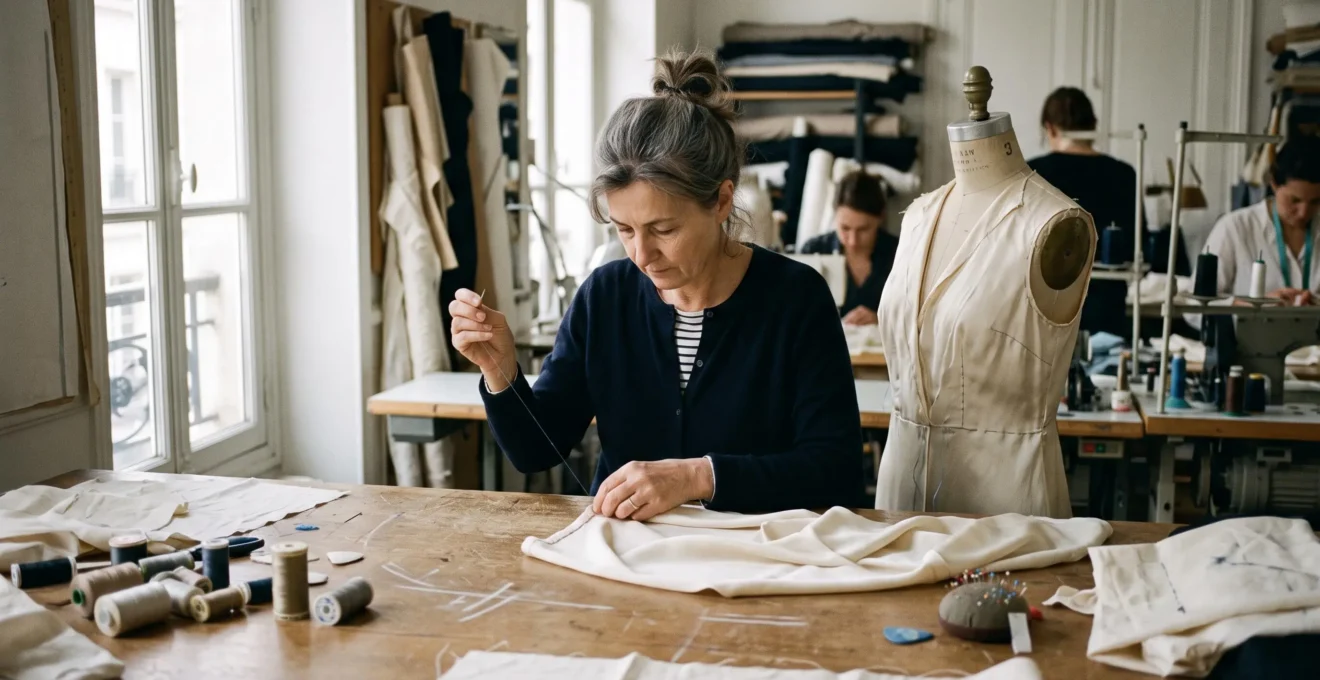
A couture garment is worth its hours when the work produces something that cannot be judged by appearance alone: a more individual fit, carefully controlled structure, considered fabric behaviour and finishing suited to the design. The price reflects not simply the number of stitches or the prestige of a label, but also specialist skills, prototype development, repeated fittings and the decisions required to make a particular garment work on a particular body.
For a UK client considering a couture dress for a wedding, gala or other important occasion, the distinction matters. A beautifully finished ready-to-wear dress may be the better purchase for a straightforward fit and a limited budget. Couture becomes more compelling when individual proportions, complex construction or a distinctive design justify the additional investment.
The important question is therefore not whether every couture technique is superior to machine production. It is whether the hours have been spent solving real design, fit and construction problems. Understanding the work behind the garment makes it easier to assess the likely benefits, discuss expectations with an atelier and decide whether the final result justifies the cost.
What the hours of couture actually buy
- Individualised pattern development, prototype testing and fittings that refine fit and comfort.
- Construction and finishing choices that influence support, durability, fabric behaviour and the garment’s appearance in motion.
- Specialist labour and a more involved schedule, whose value depends on the design, the client and the quality of execution.
- Why Do Couture Finishes Take So Long Even When You Can’t See Them From Far Away?
- How Does a Couture Garment Go From Sketch to Final Fitting in Real Life?
- Couture or High-End Ready-to-Wear: Which Gives a Better Fit Without Endless Alterations?
- The Couture Expectation Mistake That Leads to Disappointment on the Night
- When Should You Start Couture If Your Event Is in 6 Months?
- Why Does Hand-Finishing Change How Fabric Moves When You Walk?
- The Repair Mistake That Can Destroy Milgrain and Deco Detail in One Session
- Why Does Art Deco Jewellery Still Look Modern While Other Vintage Looks Dated ?
Why Do Couture Finishes Take So Long Even When You Can’t See Them From Far Away?
Couture finishes take time because the inside of a garment helps determine how it sits, supports the body and responds to movement. Seam treatments, lining attachments, hems and internal supports may be almost invisible when a dress is worn, yet they influence its comfort, shape and finish. Their value is functional as well as aesthetic, although the benefit depends on the fabric, construction and technique used.
A lining, for example, must be attached in a way that works with the outer fabric rather than pulling it out of shape. A structured bodice may need carefully positioned support to maintain its intended silhouette. A hem may require a finish appropriate to the fabric’s weight and drape. These decisions take time because different materials and designs respond differently to tension, handling and stitching.
Handwork is not automatically better than machine work. The Metropolitan Museum of Art‘s Manus x Machina exhibition documentation illustrates how couture can combine machine sewing, hand moulding and hand finishing. The meaningful distinction is whether each method suits the construction problem, not whether every operation has been performed by hand.
The time involved also varies according to visible embellishment. Beading and embroidery can require extensive labour in their own right, while an apparently simple garment may involve demanding pattern work, internal construction and fitting adjustments. Two dresses that look similar from a distance can therefore require very different amounts of skilled work.
To judge the workmanship in person, examine the inside of the hem, the armholes and the points where the lining attaches. Look for consistent finishing, secure attachments and construction that appears appropriate to the fabric. These observations are useful indicators, not a universal quality test: some excellent finishes are deliberately concealed, and a neat interior alone cannot prove that a garment fits well.
The practical test is whether the finishing supports the garment’s intended use and appearance. Once the hidden work is understood, the next question is how the atelier develops that result from an initial idea.
How Does a Couture Garment Go From Sketch to Final Fitting in Real Life?
A couture garment typically develops through a sequence of consultation, design decisions, pattern development, prototype construction, fittings, fabric selection and final assembly. The precise order varies by atelier and design. The toile—the preliminary garment, often made from inexpensive muslin—is especially useful because it allows proportions and construction to be tested before the final fabric is committed.
The process may begin with a sketch, a conversation or an initial toile. The client and atelier establish the occasion, desired silhouette, practical requirements and budget. A pattern and prototype then help reveal how the design translates into three dimensions. During fittings, the atelier assesses the garment against the client’s measurements, posture and comfort, making adjustments as the design develops.
The Metropolitan Museum of Art’s haute couture essay describes the role of specialist workrooms and successive fittings in adapting garments to individual clients. It also shows that couture is not simply a finished design decorated by hand: dressmaking, tailoring and embellishment can involve distinct areas of expertise.
A fitting is therefore a working session rather than a final presentation. The atelier may mark the toile, adjust a pattern, alter a partially assembled garment or revise construction before the next appointment. The amount of work between appointments depends on what needs changing. A straightforward adjustment and a substantial change to a structured bodice cannot be assumed to require the same effort.
The client also contributes to the outcome. Arriving with the intended shoes and suitable undergarments, where relevant, helps the atelier evaluate proportions and support under realistic conditions. Feedback should describe specific problems: a strap slipping, a bodice restricting breathing or a skirt catching when walking is more actionable than saying only that the dress feels wrong.
A useful way to keep the process manageable is to agree on the decisions and evidence required at each stage.
A five-step couture project checklist
- Define the occasion, silhouette, budget and practical needs; keep a written design brief.
- Agree on the design direction before committing to construction; retain the approved sketch or reference brief.
- Attend the toile fitting and identify specific fit or movement concerns; record the agreed adjustments.
- Confirm the fabric and construction choices with the atelier; keep a written record of the selected materials and outstanding decisions.
- Attend the final fitting in the intended shoes and suitable undergarments; record any remaining alterations and the agreed completion arrangements.
This collaboration makes the process more predictable without guaranteeing a fixed number of appointments. It also clarifies when couture’s individual approach offers a real advantage over a carefully altered ready-to-wear garment.
Couture or High-End Ready-to-Wear: Which Gives a Better Fit Without Endless Alterations?
Couture is often the stronger option when a design needs individual pattern development, substantial structural work or adjustments for distinctive proportions. High-end ready-to-wear can offer an excellent fit when the garment’s standard proportions already suit the wearer and only modest alterations are needed. Neither option guarantees a better result in every case: the design, workmanship, body, budget and available time determine the most sensible choice.
Ready-to-wear is generally developed around fit models and standardised size ranges. The pattern is graded to produce multiple sizes, which makes the garment available more quickly and at a different price point. A skilled alterations specialist can improve the fit at the shoulders, waist, hem or other suitable areas, provided the garment’s existing construction allows the change.
Couture starts from a more individualised brief. The pattern and construction can be developed around the client’s measurements, posture and asymmetries. This can be especially valuable when shoulder balance, bust support or the relationship between the bodice and waist makes standard sizing difficult.
However, alterations have limits. Taking in a seam or shortening a hem may be straightforward; changing the internal support, repositioning complex embellishment or rebuilding a structured bodice may be considerably more involved. Couture can address such requirements at the design stage, but that flexibility is reflected in the price and workload.
The following comparison helps separate genuine fit needs from the appeal of the couture label.
| Decision factor | Couture | High-end ready-to-wear |
|---|---|---|
| Body proportions | Useful when individual pattern development or complex adjustments are important. | Often sufficient when the standard size and proportions are already close to the desired fit. |
| Construction | Allows the design and internal structure to be developed around specific requirements. | Works within the structure and construction already provided. |
| Budget | Requires a larger commitment to design, specialist labour and fittings. | Usually offers a lower starting price, although alterations add to the total. |
| Timeline | Requires advance coordination with the atelier and its production schedule. | Can be faster if a suitable garment is available and alterations are limited. |
| Repeated wear | Can be designed for repeated use, but the value depends on the garment and intended wear. | Often practical for a versatile piece that needs modest adjustments. |
A fair comparison uses the final delivered result, not the original label price. Add the likely alteration costs to the ready-to-wear purchase and compare that total with the quoted couture price, including the fittings and work actually covered. Ask both providers what is included rather than assuming that every adjustment or later repair will be free.
For a simple hem adjustment on an otherwise well-fitting dress, couture may add little practical value. When the design requires more extensive individualisation, the additional work may justify the investment. The next consideration is whether the client’s expectations match what that work can realistically deliver.
The Couture Expectation Mistake That Leads to Disappointment on the Night
The most common expectation trap is treating couture as a promise that a real body will look exactly like a stylised drawing or an edited reference photograph. Couture can refine fit, support and movement, but it does not remove the physical characteristics of the wearer or make every fabric behave like an image on a screen. The objective is a successful garment on a real person, in real conditions.
A fashion illustration often exaggerates proportions to communicate the design. A photograph may use carefully selected lighting, posing, retouching or a particular camera angle. Neither necessarily shows how the same silhouette will look while the wearer sits, walks, dances or raises an arm.
There is also a difference between standing still during a fitting and wearing a garment throughout an event. A dress can look balanced in front of a mirror yet pull across the hips when seated, restrict arm movement or shift when walking. These are practical issues that can often be identified before the event, provided the fitting includes movement rather than relying exclusively on a static view.
Reference images are most useful when they communicate specific design intentions. Instead of asking for an exact copy of a red-carpet image, identify the feature that matters: the neckline, sleeve shape, waist placement, surface texture, colour relationship or way the skirt falls. The atelier can then discuss which elements can be translated into the chosen fabric and which depend on the original garment, styling or photography.
Lighting deserves attention, too. Dark fabrics can lose detail in dim venues, while highly reflective surfaces can appear different under flash photography. A rehearsal in the actual venue may not always be possible, but checking the dress in comparable indoor and outdoor light can reveal obvious differences.
Before the event, test the finished garment in a realistic sequence:
- Stand naturally and check the balance of the neckline, shoulders and waist.
- Sit down and stand up without assistance to identify pulling or displacement.
- Walk, turn and raise both arms to test freedom of movement.
- Check the hem and shoes together, especially on stairs or uneven ground.
- Look at the fabric under lighting similar to the event, where possible.
The aim is not to eliminate every unexpected movement. It is to identify avoidable problems while the atelier still has time to address them. If a change is needed, describe the behaviour observed and agree on a practical correction rather than requesting a vague improvement.
Clear expectations help both client and atelier make better decisions. They also make the project schedule more important, because realistic testing and considered corrections require enough time before the occasion.
When Should You Start Couture If Your Event Is in 6 Months?
Six months can be a useful planning horizon for a couture project, but it is not a universal delivery guarantee. The appropriate start date depends on the atelier’s availability, the design’s complexity, fabric sourcing, embellishment and the number of fittings required. A simpler garment using readily available fabric may be easier to schedule than an intricate, highly structured or heavily embroidered design.
Start by working backwards from the event date. The final fitting and any agreed corrections need to be completed before the garment is required. Before that, the atelier needs sufficient time for construction, earlier fittings, pattern and toile development, and fabric sourcing. The consultation and design approval should happen early enough for those stages to proceed without forcing premature decisions.
Some tasks can overlap, depending on the atelier. Others are difficult to compress safely. A fabric decision may affect the pattern or construction; a significant fit correction may require work beyond a quick adjustment. Complex embellishment also adds specialist labour that cannot necessarily be brought forward simply by requesting a faster delivery.
The schedule is influenced by practical dependencies as well as sewing time. A busy atelier may have limited capacity; a chosen fabric may be unavailable or require a different sourcing plan; and missed or rescheduled fittings can delay decisions. The six-month mark is therefore best treated as the start of a planning conversation rather than proof that every design is feasible.
A milestone-based schedule makes the dependencies visible. Agree when the design must be approved, when the fabric choice must be settled, when the toile fitting is expected, and when the final fitting should take place. The atelier should set dates according to the actual garment and its workload rather than applying a generic timetable.
Late commissioning creates choices, not just inconvenience. The client may have fewer fabric options, less opportunity to reconsider the design or limited time for fitting corrections. The solution is not to assume that every rushed project will fail, but to understand which decisions can still be made responsibly and which would involve accepting a compromise.
For an event six months away, ask the atelier to assess feasibility at the initial consultation. Request a proposed sequence of milestones, identify the decisions that must be made early and establish how changes will affect the agreed completion date. This gives both parties a clear basis for managing the project.
A workable schedule protects the quality of the process by leaving room for fitting and correction. Once the timetable is understood, it becomes easier to examine another aspect of workmanship that clients can observe directly: how a garment moves.
Why Does Hand-Finishing Change How Fabric Moves When You Walk?
Hand-finishing can influence how fabric falls and moves because stitch placement, tension, weight and the way a hem or seam is attached affect the finished edge. A light, flexible finish may allow a fabric to swing differently from a heavier or stiffer one. The outcome depends on the fabric, the construction and the chosen technique; hand stitching alone does not guarantee better drape.
Fabric behaviour starts before the final hem. The grain—the direction of the fabric’s threads—affects how a piece hangs and stretches. Cutting, shaping and joining the material determine how its weight is distributed across the body. Finishing then influences the edge and the way the assembled garment responds to movement.
A machine-stitched hem and a hand-caught hem may look similar from a distance but behave differently when used on a particular fabric. A dense or rigid finish can create a more visible edge or alter the way a lightweight skirt swings. A suitable hand finish may help maintain a softer fall. However, a well-chosen machine technique can also produce an excellent result, and the comparison cannot be reduced to a universal rule that one method always moves better.
The relevant question is whether the finishing method is appropriate to the textile and design. A structured wool garment has different requirements from a lightweight silk dress. The first may benefit from a finish that helps maintain a crisp line; the second may need careful handling to preserve a fluid appearance.
The relationship between handwork and machine work is also more nuanced than the idea that couture is entirely handmade. The museum’s documentation of couture construction demonstrates that different methods can coexist within the same garment. What matters is the skill with which the fabric is cut, assembled, balanced and finished.
A simple inspection can reveal useful clues before purchase. Hold the garment at the shoulder, where appropriate, and let the fabric hang naturally. Observe whether the skirt falls evenly, whether the hem creates an unintended ridge and whether the material moves freely when the garment is gently shifted. If trying the garment on is possible, walk a few steps and notice any pulling, stiffness or catching.
This is not a laboratory test and cannot establish how the garment was made. It is a practical way to assess the result: the fabric should behave in a way that suits the design and feels comfortable in use. A garment that hangs beautifully on a hanger may still need adjustment on the body.
Good fabric handling is one part of craftsmanship, but the same principle of preserving fine detail applies beyond clothing. Antique jewellery offers a useful example of how well-intentioned maintenance can permanently change carefully worked surfaces.
Key takeaways
- Assess a garment by the fit, structure, finishing and movement it achieves, not by the number of hand-sewn details alone.
- Give complex garments enough time for material decisions, fittings and corrections, and confirm the schedule with the atelier.
- Preserve fine craftsmanship by choosing maintenance and repair methods appropriate to the object’s materials and construction.
The Repair Mistake That Can Destroy Milgrain and Deco Detail in One Session
The principal risk when restoring finely detailed Art Deco jewellery is allowing an unsuitable polishing or cleaning method to remove or soften the original surface detail. Milgrain—the tiny bead-like edging used around settings and decorative borders—and crisp geometric engraving can be particularly vulnerable to abrasive refinishing. The right treatment depends on the metal, construction, condition and type of detail, so a specialist assessment is preferable to an automatic polishing routine.
Polishing changes a surface through abrasion or other finishing action. Where metal is removed, the change cannot simply be reversed by cleaning the piece again. Repeated aggressive refinishing can progressively soften crisp edges, reduce the definition of engraving or alter the appearance of a decorative border. The extent of the risk varies, and it would be inaccurate to claim that every polishing session destroys milgrain or that all mechanical tools are unsuitable.
The Gemological Institute of America‘s platinum-jewellery refinishing benchmark examines burnishing as an alternative to filing or abrasive methods when unnecessary metal removal is a concern. Its guidance relates to a specific platinum-refinishing context; it should not be treated as a universal repair prescription for every antique object, gemstone or metal.
For an owner, the distinction between routine care and restoration is important. Gentle cleaning appropriate to the jewellery’s materials may help remove ordinary surface dirt, but a piece with loose settings, delicate details, enamel, porous gemstones or previous repairs may require a more cautious approach. Avoid improvised abrasive treatment and do not assume that a machine cleaning process is suitable simply because it is quick.
Before handing over an Art Deco piece, ask the jeweller:
- Have you worked on antique jewellery with milgrain and fine engraved details?
- How will you assess the metal, setting and existing surface condition?
- Will the proposed process remove metal or alter the original detailing?
- Can the piece be cleaned or repaired without unnecessary polishing?
- Will you explain the risks and obtain approval before undertaking restoration?
A responsible specialist should be able to explain the proposed method and its limitations. The objective is not to forbid every intervention but to avoid irreversible work that is unnecessary for the piece’s condition or intended use.
Original surface detail can contribute to a piece’s historical character and appeal to collectors. However, the available technical guidance does not quantify the effect of polishing on resale prices, and no fixed financial loss should be assumed. The stronger case for careful treatment is that preserving original detail retains evidence of the maker’s work and the object’s intended appearance.
The lesson extends beyond jewellery: craftsmanship often resides in precise details that are easy to overlook until they are altered. Art Deco design makes that precision especially visible through its geometric forms and sharply defined decorative vocabulary.
Why Does Art Deco Jewellery Still Look Modern While Other Vintage Looks Dated ?
Art Deco jewellery can look contemporary because its characteristic geometry, symmetry, strong contrasts and abstract forms remain compatible with many modern design preferences. The style developed in the early twentieth century rather than simply reproducing an earlier historical look. Its visual language can therefore feel relevant in a contemporary setting, although not every Art Deco piece appeals to every wearer and no style is immune to changing taste.
The Gemological Institute of America places its discussion of Art Deco jewellery in the 1920s and 1930s, identifying strong geometric patterns, contrasting colours, platinum and streamlined abstract forms among its characteristics. Its overview of historic jewellery design also describes combinations such as diamonds with black onyx and coloured gemstones. These are identifiable historical features, not proof that every piece from the period shares the same appearance.
Geometry gives Art Deco jewellery a visual structure that can work with contemporary clothing. Repeated lines, balanced proportions and clear shapes are easy to read without depending on an elaborate historical silhouette. Contrasting stones can create definition, while a streamlined design can sit comfortably alongside modern tailoring and simpler outfits.
Other vintage styles may appear more closely tied to the fashions, proportions or decorative preferences of their own period. That does not make them inherently dated or less valuable. Their appeal depends on the individual object, the wearer’s taste and how the piece is styled. Art Deco’s continued visual relevance is best understood as an effect of its design vocabulary rather than a universal ranking of historical styles.
Craftsmanship helps determine how clearly that vocabulary is expressed. Well-preserved edges, settings and surface details can retain the intended definition of a geometric design. Worn or heavily altered details may change its appearance, which is why careful maintenance matters. Nevertheless, the claim that hand-finishing alone makes Art Deco jewellery timeless would go beyond the available evidence.
The same distinction explains what makes couture worth its hours. A garment’s enduring value does not depend only on decoration or an immediately recognisable label. It can also come from proportion, construction, fit and the precision with which a design is translated into a physical object. The work matters when it preserves the intention of the design while making it function in real life.
For anyone considering a couture commission, the practical next step is to discuss the intended fit, construction, material and use with the atelier, then assess whether the proposed work genuinely meets those needs. Hundreds of hours are not automatically a guarantee of value; their worth lies in the quality of the decisions and the finished result.
Does a couture garment have to be entirely handmade?
No. Couture can combine hand sewing, machine sewing, hand moulding and other specialist techniques. The appropriate method depends on the garment’s design, fabric and construction requirements. The amount of handwork alone does not establish the quality of the finished piece.
Does couture always fit better than a designer ready-to-wear dress?
No. A well-fitting ready-to-wear garment with appropriate alterations may be the better choice when standard proportions suit the wearer. Couture is particularly useful when the design requires individual pattern development, complex structural adjustments or repeated fittings that ready-to-wear cannot easily accommodate.
Is six months enough time to commission a couture outfit?
It may be, but the answer depends on the atelier’s availability, the design, fabric sourcing, embellishment and fitting requirements. Ask for a project-specific schedule that identifies design approval, material decisions, fittings and the planned completion date before committing.
How can a client tell whether couture finishing is worth the price?
Assess the garment’s fit, internal construction, fabric behaviour, finishing and suitability for its intended use. Ask the atelier to explain specialist techniques and what the quotation includes. A neat interior is useful evidence, but it does not independently establish fit, durability or overall value.
Can antique Art Deco jewellery be polished safely?
That depends on the metal, condition, settings and decorative details. Abrasive refinishing can remove material and soften fine features, so a jeweller experienced in antique pieces should assess the item and explain the proposed treatment before work begins.