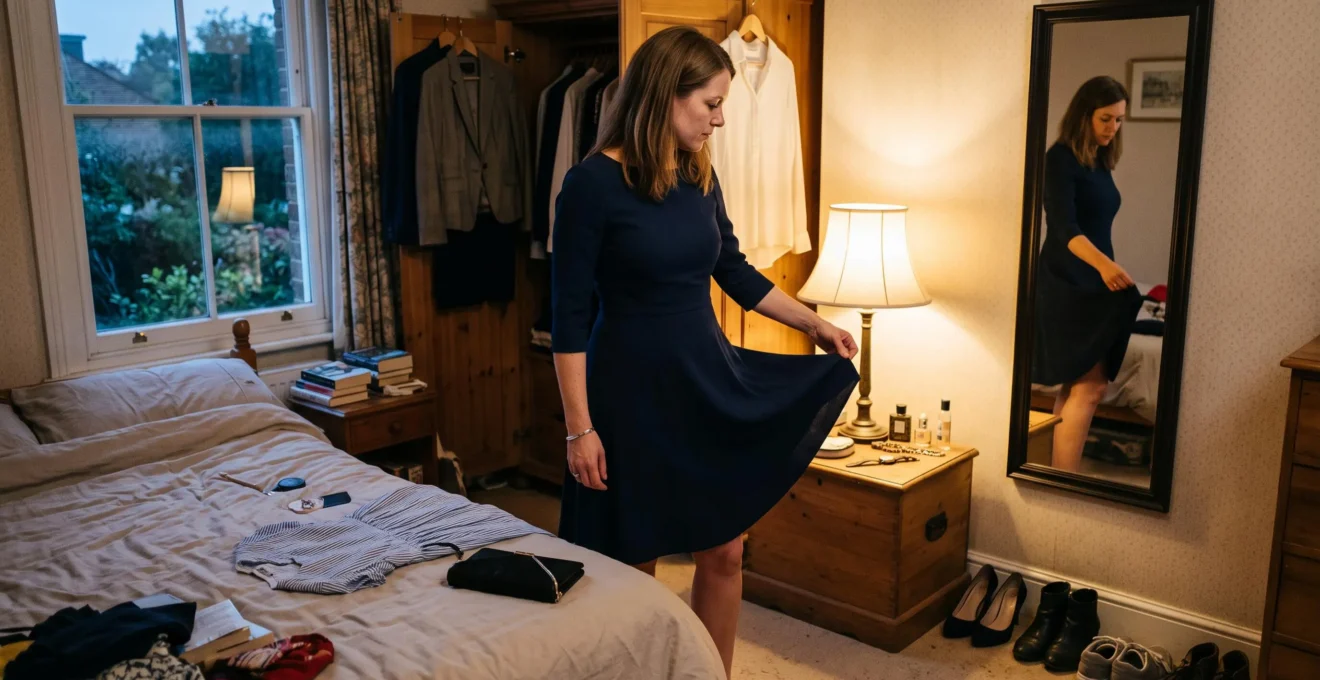
A birthday dinner in Manchester, a colleague’s leaving party in London and a wedding reception in the Cotswolds might all call for something “dressy”. Yet those three invitations can demand surprisingly different outfits.
A good cocktail dress should do more than photograph beautifully. It should help you navigate ambiguous dress codes, stay comfortable through dinner, adapt to different venues and avoid the last-minute problems that make getting ready unnecessarily stressful.
For a busy UK social calendar, the most useful cocktail dress is not necessarily the most elaborate one. It is a reliable foundation that can become more polished, more restrained or more celebratory through a few deliberate styling decisions.
That means judging fabric before hemline, testing how the garment behaves when seated, choosing underwear alongside the dress and buying with actual occasions in mind. The objective is straightforward: an outfit that looks appropriate when you arrive and still feels right several hours later.
What your cocktail dress needs to deliver
- Occasion flexibility: a suitable fabric, cut and neckline should work across different dressy settings with small styling changes.
- Real-life comfort: the dress must pass seated, movement and underwear tests, not just look good in a standing mirror.
- Better wardrobe value: buy for genuine diary commitments and use accessories to create different levels of formality.
- Why Can a Knee-Length Dress Still Look Too Casual for Evening Drinks?
- How to Make One Cocktail Dress Work for Dinner, Theatre, and a Work Party?
- Bodycon or Wrap: Which Cocktail Dress Works Best for Sitting and Eating Comfortably?
- The Underwear Choice That Ruins 80% of Cocktail Dress Looks
- When Is the Smartest Time to Buy a Cocktail Dress Without Getting Stuck With Returns?
- How to Build a Contemporary Elegant Outfit in 10 Minutes Without Overthinking?
- A 5-Accessory Rotation That Makes 20 Outfits Feel New
- How Can Statement Accessories Upgrade a Plain Dress Without Looking Try-Hard?
Why Can a Knee-Length Dress Still Look Too Casual for Evening Drinks?
A knee-length dress can look too casual for evening drinks because fabric, finish and styling communicate formality more strongly than length alone. A cotton day dress with utility pockets may feel out of place in a hotel cocktail bar, while a similarly sized crepe or satin dress looks appropriate. The venue and invitation determine how polished the overall outfit needs to be.
There is no universal cocktail-dress hemline. As British Vogue‘s guide to cocktail attire explains, the occasion, season, venue and hosts influence what works. Shorter and longer dresses can both satisfy the brief.
The practical distinction is between dress length and dress register. Length describes where the garment finishes. Register describes whether its materials, construction and details make it feel relaxed, professional or evening-ready.
Before leaving, run a three-point fabric test:
- Texture: does the fabric look like everyday shirting or casual jersey, or does it have a refined surface such as smooth crepe or restrained satin?
- Drape: does it fall cleanly over the body, or pull, crease and bunch in ways that make the outfit appear less polished?
- Finish: do visible pockets, sporty zips, contrast stitching or casual trims dominate the design?
These are styling judgements rather than fixed dress-code rules. A beautifully cut cotton dress can work for summer drinks, and satin can look inappropriate if its construction or styling does not suit the setting.
For an event starting after 6pm, especially one involving standing drinks rather than a seated meal, a useful personal rule is to elevate one element of the outfit. Choose more refined fabric, smarter shoes or a structured evening bag instead of automatically choosing a shorter dress.
Heels alone will not necessarily rescue a visibly daytime garment. Identify the detail making it look casual, then either neutralise it with considered styling or choose a different dress. A chest pocket or utilitarian zip cannot always be disguised convincingly.
Season and venue also change the equation. Summer courtyard drinks may allow open sandals and a lighter dress, whereas a winter hotel bar might call for elegant boots or closed shoes, considered hosiery and a tailored coat. A dimly lit pub function room may demand less formality than a private reception in a grand hotel.
Once the dress has the right register, it becomes easier to adapt that same piece to several occasions rather than buying a separate outfit for every invitation.
How to Make One Cocktail Dress Work for Dinner, Theatre, and a Work Party?
One cocktail dress can work for dinner, theatre and a work party when its underlying design is relatively versatile and accessories carry the occasion-specific message. Keep the dress constant, then adjust footwear, outerwear, jewellery and bags. A blazer and closed shoes create a professional impression; a clutch and expressive earrings make the same dress feel more social.
Think of this as the one dress, three shifts method. A navy crepe midi dress with a modest neckline and enough ease for sitting provides a useful hypothetical example.
| Element | Occasion | Recommended adjustment |
|---|---|---|
| Polished dinner | Restaurant evening | Heeled sandals or refined pumps, compact clutch and distinctive earrings |
| Comfortable elegance | Theatre visit | Comfortable closed shoes, compact shoulder bag and a neat coat |
| Professional celebration | Work party | Tailored blazer, restrained jewellery and structured bag |
The dress itself needs to support those changes. Before purchasing, assess it against real plans rather than an abstract claim that it is versatile.
- Neckline and coverage: can you comfortably wear it around colleagues without constantly adjusting it?
- Colour: does it work with your existing coat, shoes and bags, including in photographs?
- Silhouette: can you sit through a theatre performance without the hem riding up or the waist feeling restrictive?
- Practicality: can you move from standing conversation to a seated dinner without fuss?
For workplace celebrations, pay attention to the actual professional culture. Your manager’s likely level of formality can provide a useful reference point, but it is not a rigid standard. Consider the venue, colleagues attending and whether the invitation comes from the business or a small informal group.
A sequinned clutch and bold earrings might suit dinner with friends but feel excessive for an office Christmas gathering. Changing to a structured bag and smaller metallic earrings can make the outfit more appropriate without making it dull.
There is also a social consideration: if several events involve the same guests, repeating the exact accessories may make the outfit feel unchanged. Rotate two styling elements each time, such as shoes and bag for one occasion, then jewellery and outerwear for another.
Versatility is only worthwhile when the dress performs comfortably. That makes the seated fit, rather than the standing photograph, the next important test.
Bodycon or Wrap: Which Cocktail Dress Works Best for Sitting and Eating Comfortably?
A wrap dress may offer greater adjustability around the waist during a long dinner, while a well-constructed bodycon dress can provide a secure, consistent silhouette. Neither style guarantees comfort. Fabric stretch, lining, closure security and seated fit matter more than the label. The better choice is the one that stays comfortable and properly positioned throughout the evening.
Imagine a typical birthday celebration involving welcome drinks, a multi-course meal and several hours of conversation. A dress that looks excellent while standing might behave quite differently after sitting for an extended period.
A wrap dress can be useful because its overlapping construction may allow flexibility around the waist. British Vogue’s feature on wrap dresses also describes the silhouette as versatile across relaxed and more dressed-up occasions. That editorial assessment does not establish that every wrap dress is more comfortable than every bodycon design.
A bodycon style offers a different advantage: it can remain visually consistent without an overlapping front panel shifting position. However, this depends on suitable stretch, reliable fabric recovery and construction that does not create uncomfortable pressure.
| Fit consideration | Wrap dress | Bodycon dress |
|---|---|---|
| Waist comfort | Adjustable on some designs; ties can still dig in | Depends on stretch, cut and waistband construction |
| Seated coverage | Front overlap may open or shift | Hem may ride upwards |
| Movement | Check ties and neckline stability | Check restriction around hips and thighs |
| Fabric priority | Good drape and sufficient overlap | Stretch recovery, suitable lining and comfortable seams |
The fitting-room sit-and-eat test is more useful than making assumptions about silhouettes. Sit fully on a bench, lean forward, cross your legs and raise your arms. Check whether the waistband digs in, the hem rises excessively or the wrap neckline gapes.
For wrap dresses, inspect where the internal tie sits and how much fabric overlaps at the front. A lightweight design with a shallow overlap may need a discreet camisole, although adding a layer cannot repair an unstable closure. If the dress requires constant adjustment when sitting, consider another design.
For bodycon styles, check the lining, the placement of seams and whether the material returns to its original shape after stretching. A lined bodycon with comfortable seams may perform much better than a thin, poorly constructed wrap dress.
Shapewear can affect the result, but it should not be used to force an unsuitable dress to fit. Your clothing should still allow comfortable movement, breathing and eating.
The dress that wins is not the one with the most flattering standing silhouette, but the one you can stop thinking about once the evening begins. Underwear plays a significant part in achieving that result.
The Underwear Choice That Ruins 80% of Cocktail Dress Looks
The most disruptive underwear choice is often a bra that does not work with the dress’s neckline, fabric or construction. Visible straps, cup edges and bands can distract from an otherwise polished outfit, especially under thin or fitted materials. The 80% figure in this heading is a rhetorical exaggeration, not a verified statistic about cocktail dresses.
Underwear problems are easily overlooked because fitting-room lighting, standing posture and carefully positioned mirrors do not replicate evening conditions. A garment may look smooth in the shop but reveal seams or straps when you move or sit.
Match underwear to the dress rather than choosing it independently:
- Fitted crepe: consider smooth-edged underwear and a bra with cups that do not create visible ridges.
- Strapless neckline: test a supportive strapless bra with the actual dress, including arm movement.
- Backless design: assess compatible support options; adhesive products are not suitable or comfortable for everyone.
- Wrap dress: check whether the bra stays concealed when the neckline shifts while sitting.
- Fine satin: examine possible underwear outlines and fabric transparency in different lighting.
There is useful garment-testing evidence behind the importance of comfort and visibility. Good Housekeeping‘s shapewear testing reported evaluations of 27 styles, incorporating feedback from 80 consumer testers wearing sizes XS to 3XL. The assessment considered issues including smoothing, visibility, fit and comfort.
27 styles, 80 testers
The Good Housekeeping evaluation illustrates why shapewear comfort and visibility need garment-specific testing. Its findings do not establish the prevalence of underwear problems at UK events.
Good Housekeeping Institute Textiles Lab, 2026.
At home, wear the intended underwear beneath the dress and inspect the outfit in daylight, indoor lighting and photographs. A flash photograph can be an additional useful check for some materials, but it is not a universal test of transparency or underwear visibility.
For shapewear, consider the entire evening rather than a brief fitting. A garment that feels acceptable for five minutes may become distracting through dinner and extended sitting. Avoid first-time shapewear experiments on the night of the event.
Use this five-action rehearsal before committing to an outfit:
Your five-point cocktail dress rehearsal
- Put on the exact dress and underwear combination. Confirm that straps, bands and cup edges remain appropriately concealed.
- Sit, lean forward and raise both arms. Identify any neckline gaps, riding hems or uncomfortable pressure points.
- Check the fabric in daylight and indoor lighting. Record whether transparency or visible underwear lines need addressing.
- Take a front, side and seated photograph. Review how the outfit appears beyond the standing mirror.
- Wear the complete outfit with its intended shoes for a short rehearsal at home. Confirm that you can move comfortably without repeated adjustments.
Resolving these details early makes shopping decisions more confident and reduces the temptation to order an entirely different dress shortly before an event.
When Is the Smartest Time to Buy a Cocktail Dress Without Getting Stuck With Returns?
The smartest time to buy a cocktail dress is early enough to test the complete outfit and make changes before the event. For a confirmed invitation, prioritise selection, delivery reliability and fitting time over waiting for a discount. For a general occasion wardrobe, buying outside an immediate deadline can make it easier to assess versatility without pressure.
UK retailers’ occasionwear ranges change throughout the year, and availability can vary by brand, size and season. There is no universal month when every retailer offers the best selection or prices.
For weddings and seasonal parties, a sensible planning approach is to shop with enough time for delivery, fitting and any necessary replacement. Last-minute buying can leave fewer suitable choices, particularly when a specific colour, size or dress code matters.
Before purchasing online, distinguish the retailer’s voluntary returns policy from your statutory rights. For qualifying distance purchases, UK government guidance on returns and refunds explains that customers generally have 14 days after receipt to notify the seller of cancellation, followed by another 14 days to send the item back.
Conditions and exceptions apply. Return postage is not automatically free, and wearing clothing to an event goes beyond the normal inspection permitted when trying something on. In-store change-of-mind purchases do not automatically carry the same cancellation rights.
To reduce returns risk, verify the stated returns conditions, any collection or postage costs and whether a different size can realistically arrive before your event.
Ordering two sizes can sometimes make sense when sizing is uncertain, provided the financial commitment and return conditions are manageable. It is not a reason to buy indiscriminately.
For an event-specific purchase, try the dress on immediately after arrival with your intended shoes and underwear. Check fit, fabric, movement and lighting before removing tags or making alterations.
A versatile wardrobe purchase requires a different test. Ask whether it works for at least two real or realistically anticipated occasions, such as a workplace celebration and a birthday dinner. A discounted garment that cannot be styled with anything you own is not necessarily good value.
The final decision should account for the total outfit: alterations, underwear, shoes and accessories can change whether a seemingly inexpensive dress is a sensible purchase.
Once a dress has passed those tests and earned a place in your wardrobe, getting ready becomes a straightforward styling task rather than another shopping exercise.
How to Build a Contemporary Elegant Outfit in 10 Minutes Without Overthinking?
A contemporary elegant outfit can be assembled in 10 minutes when the components have already been tested together. Start with a reliable dress, add appropriate shoes, choose one outer layer, select restrained accessories and finish with the right bag. The method succeeds through preparation and consistency, not by making several new decisions while getting ready.
For UK occasions, contemporary elegance often means balancing a relaxed silhouette with one refined or expressive element. A simple dress with an excellent fit and distinctive earrings can feel more current than an outfit built around multiple competing embellishments.
The key is to establish an occasion capsule in advance. Keep the relevant pieces easy to locate and compatible with one another.
A practical 10-minute sequence looks like this:
- Minutes 0–2: put on your tested cocktail dress and confirm that it sits correctly.
- Minutes 2–4: select one of two pre-approved shoe options based on the venue and how much walking is involved.
- Minutes 4–6: add a tailored blazer, refined cardigan or suitable coat depending on the occasion and weather.
- Minutes 6–8: choose one focal accessory and, if useful, one quieter supporting piece.
- Minutes 8–10: pick the appropriate bag and complete a final full-length mirror check.
These timings are a planning framework, not a measured guarantee. The routine assumes the garment is clean, pressed and ready, the shoes are accessible and the underwear has already been checked.
Without that preparation, the ten-minute goal becomes unrealistic. Finding a missing clutch or discovering that a bra shows beneath the neckline can consume more time than the styling itself.
Before leaving, identify the single detail weakening the result. It could be a wrinkled hem, an exposed strap, scuffed shoes or an accessory that feels too prominent for the venue. Correct that detail rather than rebuilding the entire outfit.
The more reliably your core pieces work together, the more variety you can create without increasing the time spent deciding what to wear.
A 5-Accessory Rotation That Makes 20 Outfits Feel New
A five-accessory rotation can make a small occasion wardrobe feel much more varied by changing how each dress communicates formality. Choose accessories that complement several garments rather than purchasing pieces for one specific look. Across four suitable dresses, five distinct accessory-led styling options could create 20 theoretical combinations, although not every combination will suit every event.
The objective is not to own more accessories. It is to make each accessory useful in several settings.
Consider this five-piece rotation:
- Statement earrings: provide an evening focal point for simple necklines and restrained dresses.
- Fine necklace: adds subtle polish to work events and dinners where large jewellery feels unnecessary.
- Structured bag: makes an outfit feel composed and appropriate for professional or semi-formal occasions.
- Soft clutch: shifts the same dress towards dinner, drinks or a wedding reception.
- Tailored layering piece: adjusts coverage and formality while accommodating different venues and temperatures.
For example, a plain black dress can look professional with a tailored blazer, fine necklace and structured bag. Remove the blazer, replace the bag with a clutch and add statement earrings, and the impression changes considerably.
Rather than buying five new items, evaluate what is already in your wardrobe. Each piece should ideally work with at least two dresses, suit at least two types of event and look appropriate under both natural and evening lighting.
A special-occasion accessory that only matches one garment may still be worth owning if you love it. However, it should not be mistaken for a versatile purchase.
For a hypothetical wardrobe containing four dresses, the simple calculation of four dresses multiplied by five accessory-led variations produces 20 potential looks. That is a planning illustration rather than evidence that every combination will be aesthetically successful.
Compatibility matters more than arithmetic. A metallic clutch that works with several colours may offer more practical versatility than a highly decorative bag that coordinates with only one dress.
The strongest accessory wardrobe creates options without requiring every look to be elaborate. Knowing when to introduce a statement piece, and when to stop, is the final styling decision.
Key takeaways before choosing your statement piece
- Start with the dress’s neckline, fabric and cut; accessories should complement the foundation rather than compensate for unsuitable construction.
- Scale your accessories to the setting: dinner with friends, a wedding reception and a colleague’s celebration may require different levels of visual impact.
- Choose one dominant detail and allow the remaining elements to support it instead of competing for attention.
How Can Statement Accessories Upgrade a Plain Dress Without Looking Try-Hard?
Statement accessories elevate a plain cocktail dress most effectively when one piece becomes the clear focal point. Bold earrings, an unusual clutch or distinctive shoes can make a simple outfit feel intentional without overwhelming it. To avoid looking overdone, keep the remaining elements relatively restrained and adjust the statement’s scale to the occasion.
A plain, well-cut cocktail dress is particularly useful because it provides a visual foundation rather than competing with decorative details. Clean lines, good fabric and a balanced neckline give accessories room to stand out.
A practical starting hierarchy is earrings, necklace, bag and shoes. This is a styling decision aid, not a universal rule. Choose the strongest element based on the dress and the setting.
For example, a black crepe midi dress with an uncluttered neckline can support sculptural gold earrings beautifully. Adding a substantial necklace, embellished bag and heavily decorated shoes at the same time may make the outfit feel crowded.
That same earring choice might work for a celebratory restaurant dinner but feel too dramatic for a restrained workplace gathering. In a professional setting, reduce the size of the earrings, choose a quieter metallic finish or swap to a finer necklace.
At a wedding reception, the amount of decoration may be greater, but the host’s dress code and the formality of the venue should still guide the result. Accessories cannot automatically make a casual day dress suitable for a highly formal invitation.
Colour also affects the balance. A vivid statement bag may be sufficient against a neutral dress, while similarly bright earrings and shoes can compete with it. Metallic pieces can create impact without adding another strong colour, although their finish and size still matter.
Before leaving, apply the restraint test: remove one accessory and look at the entire outfit again. If the result appears complete, leave the item off. If it becomes noticeably less expressive, restore it.
The goal is not minimalism for its own sake. It is a coherent outfit in which the dress, accessories and occasion make sense together.
For your next invitation, begin with the dress you already own, test its fit and fabric, then choose one deliberate accessory change. That is often a more useful response to an unclear dress code than buying something entirely new.
Can you wear a cocktail dress to an event with a smart-casual dress code?
Yes, if its fabric, design and styling are not excessively formal for the setting. A simple crepe or understated wrap dress can work with low heels, a restrained bag and minimal jewellery. A highly embellished evening dress may feel out of place at a relaxed smart-casual gathering.
Is a black cocktail dress appropriate for a UK wedding?
A black cocktail dress can be appropriate for many UK wedding receptions, particularly evening celebrations. Consider the invitation, venue, cultural or religious expectations and any colour guidance from the couple. Lighter accessories or a celebratory finish can make a simple black dress feel less business-like.
What shoes work with a cocktail dress when you need to stand for several hours?
Consider supportive block heels, well-fitting low heels or refined flats that suit the dress and venue. Test them indoors before the event, paying particular attention to heel stability, toe pressure and rubbing. A shoe that works for a short photograph may not be comfortable for an entire reception.
Should a cocktail dress always be fitted at the waist?
No. Wrap, shift, softly tailored, A-line and more fitted silhouettes can all be appropriate. The important considerations are the event’s formality, the garment’s fabric and how comfortably it moves with you. A defined waist is a stylistic option rather than a cocktail-dress requirement.
Can you return a cocktail dress after trying it on at home?
For qualifying online purchases from traders covered by UK distance-selling rules, consumers generally have statutory cancellation rights that allow reasonable inspection and trying on. You should notify the retailer within the applicable period and follow the return requirements. Wearing the dress to an event may lead to a lawful deduction for diminished value, and certain exceptions or other conditions can apply.