A well-constructed wardrobe is not necessarily an expensive wardrobe, a minimalist capsule or a collection of perfectly tailored clothes. It is a reliable selection of garments that fit comfortably, withstand their intended use, work together and remain practical to maintain.
For someone commuting through British rain, working in an office several days a week and spending weekends walking or travelling, construction quality becomes visible through repetition. The trousers that survive frequent sitting, the shoes that tolerate regular maintenance and the coat that remains functional after several winters contribute more than an immaculate jacket worn twice a year.
The distinction matters because retail price is not a dependable measure of physical durability. Research from the University of Leeds, published in 2025, developed a framework for assessing commercially available T-shirts and denim jeans using multiple performance characteristics. Its findings indicate that price alone cannot predict durability.
Building a dependable wardrobe therefore requires more than buying fewer, supposedly better items. It means identifying failure points, auditing actual wear, matching purchases to practical roles and maintaining garments before small problems become expensive ones.
What makes a wardrobe durable in everyday use?
- Construction: prioritise seam integrity, fabric performance, fit and repairability over price or brand reputation.
- Selection: spend according to wear frequency, weather exposure and the number of outfits an item genuinely supports.
- Maintenance: inspect high-wear areas regularly, rotate suitable garments and address repairable damage early.
- Why Do Clothes Fail in the Same 3 Places No Matter the Brand?
- How to Audit Your Wardrobe for Weak Links in 45 Minutes Without Getting Distracted?
- Coat, Shoes, or Trousers: Where Does Spending More Pay Off the Most?
- The Quality Trap: Buying Something Beautiful That Can’t Handle Real Life
- A Maintenance Rhythm That Keeps Clothes Looking Sharp With 20 Minutes a Week
- How to Spot Quality Tailoring in 2 Minutes Without Checking the Label?
- Buy Multiples or Mix It Up: Which Builds More Outfits With Less Waste?
- How Do You Build a Clothing System That Stops You Buying Duplicates You Don’t Wear?
Why Do Clothes Fail in the Same 3 Places No Matter the Brand?
Clothing often deteriorates around three broad stress zones: areas exposed to repeated rubbing, seams subjected to pulling and edges that experience constant handling or contact. Trousers commonly show wear around the seat and inner thighs, jackets around elbows and cuffs, and shirts around collars and underarms. These are practical inspection priorities, not a universal statistical ranking of garment failures.
The location of damage is shaped by movement, fit, fabric and how frequently a garment is worn. A person who cycles to work may place unusual demands on trouser seams. Someone spending long hours at a desk may notice abrasion around jacket elbows or cuffs. Tight-fitting clothing can also experience greater stress when the wearer bends, sits or reaches.
Understanding how damage occurs matters more than simply identifying where it appears.
- Fibre abrasion: repeated rubbing gradually damages fibres. It may produce thinning, surface fuzz or eventually holes, particularly in areas contacting skin, chairs or other garments.
- Seam slippage: yarns move apart within the fabric near a stitched seam, creating an opening even when the sewing thread remains intact.
- Fabric fatigue and dimensional change: repeated mechanical stress, washing and drying can affect shape, elasticity or structural integrity, depending on the material.
The ECOS technical report on textile durability standards distinguishes abrasion resistance, seam strength, seam slippage, pilling and dimensional stability as separate properties. It also explains why no single fabric characteristic establishes overall durability.
These differences determine the appropriate response. A loose thread may be restitched. A seam pulling apart under concentrated tension may benefit from better fit, additional seam allowance or suitable reinforcement. Bar tacks can strengthen particular attachment points, but they cannot restore severely weakened fabric.
Likewise, a higher-twist yarn may improve performance in some fabrics, but it is not an automatic solution for every form of wear. Fabric structure, yarn properties and the garment’s intended use must be considered together.
Consider two hypothetical pairs of trousers. The first costs £60 and withstands 120 wears before becoming unusable. The second costs £180 and lasts 180 wears. Their purchase costs per wear are £0.50 and £1.00 respectively, excluding repairs and cleaning. The more expensive pair lasts longer but still costs more per use.
This example illustrates why frequency of wear and actual service life matter more than the price tag alone.
A well-constructed weekly wardrobe starts with recognising the stresses that clothes actually face. Once those weaknesses become visible, an existing wardrobe can be assessed without replacing everything.
How to Audit Your Wardrobe for Weak Links in 45 Minutes Without Getting Distracted?
A focused wardrobe audit begins by separating frequently worn clothes from occasional and unused pieces, then examining the items that experience the greatest physical stress. In 45 minutes, the goal is not to assess every possession. It is to identify the most urgent repairs, confirm which garments are working and recognise purchases that serve no current purpose.
Set a timer and concentrate on the clothes used for an ordinary working week and weekend. Formalwear, seasonal accessories and sentimental garments can be assessed separately.
A practical schedule divides the session into four stages:
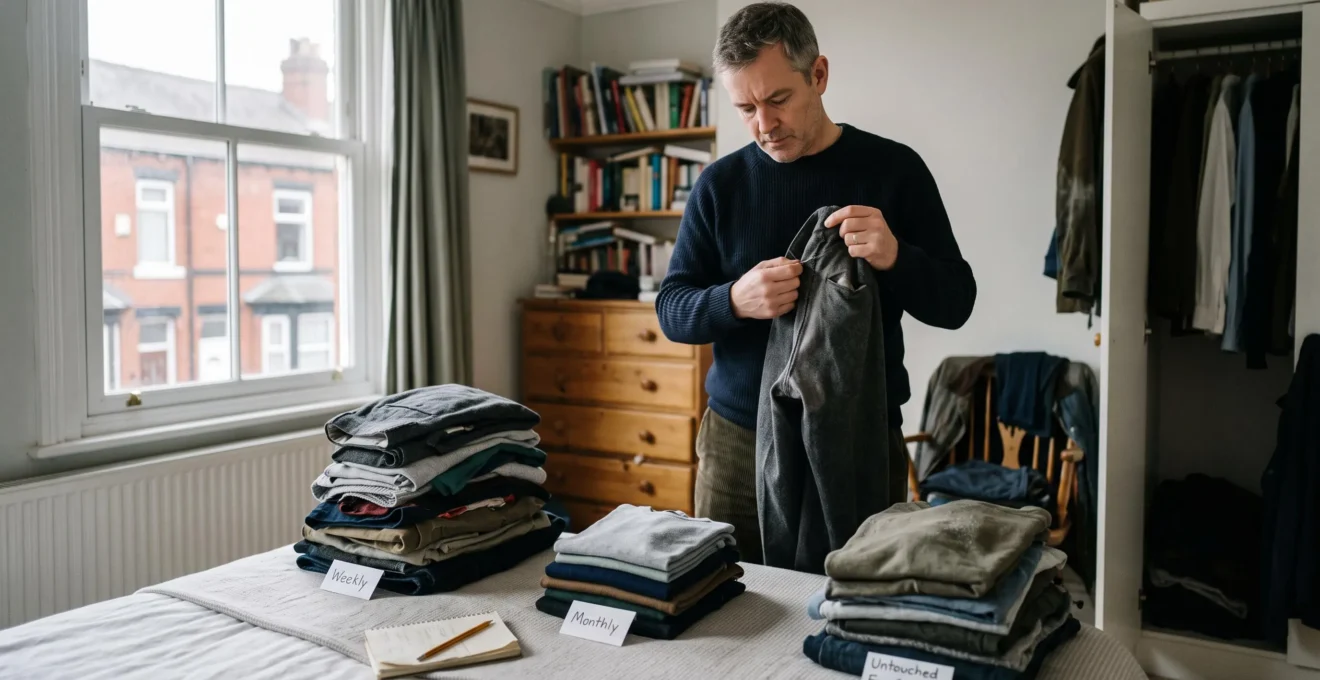
- First 10 minutes: separate clothing into worn weekly, worn monthly and untouched during the previous six months.
- Next 15 minutes: inspect the weekly rotation for visible damage, fit problems and construction weaknesses.
- Next 10 minutes: check repair requirements and identify items that no longer perform their intended role.
- Final 10 minutes: record decisions, assign repair priorities and identify genuine wardrobe gaps.
These time allocations are a practical organisational method, not a scientifically validated audit duration. A large wardrobe may require several sessions.
Inspection should be specific to the garment rather than limited to a quick visual assessment of its front.
| Garment | Inspection points | Warning signs |
|---|---|---|
| Trousers | Seat, inner thighs, crotch seams and hems | Thinning, separated yarns, worn hems or persistent pulling |
| Shirts | Collars, cuffs, underarms and buttons | Fraying, discolouration, loose stitching or weakened fabric |
| Knitwear | Elbows, underarms, cuffs and sides | Localised pilling, holes, stretched ribbing or distorted shape |
| Jackets and coats | Elbows, lining, pockets, fastenings and seams | Worn lining, strained stitching, damaged closures or thinning cloth |
| Shoes | Outsoles, heels, uppers and heel counters | Uneven wear, loose soles, collapsing support or cracked material |
Pilling deserves careful interpretation. Small fibre balls appearing where a jumper rubs against a coat or bag may primarily indicate local friction. Widespread pilling can point to a different combination of fibre characteristics, yarn construction and use. Neither observation alone proves that a garment is poorly made.
For each item, choose one outcome: repair or reinforce, keep as-is, or retire from the active rotation. Retirement need not mean disposal; wearable items might be stored for a defined purpose, altered, donated or passed on where appropriate.
26%
of clothing items in wardrobes examined by UK consumer research commissioned in 2021 had not been used during the preceding year. This is a historical wardrobe-utilisation finding, not a measurement of current UK wardrobes.
WRAP’s UK clothing longevity and wardrobe-use research, published in 2022.
An untouched garment presents a different problem from a worn-out garment. It may be beautifully constructed but unsuitable for the owner’s routine, uncomfortable or difficult to combine with existing clothes.
Your five-step wardrobe audit checklist
- Sort the accessible wardrobe into three wear-frequency groups. Deliverable: three clearly separated groups.
- Inspect the five most frequently worn garments at their main stress points. Deliverable: a written condition note for each.
- Check the shoes and outerwear currently used for commuting. Deliverable: a list of visible maintenance or repair needs.
- Assign each inspected item a keep, repair or retire decision. Deliverable: a recorded decision beside every item.
- Compare unworn purchases with genuine missing wardrobe functions. Deliverable: a short gap list that excludes unnecessary replacements.
The completed audit establishes where existing clothing already performs well. That evidence should guide spending decisions more reliably than a general intention to upgrade everything.
Coat, Shoes, or Trousers: Where Does Spending More Pay Off the Most?
Spending more on coats or shoes can be worthwhile when improved construction makes them easier to repair and they are worn frequently. Trousers may deserve priority when fit and friction are recurring problems. There is no universal winner: the best investment depends on climate exposure, commuting habits, repair options and the number of wears a purchase can realistically deliver.
In the UK, outerwear and footwear regularly encounter wet pavements, changeable temperatures and journeys between indoor and outdoor environments. Trousers face a different pattern of stress, particularly from sitting, walking and repeated contact with furniture.
A sensible purchasing decision compares four factors: expected frequency of use, exposure to demanding conditions, construction improvements that matter for that role and whether damage can be repaired economically.
| Decision factor | Coats | Shoes | Trousers |
|---|---|---|---|
| Primary wear pressure | Weather, cuffs, linings and fastenings | Ground contact, moisture and repeated flexing | Seat, inner thighs, seams and knees |
| Construction to assess | Shell performance, lining, seam integrity and replaceable parts | Sole attachment, upper materials, fit and repairable design | Fabric performance, fit, seam allowances and stitching |
| Repair potential | Selected linings, closures and weatherproof finishes | Heels, soles and certain upper repairs | Seams, hems and limited reinforcement |
| When paying more may help | Frequent wear in demanding weather | Regular use with accessible repair services | Reliable fit and demonstrably stronger construction |
Repairability creates an important distinction. Some welted leather shoes are designed to accept replacement soles, while many cemented constructions are more difficult to resole. However, the presence of stitching alone does not guarantee repairability: the specific attachment method, materials and condition must be assessed.
Similarly, a coat with accessible lining construction, replaceable fastenings and a suitable outer fabric may remain serviceable through several interventions. A coat with a damaged coating or severely degraded shell may not be economical to restore.
Trousers can present a less favourable repair equation. When fabric has thinned extensively across the seat or inner thighs, a patch may alter fit or appearance without restoring the original performance. Paying more for trousers is therefore worthwhile only when the additional cost corresponds to relevant improvements in fit, fabric behaviour or construction.
For an office commuter walking substantial distances, weather-appropriate, repairable shoes may be a high priority. Someone working mostly from home but walking outdoors regularly might gain more from a dependable coat. A person wearing the same trouser style on most working days should assess that category first.
The cost-per-wear calculation should include expected purchase price, reasonable maintenance and repair costs, and realistic use. Repairability has value when the repair is technically possible, affordable and the owner still wants to wear the item.
One further limitation matters: spending heavily on a fit or style that has not yet been tested can produce an expensive mistake. A moderately priced learning purchase may be sensible before committing to a premium version.
Higher construction quality becomes valuable when it solves a problem the wearer actually encounters. A technically excellent garment that does not fit its practical role can still be a poor purchase.
The Quality Trap: Buying Something Beautiful That Can’t Handle Real Life
The quality trap occurs when a beautifully made garment is purchased for a task its materials and construction are not designed to handle. Fine fabric, delicate finishing and refined tailoring can indicate craftsmanship without guaranteeing resistance to frequent abrasion, rain or laundering. True wardrobe quality requires the garment’s performance to match its intended role.
Consider a lightweight wool suit made from a delicate cloth. Its drape and finish may be excellent for occasional meetings, formal events or controlled indoor use. Wearing the same suit on crowded public transport every working day exposes it to an entirely different level of friction, moisture and repeated movement.
The resulting wear does not necessarily demonstrate poor workmanship. It may demonstrate a mismatch between the garment and the conditions assigned to it.
The same problem arises with light-coloured, fine-gauge knitwear frequently worn under rough outer layers. Pilling, snagging and demanding cleaning requirements can make an attractive purchase less practical than a more robust alternative.
Structured leather shoes illustrate another distinction. A polished finish and refined silhouette do not automatically make shoes suitable for prolonged exposure to wet conditions. The choice of upper materials, soles, construction and weather protection matters more than visual elegance alone.
Before buying, apply a fitness-for-purpose test:
- Where will it be worn? Identify the actual environments, including commuting, workplaces and outdoor activities.
- How often? Distinguish an occasional garment from something expected to withstand repeated weekly wear.
- Under what conditions? Consider moisture, friction, temperature changes and opportunities for laundering or drying.
- What care is required? Compare the manufacturer’s instructions with the time, facilities and budget realistically available.
- What happens when it wears? Determine whether the likely damage can be repaired or whether it compromises the garment permanently.
Fabric weight can be one useful clue, but a heavier fabric is not automatically more durable. Fibre characteristics, yarn twist, fabric structure and finishing affect different aspects of performance. A dense fabric may resist one type of wear while performing less well under another.
University of Leeds research on physical garment durability reinforces this distinction. Its multi-factor assessment of T-shirts and denim jeans found that retail price was not a reliable predictor of durability in the garment categories examined.
The lesson is not to avoid refined clothing. It is to purchase refined clothing for appropriate uses and avoid assuming that aesthetic sophistication guarantees practical toughness.
A second trap is psychological. Someone may repeatedly buy garments for an imagined future routine: more formal events, a different workplace or a lifestyle requiring clothes they rarely use. Those purchases can become permanent residents of the untouched pile identified during the audit.
Construction quality is therefore only one part of wardrobe reliability. The ability to maintain and rotate garments determines whether that quality can be preserved.
A Maintenance Rhythm That Keeps Clothes Looking Sharp With 20 Minutes a Week
A practical 20-minute weekly maintenance routine focuses on early detection rather than intensive cleaning. Brush and check frequently worn shoes, inspect vulnerable clothing seams, air suitable garments and schedule necessary repairs. The aim is to recognise wear before it becomes difficult or uneconomical to address, while following each garment’s material-specific care instructions.
Choose a consistent point in the week, such as Sunday evening, when the coming week’s clothing can be assessed together. Keeping a shoe brush, appropriate cloth and small repair kit accessible makes the routine easier to repeat.
One workable allocation is:
- Five minutes for footwear: remove loose dirt using suitable methods, inspect heels and soles, and check whether regularly worn shoes have had time to dry.
- Five minutes for clothing stress points: examine trouser seats, inner thighs, jacket cuffs and frequently stressed seams.
- Five minutes for airing and storage: air appropriate garments, check hangers and ensure clothing is stored dry and without unnecessary compression.
- Five minutes for small interventions: identify loose buttons, minor pilling, emerging holes or items that should be taken to a professional.
The time allocation is an organisational suggestion, not a measured guarantee that 20 minutes will prevent a particular amount of deterioration.
Rotation is itself a form of care. Alternating suitable garments reduces the frequency of stress applied to any single piece and allows damp or compressed materials time to dry or recover where relevant. Shoes in particular benefit from being allowed to dry appropriately between wears, although the degree of benefit depends on their materials, use and environment.
Weekly inspection also helps schedule less frequent maintenance. Waterproof or water-resistant outerwear may need periodic cleaning and reproofing according to the manufacturer’s guidance. Repairable shoes should be assessed before sole wear damages components that are harder to replace. Knitwear can be treated gently for surface pilling when appropriate, but removing pills does not reverse fibre loss.
Care should never become more damaging than ordinary use. Excessive brushing, inappropriate cleaning products, unnecessary washing and aggressive depilling can all harm materials. Delicate fabrics may require specialist treatment.
Professional services belong in the system. A cobbler can assess sole wear and the feasibility of repair. An alterations tailor can address fit, seam damage or lining problems. Neither service can guarantee recovery when the underlying material has deteriorated substantially.
WRAP‘s 2022 report associated clothing repair with an additional 1.3 years of reported clothing retention. That observational finding should not be interpreted as a guaranteed lifespan increase from every repair.
The weekly routine is therefore an early-warning system. Its value lies in finding manageable problems while the garment remains useful, rather than attempting to restore every item regardless of condition.
Regular maintenance protects an existing wardrobe, but the same principles should influence new purchases. A brief construction check can prevent avoidable weaknesses from entering the rotation.
How to Spot Quality Tailoring in 2 Minutes Without Checking the Label?
A two-minute tailoring check should prioritise fabric behaviour, seam integrity, finishing and fit rather than branding. Feel the cloth, inspect stressed seams, examine how patterned sections meet and look inside the garment for construction details. These observations can reveal useful quality signals, but they cannot establish complete durability or replace proper testing and wear experience.
The objective is not to identify the most elaborate construction. It is to recognise whether a tailored garment has the characteristics required for its intended frequency of use.
Use a simple sequence in the fitting room:
- 0–30 seconds — assess the fabric. Handle the cloth and observe its drape, surface and recovery after gentle compression. Do not assume greater weight automatically indicates greater strength.
- 30–60 seconds — examine seams. Look for even stitching, loose threads, puckering or visible gaps. Apply only gentle tension where appropriate; never force or damage store merchandise.
- 60–90 seconds — inspect pattern alignment. On checked or striped pieces, examine how the design meets at visible seams. Consistent alignment can indicate careful cutting, although not every seam or design requires exact matching.
- 90–120 seconds — inspect internal finishing. Look at linings, seam allowances, cuffs and accessible internal construction. Check whether the garment appears suitable for future adjustments.
A jacket may contain canvassed, partially canvassed or fused construction. Canvas can influence structure, drape and how the front behaves over time, while fusing uses adhesive interlinings. These methods are not reliably identified through a casual lapel pinch alone, and construction choice is not an automatic durability ranking.
Functional sleeve buttons, decorative buttonholes and hand-finished details may reveal something about a garment’s design or manufacturing process. They do not, by themselves, establish better resistance to repeated wear. In some cases, functioning sleeve buttons can even complicate alterations.
For a garment expected to be worn weekly, seam stability, comfortable movement, suitable fabric and accessible repair options are generally more practical priorities than decorative craftsmanship.
Look for enough seam allowance to support possible alterations, while recognising that fabric availability alone does not guarantee an alteration will be technically feasible. The garment must also allow comfortable movement through the shoulders, seat, elbows and other areas that experience stress.
The University of Leeds’ research on measuring garment durability demonstrates why physical performance requires multiple assessments. The researchers developed a reproducible testing framework for T-shirts and denim jeans rather than relying on one isolated indicator. Its findings are relevant to the limits of quick inspection, though the study does not validate a two-minute tailoring test.
Before purchasing, read the care instructions, check the retailer’s return terms and consider whether adjustments are needed. Some defects, including loss of shape after cleaning or deterioration of internal components, may only become apparent after use.
Once a reliable garment passes both the construction check and real-life wear test, the next purchasing decision is whether to repeat it or add something different.
Buy Multiples or Mix It Up: Which Builds More Outfits With Less Waste?
Buying multiples works best for frequently worn basics whose fit, comfort and performance have already been proven. Adding variety works better when a new item creates useful combinations that existing clothes cannot provide. Neither strategy is inherently less wasteful: the better decision depends on actual wearing habits, available outfits and whether an additional purchase is necessary.
Consider a hypothetical wardrobe built around navy trousers, neutral knitwear and several shirts. A second pair of proven navy trousers might allow a comfortable work rotation while one pair is being washed or repaired. Its value comes from fulfilling an identifiable practical need.
A different-coloured pair that works with the same shirts might also be useful, particularly when the wearer needs additional outfit options. However, introducing an unusual statement piece that only works with one shirt may add less everyday flexibility.
The distinction is between repetition value and combinability.
- Choose multiples when a garment is worn frequently, has demonstrated reliable fit and is difficult to replace with another item already owned.
- Choose variety when a garment fills a distinct functional role or produces several genuinely wearable outfits.
- Choose neither when the current wardrobe already meets the relevant need.
An outfit-count test can make this decision more concrete. Lay a prospective purchase beside existing garments and identify complete combinations suitable for real activities. Count combinations that differ in useful ways and that would actually be worn, rather than treating every theoretical pairing as a new outfit.
For example, a hypothetical neutral cardigan may work with three existing bottoms and four tops. That creates several possible combinations, but the theoretical number exaggerates its value if only a few meet the wearer’s preferences, dress code and weather requirements.
Multiples have their own failure mode. Purchasing three versions of a new shirt before testing it through repeated wear may multiply a fit problem, uncomfortable fabric or demanding care routine. A season of use can provide more practical information than a fitting-room impression, although a full season is not a formal requirement for every purchase.
Variety purchases fail when a distinctive garment requires additional purchases to become wearable. A jacket needing special trousers, shoes and shirts may create a chain of spending rather than genuine wardrobe flexibility.
The cost-per-wear principle also needs careful interpretation. Owning two identical garments does not automatically reduce the total cost per wear. It only becomes economically sensible when both are used enough to justify their combined purchase and care costs, or when the additional item provides a meaningful practical benefit.
Construction durability and wardrobe usefulness should therefore be assessed together. The decision is not about maximising the number of garments or theoretical outfits, but ensuring purchases contribute to an actively worn rotation.
These decisions become easier when clothing is managed as a small, documented system rather than a series of unrelated purchases.
Key takeaways before your next purchase
- Identify the specific role a new garment must perform before evaluating its price, appearance or brand.
- Separate proven replacements from near-duplicates and purchases motivated by an imagined lifestyle.
- Use evidence from existing wear, fit and maintenance to decide whether an item belongs in the weekly rotation.
How Do You Build a Clothing System That Stops You Buying Duplicates You Don’t Wear?
A clothing system prevents unnecessary duplicates by recording what is actually worn, identifying missing functions and requiring each potential purchase to justify its role. It combines a simple wardrobe inventory with a deliberate buying pause. Exact duplicates of proven essentials can be useful, while near-duplicates and aspirational purchases need closer examination before money is spent.
The system does not require sophisticated software or a perfectly catalogued wardrobe. A notebook or spreadsheet can hold the essential information: garment type, colour, fit, typical usage, condition, care requirements and replacement priority.
Start with the weekly rotation established during the audit. This is the most reliable evidence of what the wardrobe already accomplishes. Record which items consistently support workdays, weekends, commuting and other regular activities.
Then create a short gap list based on practical problems. For example, a person might need weather-appropriate footwear while their usual pair is being repaired. That is a defined functional gap. Wanting another pair simply because a similar colour looks appealing is a different kind of decision.
Three duplicate categories help clarify purchasing:
| Duplicate type | What it means | Appropriate decision |
|---|---|---|
| Exact proven duplicate | Same or equivalent item with established fit and reliable use | Consider when rotation, replacement or laundering needs justify it |
| Near-duplicate | Similar garment offering a modest difference in colour, fit or material | Identify the improvement before purchasing |
| Aspirational repeat | Another garment representing a style or lifestyle rarely worn | Delay until the intended use becomes real and recurring |
Before buying, establish a purchase gate. Put the item on a list rather than purchasing immediately. Check for near-duplicates already owned, compare it with at least three existing garments and imagine specific outfits for the coming week.
The three-garment comparison is a practical decision aid, not evidence that every useful item must combine with three others. Specialist outerwear, formalwear or task-specific clothing may justify an exception when its purpose is clear.
Next, ask whether buying the garment solves a problem that cannot be addressed by repairing, altering or using something already owned.
As a hypothetical example, someone considering another grey wool jumper might discover that two similar jumpers already sit unworn. The relevant question is not which new jumper has the finest fabric, but why the existing pieces are underused. Perhaps they are too warm for the office, uncomfortable against the skin or incompatible with the wearer’s preferred trousers.
Once that cause is identified, a new purchase can be judged against the actual requirement rather than repeating the original mistake.
A well-constructed wardrobe also needs a realistic replacement policy. A frequently worn garment should be replaced when its function, fit or condition no longer meets requirements and repair is unsuitable. Cosmetic age alone does not always justify replacement.
Finally, revisit the inventory periodically. Changes in employment, commuting patterns, climate exposure, body measurements or personal preferences can alter which garments are useful. The system should adapt rather than preserve an outdated ideal wardrobe.
Start with the five garments worn most often this week. Check their condition, record what makes them dependable and identify one genuine gap before considering another purchase. A well-constructed wardrobe is ultimately the one that continues to work in daily life.
Does a durable wardrobe have to contain fewer clothes?
No. Wardrobe size should reflect genuine clothing requirements, laundry frequency, work commitments and personal circumstances. A smaller collection is not automatically more durable or useful. What matters is whether garments have appropriate roles, receive sufficient wear and can be maintained without unreasonable difficulty.
Can inexpensive clothing be well constructed?
Yes. University of Leeds research found that price was not a reliable predictor of durability among the clothing categories tested. Inexpensive garments can perform well, while higher-priced alternatives may have weaknesses. Examine fabric behaviour, seam quality, fit and care requirements rather than assuming that price determines performance.
Should every damaged garment be repaired rather than replaced?
No. Repairs make sense when the garment remains comfortable and useful, the surrounding material is sufficiently sound and the work is technically and financially reasonable. A loose seam or worn heel may be straightforward to address. Extensive fabric deterioration, unsuitable fit or major structural damage may make replacement more practical.
How can clothing durability be assessed when shopping online?
Look for detailed material descriptions, close-up construction photographs, stated care requirements and information about fit and garment design. Examine the return conditions before purchasing. Online descriptions rarely provide enough evidence to establish actual durability, so avoid treating claims such as premium quality or heavyweight fabric as guarantees.
How often should a wardrobe inventory be updated?
Update it when a meaningful change occurs, such as a garment wearing out, a shift in work requirements or the beginning of a different season. A brief periodic review can also identify underused purchases and developing repair needs. The appropriate interval depends on wardrobe size and lifestyle; maintaining useful information matters more than following a rigid schedule.