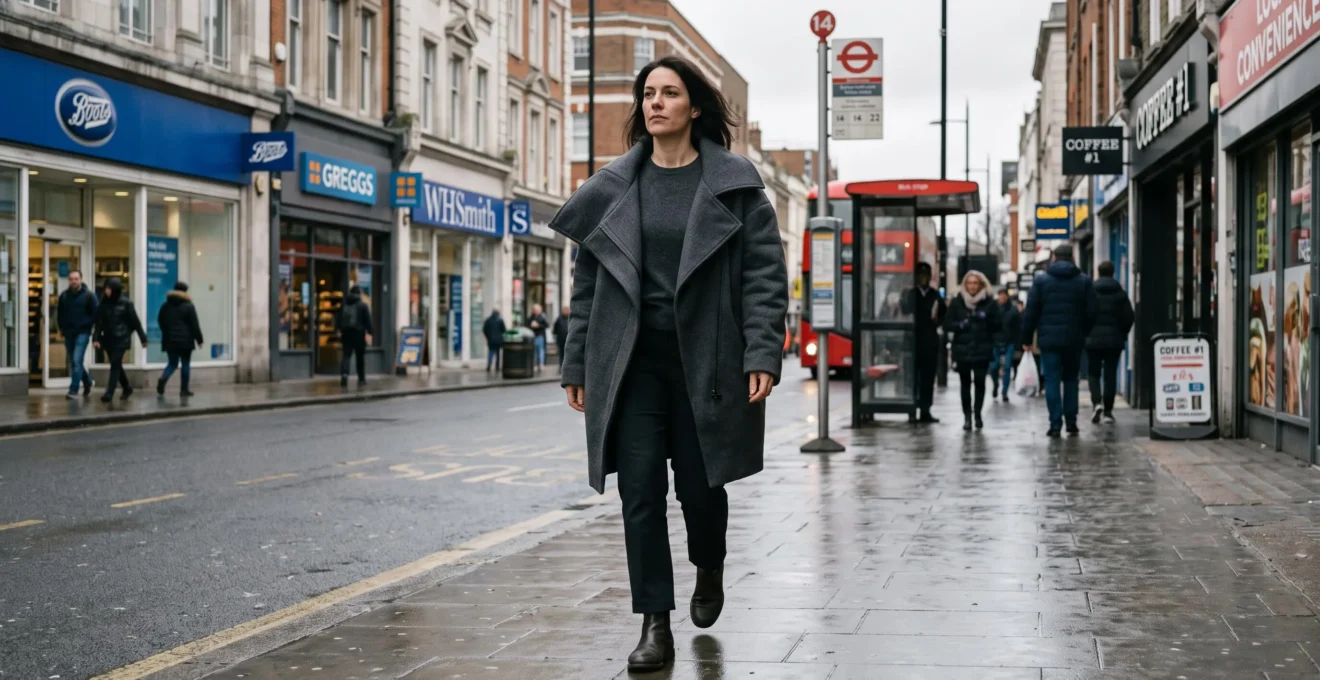
Wearing avant-garde fashion in public becomes easier when an experimental garment has a clear role within an otherwise familiar outfit. You do not need to dress like a runway model, abandon your existing wardrobe or become comfortable with attracting attention overnight. The practical starting point is to choose one distinctive silhouette, control the surrounding proportions and make sure the clothes work with your actual day.
That distinction matters in the UK, where a single outfit might need to survive a rainy walk to the station, a crowded train, an office afternoon and a spontaneous evening out. A sculptural coat can look remarkable in a photograph yet become frustrating if its shoulders prevent you from carrying a bag. An oversized outfit can feel liberating but appear shapeless when every garment has equal volume.
The solution is not to make avant-garde fashion less interesting. It is to give its unusual design elements enough structure, context and repetition to feel like part of your personal style rather than a costume reserved for special occasions.
Avant-garde dressing without the awkwardness
- Choose one focal point: let an unusual sleeve, asymmetric hem or architectural shoulder lead while other garments remain visually quieter.
- Balance design with function: consider proportions, fabric weight, movement, weather and your everyday routine before choosing a statement piece.
- Repeat rather than escalate: wear the same distinctive garment in familiar settings before introducing additional experimental elements.
- Why Do Avant-Garde Looks Feel Awkward Until You Control One Detail?
- How to Add One Avant-Garde Piece to a Normal Outfit Without Clashing?
- Oversized or Sculptural: Which Avant-Garde Direction Works Better for Daily Wear?
- The Avant-Garde Buying Mistake That Leaves You With a Piece You Can’t Sit In
- When Is the Best Time to Wear Avant-Garde Pieces So They Feel Normal?
- How to Turn a Runway Trend Into One Wearable Detail Without Looking Costume-Like?
- How to Build a Genderless Outfit Using 3 Anchor Points So It Still Looks Intentional?
- How Do Genderless Fashion Codes Work Without Losing Shape or Looking Sloppy?
Why Do Avant-Garde Looks Feel Awkward Until You Control One Detail?
Avant-garde outfits can feel awkward because unfamiliar proportions make you more aware of your appearance, particularly when you cannot identify what the outfit is supposed to emphasise. Choosing one controlled detail creates a clear visual focal point and gives you a practical styling decision to concentrate on. It does not eliminate social anxiety, but it can make an unfamiliar outfit easier to understand and wear.
Picture yourself stepping onto a busy train wearing exaggerated shoulders, dramatically wide trousers, an asymmetric bag and unusually shaped footwear. Every element asks for attention. The discomfort may come less from any individual garment than from feeling uncertain about how the pieces relate to one another.
There is also a psychological reason not to assume that everyone is studying your outfit. Research on the spotlight effect published in the Journal of Personality and Social Psychology found that people can overestimate how much others notice their appearance and behaviour. Its clothing experiments involved printed T-shirts, not avant-garde silhouettes, so the findings offer perspective on perceived scrutiny rather than proof that a particular styling formula reduces anxiety.
The practical response is the one controlled detail rule. Choose the garment feature you want people to notice, then keep the remaining elements familiar enough to support it.
- Structured shoulder: wear a sculptural jacket with a plain top, straight trousers and simple footwear.
- Asymmetric hem: pair an irregular skirt with a restrained knit and uncomplicated boots.
- Exaggerated sleeve: use a top with unusual volume alongside clean, close-fitting or straight-cut bottoms.
Next, distinguish clothing discomfort from contextual discomfort. A dramatic coat might feel completely appropriate at a gallery opening but overly conspicuous during a quick supermarket visit. That does not mean the coat is wrong. The surrounding environment may simply demand a different level of visual intensity.
Try a quick mirror test: remove the most experimental garment and assess what remains. Ideally, the base outfit still looks complete, while replacing the statement piece makes it more expressive. If everything feels disconnected without that piece, review the underlying proportions and colours rather than adding another novelty item.
Confidence does not require pretending that nobody will notice you. It begins with knowing why each garment is there, which makes the next challenge—integrating an unusual piece into normal clothing—much more manageable.
How to Add One Avant-Garde Piece to a Normal Outfit Without Clashing?
To add an avant-garde piece without creating visual conflict, keep two of three outfit variables consistent: colour palette, fabric weight and silhouette. Allow the experimental garment to disrupt the third. Then connect it to something already in your wardrobe, such as a shared tone or proportion. This establishes a deliberate hierarchy instead of making unrelated statement pieces compete.
For example, an asymmetric charcoal skirt becomes easier to style when worn with a charcoal or stone-coloured knit and familiar leather boots. The skirt provides the unusual shape, while the restrained colours and compatible fabric textures connect the outfit.
The same principle can work with a heavily structured blazer. Instead of adding architectural trousers, exaggerated shoes and an unconventional bag, try dark straight-leg denim and a simple crew-neck top. The blazer remains the strongest element because the supporting pieces do not challenge its structure.
Think of this as translating the experimental piece into your existing wardrobe. Instead of asking which other dramatic item matches it, look for an ordinary garment that shares one identifiable characteristic.
For a UK weekday office with a flexible dress code, an asymmetric midi skirt, fine-gauge knit and ankle boots can create an expressive but relatively restrained outfit. For a casual weekend, an oversized blazer with pronounced shoulders, straight jeans and flat shoes offers a similarly clear arrangement.
Weather adds another consideration. A statement skirt might need tights and sturdy boots on a wet day, while a structured jacket must fit comfortably beneath or function as an appropriate outer layer. A beautiful formula is not useful if it only works indoors.
The most common clash is often structural rather than colourful. Two garments with equally dominant architectural shapes can compete for the outline of the body. One strong structure paired with softer or simpler garments usually produces a more readable silhouette.
Once the statement garment belongs visually, the next decision is whether its impact should come primarily from volume or from architectural construction.
Oversized or Sculptural: Which Avant-Garde Direction Works Better for Daily Wear?
Oversized avant-garde clothing is generally the more adaptable starting point for daily wear when its volume is controlled, while sculptural clothing creates stronger definition but may require closer attention to movement and fit. Neither direction is automatically more comfortable or flattering. The better choice depends on fabric, construction, personal proportions and the activities your clothes must accommodate.
Oversized design works primarily through changes in scale: dropped shoulders, extended hems, wide sleeves and generous trousers. Its advantage is flexibility. However, when every garment has the same loose volume, the outfit may lose its intended shape.
Sculptural design works through deliberate form: angular panels, shaped collars, engineered folds or pronounced shoulders. It can communicate a clear design idea with just one piece, but its construction may interact with your seat, bag, outerwear or daily movements.
The following comparison is a practical styling guide, not a measured performance ranking. Individual garments can behave very differently within each category.
| Daily-life criterion | Oversized | Sculptural |
|---|---|---|
| Movement | Often offers room, although excess fabric can interfere with activity. | Depends on where rigid construction and seams sit. |
| UK weather | Can allow layering, provided proportions and sleeve openings cooperate. | May be harder to layer beneath conventional outerwear. |
| Photographs | Emphasises drape, movement and overall proportion. | Emphasises defined outlines and architectural features. |
| Sitting and commuting | Wide fabric may bunch around seats or catch on surrounding objects. | Rigid hips, collars or shoulders may restrict certain positions. |
| Wardrobe integration | Often works with fitted or straight-cut basics. | Usually benefits from simpler supporting garments. |
Body proportions influence how these choices appear, but there is no universal rule based on body type. Someone with a smaller frame may prefer shorter oversized hems to keep their preferred proportions visible. A taller person might enjoy longer volume, while someone who cycles or walks extensively may prefer softer construction regardless of height.
Posture and movement matter just as much as measurements. A jacket with an angular shoulder may look balanced while standing but feel awkward when reaching overhead. Wide trousers may fall beautifully while walking yet become cumbersome on stairs.
A particularly useful compromise is the hybrid garment: an oversized coat with one sculptural collar, a relaxed jacket with a defined shoulder or wide trousers with a deliberately controlled hem.
Once you have chosen a direction, functionality becomes the decisive buying test. A garment cannot become an everyday staple if its most interesting feature prevents ordinary movement.
The Avant-Garde Buying Mistake That Leaves You With a Piece You Can’t Sit In
The most costly practical mistake in buying avant-garde clothing is judging it only while standing still. Architectural skirts, rigid jackets and exaggerated trousers can look convincing in a mirror but interfere with sitting, bending, reaching or commuting. Before buying, test the garment through everyday movements and check whether its distinctive construction remains comfortable and functional.
A fitting-room mirror shows how a garment looks in one position. It does not necessarily reveal whether a shaped skirt pulls across the thighs when seated, a structured shoulder limits your arms or a dramatic collar presses against your neck when you turn your head.
Fashion history offers a useful precedent for designing around movement. The V&A’s analysis of Gabrielle Chanel’s approach to comfort and movement describes how she studied garments on the body and had models move so restrictions could be identified. Although the article concerns historical fashion rather than contemporary avant-garde tailoring, it illustrates why movement deserves attention during garment evaluation.
Apply that principle in the changing room. Sit fully on a bench, stand back up, lift both arms, walk several metres and bend towards the floor. Notice whether the fabric shifts naturally or whether the garment forces you to change how you move.
Watch for thoughtful construction rather than assuming all avant-garde pieces are restrictive. Gussets can provide additional room at movement points, stretch panels may accommodate motion, and softer architectural fabrics can maintain an unusual outline without requiring a completely rigid structure. Their usefulness still depends on placement, fit and garment quality.
The financial consequence is straightforward: a garment that cannot accompany your normal activities has fewer realistic wearing opportunities. Even if the piece is visually remarkable, its practical value may be limited if you repeatedly choose something easier instead.
The five-step avant-garde fitting-room checklist
- Identify the design feature. Name the exact shoulder, hem, fold or proportion you want to preserve. Your result: a one-sentence reason for buying the piece.
- Complete the sitting test. Sit fully and stand up without repeatedly adjusting the garment. Your result: a clear pass or fail for seated comfort.
- Check your movement range. Raise both arms, walk and bend towards the floor. Your result: a short list of any restricted movements.
- Recreate your daily routine. Try the garment with the shoes, bag or outer layer you expect to use. Your result: at least one realistic complete outfit.
- Confirm wearing opportunities. Identify three genuine activities where the garment would be suitable. Your result: three occasions written down before purchasing.
If a piece passes these checks, the remaining challenge is less about its physical suitability and more about finding situations where wearing it feels natural.
When Is the Best Time to Wear Avant-Garde Pieces So They Feel Normal?
The best time to start wearing avant-garde clothing is in a setting where expressive dressing already feels appropriate and you can focus on enjoying the day rather than managing your appearance. Creative workplaces, exhibitions, informal city outings and fashion-related events can provide useful starting points. Gradually wearing the same piece elsewhere can make it feel more familiar without requiring a completely different outfit every time.
Consider context rather than waiting for a special date. A structured coat might be easy to introduce during an afternoon visiting galleries in London, Manchester or Bristol. A deconstructed jacket could work at a creative networking event, while an asymmetric skirt might suit an informal weekend meal.
These are styling possibilities, not guarantees that everyone in those environments will respond positively. Comfort also depends on the people around you, local expectations and your own preferred level of attention.
Start with a context calibration approach:
- Wear the piece somewhere expressive clothing feels ordinary to you.
- Repeat it during a familiar activity, such as a café visit or weekend shopping trip.
- Introduce it into a regular weekday outfit with restrained supporting garments.
- Adapt its intensity for more formal situations when the dress code allows.
The first wear may feel unusually noticeable because the silhouette is unfamiliar. Repeating the item gives you opportunities to learn how it moves, what layers work with it and which combinations feel most comfortable. There is no established number of wears after which self-consciousness disappears; the progression is personal.
Some settings have stricter clothing expectations. A conservative corporate meeting, wedding or formal family occasion may call for a subtler interpretation. An unconventional jacket could be paired with conventional tailoring, for example, while a dramatic accessory may be left out.
Other situations genuinely require different clothing. Safety requirements, workplace policies and ceremonial dress codes should not be ignored in pursuit of a styling goal.
The aim is not to make every occasion equally experimental. It is to understand which parts of your style can travel between contexts—an important skill when taking inspiration from runway fashion.
How to Turn a Runway Trend Into One Wearable Detail Without Looking Costume-Like?
To make a runway trend wearable, identify its central design gesture and reproduce that idea at a lower intensity rather than copying the entire look. An exaggerated shoulder can become one structured detail, a deconstructed jacket can become a visible-seam layer, and dramatic asymmetry can become a slightly displaced hem. Preserve the concept while simplifying the surrounding outfit.
Runway presentations often communicate ideas through deliberate exaggeration. Designers may combine unusual materials, unconventional construction, extreme proportions and styling elements that make the concept immediately visible.
The everyday wardrobe has different requirements. Clothing must accommodate your movements, climate, workplace expectations and the pieces you already own.
The distinction between conceptual fashion and familiar garment construction is well documented in The Met‘s exhibition galleries on Rei Kawakubo and Comme des Garçons. Its curatorial analysis describes experimental approaches involving asymmetry, imbalance, unfinished construction and unconventional silhouettes. These design gestures provide useful starting points for adaptation, although the museum does not prescribe an everyday styling formula.
The detail extraction method begins with one question: what would make this runway look recognisable if everything else were removed?
From there, select an intensity level:
- Full concept: an architectural jacket with extensive deconstruction and a dramatically irregular silhouette.
- Moderate statement: a tailored jacket with visible seams and one asymmetric panel.
- Subtle reference: a conventional jacket with an exposed seam, unfinished-looking edge or displaced fastening.
These are illustrative styling translations, not replicas of specific documented runway garments.
Another example is an exaggerated runway shoulder. Rather than reproducing its maximum width, choose a coat with one clearly structured shoulder and wear it with straight trousers. A conceptual head-to-toe monochrome ensemble might instead inspire a single tonal outer layer combined with ordinary wardrobe basics.
The costume-like effect often emerges when several unfamiliar codes are stacked without a visual hierarchy. Dramatic tailoring, statement footwear, extreme accessories and heavily trend-driven trousers can all compete, leaving no quieter element to frame the idea.
Working with one idea rather than copying an entire presentation also creates room for another form of experimentation: clothing that moves beyond conventional menswear and womenswear categories.
How to Build a Genderless Outfit Using 3 Anchor Points So It Still Looks Intentional?
A genderless outfit can be built around three anchor points: one structural element that establishes the silhouette, one tonal connection that unifies the garments and one distinctive detail that expresses personality. This approach allows clothing from different departments or design traditions to work together without relying on conventional gender categories. Fit, proportion and overall composition take priority over labels.
The method is useful because it replaces the question of whether a garment looks masculine or feminine with a more practical question: how do its shape, fabric and details relate to everything else?
Gender-nonconforming clothing is not a recent invention. Historical examples discussed in The Museum at FIT‘s exhibition on Elizabeth Hawes show how designers have challenged conventional clothing categories while considering practicality and personal expression. Such historical work offers context, not proof that a particular three-anchor method is universally effective.
For everyday styling, define the anchors clearly:
- Structural anchor: wide-leg trousers, a boxy jacket or another garment establishing the outfit’s main proportion.
- Tonal anchor: related colours or fabrics that visually connect the pieces, such as charcoal, grey and washed black.
- Detail anchor: one unusual cuff, asymmetric fastening, architectural collar or distinctive accessory.
Imagine a hypothetical outfit consisting of charcoal wide-leg trousers, a cropped black jacket, a soft grey top and a jacket with one displaced fastening. The trousers establish the silhouette, the closely related colours unify the outfit, and the fastening provides an expressive detail.
The formula works as a guide rather than a compulsory uniform. Someone who already owns wide trousers could reuse them with an existing jacket. Someone shopping second-hand might find a dropped-shoulder coat and build the remaining outfit around its proportions.
Select garments by how they fit rather than which department sells them. Straight cuts, dropped shoulders, unstructured tailoring and mid-weight fabrics can provide useful options, but none is suitable for every body. Shoulder placement, hip ease, sleeve length and garment balance still need individual attention.
Small adjustments often make a significant visual difference. Hem trousers so their width falls deliberately over shoes, tuck a shirt to reveal a proportion boundary, or layer a shorter garment over a longer one to create a controlled contrast.
Once those anchors are established, the next step is to keep genderless proportions expressive without letting unnecessary fabric obscure the design.
Key takeaways before refining genderless proportions
- Choose the location of intentional volume rather than assuming every garment should be loose.
- Evaluate hems, shoulder construction and fabric behaviour before deciding whether an oversized piece fits well.
- Use proportion as a creative tool, not a restriction tied to gender, height or body shape.
How Do Genderless Fashion Codes Work Without Losing Shape or Looking Sloppy?
Genderless fashion works by focusing on proportion, construction, fabric and personal expression instead of assigning clothing to traditional gender categories. To keep an outfit visually intentional, establish at least one clear shape or proportion relationship. Wide garments can be balanced with cropped lengths, defined edges or firmer fabrics, while fluid pieces can gain structure through careful layering and fit.
Genderless dressing does not require a neutral, shapeless appearance. A sharply tailored jacket can be genderless, as can a flowing skirt, oversized coat or straight-cut trouser. The defining principle is that the garment is selected and styled without treating a gender label as the deciding factor.
One challenge emerges when volume and softness are distributed evenly across the outfit. An extremely loose knit over equally loose trousers, both in fabrics without much structure, may obscure the boundaries between garments.
That can be an intentional aesthetic choice. If the aim is a more defined composition, however, create visual contrast.
- Oversized top: try straight, tapered or cropped trousers that give the upper volume a distinct boundary.
- Wide bottoms: consider a shorter jacket, a tucked layer or a clearly defined shoulder.
- Fluid layers: introduce a firmer fabric, visible waist point or controlled hem to establish structure.
- Generous volume throughout: use deliberate length differences and fabric weights so each layer remains visible.
A helpful distinction is the difference between oversized and simply ill-fitting. Deliberately oversized clothing usually demonstrates considered proportions: dropped shoulders that sit where the designer intended, hems that establish a recognisable line and fabric that creates a specific drape.
An ill-fitting garment may pull across one area while hanging unnecessarily in another, shift uncomfortably during movement or have proportions that do not support the intended silhouette.
Neither balance nor a defined waist is mandatory. Some avant-garde designers deliberately reject conventional ideas of flattering proportions. The practical question is whether the result achieves the appearance and freedom of movement you want.
For example, a boxy charcoal coat could be worn with wide black trousers and substantial boots. Even with volume on both halves, the outfit can remain coherent if the coat and trousers have distinct lengths, the fabrics hold their intended shapes and the footwear provides a stable visual endpoint.
For your next everyday outfit, choose one avant-garde garment you already own, build around its strongest feature, check the fit while moving and wear it somewhere familiar. The goal is not to disappear into the crowd or imitate a runway presentation. It is to make an expressive design choice that works comfortably within your real life.
Can avant-garde fashion work in a conventional UK office?
Yes, when the workplace dress code permits it. Start with a subtle asymmetric detail, structured jacket or unusual collar in restrained colours. Pair it with familiar office trousers, knitwear or footwear. More conservative workplaces may require a less conspicuous interpretation, and formal policies should take priority.
Do you need designer clothing to create an avant-garde outfit?
No. Avant-garde styling depends on design choices such as asymmetry, proportion, layering and unconventional construction rather than a particular price tag. Existing wardrobe pieces, second-hand garments or careful alterations can provide opportunities to experiment. The important consideration is whether the final outfit communicates a deliberate design idea.
Which colours make experimental silhouettes easier to style?
Black, charcoal, navy, stone and other familiar tones can make silhouette experimentation easier because they allow the shape to become the main visual feature. They are not compulsory. Bright colour can also work when the remaining garments share a consistent palette and do not introduce competing structural details.
What should you do when strangers stare at an unusual outfit?
First, avoid assuming every glance represents criticism. Research on the spotlight effect suggests that people can overestimate how much attention others give their appearance. If the situation is otherwise comfortable and safe, focus on your activity rather than continually adjusting the outfit. If attention becomes intrusive or threatening, prioritise your safety and comfort over maintaining any particular fashion statement.
Can an outfit be both genderless and strongly sculptural?
Absolutely. Sculptural construction is not inherently masculine or feminine. Angular shoulders, curved panels, asymmetric hems and exaggerated volume can be incorporated into genderless clothing. Evaluate the garment according to its construction, proportions, movement and relationship with other pieces rather than the department or gender label attached to it.