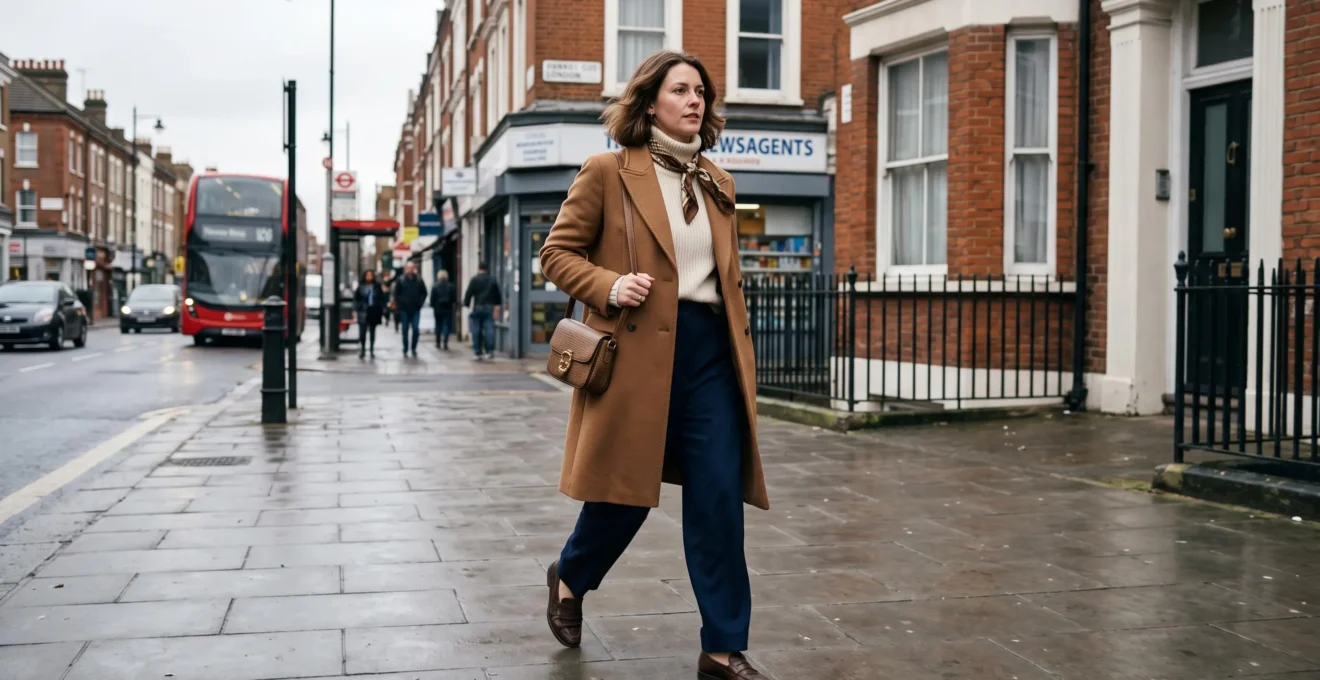
A memorable personal style rarely comes from owning the most clothes. It comes from making a handful of consistent decisions about colour, shape, proportion and finishing details. When those decisions repeat across different outfits, people begin to recognise your style without needing to see the same garments every day.
For UK professionals and creatives, the challenge is making that consistency work through unpredictable weather, different workplaces and changing social occasions. A polished outfit for a studio meeting may need to survive a wet commute, an afternoon presentation and an informal dinner. A signature look that cannot accommodate those realities will quickly become another source of decisions.
The practical alternative is to identify what you already wear successfully, turn those patterns into a few reliable outfit formulas and allow controlled variation. Your wardrobe remains flexible, but the choices behind it become simpler. The aim is not to look identical every day. It is to look recognisably yourself, with less shopping and less effort.
Your signature-look strategy in brief
- Identify the colours, silhouettes and accessories that already repeat in your 15 most-worn items.
- Build three to five outfit formulas that accommodate your actual routines, weather and dress codes.
- Keep a consistent visual foundation while changing textures, layers and one expressive detail to avoid feeling uniformed.
- Why Do People Think You’re Stylish When You Repeat Similar Outfits?
- How to Find Your Signature Look Using 15 Items You Already Own?
- Signature Colours or Signature Silhouettes: Which Is Easier to Maintain?
- The Signature-Style Mistake: Copying a Look That Doesn’t Fit Your Life
- When Should You Update Your Signature Look So It Still Feels Like You?
- A 3-Piece Outfit Formula That Keeps You Looking Polished Through 4 Seasons
- When Should You Commit to a Default Aesthetic Code So Getting Dressed Gets Easier?
- How Do You Read Aesthetic Codes So You Don’t Misjudge a Dress Code?
Why Do People Think You’re Stylish When You Repeat Similar Outfits?
Repeating similar outfits can make your style more recognisable because consistent colours, proportions and accessories create a familiar visual identity. People can begin associating particular elements with you rather than remembering individual garments. Repetition alone does not guarantee that an outfit looks stylish, however: fit, condition, context and deliberate variation still matter.
Consider someone who regularly wears navy tailoring, soft knitwear and understated silver jewellery. On Monday, that might mean navy trousers with a fine-gauge jumper. On Thursday, it could be a navy blazer over a simple top and relaxed trousers. The outfits differ, but the recurring palette and proportions make them feel connected.
This is similar to visual branding: a recognisable identity relies on a limited number of repeatable features. Once those features become familiar, the observer needs fewer distinctive cues to recognise the overall aesthetic.
There is a psychological basis for considering familiarity, although fashion-specific conclusions require caution. A Psychological Bulletin meta-analysis of the mere-exposure effect, published in 2017, examined how repeated exposure relates to familiarity, recognition and liking. Its findings were conditional, including an inverted-U-shaped relationship, and did not investigate whether repeating outfits makes somebody appear more stylish.
The useful styling interpretation is that consistency can support recognition, not that familiarity automatically creates admiration.
Repetition is different from duplication. Repeating the same outfit formula allows variation in fabric, texture and finishing details. Repeating an identical head-to-toe outfit every day is another option, but it offers fewer opportunities to adjust the visual impression.
- Repeat a colour family while alternating between cotton, wool and linen.
- Keep a familiar silhouette but change the balance between structured and relaxed fabrics.
- Use the same jewellery or bag with different combinations of existing garments.
- Maintain a consistent shoe style while adapting the material to the season.
The fear of appearing boring often comes from confusing personal consistency with a lack of imagination. A restricted palette can be intentional, expressive and visually interesting when the wearer understands proportion and detail. Conversely, constantly changing aesthetics can make individual outfits interesting without establishing a recognisable personal identity.
Recognition is a useful starting point, but the most sustainable signature is one that emerges naturally from what you already choose to wear.
How to Find Your Signature Look Using 15 Items You Already Own?
Find your signature look by selecting your 15 most-worn clothing items and looking for recurring colours, silhouettes and fabrics. Rather than inventing an aesthetic or buying a capsule wardrobe, identify the combinations you already rely on. Use those patterns to create three to five practical outfit formulas, then document them so getting dressed requires fewer decisions.
Start with actual wearing habits, not favourite purchases. A beautifully tailored blazer that rarely leaves its hanger tells you less about your working style than the trousers you reach for twice a week.
The case for examining existing wardrobes is practical. UK research published in 2022 by WRAP reported that items in the average wardrobe not worn in the preceding year accounted for 26 % of items. The findings come from consumer research conducted in 2021 and are presented in WRAP’s UK clothing longevity and wardrobe research. They do not establish an ideal wardrobe size, but they highlight the difference between owning clothes and using them.
Lay your selected items on a bed or clean floor. Group them by colour family first, then examine their shapes and fabric weights. You might discover that most of your clothes are dark neutrals, that you prefer straight trousers over tapered ones, or that soft layers dominate your everyday outfits.
Look for two or three recurring characteristics. A hypothetical wardrobe might reveal charcoal and cream as core colours, relaxed trousers as a preferred silhouette and structured outerwear as its strongest visual feature. Those observations are more useful than trying to fit everything into an aesthetic label.
Next, ask of each item: “Would I notice this missing from my week?” An item you would miss probably has real functional or stylistic importance. An item you would not miss may be peripheral, although it could still serve an occasional practical purpose.
The objective is not to dispose of peripheral pieces. It is to avoid making them the foundation of future purchases.
Your five-step signature wardrobe audit
- Select 15 frequently worn items. Write down their names or photograph them together. Your deliverable is a numbered inventory of 15 pieces.
- Identify recurring visual patterns. Group the items by colour, silhouette and fabric weight. Record at least two characteristics that appear repeatedly.
- Test their actual importance. Apply the missing-from-my-week question to each piece. Mark the items that consistently support your routine.
- Create three to five outfit formulas. Combine existing items into workable outfits for your normal activities. Save one photograph or written combination for each formula.
- Record a simple wardrobe rule. Summarise your recurring palette, preferred proportion and finishing detail in a phone note. The deliverable is a short reference you can use before getting dressed or buying anything.
For example, a saved formula might read: “Straight dark trousers + light knit + structured jacket + loafers.” The garments can change while the underlying decision remains stable.
Once your existing patterns are visible, the next decision is whether colour or silhouette should provide the strongest point of consistency.
Signature Colours or Signature Silhouettes: Which Is Easier to Maintain?
A signature colour palette is generally easier to maintain if your clothing sizes, preferred cuts or daily requirements change. A signature silhouette can provide stronger visual continuity across different colours, but it demands closer attention to fit and proportions. For many wardrobes, the most practical approach combines two or three consistent colours with one repeatable silhouette rule.
A colour-led signature creates an immediate filter. If your core palette is navy, cream and burgundy, you can assess an occasional purchase by whether its colour works with several existing pieces. You are less likely to bring home a garment that requires a completely separate outfit.
Silhouette-led dressing works differently. Instead of prioritising colour, it repeats a relationship between shapes: a fitted upper half with wide-leg trousers, a long outer layer over a narrow base, or relaxed tailoring with a defined waist.
Such proportions can remain distinctive even as seasonal fabrics or fashion trends change. However, their success depends on the actual fit of each garment, not simply the label describing its cut.
The following comparison is a practical styling framework rather than a scientifically established ranking.
| Practical consideration | Signature colours | Signature silhouettes |
|---|---|---|
| Occasional shopping | Easy to screen potential additions against the existing palette | Requires closer checking of fit and proportion |
| Changes in sizing | Colour continuity can remain intact across different cuts | May require adjusting garment shapes |
| Seasonal variation | Maintain colour families while changing fabrics and depth | Keep proportions while changing fabric weight and layers |
| Long-term consistency | Depends on access to compatible tones | Depends on finding and maintaining preferred shapes |
| Useful starting point | People whose wardrobe needs regular fit adjustments | People with established fitting preferences who shop infrequently |
The hybrid approach removes the need to choose exclusively. Select a narrow palette and pair it with a repeatable proportional rule.
For instance, navy, stone and soft grey could support a wardrobe built around structured tops and fluid lower pieces. A navy jacket, stone shirt and charcoal wide-leg trousers feel coherent without needing an identical outfit every day.
Colour and silhouette also have different failure points. A strict palette can feel monotonous without fabric or accessory variation. A strict silhouette can become impractical when weather, activity or comfort requirements change.
Neither should override how you feel wearing the clothes. The strongest signature is one you can comfortably maintain during an ordinary working week.
That choice should remain provisional until it has passed a more important test: whether the aesthetic fits the life you actually lead.
The Signature-Style Mistake: Copying a Look That Doesn’t Fit Your Life
Copying a signature look without testing it against your routine is one of the easiest ways to create a wardrobe you rarely wear. An admired outfit may work beautifully in photographs but fail during a rainy commute, a physically active day or a workplace with different expectations. Inspiration becomes useful when you adapt its underlying features rather than reproduce every garment.
A minimalist look built around delicate shoes, lightweight trousers and an unstructured jacket might suit someone who spends most of their day indoors. For somebody walking between train stations and offices in Britain, it may be less practical during wet or cold weather.
The problem is not the aesthetic itself. It is the mismatch between the outfit’s requirements and the wearer’s actual circumstances.
Before adopting a look, apply a life-fit test across a typical week:
- Weather: Does the outfit work with the outerwear and footwear your local conditions demand?
- Movement: Can you walk, sit, travel and carry your usual belongings comfortably?
- Care: Are the garments compatible with the washing, drying and maintenance you realistically manage?
- Dress codes: Does the look adapt to your work environment and regular social occasions?
- Cost: Can you maintain it using what you own, with purchases driven by genuine wear or changing needs?
The maintenance question deserves particular attention. An outfit that requires frequent specialist cleaning or constant replacement may be incompatible with the goal of reducing everyday effort.
There is also an emotional test. What do you change into when you get home? If your preferred relaxed clothing shares nothing with your intended signature, ask whether you are dressing for your identity or performing somebody else’s.
This does not mean workwear and homewear must be identical. It means there should be continuity in the preferences behind them, whether that is soft fabric, generous proportions, a particular colour or understated accessories.
Suppose you admire a photographer’s monochrome wardrobe. Rather than buying the same coat and shoes, identify what attracts you: perhaps the restrained palette, clean lines or practical layers. Apply that element to the clothes that already suit your work and commute.
Borrow the principle, not the entire outfit. This preserves the inspiration without importing the inconvenience.
A signature that survives ordinary life is worth refining over time, rather than repeatedly replacing whenever your circumstances change.
When Should You Update Your Signature Look So It Still Feels Like You?
Update your signature look when your circumstances, comfort or personal preferences change enough that your familiar formulas stop working. A new job, different commute, changed sizing or growing frustration with existing outfits can justify a review. Most adjustments need only a small change in footwear, fabric, colour or proportion rather than a complete wardrobe reset.
Calendar-based reinvention is rarely necessary. Your clothes do not become unsuitable simply because another season or year has passed. A better signal is the amount of friction you experience when choosing and wearing them.
Perhaps your trousers still fit, but you now cycle to work and need more practical shoes. Perhaps your office has become more relaxed, or the structured jackets you once loved no longer feel comfortable. These are reasons to adapt the formula, not necessarily abandon it.
It helps to distinguish between a tune-up and a reset.
A tune-up changes one feature while retaining the familiar foundation. You might exchange stiff loafers for comfortable leather trainers, replace a worn heavy knit with a lighter one, or introduce a softer jacket. Your existing palette and proportions still connect the outfits.
A reset is more appropriate when the wardrobe no longer supports your daily life. A substantial change in occupation, climate, mobility requirements or aesthetic preferences may require rebuilding several formulas.
Even then, preserve one point of continuity where it still feels authentic: perhaps your preferred colours, jewellery, bag shape or approach to layering.
Concerns about looking dated also deserve perspective. A signature’s presentation can change noticeably when shoes become worn, outerwear loses its shape or fabrics look tired. These visible details may deserve attention before you replace otherwise functional clothing.
Review the garments people see most frequently, particularly coats, shoes and bags. Check their condition, comfort and compatibility with the rest of your wardrobe. Repair, clean or maintain them where appropriate before considering replacements.
Compliments can offer informal feedback, but their absence is not reliable evidence that your style has stopped working. Your comfort, confidence and daily usefulness are more dependable measures.
Once a familiar visual foundation is established, a simple outfit structure can make that continuity easier to maintain across all four seasons.
A 3-Piece Outfit Formula That Keeps You Looking Polished Through 4 Seasons
A three-piece outfit formula works year-round when each piece has a consistent function rather than being a fixed garment. Choose an anchoring layer, a base layer near your face and a lower piece that defines your silhouette. Preserve their visual relationship as the seasons change, adjusting fabric weight, warmth and footwear without reinventing the entire outfit.
The anchoring layer provides the clearest statement of style. It might be a structured jacket, cardigan, overshirt or coat. Its purpose is to establish the outfit’s overall character.
The base layer creates continuity close to the face. A cream top, navy shirt or softly coloured knit can repeat your preferred palette without becoming visually identical every day.
The lower piece determines the proportion. Straight trousers, wide-leg trousers or a skirt establish the shape that connects your combinations.
For example, someone who favours a structured upper half and relaxed lower half can keep that relationship throughout the year. Only the material, warmth and layering need to change.
Think of the following combinations as hypothetical seasonal variations on the same three functions, not as a shopping list.
| Season | Anchoring layer | Base layer | Lower piece |
|---|---|---|---|
| Spring | Light structured jacket | Cream cotton top | Fluid navy trousers |
| Summer | Lightweight linen overshirt | Cream breathable top | Lightweight straight trousers |
| Autumn | Medium-weight wool jacket | Fine cream knit | Dark fluid trousers |
| Winter | Structured warm coat | Insulating knit layer | Heavier straight trousers |
The visual identity remains consistent: a defined upper layer, a restrained palette and a familiar lower-half shape. In warmer months, the fabrics become lighter. In colder months, insulation and outerwear take priority.
This is particularly relevant in Britain, where a rainproof or warm outer layer may be necessary even when the underlying outfit is carefully coordinated. The three-piece formula should accommodate that reality rather than force you to add visually conflicting layers.
When a winter coat becomes the visible anchoring layer, the outfit can effectively become two visible garments plus outerwear. The coat does not interrupt the formula; it fulfils the anchoring function.
Footwear and accessories provide the finishing consistency. A familiar shoe shape, watch, scarf or understated piece of jewellery can reinforce the look, provided it remains suitable for the weather and occasion.
For garment longevity, WRAP‘s clothing reuse and longevity guidance identifies appropriate care, repeated wear and adaptable clothing as relevant considerations. Using a garment in several different outfit combinations is consistent with those principles, although no particular three-piece formula has been established as optimal.
Comfort remains essential. Some winter days need additional thermal layers, while hot weather may make an outer layer unnecessary. Three pieces are a useful planning structure, not a limit on what you may wear.
Once these combinations work reliably, you can turn them into a default aesthetic code without making your wardrobe unnecessarily restrictive.
When Should You Commit to a Default Aesthetic Code So Getting Dressed Gets Easier?
Commit to a default aesthetic code once your preferred colours, proportions and outfit formulas have worked across several ordinary weeks. A useful code removes recurring decisions without controlling every detail. Keep the palette and basic shape consistent, but leave room for weather, dress requirements, personal mood and an expressive element that can change.
An aesthetic code is simply a short set of decisions you no longer need to reconsider every morning. It could specify a restrained colour palette, a preferred relationship between upper and lower garments, and a familiar outfit structure.
For example, a hypothetical code might be:
- Core colours: navy, cream and charcoal.
- Default proportion: structured upper layer with relaxed trousers.
- Usual formula: base top, anchoring layer and straight or fluid lower piece.
- Flexible detail: jewellery, scarf, footwear finish or an occasional accent colour.
That code does not determine which exact garments you wear. It simply reduces the number of competing choices.
Instead of asking, “What style should I create today?”, you ask, “Which of my existing combinations works for the temperature and occasion?”
This is the practical distinction between pre-deciding and restricting. A default simplifies choices. A uniform removes most choices altogether.
Test your code before treating it as permanent. Wear your formulas across workdays, errands and social occasions. Observe which combinations require adjustments and which feel natural without much thought.
If the system only works after purchasing several supposedly essential pieces, it may be too dependent on an imagined wardrobe. Revisit what you already own before assuming the missing garments are the solution.
Conversely, if an existing item or a genuinely necessary replacement fits the established palette and proportions effortlessly, your code is likely becoming practical.
Do not lock in every detail. Trend influences, accessories and occasional statement garments can remain flexible. Someone known for restrained tailoring can still wear a colourful scarf or an unexpected pair of shoes without losing their visual identity.
Nor does the code need a formal aesthetic name. “Soft neutrals, relaxed trousers and defined outerwear” can be more useful than trying to follow a fashionable category whose meaning keeps changing.
A successful code should make everyday dressing easier while leaving enough flexibility to respond appropriately when an occasion calls for a different level of formality.
Key takeaways before adapting your look
- Separate your signature identity from the formality of an event: colour and proportion can remain familiar while presentation changes.
- Keep versatile shoes, outerwear and accessories in mind when evaluating whether an outfit suits different settings.
- When a dress code is ambiguous, read the occasion before deciding how far to adjust your usual formula.
How Do You Read Aesthetic Codes So You Don’t Misjudge a Dress Code?
Read an unfamiliar dress code by considering the venue, occasion, invitation wording, time of day and expected activities together. Terms such as “smart casual” change meaning across settings, so context matters more than a rigid definition. A flexible signature wardrobe lets you adjust footwear, outerwear and accessories while keeping your familiar colours and proportions.
In the UK, the same wording can suggest different outfits at a restaurant, creative workplace or afternoon garden gathering. “Smart casual” at an office event may call for a more polished combination than an informal weekend lunch.
Likewise, “dress to impress” suggests an opportunity for more expressive clothing, but it does not identify a single universal level of formality.
Debrett’s advice on interpreting dress codes recommends considering the venue, invitation, time, weather and nature of the occasion. Its British etiquette guidance also identifies footwear, jewellery and removable layers as practical tools for adjusting an outfit’s formality.
Before selecting clothes, assess the likely expectations:
- Venue: Is it a formal dining room, office, private home, gallery or outdoor space?
- Invitation: Does the wording explicitly require formal attire, or does it leave room for interpretation?
- Timing: Is the occasion a daytime gathering, evening reception or business event?
- Activity: Will you be standing, walking outdoors, dining or attending a presentation?
- Host expectations: Are there useful clues from previous events, or can you ask the organiser directly?
Once the setting is clearer, adjust the register of your signature outfit rather than rebuilding it.
For example, a navy trouser-and-knit formula could become more formal with polished leather shoes, a tailored jacket and restrained accessories. The same foundation might feel more relaxed with a casual overshirt and suitable trainers.
This flexibility is particularly helpful when your wardrobe already contains compatible colours and proportions. You are changing the level of formality, not inventing another identity.
There are risks in both directions. Dressing too formally for a relaxed gathering can make you feel conspicuous or uncomfortable; dressing too casually for a formal event may conflict with the host’s expectations.
For an ambiguous occasion, aiming slightly towards the polished end of the plausible range can be a useful starting point, particularly when you can remove a jacket or simplify accessories. It is not a universal rule: clearly specified dress codes, safety requirements, cultural expectations and the event’s activities take priority.
If uncertainty remains significant, asking the organiser is more reliable than guessing.
The goal is adjustable consistency. Your recognisable palette, silhouette or accessories provide continuity, while an appropriate change in fabric, footwear or layering helps the outfit belong in the setting.
For your next working week, choose one familiar colour combination, one reliable silhouette and one flexible finishing detail. Save three suitable outfit variations using clothes you already own. That small exercise is enough to begin building a recognisable style that adapts to your life without turning into a uniform.
Can you develop a signature look on a limited budget?
Yes. Begin by identifying the clothing you wear most frequently, then create combinations around recurring colours and shapes. Maintaining, repairing and restyling existing pieces can support a coherent look without unnecessary purchases. Spend only when an item genuinely needs replacing or an important practical requirement is unmet.
Do you need one signature accessory to be memorable?
No. A recognisable style can emerge from consistent proportions, colours or layering habits alone. A repeated accessory can provide an additional cue, but it should suit your preferences and routine rather than become an obligation.
How many colours should a signature wardrobe contain?
Two or three core colours offer a manageable starting point, but there is no established ideal number. You can add supporting neutrals and occasional accents. The useful test is whether your colours combine easily and feel right in the clothing you actually wear.
Can a signature look work for both creative and corporate workplaces?
Yes, provided the look can adapt to each workplace’s expectations. A consistent palette or preferred trouser shape may carry across both settings, while tailoring, fabric, footwear and accessories change the formality. Always follow specific workplace requirements rather than assuming one combination suits every environment.
What if your personal style changes frequently?
You do not need to force a permanent aesthetic. Identify any recurring preference beneath the changes, such as a colour family, garment shape or layering habit, and use it as a flexible foundation. If experimentation is an important part of how you dress, your signature can be the way you combine clothes rather than a fixed appearance.