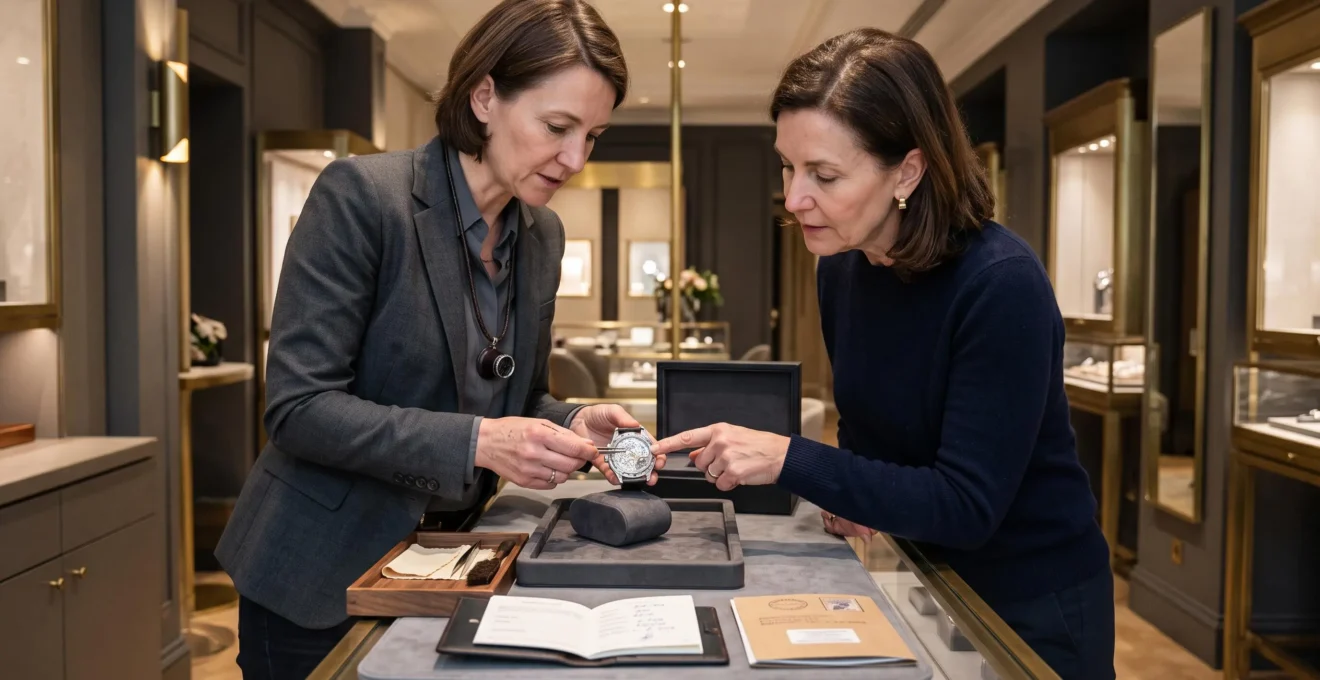
A luxury watch can display an impressive movement through a sapphire caseback, while a diamond ring can sparkle convincingly beneath boutique lighting. Neither impression tells you enough about how well the object has been made, how comfortably it will wear or what happens when something needs repairing.
Judging craftsmanship without specialist training means replacing vague impressions with questions and observations that can be checked. For watches, these include the quality of finishing, movement construction, servicing arrangements and the manufacturer’s long-term support. For fine jewellery, they include metalwork, stone security, setting design, comfort and independent documentation.
British buyers also have a practical advantage: established hallmarking rules provide a starting point for checking precious-metal content. But hallmarks, certificates and prestigious signatures each answer different questions. None establishes quality on its own.
The most useful purchase decision considers three things together: how the piece is made, how it will survive your particular lifestyle and how confidently its history can be established when you eventually service, repair or sell it.
Craftsmanship evaluation: the essentials
- Look beyond specifications. Inspect construction and finishing, then establish who will maintain the piece and what support is available.
- Make documentation part of the purchase. Match serial numbers, hallmarks and relevant grading reports to the actual item.
- Buy for a defined wearing role. A piece that fits your lifestyle and can be maintained responsibly is more useful than one chosen for impressive specifications alone.
- Why Does Servicing Matter More Than Specs in Luxury Watches and Jewellery?
- How to Ask the Right Questions in a Boutique So You Don’t Get Vague Answers?
- A Fine Watch or Fine Jewellery: Which Is Easier to Wear Every Day?
- The Paperwork Mistake That Makes Resale and Repairs a Nightmare
- A Collection-Building Strategy That Avoids Buying Two Pieces That Do the Same Job
- Why Does Adding a Chronograph Create More Failure Points Than a Simple Watch?
- How to Check a High Jewellery Setting for Comfort and Security in 2 Minutes?
- What Should You Look for in High Jewellery Besides Carat Weight and Price?
Why Does Servicing Matter More Than Specs in Luxury Watches and Jewellery?
Servicing matters because technical specifications describe a luxury piece at a particular point in time, while maintenance reveals how it can be kept functioning and wearing well over many years. A sophisticated movement or beautifully polished setting has limited practical value if essential components cannot be repaired, replacement parts are unavailable or ownership costs become unreasonable.
A watch specification sheet might describe the movement, power reserve, water-resistance rating and case materials. These are useful initial facts, but they cannot tell you whether a particular pre-owned movement has suffered damage, received appropriate lubrication or been maintained by competent technicians.
Service records offer a different kind of evidence. They may establish when the watch was examined, which components were replaced and who carried out the work. However, a documented service history is not a guarantee of condition: the scope and quality of the work still matter.
For a new watch, the manufacturer’s service infrastructure is especially revealing. Before purchasing, ask:
- Is an authorised service centre available in the UK, and where will this specific watch actually be serviced?
- Can the dealer explain typical turnaround arrangements and how estimates are approved?
- Which components can be replaced, and are original components returned when requested?
- How long does the manufacturer undertake to support discontinued movements?
- What warranty, if any, applies specifically to completed servicing?
These questions distinguish craftsmanship that looks impressive in a showroom from craftsmanship supported over an extended ownership period.
For example, Rolex‘s official World Service documentation states that parts and labour remain available for at least 35 years following a watch’s withdrawal from its catalogue. The manufacturer also describes a two-year international guarantee on parts and labour associated with its servicing.
These are manufacturer-specific commitments, not industry-wide standards, and the service guarantee is distinct from the original product warranty.
Jewellery requires a different maintenance approach. A mechanical watch has recurring inspection and servicing needs, although the appropriate interval depends on its construction, condition, use and manufacturer guidance. Fine jewellery maintenance is more dependent on materials, setting design and exposure to wear.
Possible jewellery work includes tightening or rebuilding worn prongs, repairing clasps, replacing lost metal and renewing rhodium plating on white-gold pieces where applicable. Some tasks are preventive; others become necessary after accidental damage.
That distinction changes budgeting. Watch servicing may be anticipated as a recurring ownership expense, whereas jewellery repairs can arrive unexpectedly following an impact or the discovery of a loose stone.
Consider a hypothetical comparison between two pre-owned watches: one from a prestigious manufacturer with an uncertain maintenance history, and another from a less celebrated maker supported by detailed authorised servicing records. The second may present a clearer technical risk profile, even if the first commands more attention from collectors. That does not establish which will retain more resale value; market demand, originality and condition remain decisive.
Serviceability is evidence of a manufacturer’s willingness and ability to support its work. The next challenge is obtaining precise answers about that support before handing over your money.
How to Ask the Right Questions in a Boutique So You Don’t Get Vague Answers?
Ask questions that require a verifiable answer rather than an opinion. A knowledgeable boutique representative should be able to identify who services the item, explain warranty exclusions, show appropriate documentation and describe how its construction affects durability. Responses that rely entirely on brand reputation or broad reassurance deserve follow-up questions before purchase.
A boutique visit should be treated as an opportunity to examine both the object and the seller’s understanding of it. You do not need to identify every watchmaking technique or gemstone characteristic. You need to establish whether important claims can be explained and supported.
Use the following exchanges as practical examples.
| Your question | Useful answer | Warning sign |
|---|---|---|
| Who services this piece, and where? | A named service provider, location or process, with written arrangements available. | “The Maison takes care of everything.” |
| What does the warranty exclude? | Clear distinctions between manufacturing defects, accidental damage, normal wear and maintenance. | “Everything is included.” |
| Can I inspect the hallmarks and documents? | Relevant marks, documents and identification details are explained. | Unwillingness to show available identification or clarify exemptions. |
| How are these gemstones secured? | An explanation of prongs, bezels or another setting mechanism and its maintenance needs. | “The stones cannot come loose.” |
| What happens if this component is damaged? | A realistic repair route, with limitations and an estimate process. | “That never happens.” |
Vague language is not automatic proof of poor craftsmanship or dishonesty. A salesperson may simply lack specialist training. The meaningful test is whether they can obtain a reliable answer, preferably in writing, rather than repeatedly substituting reassurance for information.
For jewellery sold in the UK, hallmarking is particularly relevant. Under the Hallmarking Act 1973 framework, qualifying precious-metal articles require legally recognised hallmarks, subject to statutory exemptions and applicable alternative recognised marks.
The UK government guidance on precious-metal hallmarking explains that a complete traditional UK hallmark includes three compulsory elements: a sponsor’s mark, a fineness mark and an Assay Office mark.
The guidance also identifies exemption thresholds of 1 gram for gold, 7.78 grams for silver, 0.5 gram for platinum and 1 gram for palladium. Other statutory conditions and exceptions may apply, so the absence of a hallmark cannot automatically establish a violation.
Importantly, hallmarking verifies precious-metal content. It does not establish the authenticity of a diamond, the security of its setting or the overall standard of craftsmanship.
When examining a gemstone setting, ask the jeweller to identify the actual retention mechanism. For example, a prong setting depends on metal projections holding the stone at its edges. Wear, deformation or impact may compromise that arrangement. A competent explanation should acknowledge such possibilities and describe how the setting is inspected.
Once claims have been clarified, the next test is more personal: whether the object suits the conditions in which it will actually be worn.
A Fine Watch or Fine Jewellery: Which Is Easier to Wear Every Day?
A well-chosen watch may be easier to wear consistently because many models are designed around practical daily use, but fine jewellery can be equally suitable when its materials, construction and setting match the wearer’s routine. Neither category is inherently more durable. Everyday suitability depends on impact exposure, moisture, comfort, maintenance and the consequences of accidental damage.
Marketing descriptions such as “everyday luxury” are not enough. A steel sports watch with appropriate water resistance and a delicate high-jewellery bracelet occupy very different practical categories, even though both can be expensive.
Equally, a simple gold wedding band may be less demanding than a complicated mechanical watch. The comparison should therefore concern individual objects rather than watches versus jewellery as entire industries.
| Consideration | Fine watch | Fine jewellery |
|---|---|---|
| Knocks and abrasion | Cases and crystals may scratch; significant impacts can affect the movement. | Metal can deform or abrade, and impacts may damage settings or gemstones. |
| Water exposure | Protection depends on the specific rating, seal condition and manufacturer instructions. | Resistance depends on the metal, stones, treatments and construction. |
| Skin products and cosmetics | Residues may affect straps and external surfaces. | Lotions and chemicals may affect appearance, finishes and certain gemstones. |
| Comfort | Case thickness, weight and strap fit matter. | Setting height, sharp edges, clasps and weight distribution matter. |
| Maintenance pattern | Periodic inspection and movement servicing may be necessary. | Cleaning and inspection, with repairs when wear or damage requires them. |
| Wear anxiety | Often relates to scratches, water exposure and mechanical damage. | May relate to snagging, stone loss, deformation or surface damage. |
Daily life in the UK provides useful test scenarios. A commuter wearing coats and knitwear should consider whether a ring catches on sleeves or a watch case sits comfortably beneath a cuff. Frequent wet-weather exposure makes the actual water-resistance provisions of a watch especially relevant.
For someone who regularly works with their hands, a high-set ring may be inconvenient even if its gemstone is exceptionally valuable. Similarly, a watch with exposed pushers or an expensive leather strap may not suit every activity.
High-karat gold can be relatively vulnerable to deformation compared with some lower-karat alloys, although construction, alloy composition and section thickness also affect durability. Gemstone hardness alone does not determine resistance to chipping or impacts.
A practical decision involves scoring each prospective piece against your own routine:
- How often will it encounter hard surfaces, water or chemicals?
- Will its weight or shape become uncomfortable over a full working day?
- Does it catch on clothing or interfere with practical tasks?
- Can it be removed and stored securely when necessary?
- Would visible wear reduce enjoyment, even if the object remains functional?
The final consideration is important. Some owners enjoy the marks acquired through regular use; others feel uncomfortable wearing a valuable piece once the first scratch appears. Wear anxiety is part of practical ownership, not merely an emotional objection to dismiss.
There is also a difference between predictable and sudden maintenance demands. A mechanical watch can require planned servicing, but it can also suffer accidental damage. Jewellery may need only occasional attention for years, yet a loose stone can call for immediate professional inspection.
Once you find an object that feels appropriate to wear, its supporting documents become essential. They help preserve the evidence needed when condition, identity and serviceability are questioned later.
The Paperwork Mistake That Makes Resale and Repairs a Nightmare
The costly paperwork mistake is assuming that an original sales receipt tells the whole story. A receipt can help establish a transaction, but it does not necessarily prove a watch’s movement condition, a gemstone’s identity or the history of subsequent repairs. Proper documentation connects the physical item to its identification details, relevant certificates and recorded maintenance.
This matters particularly in the pre-owned market, where prospective buyers and repair professionals may have limited knowledge of a piece’s earlier life.
Missing documents do not automatically make a genuine object unsaleable or unrepairable. They can, however, increase the work required to authenticate it and assess its condition. Some buyers may be unwilling to accept that uncertainty, while others may request further checks before agreeing a price.
Different records serve different purposes:
| Document | What it helps establish | Important limitation |
|---|---|---|
| Purchase invoice | Transaction details, seller identity and purchase date. | Not a substitute for authentication or technical assessment. |
| Warranty documentation | Relevant warranty terms and potentially the applicable coverage period. | Coverage depends on the issuer’s actual conditions. |
| Service records | Recorded maintenance, repairs and component replacements. | Only as reliable as the records and work performed. |
| Diamond grading report | Laboratory assessment of the stone’s reported characteristics. | Does not independently assess the finished setting. |
| Hallmarks and corresponding records | Metal fineness and applicable marking information. | Hallmarks do not certify gemstone quality or resale value. |
| Insurance valuation | An assessment for a specified insurance purpose and date. | May not represent a realistic second-hand sale price. |
One especially serious risk is documentation that does not match the object. A watch warranty card carrying an unrelated serial number or a gemstone report describing another stone can create more confusion than an openly incomplete file.
Laboratory records deserve particular attention. GIA‘s diamond buyer’s guide recommends appropriate grading documentation and provides information on verifying laboratory reports.
Checking a report against an issuing laboratory’s records is useful, but a matching report number alone does not establish that the physical diamond being offered is the one originally graded. Identification should be assessed with the seller or a qualified professional.
The same principle applies to watch identification. A serial number appearing on a document should be compared with the actual item where accessible, while recognising that serial-number information alone cannot establish the authenticity of every component.
Your five-step luxury purchase documentation checklist
- Record the item’s identifiers. Photograph accessible serial numbers, engravings and relevant hallmarks; retain an organised identification record.
- Match the documents. Compare the invoice, warranty details and any laboratory report with the item; record discrepancies requiring clarification.
- Confirm warranty conditions. Request the applicable written terms and retain a copy alongside proof of purchase.
- Build a service history. Save dated repair invoices, inspection findings and details of replaced components in one chronological log.
- Secure independent records. Store certificates and digital backups separately from the object, with a retrievable inventory entry.
Registering the piece with the manufacturer may also be useful where such a facility exists. Keep documentation secure and accessible to legitimate future buyers or repairers without unnecessarily disclosing private details.
Before authorising independent repair work, check the relevant warranty conditions. Certain interventions may affect coverage or eligibility for particular authorised services, but the consequences depend on the warranty terms and applicable consumer rights.
Reliable records make future decisions easier, but buying additional pieces still requires discipline. A collection can be meticulously documented and nevertheless consist of several objects that serve exactly the same purpose.
A Collection-Building Strategy That Avoids Buying Two Pieces That Do the Same Job
Build a collection by assigning every prospective purchase a specific role before evaluating its brand, design or specifications. A piece should improve the collection’s usefulness, introduce a genuinely different wearing occasion or fulfil a clearly defined personal objective. This approach exposes expensive duplication that can remain invisible when purchases are judged individually.
Luxury buyers often concentrate on differences between objects: one watch has a chronograph, another has a date display; one pendant contains a round diamond, another an oval stone. Those distinctions may be meaningful technically or aesthetically, but they do not necessarily create different reasons to wear the pieces.
A useful collection begins with a role audit. Possible roles include daily wear, formal occasions, a distinctive signature piece or a long-term collecting position.
These categories are not rigid. One excellent object may fulfil several roles, which can be an advantage rather than evidence of an incomplete collection.
| Piece | Primary role | Wear frequency | Maintenance profile | Resale consideration |
|---|---|---|---|---|
| Steel three-hand watch | Daily wear | Frequent | Movement servicing and condition checks | Model-specific demand and condition |
| Precious-metal dress watch | Formal occasions | Occasional | Movement and case-related servicing | Originality and collector interest |
| Diamond pendant | Occasion jewellery | Occasional | Clasp, chain and setting inspection | Stone characteristics and market demand |
| Second similar pendant | Occasion jewellery | Rare | Similar to existing pendant | Additional capital exposed to resale uncertainty |
In this hypothetical example, the second pendant may be desirable, but it adds little functional variety. Its justification must therefore come from genuine aesthetic enjoyment, personal significance or a specific collecting objective, rather than a claim that it fills a practical gap.
A collection audit should also include the expected effort of maintaining each piece. Multiple mechanical watches may require separate servicing arrangements, while intricate jewellery can demand careful storage and periodic inspection.
Resale liquidity is not the same as value retention. Liquidity concerns how readily an object can be sold under prevailing market conditions. Value retention concerns the price achieved relative to the original expenditure. Neither should be assumed from a prestigious name or certificate.
The most useful comparison is often across categories. A robust everyday watch may complement a delicate necklace more effectively than another formal watch. Conversely, a person who rarely wears watches may gain far more from a comfortable daily ring than from expanding a technically impressive horological collection.
Before buying, write down the intended wearing context and identify which existing pieces already serve it. If the purchase offers no additional use, consider whether the pleasure of ownership alone justifies its cost and maintenance demands.
There is no requirement for every luxury acquisition to be financially rational. Collecting can be emotional and expressive. The important distinction is between a conscious aesthetic choice and an unnecessary purchase disguised as diversification.
This approach becomes particularly valuable when considering technically complicated watches, where extra functionality may introduce additional servicing considerations without changing how the owner actually uses the object.
Why Does Adding a Chronograph Create More Failure Points Than a Simple Watch?
A mechanical chronograph adds a timing mechanism to the ordinary timekeeping movement. Additional wheels, levers, coupling components, controls and associated adjustments create more possible sources of malfunction than a comparable simple movement. That does not mean chronographs are inherently unreliable, but it makes construction quality, correct operation and future serviceability particularly important.
A conventional three-hand mechanical watch displays hours, minutes and seconds. A chronograph can independently start, stop and reset an elapsed-time measurement through additional mechanisms.
Depending on the design, these may include a coupling system, a column wheel or cam-operated control arrangement, reset components and additional display mechanisms. Not every chronograph uses the same architecture.
Pushers also introduce additional interfaces between the watch’s exterior and the movement. Their seals and construction form part of the watch’s protection against moisture and contamination.
The relevant distinction is between more potential failure points and proven higher failure rates. Without comparable reliability data, component count alone cannot establish that one specific chronograph is less reliable than one specific simple watch.
Quality of engineering, manufacturing tolerances, lubrication, service history and operating conditions can all influence reliability.
Nor are all additional failures activated only when a chronograph is used. Some components are involved primarily during timing operation, while others may remain subject to ageing, lubricant degradation or environmental conditions even when the function is rarely activated.
Operation nevertheless matters. Repeated heavy use can introduce wear, while pressing pushers underwater or when wet may create a risk on watches not specifically designed and approved for such use.
A water-resistance rating should never be interpreted as unrestricted permission to operate chronograph controls underwater. Follow the instructions for the exact model.
For buyers, the decision is straightforward: identify a genuine benefit from elapsed-time measurement, then establish the servicing implications before paying for the complication.
Ask whether the movement can be maintained through an accessible service network, whether the chronograph mechanism receives specific inspection during servicing and whether replacement parts remain obtainable.
Other complications follow the broader principle of balancing added function against ownership complexity, although their engineering and risk profiles differ. A date mechanism, GMT display and moonphase module do not necessarily impose the same maintenance burden as a chronograph.
Technical sophistication can be satisfying in its own right. A beautifully engineered chronograph may therefore justify ownership even when its timing function is seldom needed. The buyer should recognise that preference rather than confuse complexity with durability.
In jewellery, a similar lesson applies: complexity should be assessed through execution and maintainability, not appearance alone. An intricate gemstone setting may be technically accomplished yet unsuitable for the way its owner expects to wear it.
How to Check a High Jewellery Setting for Comfort and Security in 2 Minutes?
A two-minute boutique inspection can identify visible finishing problems, uncomfortable edges, snagging and questions about gemstone security. Examine the setting under good light, check accessible contact surfaces and briefly assess the fit. Do not apply force to stones or attempt to prove that a setting is secure yourself; professional inspection remains essential when anything appears questionable.
The purpose is screening rather than certification. A stone may appear secure to an inexperienced observer while its setting has a problem that requires magnification or specialist testing.
Start by asking permission to handle the piece and requesting a clean inspection surface. Examine it from the front, side and underneath, paying attention to edges that might contact skin or clothing.
The GIA’s guide to engagement-ring settings explains how different setting constructions affect gemstone security, wearability and maintenance. It describes prongs as metal projections bent over the edges of a gemstone and notes that they can catch on fabric.
These principles are relevant beyond engagement rings, although durability also depends on the gemstone, metal and overall design.
A brief inspection can be organised into four stages:
- Inspect the upper setting. Look for uneven prongs, visibly raised tips, rough metal edges or inconsistent finishing. If permitted, lightly move a fingernail along an accessible metal edge without pushing the gemstone or attempting to lift a prong.
- Examine the underside. Turn the piece over with the jeweller’s assistance. Look at the gallery, under-rail, ring shank or equivalent structural areas for visible roughness and potentially uncomfortable surfaces.
- Check for obvious security concerns. Ask the jeweller to explain whether each stone is seated correctly. Visible gaps, suspected movement or a rattling sound should prompt professional examination rather than further consumer testing.
- Test initial comfort. Wear the piece with permission and check for pressure points, twisting, imbalance or immediate snagging.
For prong settings, tips should appear appropriately positioned against the stone, although the correct geometry varies by design. Bezel and channel settings rely on different retention arrangements and should be assessed accordingly.
Do not press gemstones to check movement or deliberately shake delicate jewellery. Ask the jeweller to demonstrate the relevant inspection method or arrange a professional assessment.
The two-minute check cannot establish long-term comfort. A ring may feel excellent for a few seconds but become uncomfortable when your fingers swell slightly during a normal day. A necklace may rotate after movement, while an earring’s weight can become noticeable over time.
For an expensive purchase, request a longer wearing trial within the boutique. Try ordinary movements, check whether a sleeve catches and observe whether a necklace clasp migrates or a ring turns excessively.
Construction and finish matter as much as initial appearance. A polished setting may conceal awkward proportions, while a visually intricate piece can be comfortable if its engineering has been properly resolved.
The inspection should lead to specific questions: how often should the setting be checked, which components are vulnerable to wear, and what repair work could be required if a prong becomes damaged?
After establishing that the piece is wearable and its stones appear appropriately secured, the final evaluation moves beyond structural reliability to the quality of the gemstones, design and craftsmanship as a complete object.
What to remember before evaluating the finished piece
- Separate material value from craftsmanship: expensive gemstones do not automatically imply excellent setting execution.
- Evaluate beauty in ordinary lighting and comfort during realistic wear, not solely under display-case spotlights.
- Prefer identifiable workmanship, appropriate documentation and maintainable construction over unsupported claims of rarity or future value.
What Should You Look for in High Jewellery Besides Carat Weight and Price?
High jewellery should be evaluated through the quality of its design, gemstone selection, setting construction, finishing and long-term wearability, not merely the size or price of its stones. Excellent craftsmanship creates a coherent relationship between gemstones and metalwork while allowing the finished object to be worn, maintained and examined without compromising its intended appearance.
Carat weight describes gemstone mass. It does not independently establish visual beauty, cutting quality, originality or the precision of the finished mounting.
For diamonds, cut quality can be particularly important. Proportions, polish and symmetry influence how light interacts with a stone, affecting brightness, fire and scintillation.
Consequently, a smaller well-cut diamond can offer a more convincing visual performance than a larger poorly proportioned example under suitable viewing conditions. That is a possibility, not a universal rule: differences in shape, colour, lighting and other characteristics affect the comparison.
GIA’s diamond guidance distinguishes cut from colour, clarity and carat weight, and buyers should avoid treating these four factors as interchangeable. Its formal cut-grading scope also depends on the diamond type; not every shape or coloured gemstone is evaluated under identical criteria.
Once the stones have been considered, examine the mounting as a crafted object.
- Symmetry: Are repeated elements aligned appropriately, and do the stones sit coherently within the design?
- Metal finishing: Are accessible edges smooth, surfaces consistently finished and difficult-to-see areas treated with care?
- Setting execution: Do prongs, bezels and decorative details appear proportionate to the stones and their intended use?
- Design integration: Does the construction support the gemstones aesthetically, rather than simply holding the largest possible stones?
- Wearability: Does the object remain balanced, comfortable and practical for its intended occasions?
A jeweller’s loupe can make certain finishing details easier to inspect, although recognising subtle manufacturing faults still requires professional experience. A buyer should use magnification to generate questions rather than assume that every visible tool mark is a defect.
High jewellery often depends on engineering that is deliberately unobtrusive. The mount must support and protect the gemstones while preserving the proportions, movement or visual lightness intended by the designer.
That creates a useful distinction between intricate appearance and accomplished craftsmanship. Complexity is not automatically evidence of quality. A simple, beautifully finished setting may demonstrate more control than an elaborate mounting with uneven details.
Origin and documentation should be evaluated with similar care. A recognised maker’s signature, distinctive design language and credible provenance may influence desirability, particularly for collectors seeking identifiable works. However, there is no general guarantee that signed jewellery will outperform unsigned pieces at resale.
Market demand, authenticity, condition, scarcity, material characteristics and transaction costs can all influence eventual outcomes. Jewellery should not be presented as a dependable investment merely because it belongs to a prestigious house.
Finally, move the piece away from the most flattering display lighting where the boutique permits it. Observe its colour, brightness and overall character in more ordinary illumination. Compare the effect against clothing and skin, and judge whether it remains attractive beyond the sales environment.
A gemstone that excels under concentrated spotlights may create a different impression in daylight. Similarly, a dramatic high setting may become awkward once the excitement of trying it on has passed.
The most convincing purchase combines visual appeal with an understanding of what has been made, how it is secured, what documentation supports its identity and how it will be maintained.
Before committing, ask the dealer to demonstrate the setting, provide the relevant documents and explain the future repair route. Then compare those answers with your intended wearing habits. A luxury purchase is better justified by evidence of workmanship and genuine suitability than by price or prestige alone.
Can a beginner reliably identify a well-made luxury watch or jewellery piece?
A beginner can identify useful signs such as consistent finishing, appropriate documentation, comfortable construction and clearly explained maintenance arrangements. However, visual checks cannot confirm the internal condition of a watch movement or the security and authenticity of every gemstone. Independent specialist assessment is appropriate when significant uncertainty remains, especially for expensive pre-owned pieces.
Does a UK hallmark prove that fine jewellery is authentic?
A legally recognised hallmark provides evidence about precious-metal fineness under the applicable hallmarking framework. It does not authenticate an entire branded piece, establish whether its gemstones are genuine or confirm that its construction is secure. Buyers should also recognise statutory hallmarking exemptions and consider the item’s provenance and supporting documents.
Should a buyer avoid luxury watches or jewellery without original paperwork?
Not necessarily. An authentic item may have lost its original documentation, and its condition or identity may still be assessable. Missing paperwork increases the importance of independent examination, reliable seller information and understanding repair options. It may also affect buyer confidence and resale negotiations, but the outcome depends on the specific piece and market.
Is a certificate enough to establish the value of a diamond?
No. A laboratory grading report documents specified gemstone characteristics within the laboratory’s assessment framework. It is not a guarantee of resale price, nor does it grade the craftsmanship of the finished jewellery. The physical stone must also be correctly matched to its report, and valuation requires consideration of current market conditions and the complete piece.
Is an authorised service provider always better than an independent specialist?
Not automatically. Authorised providers may offer access to manufacturer-specific parts, procedures and applicable service guarantees. Competent independent specialists may also provide excellent work, depending on their expertise and the object involved. Assess experience, parts availability, documentation, warranty implications and the proposed scope of work before choosing a repairer.