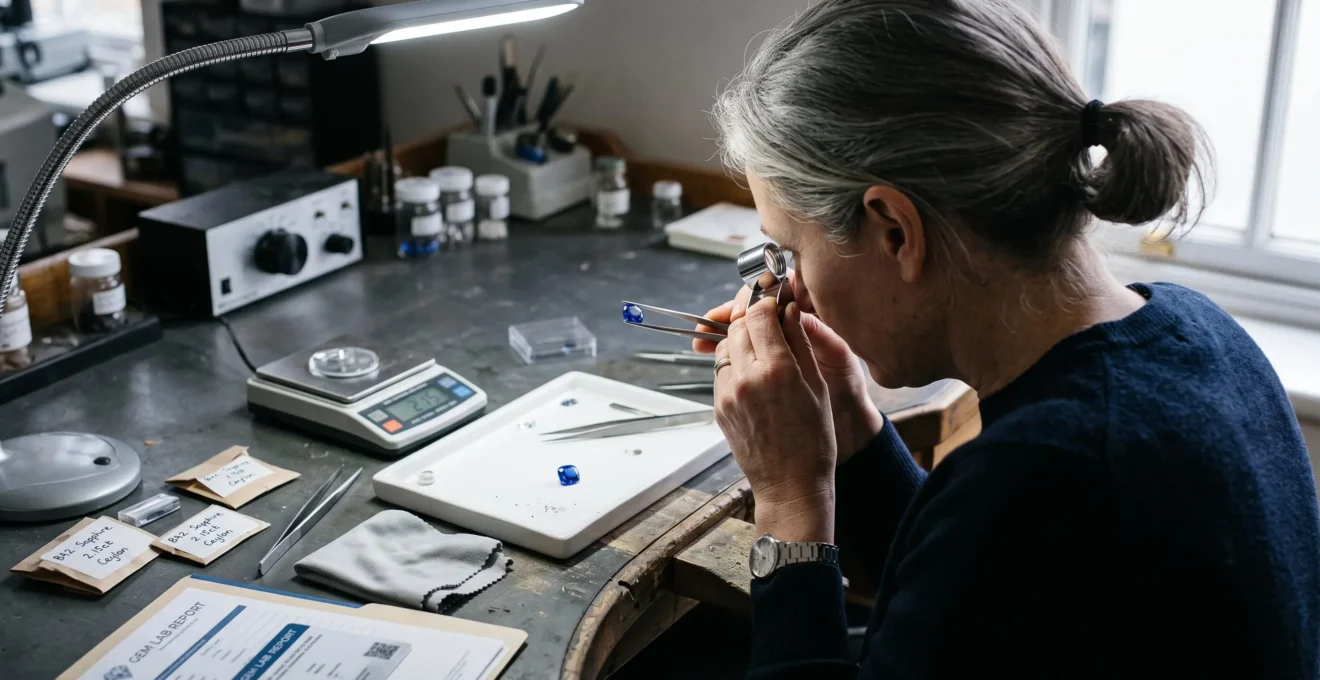
Two blue sapphires can look almost identical beneath a jewellery boutique’s spotlights while carrying very different price tags. The explanation may involve natural origin, heat treatment, microscopic characteristics or cutting quality. Sometimes, however, the difference reflects the retailer’s pricing rather than a meaningful difference between the stones.
For UK jewellery buyers, learning a few practical gemmology principles can make expensive purchases less dependent on sales conversations. You do not need professional equipment to compare colour, identify visible flaws, inspect a setting or recognise when a laboratory report matters.
The crucial distinction is between what you can assess yourself and what requires independent testing. A gemstone’s beauty is visible; its treatment history and geological origin often are not. Knowing where that boundary lies helps you ask better questions, compare quotations fairly and avoid paying for qualities that have never been verified.
Coloured gemstone buying essentials
- Compare colour, clarity, cutting and carat weight, but establish whether a gemstone is natural, synthetic or treated before evaluating its price.
- Inspect stones away from flattering display lights and ask for independent evidence of any claimed origin or treatment status.
- Verify laboratory reports and precious-metal hallmarks separately: neither alone proves that the finished jewellery is fairly priced.
- Why Can Two Gems Look Identical but Be Priced 5x Apart in the Same Shop?
- How to Inspect a Gemstone in a Boutique Using 4 Simple Checks Under Spotlights?
- Natural or Lab-Grown Coloured Gems: Which Choice Brings Fewer Surprises Later?
- The Assumption That Gets Buyers Caught Out: Thinking a Gem Is Untreated
- When Should You Request a Gem Report and What Must It Actually Say?
- How to Check Gem Colour in 3 Lighting Types Before You Buy?
- How to Read UK Hallmarks in 60 Seconds So You Don’t Overpay?
- Which Precious Metals Make the Most Sense for Jewellery You Wear Every Day?
Why Can Two Gems Look Identical but Be Priced 5x Apart in the Same Shop?
Two gemstones that appear identical can carry very different prices because visual similarity does not establish equivalent quality, rarity or treatment history. One sapphire might be unheated, while another has undergone enhancement; their origins, internal features and cutting may also differ. A fivefold price gap is possible as a hypothetical example, but appearance alone cannot establish whether that difference is justified.
A coloured gemstone’s value depends on several interacting characteristics. According to GIA research on coloured gemstone value factors, colour, uniformity, geographic origin, clarity, size and cutting quality all influence assessments.
For example, imagine two blue sapphires displayed side by side. Both look attractive under the same lighting. A laboratory report on the first identifies a natural sapphire with no indications of heating and supports a prestigious geographic origin. The second is also natural but has undergone heating, and its origin is not established.
This is an illustrative comparison, not a documented transaction. The first stone may command a substantial premium because buyers value its rarity and verified characteristics. Whether that premium is reasonable still depends on the actual stones and comparable market offers.
A useful framework starts with gemstone identity and treatment before moving to the familiar four assessment factors:
- Colour: Examine hue, tone, saturation and consistency across the stone.
- Clarity: Look for visible inclusions, fractures and features affecting appearance or durability.
- Cut: Consider proportions, symmetry, polish and how efficiently the gemstone returns light.
- Carat weight: Compare size alongside quality, rather than assuming greater weight automatically means greater value.
Geographic origin and treatment history deserve separate consideration because neither is reliably determined by these four visual criteria. Natural gemstones may also contain microscopic characteristics that require specialist instruments to interpret.
The difference between rarity and retail markup matters just as much. A prestigious boutique can charge more for presentation, location, aftercare and its own commercial margin. None of these automatically increases the gemstone’s inherent rarity.
Request comparable written specifications for both stones. If a retailer cannot explain the price difference beyond calling one stone a better investment or a superior colour, the explanation remains incomplete.
A reasonable price is one supported by identifiable characteristics, appropriate documentation and comparable offers—not simply the confidence of the person presenting the jewellery.
How to Inspect a Gemstone in a Boutique Using 4 Simple Checks Under Spotlights?
Inspect a gemstone in four stages: assess its colour, examine visible clarity, observe light return and check the setting. Begin under the boutique lights, then request a more neutral viewing position. These checks can reveal uneven colour, obvious damage or disappointing brilliance, but they cannot establish whether a stone is synthetic, heated or otherwise treated.
Jewellery displays often use carefully positioned lighting to make gemstones appear vivid and reflective. This does not necessarily indicate dishonesty; attractive lighting is standard retail presentation. The problem arises when buyers judge expensive stones under those conditions alone.
- Check colour distribution. View the stone face-up and gently change its angle. Look for distracting pale patches, unusually dark areas or colour concentrations. Some zoning is normal, and its significance depends on the gemstone variety and overall appearance.
- Examine the table, edges and pavilion. If the stone is loose and handling is permitted, ask the jeweller to turn it over safely. Look for obvious inclusions, chips or surface-reaching fractures. Never remove a mounted gemstone yourself.
- Observe brilliance and light return. Tilt the stone slowly. Notice whether broad areas remain transparent or lifeless while surrounding facets sparkle. In some faceted stones, a poorly proportioned pavilion can produce a visible window through the centre.
- Inspect the setting. On mounted jewellery, check whether the stone sits securely, whether the prongs appear even and whether accessible edges show damage. Ask about areas concealed beneath substantial metalwork.
A loupe can help with visible features, but learning to use one takes practice. It is better to identify a concern and request a professional assessment than to declare an inclusion harmless or dangerous without sufficient evidence.
Ask to compare the gemstone near a window, away from direct coloured reflections or intense spotlights. Natural daylight is useful, although its colour changes with weather and time of day; it is not a perfectly calibrated reference.
Pay particular attention to mounted stones. A setting can prevent inspection of the pavilion or hide portions of the girdle. That limitation does not prove a defect exists, but it makes documentation and the retailer’s written description more important.
Record your observations before listening to a further explanation of why one stone is supposedly exceptional. A simple note such as “dark centre under daylight” is more useful than an impression formed after an extended sales presentation.
Visual inspection is a screening method, not a laboratory test. If something looks questionable—or an expensive claim remains unverifiable—request independent evidence before buying.
Natural or Lab-Grown Coloured Gems: Which Choice Brings Fewer Surprises Later?
Lab-grown coloured gemstones can offer attractive appearance and more predictable specifications at a lower purchase price, while natural gemstones may offer rarity that some resale buyers value. Neither category guarantees financial security. The choice with fewer surprises is the one clearly identified at purchase, appropriately priced and matched to whether you want jewellery for enjoyment or potential resale.
A laboratory-grown sapphire is not merely blue glass. It has essentially the same chemical composition and crystal structure as natural sapphire, although its growth environment and some internal characteristics differ. A simulant, such as glass used to imitate sapphire, is a different material.
That distinction is fundamental when assessing a price. A natural gemstone premium should not be applied to a laboratory-grown stone represented or priced as though geological rarity were part of its value.
For buyers comparing the two categories, the practical trade-offs are as follows.
| Consideration | Natural gemstone | Lab-grown gemstone |
|---|---|---|
| Origin | Forms through natural geological processes. | Produced in a controlled manufacturing environment. |
| Appearance | Varies considerably with individual stone quality. | Can provide relatively consistent colour and clarity, depending on production and selection. |
| Treatment considerations | May have undergone heating, filling or other enhancement. | Growth method and any additional treatment should also be disclosed. |
| Purchase cost | Can command a rarity premium. | Often offers a lower-cost alternative for comparable visual appeal. |
| Resale | Some desirable examples attract specialist buyers; proceeds are uncertain. | Resale opportunities and prices may be limited. |
| Best suited to | Buyers who value natural formation, rarity and documented characteristics. | Buyers prioritising appearance and enjoyment over geological rarity. |
A natural gemstone does not automatically preserve its retail purchase price. Reselling through a dealer or auction involves a different market, transaction costs and potentially substantial differences between the original retail price and the amount offered.
Similarly, it would be misleading to describe every lab-grown coloured stone as having zero resale value. Markets vary by gemstone, quality and buyer interest. A prudent purchase should simply avoid assuming that a meaningful resale return will be available.
For an everyday pendant or earrings chosen mainly for appearance, a documented lab-grown gemstone may represent sensible value. For a collectible ruby or sapphire, natural origin, treatment findings and recognised laboratory documentation become much more significant.
Insurance adds another distinction. An insurer may require an appropriate replacement valuation, which is not necessarily the same as resale value or the amount a collector might pay.
Neither natural origin nor laboratory production makes a stone a good deal by itself. What matters is accurate identification, transparent pricing and realistic expectations about what happens after purchase.
The Assumption That Gets Buyers Caught Out: Thinking a Gem Is Untreated
A natural gemstone is not necessarily untreated. Sapphires may be heated, emeralds may contain clarity-enhancing fillers, and some rubies undergo fracture filling. These processes can affect appearance, durability and price. Buyers should ask specifically about treatments rather than assuming that the word “natural” means a stone has been left in its original condition.
Gemstone treatments range from long-established enhancement techniques to processes that materially alter how a stone should be valued or cared for. The important question is not simply whether treatment occurred, but which treatment was used and what consequences it has.
The GIA’s technical overview of gemstone treatments explains processes including heating, fracture filling and diffusion, together with their detection and durability implications.
Consider three common examples:
- Heated sapphire or ruby: Heating may change colour or apparent clarity. It is an established commercial treatment, but an otherwise comparable unheated gemstone may command a significant premium.
- Clarity-enhanced emerald: Oil, resin or other filling materials can reduce the visibility of surface-reaching fractures. The type and extent of enhancement can influence value, cleaning recommendations and maintenance.
- Diffusion-treated sapphire or glass-filled ruby: These processes differ substantially from conventional heating. Their commercial and durability implications must be assessed separately rather than grouped under a vague description such as “enhanced”.
For instance, beryllium diffusion can modify sapphire colour through treatment involving externally introduced elements. Lead-glass filling can improve the apparent transparency of fractured ruby material but introduces particular durability and care concerns.
Treatment effects on price are not governed by universal percentages. Gemstone species, quality, extent of enhancement, market demand and available evidence all matter. Traditional heat treatment should not automatically be described as financially insignificant, nor should every fracture-filled stone be assigned the same discount.
In a boutique, ask the question in precise terms: “Has this gemstone undergone any treatment, and if so, what type?” Follow up by requesting the answer in writing, particularly for an expensive purchase.
A response of “It’s a genuine natural sapphire” does not resolve the issue. That statement can be compatible with the sapphire having undergone treatment.
Do not assume that silence demonstrates treatment-free status. Conversely, a report recording no indications of a particular treatment should be read within the laboratory’s actual detection capabilities, not treated as proof that every conceivable intervention has been ruled out.
Retailers’ legal responsibilities should also be distinguished from gemmological practice. A technical description of treatments does not establish the complete UK legal position on disclosure in every transaction. Material representations must be considered under applicable consumer-protection obligations, while specific disclosure disputes can depend on their facts.
Once treatment status is documented, the next task is verifying that the report genuinely belongs to the stone being offered.
When Should You Request a Gem Report and What Must It Actually Say?
Request an independent gemmological report when an expensive purchase depends on claims you cannot verify yourself—particularly natural origin, lack of treatment or a prestigious geographic source. A suitable report identifies the gemstone and records laboratory findings. It does not establish a fair selling price, and no universal purchase-price threshold makes certification mandatory for every coloured stone.
Laboratories such as GIA, SSEF and Gübelin provide specialist gemstone analysis, although available services, methodologies and reporting terminology vary. Before accepting any document, check exactly what service was performed and whether it addresses the retailer’s claims.
According to GIA’s coloured stone report specifications, its reports identify gemstone type, natural or synthetic status and detectable treatments, alongside descriptive information. Geographic-origin determination is available for certain eligible gemstones when the laboratory can reach a conclusion.
An effective report review should address the following information:
- Gemstone identification: Mineral species or gemstone variety and whether the material is natural or synthetic.
- Treatment findings: The precise wording used for detected enhancements or treatment observations.
- Measurements: Weight, dimensions, shape and cutting description, where measurable.
- Colour and visual identification: Descriptions and photographs that help match the document to the examined gemstone.
- Geographic origin: A laboratory conclusion where the relevant service includes origin analysis and determination is possible.
A prestigious source name deserves particular scrutiny. Terms such as Kashmir, Burma or Ceylon can carry commercial significance, but a seller’s geographical claim should not be confused with an independent laboratory determination. Even specialist laboratories may sometimes be unable to determine a definitive origin.
Check the report number using the issuing laboratory’s official verification service, where available. Compare the returned information with the physical document and the gemstone’s photograph, measurements and distinguishing features. A valid report number alone does not prove that the physical stone has not been substituted.
A retailer-produced grading document and a report from an independent laboratory are not interchangeable. A seller’s description can still be commercially or legally relevant, but independence matters when the central purpose is to verify the seller’s own claims.
Five checks before paying for a certified gemstone
- Request the laboratory’s name and complete report number; record both alongside the quotation.
- Check the report through the issuer’s official verification service; save the matching result or confirmation details.
- Compare the stone’s available measurements, shape and photograph with the document; record any unexplained discrepancy.
- Identify the exact treatment and origin conclusions; highlight any sales claim not supported by the report.
- Obtain an itemised written quotation identifying the gemstone and setting, together with the applicable returns arrangements; retain a copy before committing.
The final limitation is financial. A gemmological report describes the gemstone and analytical findings; it is not an independent market appraisal or an insurance replacement valuation. A laboratory can identify an attractive natural sapphire without deciding whether a particular boutique’s asking price represents good value.
Once authenticity and treatment claims are addressed, colour remains one of the most useful quality factors a buyer can compare directly.
How to Check Gem Colour in 3 Lighting Types Before You Buy?
Check gemstone colour under indirect daylight, a warm indoor light and a neutral or cool white light before deciding. The aim is not to find one perfectly truthful source, but to observe whether the stone stays attractive under realistic conditions. Compare hue, saturation and tone each time, while avoiding strongly coloured surroundings and direct glare.
Colour is especially important for coloured gemstones, but a description such as “deep blue” is not precise enough to explain quality. Gemmologists distinguish three dimensions:
- Hue: The dominant colour and any modifying colour, such as a violetish blue.
- Saturation: The strength or purity of the colour relative to greyish or brownish components.
- Tone: How light or dark the overall colour appears.
These characteristics interact. A stone can have strong saturation but appear excessively dark, making its colour difficult to appreciate in ordinary lighting. The most desirable range also depends on the gemstone variety.
Use three realistic viewing environments rather than relying on the display case.
| Lighting condition | What to examine | What to watch for |
|---|---|---|
| Indirect daylight near a window | Overall hue, saturation and colour distribution. | Pale patches, excessive darkness or distracting unevenness. |
| Warm incandescent or warm LED lighting | Whether the gemstone remains appealing in warmer surroundings. | Unexpected shifts in apparent hue or loss of desirable colour. |
| Neutral or cool white LED lighting | Appearance under a different light spectrum. | Greyish areas, uneven colour or reduced visual appeal. |
Different light sources have different spectral distributions. Consequently, one LED may render a gemstone differently from another LED with a similar advertised colour temperature. Daylight also changes with weather and location, so none of these tests provides a universal colour grade.
Some gemstones exhibit genuine colour-change effects that are part of their valued characteristics. A shift between lighting conditions is therefore not automatically a defect. The question is whether the observed behaviour is consistent with the gemstone’s identification and the description used to sell it.
When comparing two stones, place them beside each other against similar neutral backgrounds. Maintain the same viewing angle and light conditions as far as possible. Looking at one under a bright spotlight and another in shadow produces an unreliable comparison.
Keep a short description of each stone’s appearance in the three environments. This helps separate visual preference from labels such as “royal blue”, which may be used commercially without providing a complete or standardised quality assessment.
Once the gemstone has been assessed, turn to the metal holding it. A beautiful stone can still be paired with a setting whose composition or price has been misunderstood.
How to Read UK Hallmarks in 60 Seconds So You Don’t Overpay?
To read a standard UK hallmark, locate the sponsor’s mark, precious-metal fineness number and Assay Office mark. These are the three compulsory components of a standard hallmark; a date letter is optional. Hallmarking helps verify metal content, but the legal requirement depends on the metal, article and relevant exemptions, and it says nothing about gemstone authenticity.
The UK hallmarking system provides independent verification of precious-metal fineness. Under the Hallmarking Act 1973, as amended, qualifying precious-metal articles offered for sale must meet applicable hallmarking requirements.
The UK government guidance on precious-metal hallmarking describes the compulsory marks, exemptions and recognised international hallmark arrangements.
A standard UK hallmark can be understood through three essential elements:
- Sponsor’s mark: Identifies the registered person or organisation responsible for submitting the article for hallmarking. It is not necessarily the individual who physically made the jewellery.
- Fineness mark: States precious-metal content in parts per thousand. For example, 375 denotes at least 375 parts gold per 1,000 parts of alloy, while 750 denotes at least 750 parts gold.
- Assay Office mark: Identifies the testing office. The four UK Assay Offices are London, Birmingham, Sheffield and Edinburgh.
A date letter may also appear, but its absence does not automatically invalidate a modern UK hallmark. Buyers should also recognise that qualifying international convention hallmarks may be accepted under the applicable arrangements.
Common fineness markings include 375, 585, 750, 916 and 999 for recognised gold standards, 925 for sterling silver, and 950 for certain platinum articles. The metal must be identified correctly because the same number can appear in different precious-metal contexts.
3 compulsory marks
A standard UK hallmark consists of the sponsor’s mark, metal fineness mark and Assay Office mark. The date letter is optional.
UK government hallmarking guidance.
Weight exemptions are important. The government guidance specifies hallmarking thresholds of 1 gram for gold, 7.78 grams for silver, 0.5 gram for platinum and 1 gram for palladium. Articles below the relevant threshold may be exempt, subject to applicable rules.
Accordingly, an unhallmarked article is not automatically counterfeit or unlawfully sold. Check its metal, weight and any applicable exemption before drawing that conclusion.
Likewise, a standalone engraved “925” does not by itself constitute a complete standard UK hallmark. It indicates a claimed fineness, not necessarily independent assay verification.
To judge value, compare the identified metal, its actual weight, the relevant precious-metal market price and the quoted retail price. The difference can reflect gemstone value, manufacturing, design, overheads, tax and retailer margin. It should not automatically be interpreted as excessive profit.
Also remember that hallmarking verifies the metal composition, not the full value of the finished jewellery. A ring with a correctly hallmarked 18-carat gold setting can still contain a misidentified or overpriced gemstone.
After verifying what the setting contains, the final decision concerns whether that metal is appropriate for the way the jewellery will actually be worn.
Key points to remember
- Metal fineness establishes precious-metal content, but it does not establish scratch resistance or suitability for a particular setting.
- Everyday wear places different demands on rings, earrings and pendants; choose construction and maintenance requirements accordingly.
- Judge the finished piece as a combination of gemstone, setting security, comfort and total cost—not solely by gold purity.
Which Precious Metals Make the Most Sense for Jewellery You Wear Every Day?
For everyday jewellery, 9-carat and 18-carat gold, platinum and sterling silver can all be sensible choices, depending on budget, design and expected wear. Lower gold purity does not automatically mean better scratch resistance, and higher purity does not guarantee greater durability. The quality of the alloy, setting construction and maintenance are often more important than a single fineness number.
A ring worn daily faces repeated contact with hard surfaces, occasional impacts and exposure to cleaning products. Earrings or a pendant generally experience different stresses, so a metal suitable for one piece may be less appropriate for another.
The principal options involve different trade-offs.
| Metal | Practical advantages | Considerations |
|---|---|---|
| 9-carat gold (375) | Lower gold content can make it more budget-accessible; suitable alloys can perform well in daily wear. | Mechanical properties vary by alloy, and the metal contains less gold than higher-carat alternatives. |
| 18-carat gold (750) | Higher precious-metal content, established jewellery use and several available colours. | Can be more expensive; resistance to wear depends on alloy composition and construction. |
| Platinum (commonly 950) | Dense, durable and suitable for substantial settings. | Can develop a surface patina and may cost more to manufacture or repair. |
| Sterling silver (925) | Accessible precious-metal option for many jewellery designs. | Can tarnish and may require more frequent cleaning or polishing. |
The idea that 9-carat gold is always harder than 18-carat gold oversimplifies metallurgy. Hardness depends on alloying elements, manufacturing and subsequent treatment of the metal. Scratch resistance, strength and toughness are also different properties.
Platinum is valued for its performance in jewellery settings, but it is not scratch-proof. Over time, the surface may acquire a characteristic patina. Sterling silver can work well for pieces that are easy to maintain, although tarnishing and wear deserve consideration.
Skin sensitivity is another practical factor. Some jewellery alloys contain metals that can cause contact reactions in susceptible wearers. Nickel sensitivity, for example, can make the precise alloy composition important. Platinum and palladium-based options may be worth discussing with a jeweller, although no material should be assumed universally hypoallergenic.
The gemstone itself should influence the choice of setting. Secure prongs, sufficient metal around vulnerable edges and accessible maintenance arrangements can matter more than the difference between two gold fineness grades.
Appearance matters too. Yellow gold can create warmer visual contrasts around a coloured stone, while white metals may provide a more neutral-looking surround. Neither automatically improves the gemstone’s actual colour grade.
Finally, consider how the overall budget is distributed. Allocating more money to higher-purity metal can leave less for the gemstone, setting workmanship or independent assessment. A carefully made piece with a verified gemstone may represent better personal value than a more expensive alloy paired with uncertain stone characteristics.
For your next significant jewellery purchase, ask for a written breakdown of the gemstone’s identity and treatment, the setting’s metal fineness and the total price. Inspect the piece in more than one lighting environment, verify any laboratory report and compare an equivalent alternative before paying. These steps offer a practical basis for a confident purchase without relying on a sales pitch.
Can a jeweller identify a real sapphire just by looking at it?
An experienced jeweller may recognise characteristics consistent with sapphire, but visual inspection alone does not reliably establish every aspect of identity, natural origin or treatment. Laboratory testing is particularly valuable when those details materially affect the price. Ask for a recognised independent report rather than treating a verbal identification as conclusive.
Does a gemstone certificate guarantee that jewellery is worth its asking price?
No. A gemmological report records identification and analytical findings within the scope of the laboratory’s service. It does not normally provide a retail-price judgement or guarantee resale proceeds. Price assessment requires comparing the documented stone with relevant market offers and considering the setting, retailer and purchase terms.
Can you return a gemstone ring bought in a UK boutique if you change your mind?
A change-of-mind return for an in-store purchase generally depends on the retailer’s policy, rather than an automatic statutory right to a refund. Different rules may apply to eligible distance purchases, faulty goods or items that do not match their description. Obtain the store’s written returns terms before buying, especially for bespoke or altered jewellery. The supplied gemmological and hallmarking references do not provide a complete statement of UK consumer-return law.
Should you have a valuable gemstone independently valued for insurance?
It can be sensible, particularly when the insurer requires documented replacement value or the jewellery is expensive to replace. A laboratory identification report and an insurance valuation serve different purposes: the first describes the gemstone, while the second addresses the cost of replacing an item under specified circumstances. Check your insurer’s requirements before commissioning an appraisal.
What should you do if a gemstone’s report does not match the stone being sold?
Do not rely on the report until the discrepancy is resolved. Ask the retailer to explain differences in shape, measurements, photographs or identifying details, recognising that mounted stones may have measurement limitations. Where necessary, contact the issuing laboratory or request fresh independent examination before purchase.