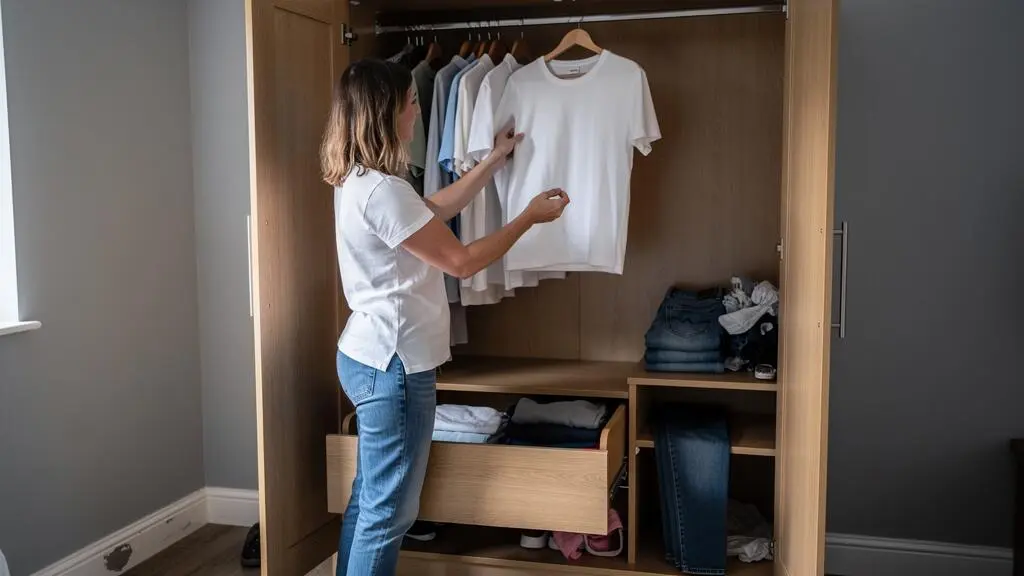
A wardrobe can be full of clothes and still leave you feeling that you have nothing suitable to wear. The problem is often less about how many garments you own and more about whether you can see them, combine them, maintain them and replace them when necessary.
Building a clothing system means managing four connected activities: choosing what deserves space, rotating what you already own, caring for garments and replacing items based on actual need. Instead of asking whether another white T-shirt looks useful, you check how many suitable ones you own, how frequently you wear them and whether the new purchase would solve a real problem.
This matters particularly for UK wardrobes, where wet commutes, heated workplaces, variable seasons and limited storage can complicate everyday clothing decisions. A useful system must accommodate those realities without imposing an arbitrary capsule-wardrobe limit.
The following approach starts with understanding repeated purchases and ends with a practical maintenance routine. Its purpose is not to eliminate the enjoyment of shopping, but to make every addition more deliberate.
How to stop unnecessary clothing duplicates
- Make your existing clothes visible and record what you actually wear before deciding something is missing.
- Buy multiples only when fit, durability and repeated use have been demonstrated; otherwise prioritise genuine outfit gaps.
- Use short wardrobe audits, condition checks and planned replacements to prevent impulse purchases and unnecessary disposal.
- Why Do You Keep Buying the Same Type of Clothing Even When You Don’t Need It?
- How to Track What You Actually Wear for 14 Days Without Any Apps?
- Buy Multiples or Mix It Up: Which Builds More Outfits With Less Waste?
- The Wardrobe Organisation Mistake That Makes You Forget Half Your Clothes
- When Should You Replace Basics Like T-Shirts and Jeans So You Don’t Waste Money?
- How to Do a Wardrobe Wear Audit in 30 Minutes Without Getting Overwhelmed?
- How to Audit Your Wardrobe for Weak Links in 45 Minutes Without Getting Distracted?
- What Does a Well-Constructed Wardrobe Look Like When You Actually Wear It Weekly?
Why Do You Keep Buying the Same Type of Clothing Even When You Don’t Need It?
You may repeatedly buy similar clothes because you cannot accurately recall what you own, your favourite pieces are unavailable when needed, or shopping temporarily satisfies a desire for comfort or novelty. These triggers create similar purchases but require different solutions. Preventing duplicates starts by identifying which problem each purchase is meant to solve.
Consider a drawer containing several nearly identical plain tops. If the first two are visible and the others are buried beneath a stack, you may repeatedly reach for the same tops and assume the category needs replenishing. Poor visibility can contribute to that mistake, although it is not the only explanation for repeated purchases.
External shopping prompts can reinforce the pattern. Oxfam’s State of Style 2026 report states that 64 % of respondents had bought clothing they were not actively looking for after encountering it through social media, apps or online shopping platforms. The finding concerns unplanned purchases, not necessarily identical garments.
64%
The proportion of respondents in Oxfam’s 2026 report who reported buying clothes they had not been actively seeking. This does not establish how many were unnecessary duplicates.
Oxfam GB, State of Style 2026.
Three buying triggers deserve separate responses:
- Comfort-buying: You want another version of a favourite garment because it feels familiar or reassuring. Check whether the original still works before buying another.
- Logistical buying: You cannot find a clean, suitable item when required. Check your laundry schedule and usable stock before increasing quantities.
- Novelty buying: An appealing colour, cut or offer creates a desire unrelated to an existing wardrobe gap. Delay the decision and test whether the item enables new outfits.
UK weather adds another complication. A jumper purchased for working from home may resemble another bought for commuting, but fabric weight, layering requirements and indoor heating can make their actual uses different. Two similar garments are not automatically wasteful duplicates if both serve identifiable purposes.
There is also an invisible gap: a category that appears missing because its existing items are damaged, uncomfortable, poorly fitting or difficult to access. Buying another garment may temporarily solve the symptom without fixing the underlying problem.
Before purchasing, ask what stopped the existing garment from doing its job: condition, availability, suitability or simply visibility.
Once the trigger is clear, actual wearing patterns provide a better basis for decisions than memory alone.
How to Track What You Actually Wear for 14 Days Without Any Apps?
Track your clothing for 14 days using one paper grid with columns for tops, bottoms, layers and shoes. Each evening, record the specific items worn, or their identifying shorthand, and note the weather and occasion. The process can take less than 30 seconds once your shorthand is established and requires no apps, photographs or detailed spreadsheets.
A fortnight is a useful practical starting period because it includes two sets of weekdays and weekends and may capture a normal laundry cycle. It is not a scientifically established minimum: people with longer laundry intervals, rotating shifts or irregular social schedules may need a longer observation period.
Set up a notebook page with 14 dated rows. Use short labels such as WHT-1 for your first white T-shirt or JNS-2 for your second pair of jeans. A category tick alone shows that you wore a type of clothing, but an item identifier is needed to distinguish the garments you rotate from those you repeatedly ignore.
| Day | Tops | Bottoms | Layers | Shoes | Context |
|---|---|---|---|---|---|
| Monday | WHT-1 ✓ | JNS-1 ✓ | KNIT-2 ✓ | TRN-1 ✓ | Office, rain |
| Tuesday | BLU-1 ✓ | TRS-1 ✓ | CARD-1 ✓ | SHO-1 ✓ | Office, dry |
| Wednesday | WHT-1 ✓ | JNS-2 ✓ | KNIT-2 ✓ | TRN-1 ✓ | Home, cold |
This is an illustrative extract, not collected research data. Repeat the process for the full fortnight, recording garments worn more than once on the same day when relevant.
Recording clothing habits has a precedent in academic research, although the method here is a simplified personal exercise. UKERC’s academic research on clothing and laundry practices describes research covering garment ownership, wearing frequency and laundering, including four-week laundry diaries completed by participants in five countries.
Do not assume the first few days represent your normal behaviour. Monitoring can make people more conscious of their choices, potentially encouraging unusual variety. As a precaution, treat days one to three as an adjustment period and give greater weight to the remaining days. This is a sensible interpretation safeguard, not a validated wardrobe-specific correction.
After 14 days, classify your findings:
- Regular rotation: Items appearing repeatedly across ordinary contexts. Maintain them and assess whether they are approaching wear-related failure.
- Loop clothes: Items worn once and then avoided despite being available. Investigate discomfort, difficult pairing or maintenance problems.
- Low-use categories: Categories worn fewer than twice. Treat these as provisional no-buy zones unless an upcoming occasion creates a genuine need.
- Laundry bottlenecks: Garments needed again before they are clean. Check laundry timing and available alternatives before buying more.
A waterproof coat might appear only once during a dry fortnight and still be essential. Record context alongside frequency so that low use is not confused with low value.
The resulting record makes the next decision more precise: whether an additional item would genuinely help or merely increase the number of similar choices.
Buy Multiples or Mix It Up: Which Builds More Outfits With Less Waste?
Buy multiples when a garment is worn frequently, its fit has been tested and having another genuinely supports your laundry or replacement needs. Choose variety when it helps existing clothes work in different settings or combinations. Neither approach automatically produces less waste: the useful question is whether each additional item increases practical outfit options without creating unnecessary surplus.
For reliable basics, repeat purchases can be efficient. Plain socks, well-fitting white T-shirts or an established pair of dark jeans may serve predictable purposes. Owning more than one can reduce laundry pressure without complicating outfit selection.
Variety is more useful when your wardrobe lacks contrast. A second identical black jumper may contribute less than a different layer that makes your existing trousers and shirts appropriate for another setting.
The distinction becomes clearer when assessed against actual use:
| Decision factor | Buy multiples | Choose variety |
|---|---|---|
| Wearing frequency | Item is repeatedly used | Existing versions are rarely used |
| Fit certainty | Fit remains reliable after washing | Fit or style is still being tested |
| Laundry demands | Shortages regularly interrupt rotation | Current quantities cover normal needs |
| Outfit combinations | Identical items support established outfits | Different colours, textures or cuts enable missing combinations |
| Purchase risk | Known durability and repeat use | A specific wardrobe gap has been identified |
The largest risk with multiples is fit-lock: committing to several garments before knowing how the first behaves. A T-shirt may feel excellent in the fitting room but shrink, twist or pill after repeated washing.
Apply a practical one-then-three rule: buy one item, wear and wash it through a normal cycle, and only consider increasing the quantity once its fit and usefulness are established. Three is a potential total quantity to assess, not a purchasing target. Additional wear-and-wash cycles improve confidence.
Cost per wear can help compare options:
Cost per wear = purchase price ÷ number of actual wears.
For a hypothetical example, a £30 top worn 30 times costs £1 per wear, while a £20 top worn five times costs £4 per wear. These figures describe usage, not the item’s overall environmental impact.
Cost per wear also has a limitation: buying several copies of a popular item can spread future wears across all of them, reducing each item’s utilisation. It does not measure whether a purchase prevents other garments from being used.
Pair it with an outfits-enabled count: the number of distinct, realistic complete outfits the new garment creates using clothes already owned. A useful outfit must suit a real occasion, not merely look possible on paper.
For example, a versatile shirt that works with three existing bottoms for two actual contexts might be more valuable than another copy of a top already available in sufficient quantities. Those combinations are hypothetical and should be checked against personal wearing habits.
Once you know which clothes deserve repetition and which provide useful contrast, storage must make those choices visible.
The Wardrobe Organisation Mistake That Makes You Forget Half Your Clothes
The organisation mistake most likely to hide usable clothing is storing garments in deep stacks or crowded spaces where only the front or top items remain visible. The easiest-to-reach clothes get repeated attention while other options disappear from daily consideration. A better arrangement makes each usable garment identifiable at a glance, even when storage space is limited.
In a deep drawer, reaching for the bottom T-shirt means moving everything above it. In an overcrowded wardrobe, recently purchased clothes may occupy the accessible rail while older pieces shift into corners or onto high shelves.
This creates a practical accessibility bias. Your most reachable space becomes disproportionately important to your outfit decisions, regardless of whether the items there are the most suitable ones.
The solution is not necessarily more storage equipment. Single-row hanging and vertical file-folding can improve visibility without requiring a complete wardrobe redesign.
For someone using a compact wardrobe in a London flat or shared house, a minimal arrangement may be more sustainable than elaborate colour-coded shelving:
- One rail: Hang frequently used outer layers, workwear and garments that need to retain their shape. Leave enough room to see and remove individual items.
- One drawer: Store compatible everyday basics upright, grouped loosely by function.
- One quarantine box: Keep uncertain items temporarily separate, clearly dated and out of the active rotation.
Items not worn during your tracking period should not automatically be donated. Move one or two suitable pieces into the easiest-to-reach area for a week. If they remain unworn, identify whether the problem is fit, condition, pairing or relevance to your present lifestyle.
Visibility also needs to extend beyond your home. A quarterly wardrobe photograph or simple written map showing key categories and quantities can act as a portable inventory.
Before buying another navy jumper, checking a saved photograph of your knitwear section may be enough to confirm whether the purchase fills a genuine need. The photograph is a memory aid, not proof that every similar garment is interchangeable.
Once the wardrobe is easier to navigate, separating genuine wear-related replacements from unnecessary additions becomes much simpler.
When Should You Replace Basics Like T-Shirts and Jeans So You Don’t Waste Money?
Replace T-shirts, jeans and other basics when their condition, fit or function no longer meets your needs and reasonable care or repair cannot restore them. There is no universal replacement interval. Wearing frequency, fabric construction, washing habits and individual fit determine how long an item remains useful, so inspect physical deterioration rather than relying on a calendar alone.
For T-shirts, meaningful warning signs include a stretched collar that no longer recovers, failing seams around the underarms, persistent fabric distortion or material becoming uncomfortably thin or translucent.
For jeans, check inner-thigh abrasion, crotch seam stress, thinning fabric and knee bagging that remains after normal care. These issues vary considerably between raw denim, rigid cotton denim and stretch blends.
Not every visible imperfection requires replacement. A small seam failure may be repairable, while minor fading can be acceptable for casual wear. The decision depends on whether the garment still performs its intended role.
Care should be assessed before disposal. Less Waste’s Wear, Care and Repair guidance recommends following care labels, avoiding unnecessary washing, using suitable washing methods, air-drying where practical and considering repairs.
Use the garment’s care label as the authority, especially for temperature and tumble-drying restrictions. The following practices can help guide that assessment:
| Garment | Care check | Replacement consideration |
|---|---|---|
| Cotton jersey T-shirt | Check wash temperature, spin setting and drying method against the label | Persistent shape loss, thinning or irreparable damage |
| Raw denim jeans | Follow the maker’s instructions, considering colour transfer and fabric behaviour | Structural wear affecting comfort or durability |
| Stretch denim jeans | Avoid excessive heat where the label warns against it | Persistent loss of shape or fabric failure |
Replacement timing involves balancing two risks. Buying too soon wastes remaining useful life; waiting until an essential garment fails completely can lead to rushed, potentially unsuitable purchases.
A practical two-box method separates items that need attention from confirmed replacements. Put the deteriorating item in a labelled holding box if it is no longer suitable for regular rotation. Record what failed and seek a repair or suitable replacement.
After the replacement has been successfully worn on three separate occasions, reassess the original. Repair, repurpose or pass it on if appropriate; use suitable textile collection where it is no longer reusable. Three wears is a practical personal confidence check, not a validated durability threshold.
Finally, maintain a small replacement calendar. If a frequently worn pair of jeans begins to show significant thinning, note the issue before failure becomes urgent. You can then compare suitable purchases during planned shopping periods, including seasonal sales, without assuming a discounted item is automatically good value.
To make these decisions manageable across the whole wardrobe, the next task is a short inventory audit that establishes what you actually have.
How to Do a Wardrobe Wear Audit in 30 Minutes Without Getting Overwhelmed?
Complete a wardrobe wear audit in 30 minutes by dividing the session into three timed passes and evaluating one clothing category at a time. Sort garments into keep, testing and out, using condition, current fit and recent use as your criteria. Avoid permanent decisions about uncertain items; placing them in a dated holding box keeps the process focused.
The purpose is to establish a usable baseline, not to produce an immaculate wardrobe in one session. Starting with every garment spread across the bedroom often makes the task feel larger than necessary.
Set a timer and choose a manageable category, such as everyday tops. If that category is unusually large, divide it into smaller groups rather than allowing the audit to expand indefinitely.
Use three fixed passes:
- Minutes 0–10 — Gather and identify: Pull out one category and count the items. Note obvious duplicates and any pieces that are difficult to access.
- Minutes 10–20 — Sort: Apply the keep, testing and out criteria. Do not start constructing outfits or browsing replacements.
- Minutes 20–30 — Record and reset: Write down usable quantities, date the testing box and return active clothes to visible storage.
Keep means the garment fits now, remains suitable and has been used during its relevant recent season. Testing means you are uncertain about fit, comfort, use or styling. Out is reserved for items with an unwearable fit, irreparable damage or a clear personal decision not to wear them again.
The out category should still be handled responsibly. Items suitable for reuse can be passed on, while damaged textiles may need repair or appropriate recycling. Uncertainty alone is not a reason for immediate disposal.
Your five-action wardrobe audit checklist
- Choose one clothing category and set a 30-minute timer. Deliverable: a named category and session end time.
- Count every accessible item in that category. Deliverable: a written starting quantity.
- Sort into keep, testing and out using the stated rules. Deliverable: three distinct groups with item counts.
- Date the testing box and schedule a review for the next relevant season. Deliverable: a labelled box with a review date.
- Record usable stock and one issue to monitor during wear tracking. Deliverable: a one-line inventory entry and a specific observation.
A particularly costly audit mistake is treating a burst of decluttering enthusiasm as proof that everything uncertain should leave immediately. A few months later, the same clothing type may be purchased again because its useful role was overlooked.
Give testing items a review date one relevant season later, while keeping necessary seasonal garments safely stored. This creates time to distinguish temporary non-use from genuine redundancy.
The completed audit should feed directly into the 14-day wear record. It establishes how many items you own, while tracking shows which ones actually contribute to everyday dressing.
Knowing what deserves to stay is one decision; knowing whether the remaining wardrobe can reliably support your lifestyle requires a different kind of assessment.
How to Audit Your Wardrobe for Weak Links in 45 Minutes Without Getting Distracted?
Audit wardrobe weak links by checking whether your existing clothes can cover each recurring situation in your week. A weak link is a garment or category whose absence would disrupt an important outfit, such as your only suitable work trousers. Spend 45 minutes mapping contexts, testing combinations and writing specific gaps without becoming distracted by styling experiments.
This audit differs from a decluttering exercise. A 30-minute wear audit asks which garments belong in active rotation. A weak-link audit asks where that rotation might fail, even when every individual item is useful.
Begin by listing your genuine weekly contexts. Depending on your lifestyle, these might include commuting, office work, working from home, social outings, exercise and outdoor activities.
Next, record the complete outfits currently available for each context. Include shoes and outerwear where necessary. An outfit counts only if its garments fit, are serviceable and can realistically be worn together.
For many recurring situations, having two or three viable combinations provides useful flexibility. This is a planning heuristic rather than a universal requirement: uniforms, laundry frequency and personal preferences may justify a different number.
Divide the 45 minutes into three stages:
- First 15 minutes: List ordinary weekly contexts and identify the clothing needed for each.
- Next 15 minutes: Check complete existing outfits, marking categories with no practical alternatives.
- Final 15 minutes: Identify the two or three most consequential weak links and record the exact reinforcement required.
Stay in inspection mode. Examine fit, condition and compatibility, but do not begin restyling, altering, shopping or researching trends. Record those tasks for later so the audit finishes with decisions rather than an unfinished pile of clothes.
For example, imagine a commuter with several suitable shirts but only one pair of work trousers. If those trousers are damaged or unavailable during laundry, several outfits become unusable. The weak link is not the shirt collection; it is the lack of an appropriate trouser alternative.
Your one-page weak-link map might look like this:
| Context | Current vulnerability | Action |
|---|---|---|
| Office commute | Only one suitable pair of work trousers | Test a second compatible pair |
| Wet-weather travel | Existing outer layer no longer provides adequate protection | Check care, repair or replacement |
| Social occasions | Several separates but no comfortable complete outfit | Test combinations before buying |
The map should lead to a restricted shopping list, not permission to fill every possible gap. Prioritise problems by frequency, consequences of failure and whether rearranging or caring for existing clothes can solve them.
That distinction closes an important buying loop: repeated purchases are less likely to help when the actual shortage concerns a different category.
With inventory, wearing frequency, storage and weak links understood, the final measure of success is how smoothly the wardrobe works over an ordinary week.
Key takeaways before putting the system into practice
- Judge each clothing purchase against an identified wardrobe problem, not against a vague feeling that more options would be useful.
- Keep enough flexibility for laundry, UK weather and real weekly commitments without imposing an arbitrary garment limit.
- Maintain a short, repeatable review process so useful information survives beyond the initial clear-out.
What Does a Well-Constructed Wardrobe Look Like When You Actually Wear It Weekly?
A well-constructed wardrobe lets you dress for your usual activities without repeatedly encountering missing basics, unsuitable outfits or forgotten clothes. Its success is measured by reliable rotation, manageable maintenance and deliberate purchases rather than a specific number of garments. The right size depends on your lifestyle, laundry schedule, climate, available storage and personal preferences.
Imagine an ordinary week. On Monday, suitable work clothes are ready without needing an emergency wash. On Wednesday, a familiar jumper works with a different bottom because both pieces are visible and accessible. At the weekend, casual clothes are available without buying another version of something already owned.
When laundry is finished, clothes return to their established places. The same few items are not automatically chosen because everything else is buried, and rarely worn pieces can be assessed rather than forgotten.
This is the practical end-state: less friction between owning clothes and actually using them.
The system needs maintenance, but it should not become a second job. A simple review rhythm is enough for many wardrobes:
| Frequency | Action | Purpose |
|---|---|---|
| Weekly | Return clean clothes to visible locations and note obvious damage | Protect rotation and identify care needs |
| Quarterly | Run a focused 30-minute inventory audit | Update stock and reassess uncertain items |
| Once or twice yearly | Repeat a 14-day wear record during a representative period | Check whether actual use has changed |
| After a significant life change | Complete a weak-link assessment | Adapt to different work, housing, fit or activity requirements |
| Before a planned purchase | Check inventory, condition and outfit compatibility | Avoid unnecessary duplicates |
These intervals are suggested operating habits, not evidence-based universal schedules. The appropriate cadence depends on how quickly your circumstances and clothing needs change.
Working signals include fewer unplanned purchases, repeatable outfit combinations, better use of serviceable clothes and a quarantine box that is reviewed rather than endlessly filled.
Warning signals include repeatedly buying the same category, discovering usable garments only during clear-outs, or finding that essential outfits depend on one vulnerable item. Such patterns indicate that the inventory, trigger diagnosis or weak-link map needs updating.
The wider issue is significant. Zero Waste Scotland’s Valuing our clothes report summarises WRAP research involving 7,950 UK adults and reports that around 30 % of clothing in the average wardrobe had not been worn for at least a year. Poor fit was identified as the most common reason for non-use.
That finding does not mean all unworn garments are unnecessary duplicates. It reinforces the need to investigate why clothes are unused before deciding whether to keep, alter, replace or pass them on.
A good system also recognises that people enjoy shopping. A new garment can be appealing even when it fills no practical gap. Rather than pretending that desire will disappear, establish a distinction between planned discretionary purchases and functional wardrobe needs. An optional shopping budget or waiting period can help keep those decisions conscious.
Start with one category this week: count what you own, make every usable item visible, and record what you wear for the next fortnight. Use those observations to decide whether the next clothing purchase is a genuine improvement or simply another version of something already available.
How can you prevent duplicate purchases when shopping online?
Keep a simple inventory or wardrobe photograph available on your phone. Before ordering, check how many comparable garments you own, whether the proposed item meets a specific need and which complete outfits it supports. Save uncertain purchases for later review instead of treating an offer or limited-time promotion as proof of necessity.
Should seasonal clothing count as a duplicate if it looks similar?
Not necessarily. A lightweight indoor layer and a warmer outdoor version may serve different functions despite looking alike. Compare their actual use, fabric properties and suitability for UK weather conditions. Store clearly seasonal items where they remain identifiable, and assess them during the relevant season rather than judging them solely on short-term wearing frequency.
What should you do with good clothes that no longer fit?
Move them out of daily rotation and assess whether alteration is realistic. If their future suitability is uncertain, use a dated testing box with a reasonable review point. When you decide not to keep them, consider reuse, resale or donation if they are suitable for another wearer. Do not treat a poor-fitting garment as available stock when planning daily outfits.
Can a clothing system work without buying matching storage products?
Yes. Existing hangers, drawers, shelves and a labelled box can support the system. The priority is being able to identify usable garments and access them without dismantling piles. Vertical folding, clearer grouping and removing uncertain pieces from active storage may help without spending money on organisers.
How do you know whether a clothing system is saving money?
Compare your clothing purchases over several months, separating planned replacements from discretionary purchases. Record actual spending, the number of garments added and whether previously unused clothes have returned to rotation. Reduced spending is a useful financial measure, but a system can also improve reliability and reduce waste even when some necessary replacements remain expensive.