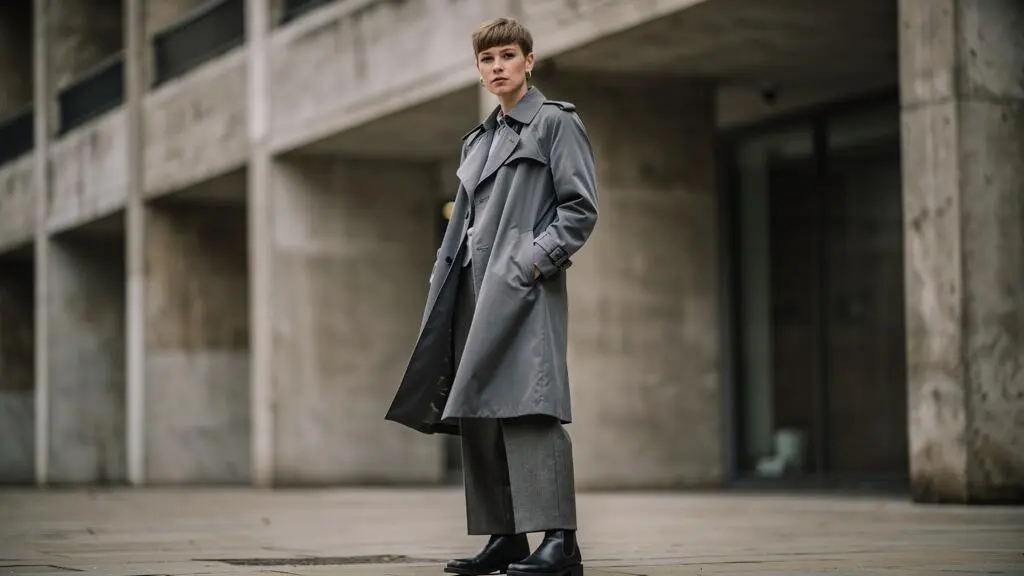
Genderless fashion is not simply a matter of wearing larger clothes or ignoring traditional menswear and womenswear departments. It involves choosing garments according to their proportions, construction and expressive possibilities rather than the gender category printed on the label.
The challenge is maintaining a recognisable silhouette when familiar tailoring conventions no longer dictate which areas should be fitted, concealed or emphasised. A generously cut coat can look architectural over straight trousers, yet the same coat combined with an equally shapeless outfit may lose its visual definition.
For UK wardrobes, the practical solution lies in three decisions: where the outfit carries volume, where it retains structure, and how its edges are finished. Fabric performance, sizing systems and everyday social settings also matter. These principles allow anyone to experiment with gender-neutral dressing without sacrificing comfort, personal expression or the level of polish appropriate to their day.
Genderless dressing: the essentials
- Define at least one silhouette zone — shoulder, waist or hem — instead of allowing every garment to expand without direction.
- Balance volume, structure and finishing details across different garments to create an intentional outfit.
- Choose clothing by actual measurements and fabric behaviour, then introduce unfamiliar silhouettes gradually in everyday settings.
- Why Does Genderless Dressing Look Sharp on Some People and Baggy on Others?
- How to Build a Genderless Outfit Using 3 Anchor Points So It Still Looks Intentional?
- Unisex Sizing or Cross-Section Shopping: Which Fits Better Without Alterations?
- The Fabric Choice That Makes Genderless Outfits Look Tired by Midday
- When Should You Try Genderless Styling So You Feel Confident, Not Exposed?
- Why Can a £200 Outfit Look Cheap When the Proportions Are Wrong?
- Oversized or Sculptural: Which Avant-Garde Direction Works Better for Daily Wear?
- How Do You Wear Avant-Garde Staples in Public Without Feeling Self-Conscious?
Why Does Genderless Dressing Look Sharp on Some People and Baggy on Others?
Genderless dressing looks sharp when the clothing retains a deliberate silhouette, even if several pieces are loose. It looks unintentionally baggy when the shoulders, waist and hems lose definition simultaneously. The difference is not necessarily body type or styling ability: garment construction, pattern proportions and the distribution of volume determine how the outfit sits.
The first distinction is between deliberate volume and accidental excess. A roomy jacket with a clear shoulder line establishes a shape. An oversized shirt with a carefully chosen hem can do the same. Neither needs to follow conventional masculine or feminine tailoring.
Before buying a garment, examine three silhouette zones:
- Shoulder: Does the seam, padding or sleeve construction create an identifiable upper-body line?
- Waist: Does the garment introduce shape through its cut, fastening, belt or relationship with another layer?
- Hem: Does the length end deliberately, or does fabric accumulate without a clear visual purpose?
Defining one zone is a useful starting rule, not a universal requirement. Some intentionally shapeless designs succeed through fabric movement or sculptural construction. For everyday outfits, however, one recognisable line makes relaxed proportions easier to control.
Pattern drafting also explains why identical clothing can behave differently on different bodies. Traditional menswear and womenswear blocks often use different assumptions about chest, waist and hip proportions, although these conventions vary by brand and garment. A cut designed around one set of measurements may pull, flare or collapse when worn by someone with different proportions.
The University of Manchester study on body shape and garment fit examined 30 UK women aged 18–34 using garment try-ons, body scanning and interviews. Its findings highlight the importance of body shape in fit appraisal. The study does not prescribe genderless styling rules, but it helps explain why relying on a size label alone is insufficient.
Consider an illustrative outfit: a loose charcoal blazer, wide-leg trousers and an untucked oversized shirt. Each item adds volume, but none establishes a clear boundary. Replacing the shirt with a closer-fitting top, or refining the trouser break, introduces contrast without changing the outfit’s gender-neutral character.
As a practical default, relax one major garment while controlling another. The fitted element need not be tight; it only needs to offer a readable contrast in proportion.
Once the silhouette has a recognisable line, the next challenge is creating that balance consistently rather than relying on trial and error.
How to Build a Genderless Outfit Using 3 Anchor Points So It Still Looks Intentional?
Build an intentional genderless outfit by assigning three different jobs to three separate garments or styling elements: one provides volume, another creates structure, and the third supplies a visible finishing detail. Keeping these anchors distinct prevents oversized pieces from competing and makes the silhouette feel considered rather than accidental.
The three-anchor method is a practical styling framework, not a scientifically validated formula. Its value is that it turns an abstract judgement — whether an outfit looks balanced — into decisions that can be checked in a mirror.
- Volume anchor: Choose where the silhouette expands. This might be wide-leg trousers, an oversized coat or a generously cut overshirt.
- Structure anchor: Introduce a controlled line elsewhere, such as a close-fitting knit, straight-cut shirt or precisely fitted jacket.
- Finish anchor: Complete the look with a deliberate cuff, tuck, trouser break, sleeve roll or neckline adjustment.
For example, begin with loose wool trousers as the volume anchor. Add a compact cotton top for structure, then use a neatly turned jacket cuff as the finishing detail. The three decisions support one another without concentrating every visual effect in the trousers.
To apply this method to an existing wardrobe, start with the item you most want to wear. Decide which anchor it provides, then choose the remaining garments to perform the other two functions. Avoid making one piece responsible for all three: if the whole silhouette depends on a single clever tuck, removing it may leave the outfit unresolved.
This leads to a useful reversal test. Stand in front of a mirror and temporarily conceal or undo the finishing detail. Does the outfit still have a clear relationship between volume and structure? If not, reconsider the main garment proportions before restoring the finish.
Finishing details can also influence how an outfit communicates gender without assigning fixed meanings to particular garments. A crisp tuck may evoke formal tailoring; a loose, unfinished edge may feel more relaxed or experimental. Neither detail is inherently masculine or feminine. Meaning depends on the wearer, the combination and the setting.
Qualitative research involving ten gender-diverse participants in Greater London identified strategies involving gender perception, challenging expectations and seeking safety through dress. The Clothing and Textiles Research Journal study on nonbinary dress strategies demonstrates that clothing can communicate identity in context, rather than through universal visual codes.
A five-step outfit check using your existing wardrobe
- Choose one base garment and write down whether it provides volume, structure or finish. Deliverable: one clearly identified starting anchor.
- Select a second garment with a contrasting function. Deliverable: a two-piece silhouette with a visible difference in shape.
- Add a finishing detail on a separate garment or element. Deliverable: three distinct anchors without unnecessary duplication.
- Photograph the outfit with and without the finishing detail. Deliverable: two images showing whether its main proportions remain coherent.
- Check the shoulder line, waist relationship and hem lengths before leaving. Deliverable: one final outfit with no unresolved length or fit problem.
The framework becomes particularly valuable when shopping across clothing departments, where nominally similar sizes can conceal very different garment shapes.
Unisex Sizing or Cross-Section Shopping: Which Fits Better Without Alterations?
Unisex sizing works well for garments designed around flexible proportions, while cross-section shopping often gives more options when fit at the shoulders, chest, bust or hips is critical. Neither approach guarantees an alteration-free garment. The better choice depends on which measurements determine the intended silhouette, not which department carries the item.
Unisex sizing generally offers a shared size system intended for multiple wearers. Some collections use blocks resembling conventional menswear cuts, but there is no single construction standard across all unisex clothing.
Cross-section shopping takes a different approach: compare garments from menswear, womenswear and unisex collections, then choose the actual cut that works for your proportions. It removes the assumption that the department label should determine the purchase.
The following decision grid offers a practical starting point.
| Fit consideration | Unisex sizing | Cross-section shopping |
|---|---|---|
| Relaxed T-shirts and sweatshirts | Often practical when overall ease matters more than precise shaping. | Useful when sleeve, chest or hem proportions need closer control. |
| Tailored jackets and coats | Works if the shoulder construction suits the wearer. | Offers more pattern options for shoulder, chest and hip balance. |
| Structured trousers | Suitable when rise, waist and hip measurements already align. | Often worth comparing for different rise and hip configurations. |
| Soft oversized layers | Convenient when the garment is deliberately roomy. | Helpful if oversized cuts create unwanted bulk in a particular zone. |
| Avoiding structural alterations | Depends on matching the original garment block. | May improve the chance of finding a suitable existing cut. |
UK retail size labels should be treated as a starting point rather than a precise measurement system. Different departments may use different numerical or letter-based conventions, and even garments carrying the same label can behave differently according to design and fabric.
Primark‘s UK clothing size charts and measurement guide provides separate menswear and womenswear sizing information and instructions for measuring the body. It also acknowledges the influence of cut, fit and fabric. Its charts describe Primark’s own ranges, not a universal UK sizing standard.
For online shopping, compare body measurements with the brand’s size guide, then check finished garment measurements wherever they are available. These are not interchangeable: a garment’s chest width includes the wearing ease designed into its cut, whereas a body chest measurement does not.
If measuring clothing laid flat, record shoulder width, chest or hip width as appropriate, sleeve length and total length. Compare these dimensions with a garment you already own that fits as intended. A flat width must also be interpreted correctly: when the garment is laid symmetrically, doubling it can provide an approximate circumference, although construction and stretch affect the comparison.
Additional fit research reinforces the importance of individual proportions. A 2025 Fashion and Textiles study developed 48 optimised patterns using body-proportion and posture classifications. Expert assessments reported improvements over a reference block pattern, although the study’s South Korean male reference data and controlled size range limit generalisation to UK shoppers.
The realistic goal is zero structural alterations, not necessarily zero adjustments. A garment can fit well through the torso and still benefit from a cuff, careful trouser break or deliberate sleeve styling.
Even a well-fitting garment can lose its intended shape during the day, however, if its fabric cannot support the chosen silhouette.
The Fabric Choice That Makes Genderless Outfits Look Tired by Midday
Relaxed genderless outfits can lose definition when the fabric creases, stretches or collapses during wear. Lightweight materials with limited recovery may stop holding the folds and lines that made the outfit look polished in the morning. More substantial or resilient fabrics can preserve an intended silhouette, although fibre content alone cannot predict performance.
Fitted garments often rely on seams, darts and close contact with the body to maintain their outline. In oversized clothing, more of the visual structure must come from fabric behaviour: its weight, thickness, bending resistance, drape and recovery after movement.
Thin viscose and some lightweight linen blends can develop prominent creases or lose a crisp shape during repeated sitting and movement. Yet neither fibre is automatically unsuitable. A deliberately fluid viscose garment may drape beautifully, while linen’s natural creasing can be part of the design.
The problem arises when fabric behaviour conflicts with silhouette intention. A sharply defined oversized shirt needs different material properties from a soft, flowing tunic.
For relaxed everyday pieces, consider these options:
- Mid-weight cotton twill: Often useful for overshirts, trousers and outerwear that need a recognisable line.
- Wool flannel: Can provide a controlled drape while retaining comfort, depending on weave and garment construction.
- Substantial denim: Suitable for straight or wide-leg silhouettes where fabric weight contributes to shape.
- Recovery-focused knits: Useful where stretch and recovery are needed, although knit construction and elastane content both affect performance.
- Lightweight fluid fabrics: Best used deliberately, especially when another garment provides a firmer structural anchor.
In a shop, gently compress a small section of fabric and observe whether pronounced creases remain after release. This quick test offers a clue about crease behaviour, but it does not reliably predict an entire day’s wear or assess long-term recovery. Movement, humidity, garment construction and care all matter.
Fabric weight also affects the visual direction. A heavier cloth may create longer vertical folds or support engineered shapes. A lighter fabric often produces softer, more mobile volume. Neither is inherently better; they communicate different intentions.
For UK weather, consider comfort alongside appearance. Breathable mid-weight wool and cotton layers can be useful across cool outdoor conditions and heated interiors. However, drying time, rain resistance, warmth and comfort vary substantially by fabric construction and finishing. Some performance synthetics are better suited to damp conditions than untreated natural fibres.
Try sitting, walking and raising your arms while wearing the garment. If it only looks convincing while standing still, it may not suit a working day, commute or extended outing.
A reliable fabric makes the outfit easier to manage, but confidence also depends on introducing unfamiliar proportions in situations where experimentation feels comfortable.
When Should You Try Genderless Styling So You Feel Confident, Not Exposed?
The most comfortable time to experiment with genderless styling is usually during familiar, low-pressure activities rather than occasions where appearance is already being evaluated. Start with one new garment in an established outfit, repeat it in everyday settings, and gradually introduce more unfamiliar combinations. This approach builds familiarity without requiring immediate public confidence.
Feeling exposed does not necessarily mean other people are paying unusual attention. An unfamiliar silhouette can initially alter how the wearer perceives their own proportions. The gap between a habitual appearance and a new reflection may be distracting even in a private setting.
That experience is worth separating from genuine concerns about social reactions or personal safety. Clothing communicates different things in different environments, and not everyone can experiment without considering how others might respond.
A graduated styling approach makes the transition manageable:
- Wear one unfamiliar piece at home with otherwise familiar clothing. Notice its movement, fit and comfort.
- Repeat that combination during a routine errand, casual walk or familiar social activity.
- Build a complete genderless outfit once the individual pieces feel ordinary to wear.
- Introduce the look in more visible settings when it feels appropriate to your preferences and circumstances.
For instance, someone accustomed to slim trousers might first try wide-leg tailoring with their usual jumper and shoes. Once that proportion feels familiar, they could introduce a boxy jacket or more experimental layering.
A useful principle is to change one variable at a time. Wearing a new silhouette, unfamiliar footwear, a dramatically different hairstyle and a completely new outfit for an important occasion makes it difficult to identify which element feels uncomfortable.
Job interviews, important first meetings and formal family gatherings may introduce additional expectations. They are not inherently inappropriate places for genderless fashion, but they can be demanding first tests when the wearer is still adjusting to the clothes.
The Greater London study of nonbinary dress strategies also illustrates why confidence cannot be separated from context. Participants described clothing in relation to identity, other people’s perceptions and safety. Those findings should not be generalised to everyone who wears gender-neutral clothing, but they demonstrate that personal expression and external expectations may interact.
Confidence is not a requirement to wear genderless clothing. It is something that may develop as the garments become familiar and their fit, movement and meaning feel more predictable.
Once a new style feels natural, attention can shift from self-consciousness to more precise decisions about proportion, value and wardrobe investment.
Why Can a £200 Outfit Look Cheap When the Proportions Are Wrong?
A £200 outfit can appear less polished than an inexpensive one when sleeve lengths, shoulder lines and trouser proportions conflict. Price does not automatically correct fit. Viewers may notice unresolved garment lengths or awkward construction before recognising expensive materials, making proportional control more important than spending alone when the aim is a considered appearance.
Perceived quality is subjective and influenced by context, styling and personal taste. Nevertheless, several fit problems can make otherwise well-made clothing appear accidentally oversized rather than deliberately relaxed.
Common examples include:
- Sleeves extending well beyond the wrist without an intentional long-sleeve design or finish.
- Trouser hems accumulating around the shoes when the intended silhouette calls for a clean break.
- Jacket shoulders extending beyond the wearer’s natural shoulder without the construction needed to support that shape.
- A top or jacket hem ending at a point that creates unintended visual width or disrupts the proportions beneath it.
These are diagnostic clues, not prohibitions. An avant-garde designer may deliberately use extremely long sleeves or exaggerated shoulders. The distinction is whether the effect looks structurally resolved and suits the intended outfit.
Consider a hypothetical £200 wardrobe purchase consisting of a jacket, trousers and top. Spending more on a jacket whose shoulders fit properly, while choosing a less expensive basic top, may produce a more coherent result than buying uniformly expensive garments with unsuitable proportions.
The strongest allocation principle is to prioritise difficult-to-correct fit zones. Jacket shoulder construction and trouser rise can require substantial alteration. By contrast, a sleeve cuff, shirt tuck or deliberate roll can sometimes improve a finish without professional tailoring.
Genderless shopping makes this distinction particularly relevant because the wearer may compare garments built from different pattern assumptions. A higher price cannot compensate for choosing a cut that conflicts with the body’s measurements.
Before purchasing, examine the garment’s finished measurements if available, assess it in motion and compare its critical proportions with a well-fitting item at home.
Once proportion matters more than price, it becomes easier to distinguish useful everyday volume from statement-making shapes that require more attention.
Oversized or Sculptural: Which Avant-Garde Direction Works Better for Daily Wear?
Oversized clothing is generally easier to incorporate into everyday wardrobes because it accommodates movement, layering and repeated styling. Sculptural clothing offers a stronger, more defined visual statement but may demand more careful storage, cleaning or fit adjustments. A combination of one sculptural garment with relaxed basics often provides the most practical balance.
Both directions can express genderless fashion, but they create shape through different mechanisms.
Oversized dressing uses additional fabric, generous ease and sometimes deliberately dropped or softened lines. The silhouette often responds visibly to the body moving beneath it.
Sculptural dressing relies on garment construction to establish a shape of its own: reinforced shoulders, engineered pleats, curved hems, angular panels or other controlled forms.
The difference is not simply how large the garment appears. A voluminous coat can remain highly structured, while a comparatively compact piece can contain architectural design details.
For daily wear, the practical trade-offs are worth comparing.
| Consideration | Oversized | Sculptural |
|---|---|---|
| Comfort and movement | Generous ease often accommodates movement, provided the cut is balanced. | Structured elements may restrict movement, depending on construction. |
| Layering | Usually adaptable to shirts, knitwear and seasonal layers. | May require simpler layers to preserve the designed outline. |
| Visual effect | Emphasises drape, proportion and fabric movement. | Emphasises recognisable form and engineered volume. |
| Care and storage | Often easier to fold or pack, depending on fabric. | May need careful hanging, storage or specialist care. |
| Wardrobe rotation | Versatile designs can work across many combinations. | Distinctive pieces may be harder to repeat in varied settings. |
| Fit requirements | Depends on intentional ease and fabric recovery. | Depends on the placement and stability of structural features. |
These comparisons describe common tendencies rather than fixed characteristics. A well-engineered sculptural jacket can be comfortable, while a poorly cut oversized coat may restrict movement through excessive fabric.
For a UK capsule wardrobe, a practical hybrid might consist of a structured wool coat, loose trousers, simple knitwear and understated leather shoes. The coat establishes an architectural line while the supporting pieces preserve comfort and adaptability.
Purchase frequency should also influence the decision. If a distinctive sculptural piece is suitable for only a small number of occasions, its cost per wear may remain high. An oversized staple worn regularly may offer better wardrobe value, provided it holds its shape and feels comfortable.
Rather than judging items solely by their visual impact, assess how often they could realistically be worn with clothing already owned.
The next step is translating that visual experimentation into outfits that feel natural in public rather than reserved for a fashion editorial.
Key takeaways before wearing experimental styles in public
- Choose a statement garment that works with existing wardrobe basics rather than requiring an entirely new outfit.
- Check whether the garment remains comfortable and visually intentional during an ordinary day.
- Evaluate its practical wear frequency, not just its initial visual impact or the reactions it receives.
How Do You Wear Avant-Garde Staples in Public Without Feeling Self-Conscious?
Wear avant-garde staples more comfortably by pairing one experimental garment with familiar, practical clothing. A sculptural coat, unusually proportioned shirt or oversized trouser can become the outfit’s focal point without requiring every other element to be dramatic. Repeating the combination in ordinary settings can help the wearer become more familiar with its appearance and movement.
Self-consciousness often arises when personal expectations and visual familiarity diverge. Someone who regularly wears conventional tailoring may notice every unusual fold in an oversized jacket, even when the overall outfit is coherent.
The one-statement-per-outfit rule provides an accessible starting point. Select one conspicuous garment and allow the remaining pieces to support it.
For example, combine an angular coat with straight denim, a plain knit and familiar footwear. Alternatively, wear voluminous pleated trousers beneath a conventional trench coat. The contrast gives the eye a recognisable reference point while keeping the experimental element visible.
This is a practical default rather than a prohibition on multiple statement pieces. More complex outfits can work when colour, fabric, proportion or construction provides coherence. They simply require more deliberate coordination.
For UK wardrobes, recognisable staples such as trench coats, straight-leg jeans, understated knitwear and simple leather shoes can offer that visual continuity. Their familiarity may make an experimental piece easier to integrate into different settings.
However, there is no established basis for claiming that these combinations reliably change how strangers approach the wearer. Social responses depend on many factors, including context, local norms and individual interpretation.
The more useful measure is whether the wearer can move comfortably through the day without repeatedly adjusting or worrying about the garment.
External feedback deserves perspective too. A compliment from a fashion-focused group may highlight a visually memorable outfit, but it does not necessarily indicate that the clothes will become useful wardrobe staples.
Try a simple wear-frequency review across a season. Notice which experimental pieces are repeatedly selected, which remain comfortable over long periods, and which require extensive styling to feel wearable.
Repeat wear is a stronger personal usability test than the intensity of an initial reaction, although special-occasion garments can still justify their place in a wardrobe.
The aim is not to make avant-garde clothing invisible or to dress according to other people’s comfort. It is to create enough familiarity and practical coherence that the wearer can concentrate on their day rather than continually monitoring the outfit.
For your next outfit, choose one gender-neutral or avant-garde garment you already own, combine it with familiar basics, check the silhouette in motion and wear it during a routine activity. Keep the combination that feels both expressive and workable, then build from there.
Do you need an androgynous body shape to wear genderless fashion?
No. Genderless clothing is not restricted to a particular body shape or appearance. The relevant question is whether the garment’s pattern, measurements and intended volume work for the individual wearing it. Comparing actual cuts and adjusting the relationship between structured and relaxed pieces is generally more useful than trying to achieve a specific body silhouette.
Can gender-neutral clothing still communicate masculinity or femininity?
Yes. Clothing can communicate gender expression through styling, proportions, cultural associations and context, without belonging exclusively to a gendered category. A tailored shirt, fluid trousers or structured coat may carry different meanings for different wearers and observers. Those interpretations are not universal, and gender-neutral dressing does not require suppressing masculinity, femininity or any other form of personal expression.
How can you tell whether an oversized garment is deliberately designed that way?
Look beyond the size label. Check the shoulder construction, sleeve placement, garment length and how the fabric falls when moving. Deliberately oversized designs often include construction decisions that make the additional volume function as part of the silhouette. A standard garment purchased several sizes larger may create a similar effect, but it can also introduce unwanted length or distortion.
Is tailoring essential for a polished genderless wardrobe?
No. Many garments can be worn successfully without structural alterations when their original measurements suit the wearer. Cross-section shopping can expand the available fit options, while cuffs, tucks and deliberate layering can refine an outfit. Tailoring remains useful when important dimensions, such as jacket shoulders or trouser rise, cannot be resolved through styling alone.
Can a genderless capsule wardrobe work across different UK seasons?
Yes, provided the wardrobe includes suitable fabric weights and layering options. Straight trousers, versatile knitwear, structured overshirts and adaptable outerwear can support different silhouettes throughout the year. For colder or wetter conditions, consider warmth, breathability, drying characteristics and weather protection alongside appearance. The ideal combination depends on local conditions, activities and personal comfort.