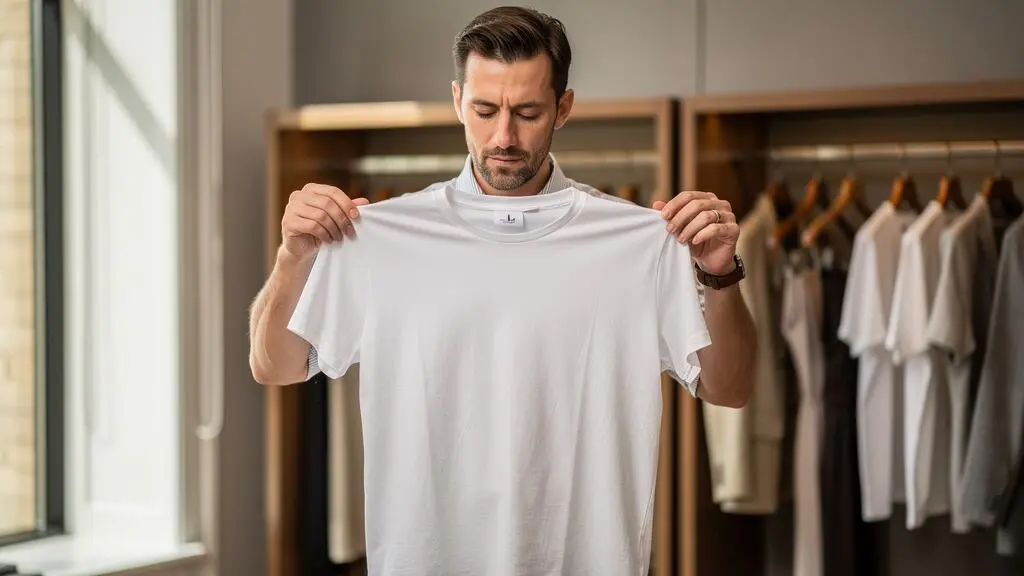
Organic cotton can justify a higher price when its farming credentials matter to you, but it is not automatically a better investment in clothing that lasts. A premium cotton T-shirt may feel luxurious on the shop floor and still develop a twisted hem, loose neckline or surface pilling after repeated washing. An organic label alone cannot tell you whether that will happen.
For UK shoppers upgrading everyday clothes, the meaningful distinction is between how cotton was grown and how the finished garment was made. Fibre length, yarn quality, fabric construction, stitching and laundering all influence whether a piece remains wearable. Certification can help establish environmental and supply-chain credentials, but it does not replace an assessment of physical quality.
The smartest purchase therefore combines credible evidence about the cotton with observable construction quality, realistic care requirements and an honest estimate of how often you will wear the garment. That applies whether you are buying a luxury white T-shirt, an office shirt or a dependable pair of summer trousers.
Organic Cotton: What Matters Before You Pay More
- Organic is a farming claim, not a durability rating. Look separately at fibre quality, fabric construction and finishing.
- Check the garment, not just its label. Fabric recovery, stitch quality, density and care requirements reveal useful information about expected wear.
- Pay for verifiable benefits and realistic longevity. Credible certification, frequent use and careful laundering make an upgrade easier to justify.
- Why Doesn’t Organic Cotton Automatically Mean Better Fabric Quality?
- How to Spot High-Quality Cotton Using 5 Touch-and-Look Tests?
- Organic Cotton, Linen, or Tencel: Which Feels Best in Warm UK Commutes?
- The Washing Habit That Shrinks Cotton and Ruins Fit Faster Than You Think
- Which Cotton Basics Are Worth Upgrading First if You Have £200 to Spend?
- Why Do Two White T-Shirts Look Identical but Wear Totally Differently After 10 Washes?
- Metals, Leather, or Textiles: Which Supply Chain Is Easiest to Trace Credibly?
- Where Do Supply Chains Break Down in Luxury, and Why Should UK Buyers Care?
Why Doesn’t Organic Cotton Automatically Mean Better Fabric Quality?
Organic cotton does not automatically produce better fabric because organic certification principally concerns how the fibre is cultivated, while garment durability depends heavily on what happens afterwards. Fibre selection, spinning, knitting or weaving, finishing and garment construction all influence performance. A poorly constructed organic cotton shirt can wear out sooner than a well-made conventional cotton equivalent.
Organic cultivation involves production requirements governing agricultural inputs and practices, including restrictions on specified pesticides and genetically modified organisms under applicable organic standards. These requirements help establish the cotton’s agricultural credentials. They do not establish whether a T-shirt will resist pilling, whether its seams will remain straight or whether its collar will recover after stretching.
Consider two shirts. The first uses conventionally grown long-staple cotton, carefully spun yarn and a stable, well-constructed fabric. The second uses certified organic cotton but loosely constructed yarn and poor stitching. The first may retain its appearance longer, despite having no organic fibre claim.
The distinction becomes more important when certification schemes enter the picture. The GOTS Version 8.0 textile certification standard extends requirements beyond raw fibre to relevant processing, manufacturing and trading stages. Certified entities must meet applicable criteria and maintain documentation covering their authorised activities. However, even GOTS does not provide a universal guarantee of garment longevity.
Consumers should consequently distinguish three questions:
- Farming: Is the cotton genuinely organically produced, and what evidence supports that claim?
- Processing: Which textile production stages and environmental or chemical criteria are covered by certification?
- Durability: Is the actual garment sufficiently well made to withstand its intended use?
Luxury branding can blur these categories. A product description may emphasise organic cotton, responsible sourcing and softness while saying little about yarn structure, fabric density or seam construction. These omissions do not prove poor quality, but they leave important purchasing questions unanswered.
Organic sourcing can still justify a premium for shoppers who value the specific agricultural practices covered by certification. That is a distinct benefit from extended garment life and deserves to be evaluated on its own terms.
The practical next step is to assess the garment itself. Several simple tests can reveal weaknesses that neither a fibre composition label nor an appealing product photograph will reliably disclose.
How to Spot High-Quality Cotton Using 5 Touch-and-Look Tests?
To assess cotton quality before buying, examine how the fabric recovers from gentle stretching, how evenly it transmits light, how securely its seams are sewn, how its surface responds to light friction and whether its fibre-quality claims are specific. Together, these checks provide useful clues, although none independently guarantees durability or replaces standardised textile testing.
Start with fabric behaviour rather than softness alone. Softness can result from fibre properties, fabric construction or finishing treatments. A pleasantly smooth surface is useful for comfort, but it does not establish how the garment will perform after repeated laundering.
- Stretch and rebound: Gently stretch a knitted fabric across its width, release it and observe whether it returns close to its original shape. Poor recovery may suggest an unstable construction. Woven shirts naturally behave differently, so do not compare them directly with jersey.
- Hold to the light: Examine the fabric against an even light source. Look for unexpected thin patches, uneven yarn distribution or inconsistent density. Some lightweight summer fabrics are deliberately translucent, so judge consistency rather than opacity alone.
- Inspect seams and stitches: Check that stitching is regular, seams sit flat and loose threads are minimal. Gently inspect areas subject to movement, including shoulders, underarms and hems. Stitch density matters alongside stitch type, thread quality and fabric compatibility.
- Check surface friction: Rub a small, inconspicuous area gently against itself and observe whether loose fibres appear immediately. This is only a screening check; true pilling resistance requires repeated abrasion testing.
- Examine fibre claims: Look for meaningful information about staple length, yarn and construction. Long-staple cotton can support stronger, smoother yarns when processed appropriately. Egyptian cotton and Supima claims require credible identification rather than blind acceptance.
Fabric weight offers another useful clue. Expressed in grams per square metre (GSM), it describes mass relative to fabric area, not strength or quality directly. A heavier jersey may feel substantial and conceal more of the body, while a carefully constructed lighter fabric may suit a summer shirt better. Higher GSM is not automatically evidence of longer life.
For online luxury shopping, use product descriptions and high-resolution photographs as substitutes for the initial inspection. Check exact fibre composition, construction details, fabric weight where disclosed and close-up images of collars and seams. A missing specification is an information gap, not proof that the garment is inferior.
Review the retailer’s return terms before ordering so you know whether you can examine the garment at home and return it in the required condition. Do not assume a retailer permits wear or laundering during the return period.
Your Five-Step Cotton Quality Inspection
- Gently stretch and release the garment; record whether the fabric returns evenly to its original shape.
- Hold the fabric against consistent light; identify any unexpected thin patches or irregularities.
- Inspect the shoulder, side and hem seams; note visible gaps, loose threads or uneven stitching.
- Check a discreet fabric area for loose surface fibres after gentle friction; record any immediate changes.
- Read the composition and construction information; save a product specification or photograph showing any verifiable fibre-quality claims.
These observations are most useful when comparing garments of similar construction and intended purpose. A luxury T-shirt should not be judged against the same opacity, stretch or weight expectations as a loosely woven summer blouse.
Once basic construction quality is established, fibre choice becomes a question of comfort, function and maintenance. A cotton garment that passes every inspection may still be less suitable than linen or lyocell for a crowded summer commute.
Organic Cotton, Linen, or Tencel: Which Feels Best in Warm UK Commutes?
For warm UK commutes, organic cotton is a versatile choice for everyday tops, linen often suits airy summer shirts and trousers, and TENCEL Lyocell is worth considering when moisture handling and a fluid drape matter. No fibre is universally the coolest or most durable. Fabric weight, weave, fit, humidity and finishing can change the experience considerably.
A British commute may involve a cool walk to the station, a crowded train and a warm office later in the day. The best fabric must therefore handle changing conditions without becoming uncomfortable or looking excessively tired before evening.
Cotton absorbs moisture and usually feels familiar against the skin, particularly in breathable, appropriately constructed fabrics. However, it may retain a damp sensation when heavily saturated. Organic cultivation does not independently improve this moisture behaviour.
Linen is often appealing for warm-weather clothing because suitable open constructions allow ventilation. It can provide good wear resistance and commonly softens with use. Its defining compromise is visible creasing, which may be attractive in casual clothing but less convenient where a sharply pressed appearance is expected.
TENCEL is a trademark used for specified cellulosic fibres, including lyocell. Lenzing describes its wood-derived TENCEL Lyocell fibres as having substantial moisture uptake and moisture-release capabilities. The manufacturer’s technical information on TENCEL Lyocell supports these fibre-level properties, but does not establish that every finished lyocell garment outperforms cotton or linen in actual UK commuting conditions.
The following comparison focuses on common wardrobe applications rather than laboratory rankings.
| Consideration | Organic cotton | Linen | TENCEL Lyocell |
|---|---|---|---|
| Everyday feel | Familiar, soft and versatile | Often crisp initially, softening with wear | Often smooth with a fluid drape |
| Moisture behaviour | Absorbs moisture; can remain damp | Absorbs moisture; comfort depends on construction | Good fibre-level moisture uptake and release |
| Creasing | Varies with construction and finishing | Usually creases noticeably | Often drapes smoothly; creasing varies |
| Care and durability | Good potential with stable construction and proper washing | Wear-resistant in suitable fabrics; benefits from appropriate care | Can offer good strength but requires attention to garment-specific washing instructions |
| Practical wardrobe role | T-shirts and daily base layers | Relaxed visible shirts and summer trousers | Draped shirts and smart-casual layers |
For a base layer beneath an overshirt, a well-made cotton jersey may provide the simplest balance of comfort and washing convenience. For visible summer shirts, linen offers a deliberately relaxed appearance, while lyocell may be preferable when a softer drape is important. For trousers, compare fabric structure and abrasion resistance rather than fibre name alone.
Blends introduce further possibilities. Cotton-lyocell fabrics can combine desirable characteristics of both fibres, potentially improving handle or dimensional stability in an appropriately engineered garment. The blend itself does not guarantee shrink resistance, however. Mixed fibres may also be harder to separate for certain fibre-to-fibre recycling processes.
Comfort should guide fibre selection, but keeping that comfort over time depends partly on what happens after purchase. Even carefully made cotton can lose its intended fit through unsuitable laundering.
The Washing Habit That Shrinks Cotton and Ruins Fit Faster Than You Think
High-heat tumble drying is a preventable contributor to cotton shrinkage and fit distortion, particularly when combined with an unsuitable wash cycle. Cotton fabrics can relax tensions introduced during manufacturing, especially in early washes. Heat, moisture and mechanical action influence the result, so gentler washing followed by air drying often gives a garment a better chance of retaining its intended dimensions.
Cotton fibres absorb water and swell during laundering. At the fabric level, yarns and knitted or woven structures can rearrange as tensions from manufacturing are released. This relaxation helps explain why some garments shrink most noticeably during their initial washes, even without extreme temperatures.
Drying can add further dimensional change. Tumble drying introduces heat and mechanical movement, while overdrying can make unnecessary stress worse. The exact response depends on the original fabric, whether it was stabilised during manufacturing and the care treatment it has already received.
Changing detergent alone is unlikely to resolve a shrinkage problem caused primarily by heat, agitation or drying practices. A gentler drying method is often a more relevant adjustment, although no care routine can eliminate all residual shrinkage.
A sensible routine for luxury cotton begins with the sewn-in care label. Where permitted, wash at a cool or low temperature using an appropriate gentle cycle. Avoid unnecessarily vigorous agitation, use a suitable spin setting and remove garments promptly when the cycle finishes.
While the fabric is still damp, gently restore the garment’s shape without forceful stretching. Pay particular attention to the shoulder line, collar, side seams and hem. Dry it on a suitable airer or flat surface, as directed by the label, away from concentrated heat. Heavy wet knits may need flat drying to avoid stretching under their own weight.
Labels such as pre-shrunk or Sanforised indicate that a manufacturer has applied a process intended to control dimensional change. They are useful signals, but reduced shrinkage does not mean zero shrinkage. The remaining risk depends on the material, treatment and subsequent care.
Care habits have direct financial consequences. An expensive shirt that no longer fits after avoidable laundering damage may deliver far fewer wears than expected. This can overwhelm a modest difference in initial material quality when evaluating cost per wear.
There is also a practical reason not to wash every garment unnecessarily: washing and drying introduce repeated mechanical stress. Appropriate cleaning frequency depends on hygiene, wear conditions and garment type, but following the care label and avoiding unnecessary harsh cycles can help preserve appearance.
Once care is accounted for, the next decision is financial: which everyday garments deserve a larger share of a limited clothing budget, and which upgrades are unlikely to deliver meaningful additional value?
Which Cotton Basics Are Worth Upgrading First if You Have £200 to Spend?
With £200 to upgrade cotton basics, prioritise the clothes you wear and wash most frequently, provided they are well constructed and comfortable. Everyday T-shirts, frequently worn shirts and underwear often deserve attention before occasional statement pieces. Spending more makes sense when an upgrade offers a credible improvement in fit, comfort or longevity, not simply a more prestigious label.
A practical starting point is to assess the clothes already in rotation. Identify which garments lose shape, become uncomfortable or need replacing most often. Then compare those weaknesses with the quality improvements available in prospective replacements.
There are two sensible ways to distribute the budget: buy one particularly strong wardrobe foundation and several supporting basics, or buy a slightly larger rotation of mid-priced, well-made items. Neither approach is inherently better.
Consider these hypothetical budget allocations. They illustrate decisions rather than current retail prices or verified product recommendations.
| Allocation | Quality-first approach | Rotation-first approach |
|---|---|---|
| Primary purchases | One everyday shirt: £100 | Four everyday T-shirts: £35 each |
| Supporting purchases | Two T-shirts: £40 each | Two additional basics: £25 each |
| Remaining budget | £20 | £10 |
| Main benefit | Higher allocation to one frequently worn piece | More garments available for rotation |
| Main trade-off | Fewer replacement options | Less budget per individual garment |
The first approach can work if a particular shirt is genuinely indispensable and has unusually good construction. The second may suit someone who needs several reliable T-shirts for work, commuting and daily life. Rotation is useful for managing laundry and availability, but owning more pieces does not automatically reduce total clothing consumption.
Cost per wear helps make the trade-off clearer. It is calculated by dividing the purchase price by the number of times the garment is worn.
Hypothetical Example: The £60 T-Shirt Versus the £20 T-Shirt
Suppose a £60 T-shirt remains wearable for 120 wears. Its purchase cost per wear is £0.50. A £20 T-shirt that lasts only 25 wears costs £0.80 per wear.
These are illustrative assumptions, not observed durability results. If the £20 shirt instead lasts 100 wears, its purchase cost per wear falls to £0.20 and the cheaper option performs better financially. Laundry costs and other ownership expenses are excluded.
The premium only works economically when the added expenditure is matched by enough additional use. Care, fit, changing preferences and actual construction quality all affect that outcome.
Underwear may also deserve upgrading because of frequent skin contact and laundering, but price and organic certification alone are not reliable predictors of comfort or lifespan. Evaluate waistbands, seams, fit and care requirements alongside fabric composition.
The most avoidable spending mistake is allocating nearly the entire budget to a rarely worn designer piece while continuing to replace poor-quality everyday garments.
To judge whether an upgrade actually worked, examine how the garment behaves after repeated washing. Plain white T-shirts are particularly revealing because subtle changes in fabric quality become difficult to overlook.
Why Do Two White T-Shirts Look Identical but Wear Totally Differently After 10 Washes?
Two white cotton T-shirts can look nearly identical when new yet change differently after ten washes because they may use different fibre lengths, yarn structures, knit densities and finishing processes. Those differences influence pilling, collar recovery, seam distortion and surface appearance. Washing conditions also matter, so visible deterioration cannot be attributed to cotton quality alone without considering care.
The most significant variables are often invisible in a standard product photograph. Longer, more uniform fibres can make it easier to produce smooth, cohesive yarns. Yarn twist influences strength, handle and stability. Fabric density affects how the knitted structure behaves, while finishing treatments can alter the original softness or appearance.
These characteristics interact. A tightly constructed fabric made from unsuitable yarn is not necessarily superior to a balanced fabric using a different structure. Likewise, an expensive finishing treatment may improve the initial feel without providing an equivalent improvement in long-term performance.
White makes these differences particularly noticeable. Greying, yellowing, fabric thinning and changes in transparency can become visible sooner than they would on some darker garments. However, colour changes can also result from laundry contamination, product residues, storage conditions or unsuitable care; they are not automatically evidence of inferior cotton.
The most useful way to assess a brand is to compare actual wear over time. At the beginning of ownership, record the garment’s appearance and basic measurements. After a consistent number of washes, examine the same areas under similar conditions.
- Collar: Has the neckline stretched, curled or lost its original shape?
- Side seams: Do they remain aligned or appear to twist?
- Hem: Is it level, or has the fabric changed shape unevenly?
- Surface: Are there new pills, rough patches or visible areas of thinning?
- Printed labels and decoration: Have prints cracked or faded, where present?
Photographs taken before use and after ten comparable wash cycles offer a simple personal record. Keep the detergent, drying method and wash conditions reasonably consistent if comparing different T-shirts. Otherwise, differences in treatment may explain part of the result.
This is not a controlled laboratory experiment. Garments can experience different friction, perspiration and wearing conditions. Nevertheless, a consistent personal record is more informative than relying entirely on promotional descriptions.
It also provides a useful bridge between pre-purchase inspection and long-term evaluation. Fabric density, seam regularity and recovery can be examined in store, then revisited after real use to see whether those initial signals were meaningful.
Physical performance is only half the premium-cotton decision. If the organic claim also influences the price, buyers need to know how reliably the claimed fibre can be traced through manufacturing.
Metals, Leather, or Textiles: Which Supply Chain Is Easiest to Trace Credibly?
No material family is automatically the easiest to trace credibly. Metals, leather and textiles all require evidence appropriate to their production processes, and traceability varies with the certification system and individual supply chain. Cotton presents particular challenges because fibre can pass through numerous intermediaries and may be mixed during processing, making documentary continuity important.
Metals can be supported by refining records, supplier documentation and relevant chain-of-custody arrangements. Yet melting and recycling may combine material from multiple origins, making a claim about the exact source of every constituent difficult without a suitable traceability system.
Leather may be associated with documented tanneries and manufacturing facilities, but identifying a tannery does not necessarily establish the identity of the original farm or animal. Upstream traceability depends on records and how securely they connect successive stages.
Cotton involves a different set of challenges. Fibre travels from agricultural production through ginning, spinning, fabric manufacturing and garment assembly. Materials may be aggregated, transferred between businesses or processed by subcontractors. A brand may know its garment factory while having limited evidence about earlier stages.
The comparison is therefore about the strength of the chain of evidence rather than an assumed ranking of materials.
| Material family | Potential evidence | Important limitation |
|---|---|---|
| Metals | Supplier records, refinery documentation and applicable chain-of-custody certification | Mixed or recycled inputs may complicate origin attribution |
| Leather | Tannery identification, supplier records and relevant traceability arrangements | Tannery visibility may not establish farm-level origin |
| Cotton textiles | Organic-fibre documentation, scope certificates and applicable transaction records | Mixing and multiple processing intermediaries can interrupt documentary continuity |
For cotton, a credible claim should identify what is certified and which organisations are responsible for verification. A scope certificate helps identify the product and processing categories an entity is authorised to handle. Transaction-level records can provide additional evidence relating to material moving through a certified supply chain.
Neither document should be interpreted more broadly than its actual coverage. Evidence concerning a supplier’s certification status does not necessarily establish the organic content of every finished item sold by that supplier.
Publication of tiered supplier information can improve transparency, particularly when it distinguishes raw-material processing from fabric production and garment assembly. However, a supplier list is not equivalent to verified chain-of-custody evidence.
Descriptions such as “responsibly sourced” or “consciously made” are difficult to assess unless a brand explains the specific practices, coverage and substantiation behind them. These phrases alone are not certifications.
For UK buyers, this distinction has a wider implication: environmental claims are not merely technical descriptions. They also form part of the information consumers rely on when deciding whether a premium purchase is justified.
Key Takeaways Before Paying a Premium
- Ask which stages of the cotton supply chain are covered by the stated certification, rather than assuming a fibre claim covers the finished garment.
- Treat documentation of organic content and evidence of physical garment quality as separate requirements.
- Give greater weight to precise, substantiated product claims than to broad sustainability language without a clearly defined scope.
Where Do Supply Chains Break Down in Luxury, and Why Should UK Buyers Care?
Luxury cotton supply chains can lose traceability when materials are mixed, intermediaries are insufficiently documented or environmental claims extend beyond what certification actually covers. UK buyers should care because an organic premium is meaningful only when the claim is credible and properly explained. Consumer protection guidance requires businesses to substantiate environmental representations, but legal safeguards do not guarantee superior garment durability.
A typical cotton garment may pass through agricultural production, ginning, spinning, knitting or weaving, dyeing and finishing, cutting, sewing, distribution and retail. Each transition creates a point where information about the material must remain accurate.
Problems can arise when certified and non-certified fibres are mixed without the appropriate certified control system, when material transfers are poorly documented or when subcontracted processing falls outside the evidence supporting a particular claim. These are potential vulnerabilities, not proof that a particular luxury brand has acted improperly.
Even when a product contains genuinely organic cotton, a claim about that fibre should not automatically be extended to the entire garment’s manufacturing process or environmental impact. Dyes, finishing chemicals, energy use, packaging and manufacturing conditions involve additional considerations.
The UK Competition and Markets Authority addresses this distinction in its guidance on environmental claims in fashion retail. It expects environmental representations to be clear and substantiated, recommends precise descriptions of fibre composition and identifies relevant supplier certificates as potential supporting evidence.
In practical terms, shoppers should be able to understand what percentage of a garment uses the claimed organic material and what the claim actually covers. A broad statement about an entire product can be misleading if its wording suggests environmental characteristics that the supporting evidence does not establish.
UK consumer protection rules provide mechanisms to challenge misleading commercial practices. The CMA’s guidance is particularly relevant to UK retail claims; EU requirements can also be relevant to businesses operating in EU markets, but should not be treated as an identical or automatically applicable UK legal framework. A consumer’s available remedy depends on the circumstances and applicable law.
Before paying extra for an organic cotton luxury garment, apply four distinct checks:
- Organic certification: Identify the precise fibre claim, the percentage of organic material and the standard or evidence supporting it.
- Traceability: Check whether the claimed certification and supplier evidence relate to the relevant stages and product, rather than merely to an unrelated certified facility.
- Construction quality: Examine the yarn, fabric, seams, fit and finishing wherever information or physical inspection permits.
- Care compatibility: Confirm that the required cleaning and drying routine fits your lifestyle and is likely to preserve the garment’s intended appearance.
These four checks answer different questions. Certification and traceability support confidence in sourcing claims. Construction and care provide a more relevant basis for judging longevity. A weakness in any one area reduces the strength of an overall claim that a premium garment represents a better long-term purchase.
Not every brand will publish extensive supply-chain documents for every product. Limited public information is not conclusive evidence of wrongdoing, but it is reasonable for a buyer to request clarification when environmental claims materially influence the purchase decision.
A useful question to send a retailer is: “What certification supports the organic cotton content of this specific garment, and does it cover only the fibre or also subsequent processing?” A separate question can ask for fabric construction details and expected care requirements.
Paying more can be worthwhile when the organic farming credentials are independently meaningful to you, the claim is credibly documented and the garment demonstrates the construction quality needed for its intended use. It is less convincing when premium pricing rests mainly on the word “organic” without supporting information.
For your next cotton upgrade, shortlist garments that meet your comfort and quality requirements, examine their certification claims and choose the piece you are realistically prepared to wear and care for repeatedly. That approach makes a premium easier to justify without confusing environmental credentials with a promise of longevity.
Does 100% organic cotton mean a garment contains no finishing chemicals?
No. A 100% organic cotton composition claim describes the stated cotton content, not necessarily every treatment applied during textile manufacturing. Dyeing, finishing and other processing steps may involve additional substances. Certification covering processing stages can provide further information about applicable chemical restrictions and controls.
Is expensive cotton always less likely to pill?
No. Pilling depends on fibre characteristics, yarn construction, fabric structure, finishing and friction during use. A higher price does not independently establish superior pilling resistance. Detailed product information and actual wear experience are more informative than price alone.
Can a cotton garment be genuinely organic without carrying a GOTS label?
Yes. An organic-fibre claim and GOTS certification are not equivalent. Cotton may have agricultural organic credentials without the finished textile being certified under GOTS. The appropriate question is which claim is being made, what evidence supports it and whether that evidence covers the specific garment.
Should you wash new organic cotton clothes before wearing them?
Washing new clothing before its first wear can be a reasonable personal preference, particularly for items worn directly against the skin. Follow the garment’s care instructions, since organic fibre status does not determine the correct washing temperature or drying method. An initial wash may also reveal dimensional changes, but it is not a reliable certification or quality test.
What should you do if an organic cotton product description seems misleading?
Keep a copy of the product description, relevant labels and purchase evidence. Ask the retailer to clarify the exact organic content and supporting certification. If the explanation is inadequate, consider the applicable retailer complaints process and UK consumer advice channels. Whether a legal remedy is available depends on the specific representations and circumstances.