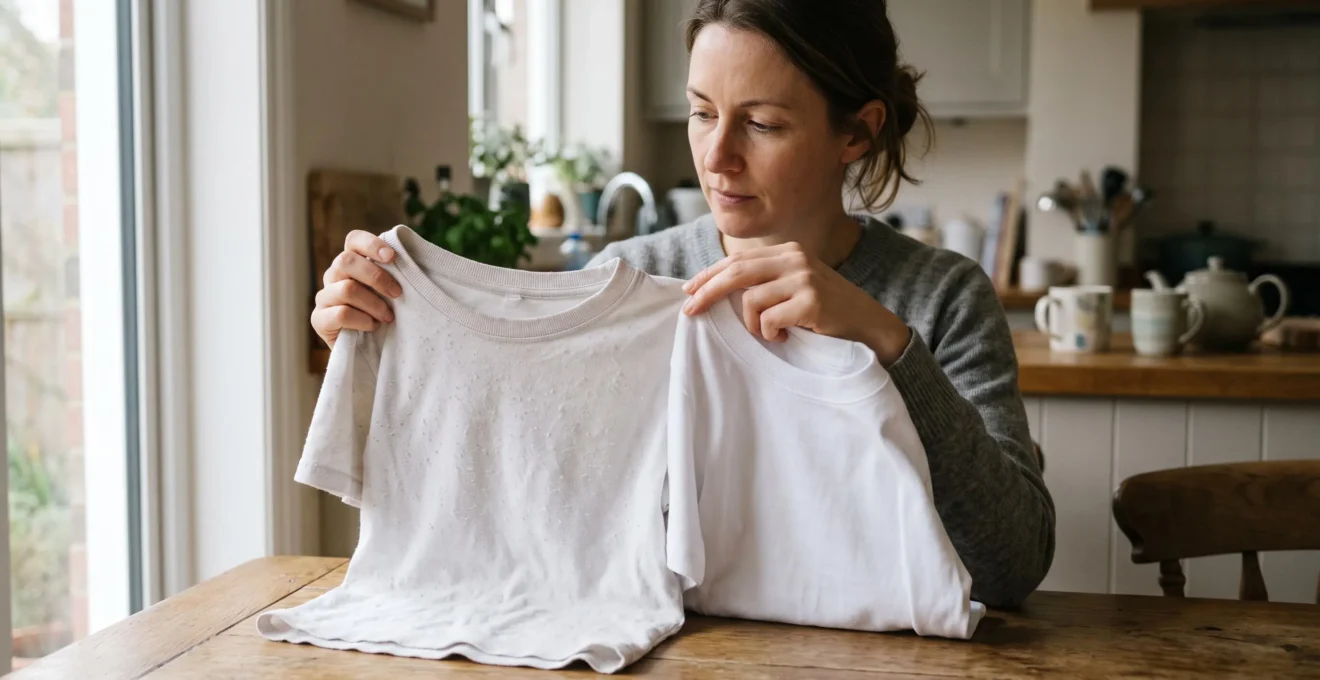
Luxury casualwear is everyday clothing distinguished by thoughtful materials, precise construction, comfortable fit and finishing that continues to perform through regular use. In the UK, it can mean a beautifully made cotton T-shirt, well-balanced wool jumper or understated jacket rather than an outfit covered in designer logos.
The difference is often easier to feel than to see. A neckline sits comfortably against the skin, a sleeve moves without pulling, and a fabric drapes naturally instead of collapsing or clinging. These qualities depend on decisions made long before a garment reaches the shop rail: fibre selection, yarn production, knitting, cutting, stitching and finishing.
Yet expensive does not automatically mean excellent. Branding, design and retail positioning also influence prices, while a modestly priced garment can demonstrate impressive workmanship. The useful question is therefore not whether something looks luxurious, but which observable details justify its price and predict how well it will serve its owner.
Learning to recognise those details makes everyday dressing simpler, reduces dependence on labels and helps shoppers distinguish genuine quality from attractive presentation.
Luxury casualwear: what matters most
- Fabric construction, consistent stitching, shape retention and fit reveal more about practical quality than logos or price alone.
- Simple inspections and a controlled first wash can expose weaknesses before they become expensive disappointments.
- A coherent wardrobe of adaptable pieces offers more everyday value than individually expensive garments that rarely work together.
- Why Do Two White T-Shirts Look Identical but Wear Totally Differently After 10 Washes?
- How to Check Casualwear Quality at Home Without Any Special Tools?
- Quiet Luxury or Logos: Which Signals Better Taste in the UK Workplace?
- The Casualwear Mixing Mistake That Makes Even Expensive Pieces Look Random
- A 12-Item Casual Luxury Capsule That Cuts Shopping Trips by Half
- Why Doesn’t Organic Cotton Automatically Mean Better Fabric Quality?
- How to Check Luxury Accessory Quality in 8 Points Before You Leave the Shop?
- What Actually Defines Luxury in Accessories When Logos Don’t Impress Anyone Anymore?
Why Do Two White T-Shirts Look Identical but Wear Totally Differently After 10 Washes?
Two white T-shirts can look identical when new yet develop very different appearances after repeated washing because their fibres, yarns, knit structures and finishing processes differ. One may retain a smooth surface and stable shape while another pills, twists or develops a distorted neckline. Their initial appearance does not reveal how their construction will respond to use.
A plain white T-shirt makes a useful comparison because printed graphics and decorative details cannot distract from the fundamentals. The fabric, collar, seams and fit carry almost the entire impression of quality.
Start with the yarn. Cotton fibres vary in length and other characteristics, and spinning methods influence how securely those fibres are held together. Longer fibres can help produce smoother yarns under suitable manufacturing conditions, but fibre length alone cannot guarantee superior resistance to wear.
Scientific research on yarn construction and fabric pilling examined polyester-cotton woven fabrics and found that variables including yarn twist, spinning method, fabric density and finishing influenced pilling behaviour. The researchers assessed samples after different abrasion exposures, not domestic washing cycles. Their findings explain why construction matters, without predicting exactly how a cotton jersey T-shirt will look after ten washes.
Fabric weight is another clue. GSM means grams per square metre, describing the mass of a given area of fabric. A higher-GSM jersey often feels more substantial, but heavier does not automatically mean stronger or longer-lasting. Yarn quality, knit stability and finishing still matter. A lighter, well-made jersey may perform better for its intended use than a heavier, poorly constructed alternative.
Before buying, imagine how each T-shirt might behave through ten ordinary washes and inspect three vulnerable areas:
- Collar ribbing: look for even attachment, consistent tension and a neckline that lies flat without visible stretching.
- Side seams: check whether the fabric panels align naturally, without diagonal pulling or uneven stitching.
- Hem: examine whether the lower edge hangs straight and whether the knit appears to pull in one direction.
These observations are screening clues rather than a validated ten-wash prediction. Knit distortion can also arise during laundering, and even carefully constructed garments need appropriate care.
Price deserves separate scrutiny. One manufacturer may invest in superior yarn and finishing; another may invest heavily in visual branding or a particular design identity. Without verified cost information, the proportion of a retail price attributable to either cannot be established simply by examining the label.
The strongest purchase decision combines visible construction, comfort and care requirements rather than treating weight, softness or a premium price as sufficient proof. Once those distinctions become familiar, they can be checked at home with remarkably little equipment.
How to Check Casualwear Quality at Home Without Any Special Tools?
Casualwear quality can be assessed at home by examining fabric consistency, stretching and recovery, seam alignment, fibre composition and performance after washing. These checks require no specialist equipment and help identify practical weaknesses that a product photograph cannot show. None provides a certified durability rating, but together they offer a repeatable way to judge everyday clothing.
Begin with light. Hold a garment against a household lamp and look for unexpected variations in the knit or weave. Irregularities may reveal uneven construction, although deliberate texture, open knitting and naturally varied yarns should not be mistaken for defects.
Next, gently stretch a cuff or ribbed neckline and release it. A well-suited elastic component should recover reasonably close to its original form. Avoid pulling hard enough to damage the garment. Recovery depends on the intended fabric structure, so a soft, relaxed knit should not be judged against the behaviour of sportswear.
Lay the piece flat and compare corresponding seams. Shoulder lines, side seams and hems should appear balanced relative to the intended design. Asymmetry can be deliberate, but unexplained twisting or puckering deserves attention.
Finally, read the composition label. According to UK government guidance on textile labelling, textile fibre content must be disclosed under the rules described for England, Scotland and Wales. This information identifies the materials used; it does not certify the garment’s mechanical durability.
A label stating 100% cotton is not a quality award. Small amounts of elastane can provide useful stretch in appropriate constructions, while mercerisation and garment dyeing can affect surface appearance and hand feel. Their presence or absence does not establish that the finished piece will last longer.
When appropriate, the first wash provides another practical assessment. Follow the care label, turn the garment inside out where suitable, separate colours appropriately and use the intended washing programme. After drying as instructed, inspect the seams, colour distribution, neckline and hem. Look for unexpected dye transfer, seam puckering or distortion.
One wash cannot establish lifetime performance, and unsuitable laundering can create damage unrelated to manufacturing quality. The purpose is to observe how the garment responds to the care conditions it is designed to tolerate.
Your five-step home quality inspection
- Inspect fabric against light: record whether the structure appears consistent or shows unexplained irregularities.
- Test a cuff or neckline gently: note whether its original shape returns after release.
- Check garment alignment: lay it flat and record any unexplained twisting, puckering or asymmetric seams.
- Read the composition and care labels: make a short note of the fibres and permitted washing conditions.
- Review the first appropriate wash: record any noticeable change in colour, seams, neckline or hem.
Keeping these five observations in a simple note creates a useful record for comparing future purchases. Over time, it also helps distinguish a brand’s marketing language from the actual performance of garments already owned.
Material assessment is only part of the decision. In professional settings, the way a garment communicates competence and personal style can matter just as much as its construction.
Quiet Luxury or Logos: Which Signals Better Taste in the UK Workplace?
Neither quiet luxury nor visible logos automatically demonstrates better taste in a UK workplace. Understated clothing often integrates more easily into formal professional environments, but fit, garment condition and appropriateness matter more than branding alone. The strongest choice depends on the employer’s dress code, the wearer’s responsibilities, client expectations and the surrounding office culture.
Quiet luxury describes an approach in which material, silhouette and finishing carry the impression of refinement rather than prominent brand marks. A fine-gauge jumper, cleanly fitted trousers and polished leather shoes can communicate considered dressing without announcing their manufacturer.
Visible branding works differently. It relies partly on recognition: the viewer must know the mark and associate it with a particular image. That can be useful in some creative or fashion-oriented environments but distracting in settings where discretion is expected.
UK workplaces are not uniform. A London media office may welcome expressive styling, while a client-facing role in a traditional financial or legal organisation may favour restraint. Yet geography and industry are only starting points, not reliable substitutes for observing the actual workplace.
Four practical variables can guide the choice:
| Variable | When restraint may help | When more expression may fit |
|---|---|---|
| Sector | Traditional professional services | Creative or fashion-focused roles |
| Seniority | Roles requiring consistent formal presentation | Roles permitting an established personal style |
| Work responsibilities | Formal client meetings | Informal internal collaboration |
| Office dress code | Explicit smart or business expectations | Flexible casual policies |
These are contextual judgements, not evidence that one style produces better career outcomes. Clothing should support the professional situation without making the wearer uncomfortable or self-conscious.
Quiet luxury also fails when the basics are wrong. Plain trousers that bunch badly, a stretched jumper or visibly worn shoes do not become refined merely because they lack logos. Conversely, a thoughtfully chosen branded piece can look excellent when its colour, fit and formality suit the rest of the outfit.
Quality-driven dressing requires the same inspection skills used for everyday T-shirts: assess the drape, surface, seams and shape before considering the name attached to them.
The aim is not to conceal every brand. It is to make each garment feel intentional. That principle becomes especially important when several individually expensive items are worn together.
The Casualwear Mixing Mistake That Makes Even Expensive Pieces Look Random
Expensive casualwear often looks disconnected when garments belong to conflicting levels of formality or follow inconsistent proportions. A highly technical running jacket, refined wool trousers and formal leather shoes may each be excellent individually, yet their materials and intended uses can pull the outfit in different directions. Coherence matters more than the combined retail price.
The mistake is not mixing styles as such. Deliberate contrast can be effective. Problems arise when the combination offers no clear relationship between its pieces.
Consider three characteristics that influence visual harmony.
- Texture: matte cotton, brushed wool and smooth technical synthetics create different visual effects. Combining them requires a deliberate reason rather than merely a matching colour.
- Finish: an extremely glossy surface can feel disconnected from otherwise soft, matte garments unless repeated or balanced elsewhere.
- Proportion: a structured heavyweight top with very lightweight bottoms may produce an unintended imbalance. Shape and drape matter alongside fabric mass.
Fit inconsistency is another frequent source of confusion. An oversized shirt can work with tailored trousers, but it needs to look deliberately relaxed rather than simply too large. Sleeve length, shoulder placement and trouser width help communicate that intention.
Imagine a hypothetical wardrobe containing three expensive pieces: a tailored navy wool trouser, a glossy technical running jacket and a pair of polished leather loafers.
A hypothetical three-piece styling comparison
Combination A: the running jacket is zipped tightly over a formal shirt, the navy trousers are sharply pressed, and the loafers are highly polished. The technical outerwear and formal details compete because neither register clearly leads.
Combination B: the same jacket is worn open over a plain fine-gauge knit, with the trousers styled in a softer, more relaxed manner and the loafers worn without overtly formal accessories. The outfit creates a more deliberate smart-casual transition, although personal preference still determines whether the contrast succeeds.
The difference is not a purchase. It is how the existing pieces are worn and connected. A repeated colour, a relaxed silhouette or a consistent surface finish can help establish a common visual language.
This approach also discourages buying isolated statement pieces without considering what they will accompany. Before paying for an expensive garment, picture at least three outfits using clothes already owned.
A smaller wardrobe makes these relationships easier to manage because each garment can be selected to complement several others rather than requiring a separate outfit around it.
A 12-Item Casual Luxury Capsule That Cuts Shopping Trips by Half
A twelve-item casual luxury capsule can make shopping less frequent by concentrating purchases on garments that work across multiple outfits and seasons. The benefit comes from versatility, suitable construction and longer useful service, not from reaching a particular item count. Cutting shopping trips by half is a possible personal goal, not a demonstrated or guaranteed result.
For UK conditions, the wardrobe needs to handle variable temperatures, occasional rain and movement between outdoor weather and heated interiors. Layers are therefore more useful than building everything around a single heavy garment.
The following twelve-piece example deliberately prioritises understated clothing that can be combined without requiring matching designer labels.
| Item | Garment | What earns its place |
|---|---|---|
| 1 | Weather-resistant outer jacket | Reliable protection for typical wet-weather journeys |
| 2 | Structured overshirt | An adaptable layer for mild days and indoor wear |
| 3 | Fine-gauge wool jumper | Comfortable warmth without excessive bulk |
| 4 | Cotton or wool-blend cardigan | Adjustable insulation for temperature changes |
| 5 | White cotton T-shirt | A versatile base layer with stable collar construction |
| 6 | Dark neutral T-shirt | An alternative base layer for repeated outfits |
| 7 | Oxford-style casual shirt | A useful bridge between relaxed and smart dressing |
| 8 | Dark straight-leg jeans | Durable everyday styling when appropriately fitted |
| 9 | Relaxed tailored trousers | A smarter option without formal suit styling |
| 10 | Casual cotton trousers | A lighter alternative with complementary proportions |
| 11 | Understated leather footwear | A versatile choice for smart-casual settings |
| 12 | Comfortable everyday trainers | Practical footwear for informal routines |
This is a planning example rather than a universal wardrobe prescription. Climate exposure, work requirements, laundry frequency and personal style can justify different selections. A capsule also does not have to include all socks, underwear, specialist sportswear or occasion-specific clothing in its stated count.
Apply a simple compatibility rule: each new garment should work with at least three other capsule pieces in plausible outfits. That threshold is a practical design choice, not a scientifically established optimum.
Choose colours and silhouettes according to actual preferences rather than copying an inflexible neutral palette. Navy, grey, camel and off-white can be straightforward to combine, but a carefully selected brighter colour may work just as well.
To evaluate whether the capsule reduces shopping, record clothing purchases and replacements over a personally meaningful period. Fewer purchases may follow if garments remain wearable longer and already cover everyday needs. However, excellent construction cannot prevent changing sizes, evolving preferences or unexpected damage.
Once a wardrobe has a clear purpose, individual material claims become easier to examine. Organic cotton, for example, deserves consideration, but its certification should not be confused with proof of superior garment performance.
Why Doesn’t Organic Cotton Automatically Mean Better Fabric Quality?
Organic cotton does not automatically produce better fabric because agricultural production methods and finished textile performance are different characteristics. Certification can address how fibres are grown and processed, while softness, shape retention and resistance to pilling also depend on yarn production, fabric structure, finishing and garment construction. An organic label alone cannot establish which T-shirt will wear better.
The distinction matters because sustainability language is often presented beside claims of premium comfort and quality. Those ideas may overlap in an individual product, but one does not prove the other.
Organic cotton begins with agricultural practices governed by applicable organic production requirements. Once harvested, the fibre still undergoes manufacturing decisions that affect its final properties. Cotton can be spun into different yarn structures, knitted at different densities and finished using different techniques regardless of whether it was organically grown.
GOTS, the Global Organic Textile Standard, takes a broader approach than a simple farming claim. As explained in TÜV NORD‘s explanation of GOTS certification, the scheme addresses environmental and social requirements across relevant textile processing and supply-chain activities. Eligible certified products must meet specified organic fibre requirements, including a minimum organic proportion for the relevant certification category.
Certification should therefore be understood according to its defined scope. It is not evidence that every certified garment will outperform an uncertified alternative in pilling resistance, comfort or shape retention. Equally, GOTS should not be described as having no physical quality requirements without considering the applicable standard and product criteria.
The same distinction applies to sensitive skin. A shopper may have reasons to prefer certain materials or processing characteristics, but organic cotton certification alone cannot establish that a finished garment will be more comfortable for every individual.
When comparing two garments, assess the relevant claims separately:
- Organic certification: identify the standard, the exact product claim and whether certification is verifiable.
- Mechanical quality: inspect the fabric structure, seams, collar and recovery.
- Comfort: consider how the finished fabric actually feels against the skin.
- Price: decide which verified characteristics justify the additional expenditure.
A higher price attached to an organic label cannot automatically be interpreted as evidence of either better construction or excessive retailer profit. The necessary production and pricing information would need to be examined separately.
Responsible sourcing and satisfying everyday performance are both worthwhile considerations. The strongest garment is one whose relevant claims can be understood and whose construction suits the way it will be used. This same material-first thinking becomes valuable when assessing leather accessories.
How to Check Luxury Accessory Quality in 8 Points Before You Leave the Shop?
Luxury accessory quality can be assessed in-store through eight practical checks covering stitching, edges, hardware, lining, leather, closures, structure and aftercare. These observations help reveal workmanship that a prominent logo cannot guarantee. They are useful consumer screening methods rather than certified performance tests, and individual design choices should always be considered alongside visible construction.
A leather bag is a particularly revealing example because it combines several materials and mechanical components. Its quality depends not just on the outer leather, but also on how panels, edges, handles, zips and internal structures work together.
The following comparison explains what to examine before purchasing.
| Inspection point | Potential warning sign | More reassuring observation |
|---|---|---|
| 1. Stitching | Skipped stitches, loose threads or inconsistent seam placement | Even stitching, secure ends and alignment suited to the design |
| 2. Edge finishing | Peeling coating, exposed adhesive or unintentionally rough edges | Neat burnishing, secure edge paint or deliberately finished raw edges |
| 3. Hardware | Loose fittings, sharp edges or visibly inconsistent plating | Secure attachment, smooth surfaces and an appropriate weight for the component |
| 4. Lining | Loose attachment, puckering or poorly secured internal pockets | Securely fitted lining that supports access and everyday use |
| 5. Leather and grain | Unexplained surface damage, inconsistent finishing or excessive stiffness | Material characteristics consistent with the stated leather type and intended finish |
| 6. Zips and closures | Snagging, misalignment or unreliable fastening | Smooth, repeatable operation without unnecessary force |
| 7. Base structure | Unintended distortion or instability when placed down | Structure and flexibility consistent with the bag’s intended silhouette |
| 8. Aftercare | Unclear repair options or unsupported service claims | Written information on available repairs, care and applicable warranty terms |
The differences require interpretation. A deliberately unstructured bag may slump beautifully, while a rigid briefcase should retain a more defined silhouette. Similarly, heavyweight metal hardware is not automatically superior: secure fitting and suitability for the design matter more than weight alone.
Leather smell deserves particular caution. Odour can reflect tanning, finishing, storage or added fragrance, but it is not a reliable independent test of leather authenticity or quality. Natural variation in grain is also not necessarily a defect. Judge appearance against the material description and intended finish rather than expecting every surface to look identical.
Before payment, extend the inspection beyond the product. Ask for the shop’s written returns policy, applicable warranty terms and information about repair services. In the UK, a retailer’s voluntary returns arrangements should not be confused with statutory consumer rights; the practical options may differ depending on whether goods are faulty and how they were purchased.
Check whether aftercare requires proof of purchase, whether parts can be repaired or replaced, and whether any service limitations are clearly disclosed. Avoid assuming that a high purchase price includes indefinite repair support.
A shop-floor inspection cannot reveal every long-term weakness, but it can expose enough construction detail to make the buying decision more informed. Understanding what different leather and component descriptions actually mean adds another layer of confidence.
What to remember before choosing luxury accessories
- Identify the material and its finish before drawing conclusions from how premium it looks.
- Evaluate seams, edges and moving components as an integrated construction, not isolated decorative details.
- Ask what can be maintained or repaired, because long-term usefulness extends beyond the condition at purchase.
What Actually Defines Luxury in Accessories When Logos Don’t Impress Anyone Anymore?
Luxury accessories are most convincingly distinguished by appropriate materials, careful construction, thoughtful design and dependable support over their useful life. A logo can identify a maker or communicate status, but it cannot independently establish leather quality, finishing precision or repairability. The practical definition of luxury is therefore broader than brand recognition and depends on how the accessory performs.
Leather terminology illustrates why material knowledge matters. Full-grain leather retains its original grain surface without corrective mechanical removal. Corrected-grain leather has undergone surface correction and subsequent finishing. These terms describe different material treatments, not a universal ranking of finished products.
The Leather Working Group‘s leather terminology reference also distinguishes split leather, aniline leather and pigmented finishes. Understanding those categories helps consumers ask more precise questions about what they are buying.
Full-grain is not automatically the best choice for every use. Surface appearance, maintenance requirements, tanning, finishing and construction must be considered together. A corrected surface may be appropriate for a particular aesthetic or practical requirement, while a more natural finish may appeal to buyers who value visible grain characteristics.
Manufacturing quality adds another dimension. Consistent panel cutting, well-executed stitching and carefully finished edges can influence how an accessory looks and functions. Zips and hardware also deserve attention, especially when replacement is difficult.
Some manufacturers identify specialist component suppliers, but a familiar supplier name is not sufficient proof of the finished product’s quality. The relevant question remains whether the chosen component suits the accessory and is properly installed.
Quiet luxury has made discreet branding a familiar style preference, particularly among shoppers interested in understated design. However, claims that UK consumers have collectively abandoned visible logos, or that a measurable market-wide shift has occurred, would require specific market evidence. Both understated and logo-led styles continue to represent legitimate aesthetic preferences.
A useful buying hierarchy places the characteristics that most directly affect ownership ahead of brand visibility:
- Materials: identify what the accessory is made from, how it is finished and whether it suits its intended use.
- Construction: examine seams, attachments, edges, closures and repair possibilities.
- Design: assess comfort, function, proportions and compatibility with the existing wardrobe.
- Branding: consider reputation and personal preference after evaluating the physical product.
This hierarchy is a practical shopping framework, not a scientific formula. Design or branding may reasonably carry greater weight for a collector or for someone purchasing an accessory primarily as a fashion statement.
Durability is also more complex than simply choosing the hardest or thickest material. Flexible leather, soft linings and lightweight fittings can be appropriate when their properties suit the product. High-quality construction involves achieving the intended balance between appearance, comfort, function and maintenance.
The connection with everyday casualwear is straightforward. A white T-shirt and a leather bag may look simple, yet their real qualities depend on decisions that are not immediately visible. Both can be assessed through materials, workmanship, the way they respond to handling and their suitability for regular use.
Before the next purchase, compare the garment or accessory against something already owned. Examine its materials, construction, fit or function, care requirements and compatibility with daily life. Choose the piece whose qualities can be explained without relying solely on its logo or price.
Is luxury casualwear always more comfortable than ordinary clothing?
No. Comfort depends on fabric characteristics, fit, construction, temperature and individual preference. A premium garment may use carefully selected materials and refined finishing, but its price does not guarantee a more comfortable experience. Comparing similar garments directly is more useful than relying on their market positioning.
Can you recognise a durable T-shirt from its GSM alone?
No. GSM indicates fabric mass per unit area, not a complete measure of durability. Yarn structure, knitting, finishing and garment construction also affect performance. Compare fabric weight alongside collar stability, seam alignment and intended use rather than treating a higher GSM as an automatic advantage.
Does buying more expensive clothing necessarily save money over time?
Not necessarily. A higher upfront price may be worthwhile if the garment remains useful for longer and replaces purchases that would otherwise be necessary. However, long-term value depends on purchase cost, actual wear, maintenance and replacement frequency. A simple personal cost-per-wear comparison can help evaluate purchases without assuming that expensive always means economical.
Should leather accessories be treated differently from casual clothing when assessing quality?
The underlying principle is similar: identify the materials, inspect construction and consider how the product will be used. Leather accessories additionally require attention to edge finishing, hardware, closures, linings and repairability. Leather terminology can clarify material characteristics, but no single description establishes the quality of a complete bag or accessory.
What should UK shoppers prioritise when buying their first luxury casualwear piece?
Start with a garment that will be worn regularly, such as a plain T-shirt, versatile knit or weather-appropriate outer layer. Check its fit, fabric construction, care requirements and compatibility with clothing already owned. An adaptable, comfortable piece with observable workmanship provides a more useful introduction to luxury casualwear than an expensive item purchased mainly for brand recognition.