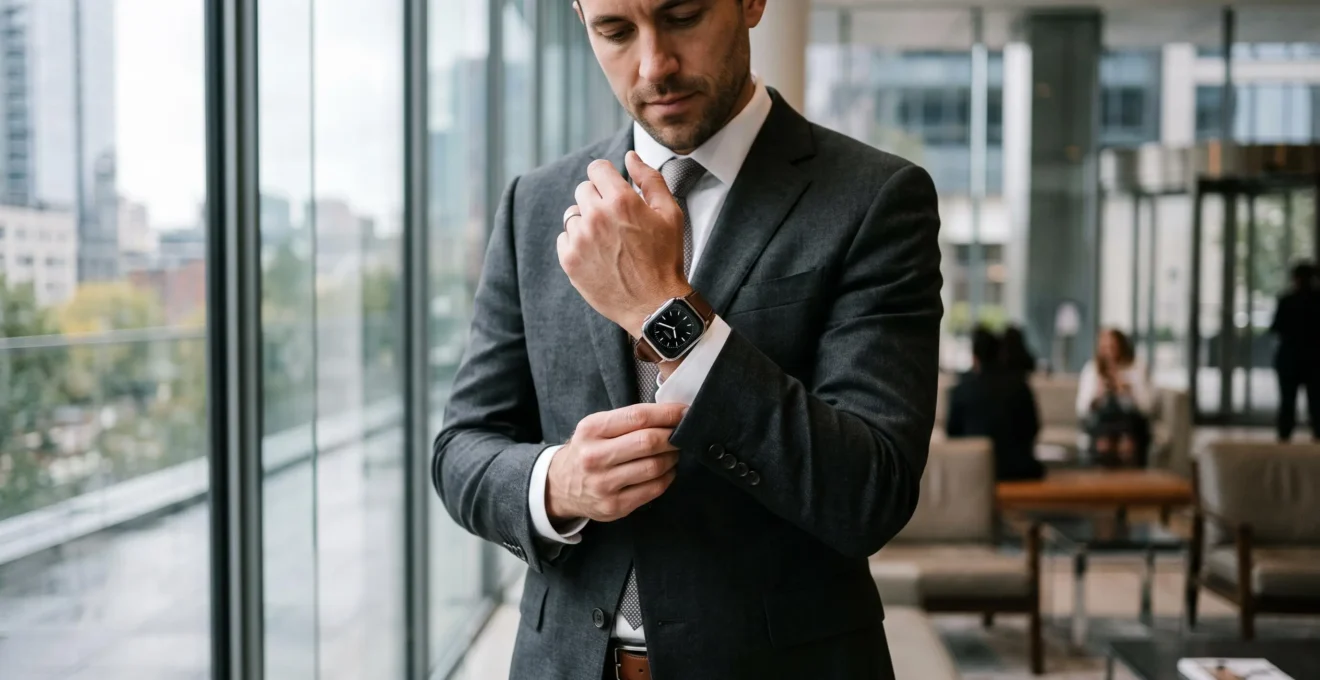
Wearable tech can work with a tailored suit, a crisp shirt or an evening outfit without making the wearer look ready for a workout. The trick is to treat a smartwatch as a considered accessory rather than a piece of fitness equipment that happens to be on your wrist.
For UK professionals who depend on health tracking, calendar alerts and notifications, removing a wearable every time the dress code changes is rarely practical. Fortunately, an understated watch face, compatible leather or metal strap, and attention to proportion can make the same device feel appropriate in very different settings.
The most convincing combinations borrow familiar principles from traditional watch styling: coordinate metals, balance textures and avoid competing focal points. A steel smartwatch with a restrained dial can sit comfortably beside a wool blazer, while a brightly coloured silicone band may interrupt the same outfit.
Beyond the watch itself, thoughtful accessory rotation and suitable clothing fabrics help technology become part of a coherent wardrobe rather than an afterthought.
Wearable tech styling: the essentials
- Match the watch’s case finish, strap material and proportions to your outfit and jewellery.
- Use interchangeable sport, leather and metal bands to move between exercise, professional settings and formal occasions.
- Keep screens discreet, maintain your straps and let one accessory dominate rather than competing for attention.
- Why Does a Fitness Watch Make a Smart Outfit Look Less Polished?
- How to Match Wearable Tech Metals and Bands to Your Jewellery in 5 Minutes?
- Smartwatch or Hybrid Watch: Which Looks Better at Weddings and Dinners?
- The Band Choice That Looks Tired After 30 Days and Irritates Your Skin
- When Should You Switch Bands to Keep Wearable Tech Appropriate All Day?
- Thermal-Regulating or Moisture-Wicking: Which Smart Textile Helps More in the UK?
- A 5-Accessory Rotation That Makes 20 Outfits Feel New
- How Can Statement Accessories Upgrade a Plain Outfit Without Looking Try-Hard?
Why Does a Fitness Watch Make a Smart Outfit Look Less Polished?
A fitness watch can make a smart outfit look less polished because its sporty materials, prominent case and high-contrast display interrupt the visual balance of tailored clothing. The mismatch is usually about texture, colour and proportion rather than the technology itself. A restrained watch case and understated strap can substantially reduce that contrast.
Tailoring generally relies on controlled silhouettes and considered materials. Wool trousers, structured blazers and polished leather shoes create a relatively consistent visual language. A large fitness watch with a thick rubber strap introduces a different one: practicality, movement and athletic performance.
Neither aesthetic is inherently better. They simply communicate different priorities. The problem appears when the wearable becomes the most visually assertive object in an otherwise restrained outfit.
Material is often the first clue. Matte rubber, luminous colours and oversized bezels make a wearable look like technical equipment. Brushed steel, titanium or discreet gold-tone finishes, paired with leather or metal, echo traditional watches more closely.
Proportion matters just as much. A bulky device can compete with narrow shirt cuffs and delicate jewellery, even if every element shares the same colour. Conversely, a compact watch that fits comfortably beneath a jacket sleeve usually attracts less attention.
There is also an overlooked styling element: the display. A bright digital face crowded with workout rings, performance statistics and notifications can undermine an otherwise smart combination.
Try choosing a minimalist analogue-style dial, reducing unnecessary complications and silencing distracting workout alerts during meetings or formal occasions. These adjustments change the appearance without requiring new hardware.
Before leaving home, conduct a quick visual check:
- Photograph your complete outfit in natural daylight.
- Take a closer photograph of the watch beside your cuff.
- Identify the watch’s dominant material, colour temperature and overall size.
- Check whether these characteristics appear elsewhere in the outfit.
If the watch introduces a completely different visual theme, change the strap, simplify the face or remove a competing bracelet. The photographs make subtle clashes easier to notice than a quick glance in the mirror.
The goal is not to disguise every technological feature. It is to make the wearable look intentional. Once the visual mismatch is understood, choosing compatible metals and straps becomes much simpler.
How to Match Wearable Tech Metals and Bands to Your Jewellery in 5 Minutes?
Matching wearable tech to jewellery takes three checks: coordinate the watch case with your dominant jewellery metal, choose a strap texture that suits your clothing, and repeat an existing outfit colour in the band. Pay attention to polished versus brushed finishes, too. A consistent finish can matter as much as matching gold or silver.
Start with the accessories already on your body: wedding ring, bracelet, cufflinks, necklace or belt buckle. Identify the metal tone that dominates rather than trying to match every tiny detail.
A silver or steel watch case usually pairs naturally with silver-toned jewellery. A yellow-gold case can echo gold jewellery and warm-toned accessories. Rose-gold finishes may work especially well alongside softer warm colours.
Mixed metals are not automatically a mistake. The most controlled combinations repeat each tone deliberately rather than introducing several unrelated finishes.
Finish consistency is the detail many people overlook. Highly polished steel catches the light differently from brushed steel, while a matte titanium surface creates a more muted impression. When the watch and jewellery sit close together, matching their finish family can create a more coherent result.
Next, select the strap according to the clothing:
- Leather: particularly versatile with wool tailoring, cotton shirts and smart-casual knitwear.
- Metal links: a useful choice with structured suits, formal shirts and refined evening clothing.
- Silicone or rubber: practical for exercise, active commutes and relaxed outfits.
- Woven fabric: often suited to casual layers and less formal wardrobes, depending on texture and finish.
Finally, repeat a secondary colour. A dark brown leather strap can connect with brown shoes or a belt. A navy band can echo a tie, blazer or discreet pattern in a shirt.
Interchangeable straps make this process realistic, but compatibility must be checked before buying. Manufacturers may use conventional lug widths or proprietary attachment systems, and apparently similar watches do not necessarily accept the same bands.
For Apple Watch owners, Apple‘s instructions for changing and fitting watch bands explain case-size compatibility and the manufacturer’s release mechanism. That guidance is specific to Apple Watch and should not be assumed to apply to other brands.
For many wardrobes, one good leather band and one well-matched metal-link band provide more useful styling options than several inexpensive straps in unrelated colours.
Keep scale in mind. A substantial smartwatch is already a strong wrist accessory, so pairing it with several delicate bracelets can create visual clutter. Either give the watch visual priority or choose a quieter configuration that allows another piece of jewellery to lead.
Your five-minute wearable styling checklist
- Identify your dominant jewellery metal and write down its colour and finish.
- Choose a compatible strap that suits the day’s main clothing material; have the selected band ready.
- Repeat one existing outfit colour in the strap, producing a coordinated colour pairing.
- Set a restrained watch face and check that its display complements the clothing.
- Take one full-outfit photograph and confirm that the watch, jewellery and cuff look balanced together.
Once the watch fits the everyday wardrobe, the next decision is whether that same device can satisfy more demanding occasions such as weddings, business dinners and formal celebrations.
Smartwatch or Hybrid Watch: Which Looks Better at Weddings and Dinners?
A hybrid watch is generally the more discreet choice for weddings, formal dinners and black-tie events because its analogue hands resemble a traditional timepiece. A full smartwatch can still look appropriate with a refined strap and understated display. The better option depends on the dress code, how much functionality you need and whether checking notifications would feel intrusive.
The difference becomes clear at arm’s length. A hybrid with physical hands and a hidden or subtle display looks much like an ordinary wristwatch when someone sees it across a table. A full smartwatch is more recognisably electronic, especially when its screen is illuminated.
Garmin’s vívomove Trend provides a concrete example of hybrid design. According to Garmin‘s announcement of the vívomove Trend hybrid smartwatch, the model combines physical analogue hands with a display that appears when needed, plus notifications and health-related features.
Garmin specified up to five days of battery life in smartwatch mode for this particular model when it was announced in February 2023. That figure is model-specific, not a benchmark for every hybrid watch, and the announcement does not establish current availability.
For formal styling, the useful comparison is less about product categories and more about the trade-offs each person is prepared to make.
| Occasion or priority | Full smartwatch | Hybrid watch |
|---|---|---|
| Wedding with photography | Use a discreet face and refined strap; check how the screen appears in photographs. | Analogue hands can blend more naturally with traditional formalwear. |
| Business dinner | Useful for discreet alerts, provided the display does not interrupt conversation. | Offers a traditional appearance with selected smart functions. |
| Cocktail event | A metal-link or leather band can complement smart evening clothing. | Often needs fewer styling adjustments. |
| Black-tie setting | Choose an especially restrained configuration or consider leaving it off. | Generally less visually technological, although a conventional dress watch may be preferable. |
| Health tracking continuity | Retains the device’s supported tracking functions while worn. | Functions depend on the specific model and sensors. |
| Notifications and interaction | Typically offers richer screen-based interaction. | May provide fewer controls or less immediately visible information. |
Battery life, supported health measurements and notification features should be compared by exact model. A watch that looks more traditional does not necessarily offer the same tracking capabilities as a full smartwatch.
There is also a practical alternative: wear a conventional dress watch for the evening and accept the temporary interruption in wearable data. For someone attending a particularly formal occasion, that may be preferable to compromising the outfit.
Etiquette matters alongside appearance. During a British wedding speech, client dinner or formal conversation, repeatedly checking a glowing wrist display may suggest that something else deserves your attention. An analogue-style watch is less visually disruptive, although frequent glances at any watch can still appear impatient.
Silencing unnecessary notifications and avoiding screen checks during conversation are therefore as important as choosing the right hardware.
A carefully styled full smartwatch is often sufficient for everyday business wear. For highly formal settings, visual discretion and social etiquette may justify switching devices or leaving the wearable behind.
The Band Choice That Looks Tired After 30 Days and Irritates Your Skin
A silicone or rubber watch band can look tired after frequent wear because its surface is exposed to sweat, skincare products and repeated friction. It can also contribute to discomfort when moisture or soap remains trapped against the skin. However, deterioration within 30 days is not inevitable, and irritation depends on fit, hygiene, materials and individual sensitivity.
Sport bands are designed to be practical during movement. Their flexibility, water resistance and easy cleaning make them useful for training, but the same strap may look less refined alongside office clothing.
Frequent contact with sleeves, hand creams and perspiration can leave visible residues or surface marks. Certain finishes may show discolouration or dullness more readily than others. Actual wear depends on band quality, use and maintenance, so a fixed one-month lifespan would be misleading.
Skin comfort deserves separate attention. Apple’s guidance on watch fit and skin sensitivities identifies overly tight straps, rubbing, sweat, soap and material sensitivities as potential causes of discomfort.
The manufacturer advises keeping the device, band and skin clean and dry. It also notes that some watch components contain nickel, which can matter for susceptible wearers.
These points do not mean every silicone strap causes irritation. A band may be comfortable for years when worn correctly, while another material may cause problems for a particular person.
Different materials also have different ageing characteristics. Full-grain leather can develop a patina with use, although water, sweat and poor maintenance may damage it. Metal links can remain visually consistent with suitable care but may collect dirt between components or show scratches.
Woven nylon may eventually show fraying at high-friction edges, while low-quality bonded leather can peel or separate as it ages. None of these outcomes follows a universal timetable.
For a professional wardrobe, the useful comparison is cost per wear rather than the lowest purchase price. Two durable, complementary straps that are worn regularly may offer better value than an assortment of low-quality bands that seldom match the outfit.
A simple maintenance routine helps protect both appearance and comfort:
- Clean workout bands after exercise according to the manufacturer’s material-specific instructions.
- Allow the strap, wrist and watch underside to dry before wearing them again.
- Remove soap and skincare residues rather than allowing them to accumulate.
- Keep leather away from unnecessary water exposure and follow suitable leather-care guidance.
- Rotate straps according to activity instead of exposing a dress band to regular workouts.
Manufacturer instructions take priority because not every cleaning method is suitable for every strap or device. Leather and some metal bands, for example, may be unsuitable for exercise or water exposure.
If redness, swelling, itching or persistent discomfort develops, stop wearing the device and seek appropriate medical advice before resuming use. Do not assume that cleaning alone will resolve a material sensitivity.
A clean, comfortable band is easier to incorporate into a polished outfit. Maintaining different straps for different situations also makes switching between work and exercise more practical.
When Should You Switch Bands to Keep Wearable Tech Appropriate All Day?
Switch smartwatch bands when the day’s activity or dress code changes significantly: use a washable sport band for exercise, leather for most smart workwear and a restrained metal or dress band for formal occasions. Checking your agenda each morning makes the decision straightforward. The aim is to adapt the same device to different settings without changing its core functionality.
For someone who exercises before work and attends an evening event, one strap is unlikely to be equally suitable for every activity.
A bright sport band may be perfectly appropriate during a morning run but visually distracting beneath a suit jacket. A leather strap may look excellent in the office yet be uncomfortable or difficult to maintain during a sweaty workout.
The simplest solution is a three-context strap rotation:
- Training and casual weekends: a manufacturer-approved sport band that can be cleaned and dried appropriately.
- Office and smart-casual occasions: a leather band in black, dark brown or another versatile wardrobe colour.
- Evening and formal occasions: a restrained metal-link band or dress strap with a finish matching the watch case and jewellery.
These are styling categories, not universal material rules. A sophisticated metal band can work in many offices, and a discreet sport band may be entirely appropriate in a relaxed workplace.
Make the morning agenda your decision point. If the day contains only desk work, select the office band at home. If it includes training followed by a meeting, bring the alternative strap in a small protective pouch and change it when practical.
The convenience of this routine depends on the attachment system. Some watches use standard quick-release spring bars, while others rely on proprietary connectors or release mechanisms.
Although certain designs make changing bands a brief task, the required effort varies. There is no reliable universal switching time, and a poorly fitting replacement should never be forced into place.
Compatibility matters for comfort as well as convenience. A replacement strap must fit the case securely and allow the watch to sit correctly on the wrist, particularly when its sensors require skin contact.
Not everyone needs three bands. Someone who works in a consistently casual office might use a single neutral, easy-care strap for most of the week. Others may prefer a hybrid watch whose traditional appearance reduces the need for frequent styling changes.
The useful principle is to switch for context rather than habit. There is little benefit in changing a band repeatedly when the outfit, activity and comfort requirements remain the same.
Once the wrist accessory is appropriate, the rest of the outfit can support it through equally considered fabric choices. This is particularly relevant in Britain’s changeable weather.
Thermal-Regulating or Moisture-Wicking: Which Smart Textile Helps More in the UK?
Thermal-regulating fabrics are often the more versatile choice for UK smart wardrobes because they support comfort across changing temperatures and layered outfits. Moisture-wicking fabrics are particularly useful for active commutes, warm conditions and perspiration management. Neither function automatically makes a fabric more elegant, and the best option depends on activity, garment construction and the actual material.
Moisture-wicking refers to a fabric’s ability to move perspiration away from the skin so it can spread through the material and evaporate. Thermal regulation is a broader concept involving insulation, breathability and the management of body heat.
Some textiles support both functions. The terms should not be treated as mutually exclusive, and claims of advanced temperature adaptation require more scrutiny than ordinary descriptions of breathability or warmth.
For a UK professional travelling between a cool morning street, a heated train and an office, changing temperatures can be more challenging than sustained outdoor heat.
Lightweight merino knitwear, breathable base layers and suitable jacket construction can help create a flexible clothing system without introducing a conspicuously athletic appearance.
According to REI‘s comparison of base-layer fabrics, synthetic materials generally perform well at moisture management and drying, while merino wool also manages moisture but typically dries more slowly. Fabric weight and additional insulating layers influence warmth.
These are useful material characteristics, but they do not prove that any particular advanced smart textile will automatically regulate temperature across every environment.
Appearance creates another constraint. Some technical synthetic garments have a smooth sheen, prominent seams or athletic cut that looks out of place under tailoring. Fine-gauge merino and other understated knitwear can blend more easily with a smart wardrobe, depending on the garment.
Use the following comparison as a practical decision guide.
| Situation | Priority | Practical direction |
|---|---|---|
| Changeable spring or autumn weather | Managing warmth and changing conditions | Breathable layers with appropriate insulation and weight |
| Walking or cycling commute | Managing perspiration | Moisture-wicking base layer suitable for the activity |
| Formal indoor event | Comfort with a refined appearance | Understated, breathable fabrics appropriate to the dress code |
| Warm train journey beneath a jacket | Managing moisture and excess heat | Lightweight base layer with good moisture management |
| Cool office environment | Maintaining comfortable warmth | Fine knitwear or another suitable insulating layer |
When comparing products, inspect fibre composition, garment weight and care instructions rather than relying solely on labels such as smart, adaptive or performance. A conventional, well-chosen fabric can be more practical than one carrying an elaborate technical claim.
The most useful approach is situational: prioritise wicking when perspiration is the main concern and appropriate warmth and layering when temperature variation dominates. If both matter, combine compatible garments instead of expecting one textile to solve every problem.
Comfortable, visually understated fabrics provide a strong foundation for wearable accessories. The next opportunity is to create more outfit variety without continually buying additional garments.
A 5-Accessory Rotation That Makes 20 Outfits Feel New
A five-accessory rotation can make 20 existing outfits feel more varied by changing their finishing details rather than replacing the clothing itself. Choose a versatile wearable, belt, bag, footwear option and accent accessory that work together across your wardrobe. Small changes in texture, colour and silhouette can alter an outfit’s impression while keeping its overall style coherent.
The number 20 is a practical wardrobe scenario, not a guaranteed number of unique looks. The actual variety depends on how many garments you own, how often they can be combined and whether the accessories suit each combination.
For a professional who already owns several shirts, trousers, jackets and knitwear, accessories offer a way to change the appearance of familiar combinations without expanding the wardrobe substantially.
Consider five accessory roles:
- Watch or wearable: one discreet device with a compatible strap that suits the outfit’s level of formality.
- Belt: a good-quality leather belt in a versatile colour, coordinated with shoes where appropriate.
- Bag or briefcase: a structured, practical design that complements professional clothing.
- Footwear option: a pair of smart shoes or refined alternatives that can change the formality of familiar separates.
- Accent accessory: a scarf, pocket square or another restrained item introducing colour or texture.
These five categories form a capsule system rather than five compulsory purchases. Someone may already own suitable items in every category and need only organise them more deliberately.
Imagine a hypothetical wardrobe containing navy trousers, a white shirt and a grey blazer. With a steel watch on a dark leather band, brown shoes and matching belt, the result feels traditionally professional.
Keep the main garments but change to dark loafers, a softer bag and a muted scarf. The overall silhouette and colour emphasis shift, even though the central clothing remains the same.
For a more formal variation, use a restrained metal-link watch band, polished footwear and a structured briefcase. For a relaxed Friday, simplify the accents and use a less formal bag.
The perceived difference comes from adjustments at the edges of the outfit: wrist, waist, feet and carried accessories. These details influence whether the same clothes read as businesslike, relaxed or evening-appropriate.
Build the rotation around the watch rather than treating it as an exception. A steel case can establish a metal-tone reference for buckles and jewellery. A brown leather strap can support the same colour family as a belt or pair of shoes.
The result is a more predictable dressing routine. Accessories already complement one another, so there is less need to solve the same styling problem every morning.
Quality and compatibility are more important than the number of combinations. A versatile accessory that works with many outfits is usually more useful than an eye-catching piece suitable for only one occasion.
Once the practical rotation is in place, a single more expressive accessory can add personality. The challenge is deciding when to let it stand out and when restraint produces a stronger result.
Key takeaways for a cohesive wardrobe
- Choose a clear focal point: the watch can be the statement accessory, but it does not need to be one every day.
- Use complementary finishes and proportions to make expressive accessories look deliberate.
- Test unfamiliar combinations in a relaxed setting before relying on them for an important event.
How Can Statement Accessories Upgrade a Plain Outfit Without Looking Try-Hard?
Statement accessories upgrade a plain outfit most effectively when one item provides the main visual interest and everything else supports it. A distinctive smartwatch strap, bold scarf or unusual pair of shoes can make simple clothing feel intentional. To avoid an overworked appearance, keep competing colours, oversized details and multiple focal points under control.
A simple outfit provides a relatively quiet background. A white shirt, navy trousers and restrained jacket do not demand much visual attention on their own, leaving room for an accessory with an interesting colour, shape or texture.
The difficulty appears when several pieces compete simultaneously. A brightly coloured watch strap, oversized bracelet, patterned scarf and striking shoes may each work individually, but together they can overwhelm the outfit.
The most useful starting principle is one dominant focal point.
If the smartwatch has a distinctive metal bracelet or unusual strap, allow it to lead. Keep the belt, bag and other jewellery comparatively restrained. If the outfit instead features bold shoes or a colourful coat, choose a quieter watch band and dial.
The distinction is not between expressive and conservative dressing. It is between a deliberate hierarchy of details and several accessories competing for equal attention.
For a straightforward colour strategy, use one saturated accent hue and let neutrals carry the rest of the outfit. A burgundy strap might complement charcoal tailoring and a white shirt without requiring matching burgundy accessories everywhere.
Metal finishes should remain considered. A distinctive gold-tone smartwatch can work as the main accent, but adding several oversized pieces in contrasting finishes may make the wrist area feel crowded.
Scale is equally important. A large wearable alongside broad tailoring may look balanced, while the same watch and a substantial bracelet could dominate a narrower sleeve.
The setting should determine how far to push the styling. A creative workplace may welcome unusual accessories, while a conservative business dinner typically benefits from a more restrained approach. Neither environment demands that every outfit look identical.
A useful test is to wear a new statement accessory during a low-pressure day. Notice whether it works naturally with your clothing, feels comfortable and remains appropriate as you move between situations.
Comments from others can provide feedback, but they are not an objective measure of success. An accessory attracting attention is not necessarily excessive. The more meaningful question is whether that attention aligns with the impression you intended to create.
Finally, remember that visual confidence and physical comfort reinforce each other. A watch that repeatedly catches on a cuff, feels too heavy or needs constant adjustment may be distracting regardless of how attractive it looks.
For your next smart outfit, select the clothing first, identify one accessory worth highlighting, then coordinate the watch strap, jewellery and remaining details around it. Take a quick photograph before leaving home and adjust only what genuinely disrupts the balance. With a small collection of compatible accessories, wearable technology can become a natural part of personal style rather than a compromise.
Can you wear a smartwatch with a three-piece suit?
Yes. A smartwatch can complement a three-piece suit when its case size is proportionate, its strap suits the tailoring and its display remains discreet. A restrained leather or metal band often looks more appropriate than a bright sport strap. For very formal dress codes, a conventional dress watch may still be the preferred choice.
Do smartwatch straps need to match your shoes exactly?
No. Matching the general colour family and formality level is usually sufficient. A dark brown watch strap can work with brown footwear even when the leather shades differ. Exact coordination matters less than avoiding obvious clashes in texture, colour intensity or overall style.
Can you wear a smartwatch underneath a tight shirt cuff?
Yes, provided the device fits comfortably and does not force the cuff outward. A lower-profile case and less bulky strap may sit more naturally under fitted shirts. Do not tighten the band excessively to make it fit: appropriate skin contact, comfort and freedom from rubbing remain important.
Is a metal smartwatch strap suitable for everyday office wear?
A restrained metal-link strap can work very well in professional environments, especially when its finish complements jewellery, cufflinks and other hardware. However, metal straps may be less convenient for certain workouts or activities involving water and perspiration. Check the manufacturer’s care and activity guidance for the specific band.
What if your smartwatch does not support interchangeable bands?
Focus on the elements you can change safely, such as the watch face, notification settings and surrounding accessories. Choose clothing colours and jewellery that complement the existing strap. If the hardware is permanently sporty, reserve it for less formal settings when appropriate, or consider a more discreet wearable for occasions where appearance matters most.