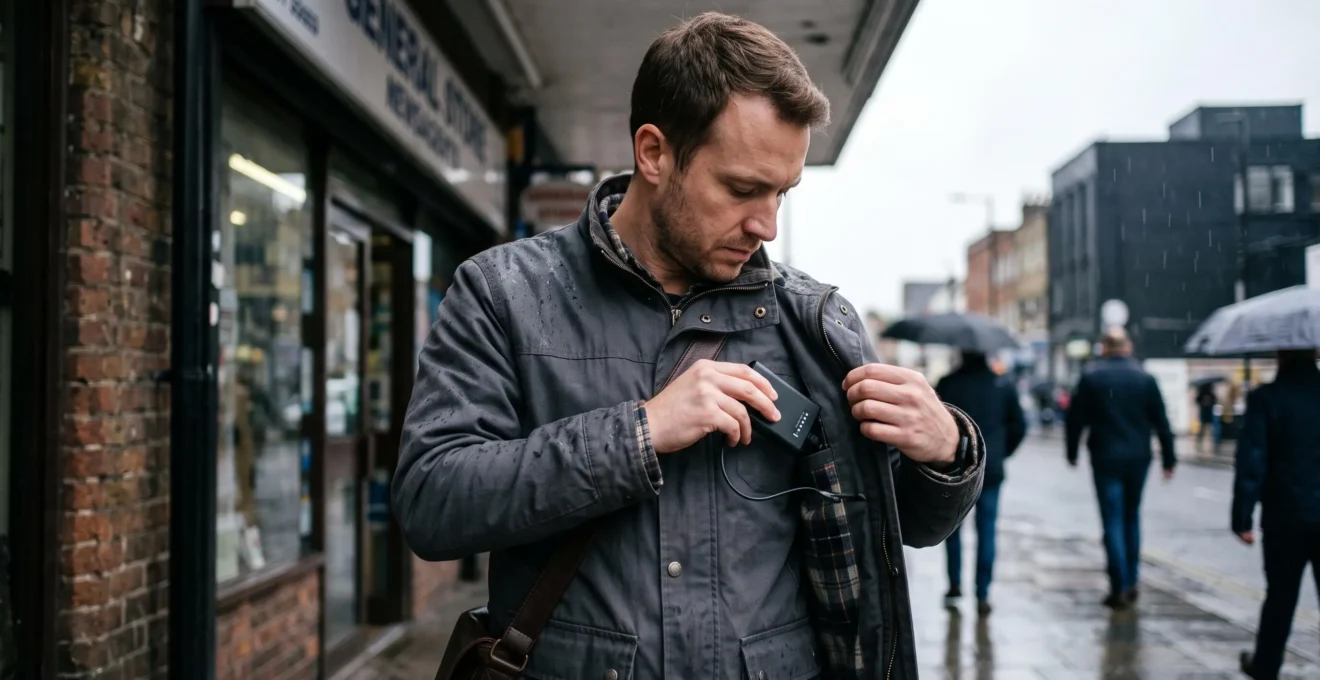
A jacket that adjusts its warmth, a shirt that monitors your posture, or a fabric that promises to keep you comfortable through a rainy British commute sounds genuinely useful. The difficulty is determining which benefits survive ordinary wear, washing and repeated use.
Smart textiles can work in everyday clothing, but their usefulness depends on the technology, its durability and whether the added function solves a genuine problem. Moisture-wicking fibres are already practical and widely available, while electronic sensing garments face additional challenges involving conductive materials, batteries, connectivity and laundering.
For UK shoppers, the most revealing questions are often less glamorous than the marketing demonstration. Can the garment tolerate a normal washing routine? Will it remain comfortable under a coat? What happens when the battery or sensor stops working? And is the improvement worth paying more than for ordinary technical clothing?
The distinction matters because a fabric can remain perfectly wearable after its electronic functionality has deteriorated. Assessing smart clothing therefore means judging both the garment and the technology inside it.
Smart textiles: the practical verdict
- Real technology, uneven usefulness: electronic sensing and controlled heating offer capabilities ordinary fabrics cannot replicate, but laboratory performance does not guarantee everyday reliability.
- Care determines value: washing, drying, mechanical stress and removable electronics can all affect how long a smart garment performs its intended function.
- Conventional clothing often wins: moisture-wicking layers, wool blends and sensible layering can solve many comfort problems without batteries, connectivity or specialist laundering.
- Why Do Smart Fabrics Perform Great in Demos but Disappoint in Real Life?
- How to Evaluate Smart Textile Care Needs Before You Buy So You Don’t Ruin It
- Thermal-Regulating or Moisture-Wicking: Which Smart Textile Helps More in the UK?
- The Care Mistake That Kills Tech-Infused Clothing After a Few Washes
- When Is Smart Fabric Worth It Compared With Simply Layering Better?
- Performance Wool Blend or Synthetic: Which Smells Less After a Long Commute?
- Smartwatch or Hybrid Watch: Which Looks Better at Weddings and Dinners?
- How Do You Wear Wearable Tech Without It Clashing With a Smart Outfit?
Why Do Smart Fabrics Perform Great in Demos but Disappoint in Real Life?
Smart fabrics can perform impressively in demonstrations because the environment, equipment and testing procedure are controlled. Everyday clothing experiences unpredictable movement, perspiration, weather and washing. A sensor that accurately detects a signal in a laboratory may become less reliable when its position changes, conductive threads stretch or wireless connections are interrupted.
The problem is not necessarily dishonest marketing. A demonstration may establish that a technology works under particular conditions without proving that a finished garment will deliver the same performance over months of ordinary use.
A scientific review of intelligent textile sensing systems, published in Communications Materials, identifies durability, reliability, wireless communication and data processing among the challenges affecting practical deployment. These are system-level concerns: strong sensor sensitivity alone does not make an entire garment dependable.
Three failure mechanisms deserve separate attention:
- Sensor degradation: sensing elements may produce less consistent readings after mechanical wear or material deterioration.
- Conductive pathway fatigue: stretching, bending and laundering can alter the electrical properties of conductive yarns or printed connections.
- Power and connectivity problems: a functioning textile sensor may still provide no useful output when its battery, electronic module, application or wireless connection fails.
These faults require different remedies. Recharging a battery will not repair a damaged conductive seam, while replacing a sensor will not necessarily resolve unreliable wireless communication.
Before accepting a performance claim, examine what the demonstration actually involved. Was the garment worn naturally or held in a particular position? Did it require an external measuring device? Was the temperature regulated? Was the fabric new, or had it undergone repeated washing?
Results obtained under ideal conditions are valuable, but they should be treated as evidence of capability rather than a guarantee of identical performance on a crowded train or during a damp winter walk.
There is also a straightforward consumer-experience issue. The novelty of a connected garment may initially outweigh inconveniences such as charging, careful washing or adjusting sensor placement. As those steps become routine, the perceived benefit can diminish. However, available evidence does not establish a universal first-month decline in customer satisfaction.
The useful question is not whether the technology can work once. It is whether the complete garment can continue delivering the promised function under the conditions in which it will actually be worn.
How to Evaluate Smart Textile Care Needs Before You Buy So You Don’t Ruin It
Evaluate smart textile care requirements before buying by checking whether electronic components are removable, what washing and drying methods the manufacturer permits, and whether electrical performance has been tested after repeated laundering. A garment that requires hand washing, battery removal and prolonged air drying may be unsuitable for someone accustomed to machine-washing everyday clothes.
Start with the manufacturer’s care label and complete product instructions, not a general description such as “washable technology”. That phrase tells you little about whether the entire garment can be washed or whether some components must be detached first.
Make particular note of the distinction between fabric durability and functional durability. A jacket can retain its colour, fit and softness while its sensing or heating circuits deteriorate.
Research published in RSC Advances examined silver-coated conductive knitted fabrics under different washing conditions. The RSC Advances study on washing conditions for smart fabrics found that laundering conditions affected conductive coatings and electrical resistance. This demonstrates why visual inspection alone is insufficient for assessing some smart textiles.
The findings apply to the materials investigated rather than establishing universal washing rules for every smart garment.
For UK households using front-loading washing machines, a manufacturer’s approved low-temperature cycle may fit an existing routine. However, a machine’s gentle programme is not automatically suitable for electronic textiles. The specified detergent, spin setting and drying method still matter.
Air drying also deserves attention. A garment that must lie flat or dry completely before its electronics are reattached may be inconvenient in a small flat with limited drying space.
Five checks to complete before buying smart clothing
- Find the complete care instructions. Save a photograph or screenshot showing the permitted washing and drying methods.
- Identify every detachable component. Record whether the battery, sensor and electronic controller must be removed before cleaning.
- Check documented wash durability. Note the number of laundering cycles tested, the test conditions and whether electrical performance was measured. Record “not disclosed” where appropriate.
- Compare care requirements with your household routine. Write down any extra steps, such as hand washing, special storage or air drying.
- Verify support and replacement options. Save the manufacturer’s information about replacement modules, connectors, warranty exclusions and repair availability.
If the manufacturer does not disclose testing conditions or care limitations, that uncertainty belongs in the buying decision. It should not be interpreted as proof that the product is either reliable or unreliable.
A garment that demands more maintenance than its owner can realistically provide is a poor practical fit, even when its technical performance is impressive. The next decision is whether its claimed comfort function addresses the right problem in the first place.
Thermal-Regulating or Moisture-Wicking: Which Smart Textile Helps More in the UK?
Moisture-wicking clothing is generally the more straightforward choice for UK shoppers who become sweaty during commuting, walking or indoor activity. Thermal-regulating textiles are more relevant when changing temperatures are the main source of discomfort. Neither technology automatically outperforms good conventional layering, and neither solves the same problem as the other.
Thermal regulation manages temperature changes; moisture wicking manages perspiration. This distinction is essential because both functions are frequently presented under broad labels such as “climate control” or “adaptive comfort”.
Some thermal-regulating textiles incorporate phase-change materials, or PCMs. These materials absorb or release thermal energy as they change physical state, potentially buffering certain temperature fluctuations.
The Results in Engineering review of phase-change materials in textiles explains their thermal-energy mechanisms and textile applications. It does not establish a universal comfort advantage for commercial garments worn in UK conditions.
Moisture-wicking textiles work differently. Their fibre and fabric structure helps move moisture away from the skin towards other parts of the material, where evaporation may occur. Their effectiveness also depends on ventilation, humidity and the layers worn over them.
Consider how these different functions fit a British working day:
| Buying criterion | Thermal-regulating textile | Moisture-wicking textile |
|---|---|---|
| Main purpose | Buffer certain temperature changes | Move moisture away from the skin |
| Potentially useful situation | Alternating between chilly outdoor conditions and warmer interiors | Walking quickly, cycling or travelling in warm, crowded transport |
| What it does not guarantee | Continuous heating or cooling at every temperature | Dry clothing in high humidity or beneath poorly ventilated outerwear |
| What to verify | Thermal testing, operating conditions and durability | Moisture-management testing, drying behaviour and comfort |
| Conventional alternative | Adjustable insulating layers | A breathable technical base layer |
A hypothetical commuter walking briskly to the station before entering a heated train may benefit more from moisture management than from additional insulation. Another person standing outdoors for extended periods may place greater value on thermal comfort.
The distinction becomes more important when a product promises both functions. A garment can genuinely combine multiple textile technologies, but each claim should have its own supporting test data. Strong evidence for moisture transfer does not independently establish effective thermal regulation.
For everyday clothing, passive materials also have advantages: they generally avoid the need for electronic charging or wireless connectivity. However, some specialised finishes and materials can still require particular care.
Choose the feature that addresses your most frequent discomfort, then evaluate the garment’s breathability, fit and care requirements. A technically sophisticated fabric is not automatically the most comfortable one for the UK’s variable weather.
The Care Mistake That Kills Tech-Infused Clothing After a Few Washes
One particularly risky mistake is exposing a smart garment to washing or drying conditions that its manufacturer has not approved, especially excessive heat or tumble drying. Conductive coatings and bonded electronic elements can deteriorate even while the surrounding fabric looks normal. Mechanical abrasion, detergent chemistry and moisture exposure can also contribute to damage.
That is why ordinary-looking laundry results cannot confirm that the technology survived. An electronic textile may emerge from the washing machine without visible defects yet deliver altered electrical readings or less consistent functionality.
In the previously discussed RSC Advances experiments, washing silver-coated fabrics at 60°C caused substantial coating deterioration under the tested conditions. Temperatures below 40°C produced relatively less damage, while machine drying caused more damage to the conductive layer than air drying.
These results demonstrate material-specific vulnerability, not a universal rule that every smart garment can be washed safely at a particular temperature.
Damage may accumulate across repeated cleaning cycles. As conductive layers deteriorate, electrical resistance can change, potentially affecting sensing or power delivery. However, there is no evidence here for a universal progression in which smart clothing works after five washes, declines after ten and fails after fifteen.
Reducing unnecessary laundering may help limit cumulative stress, but it should not override hygiene requirements. Airing a garment between suitable wears or spot-cleaning a permitted area may be practical for some products. Neither method should be assumed safe for every electronic assembly.
Even correct laundering does not eliminate every risk. Connectors can become damaged or corroded, components can suffer mechanical fatigue, and removable modules can be misplaced or accidentally left attached during washing.
Before purchasing a smart jacket or sensor-equipped shirt, check whether damaged parts can be replaced independently. A removable and replaceable electronic module may be more economical than a permanently integrated system, although replaceability alone does not guarantee durability.
After cleaning, follow the manufacturer’s instructions for drying, reconnecting and checking the garment. If the device provides a diagnostic or functional test, use it rather than assuming that an undamaged appearance confirms proper operation.
Smart clothing needs a care routine designed for its complete construction, not simply its outer fabric. That maintenance burden should also be considered when deciding whether the additional technology is worth buying.
When Is Smart Fabric Worth It Compared With Simply Layering Better?
Smart fabric is worth considering when it provides a useful function that conventional clothing cannot readily deliver, such as integrated sensing, data collection or electronically controlled heating. For ordinary warmth, sweat management and changing weather, a well-chosen combination of base layers, insulation and outerwear will often be simpler to maintain and more economical.
The first distinction is between functional textile technology and electronically connected clothing. Many garments marketed as smart rely on passive fabric properties rather than embedded electronics. These properties can be useful, but similar comfort benefits may already be available from established performance fabrics.
Traditional layering provides several straightforward advantages:
- A breathable base layer can help manage perspiration.
- Wool or suitable technical insulation helps retain warmth.
- A wind-resistant or waterproof outer layer offers weather protection.
- Individual layers can be removed, replaced or washed according to their own care instructions.
Connected textiles introduce functions that layering alone cannot reproduce. A garment with integrated sensors may record physiological or movement-related signals. An electronically heated jacket may provide adjustable warmth through powered heating elements. Connectivity may also allow information to be transferred to another device.
These capabilities come with additional considerations: component durability, software support, battery life, data accuracy and, where personal information is recorded, privacy and data security.
A sensing garment should not be treated as a medical device simply because it measures a physiological signal. Medical suitability depends on the product’s intended purpose, applicable regulatory status and supporting evidence.
Price comparisons are more meaningful when they include realistic usage rather than purchase price alone.
Hypothetical example: calculating the smart-textile premium
Imagine an electronic garment costing £180 and a suitable conventional alternative costing £80. The additional technology costs £100. If the electronic function remains useful for 100 wears, the premium is £1 per wear.
If that function is useful for only 25 wears, the premium becomes £4 per wear. These figures are illustrative assumptions, not measured prices or durability results for a commercial product. They exclude charging, repairs and other ownership costs.
The underlying calculation is straightforward: subtract the conventional garment’s price from the smart garment’s price, then divide the difference by the expected number of useful wears while the additional function remains operational.
Because long-term performance data may be unavailable, the result should be regarded as a scenario rather than a precise prediction.
For most shoppers, the strongest case for paying extra is a clearly defined, frequently used function. Integrated monitoring or controllable heating may justify the complexity for a particular user. An indistinct promise of being more “adaptive” or “intelligent” provides a weaker reason to upgrade.
A smart garment earns its place when its extra function remains valuable after accounting for care, comfort and maintenance. Otherwise, better layering is often the more dependable purchase.
Performance Wool Blend or Synthetic: Which Smells Less After a Long Commute?
A suitable wool blend may retain less noticeable body odour than an equivalent polyester garment after a sweaty commute, although performance depends on fibre composition and fabric construction. Synthetic fabrics may be preferable when rapid moisture transport, light weight or quick drying is the main priority. Neither material guarantees that clothing will remain fresh indefinitely.
Odour performance is more complicated than the amount of sweat a garment absorbs. Body odour is influenced by skin microorganisms, perspiration, retained odorous compounds and how fabrics absorb and release those compounds.
Wool and polyester interact differently with moisture and odour molecules. That can change how strongly a garment smells after wearing, even when the wearer has undertaken the same activity.
Deakin University research on odour retention in wool-polyester blends reports that fabrics containing 20% wool had substantially reduced odour intensity compared with 100% polyester in the investigated experiments. A wear trial also supported lower perceived body odour for the tested wool-containing blend.
This does not mean that every merino garment outperforms every synthetic fabric. Yarn structure, treatments, garment fit and laundering history can influence the result.
What a wool-polyester odour comparison found
Researchers evaluated odour sorption and emission in polyester-wool fabrics using instrumental measurements and sensory testing. Their work included a comparison between a 20% wool and 80% polyester blend and pure polyester.
The wool-containing fabric showed lower perceived odour intensity under the reported conditions. The finding supports considering fibre composition when buying commuting clothing, but it does not establish an ideal wool percentage for every garment.
For a long journey followed by a full working day, a comfortable wool blend may be appealing when noticeable odour retention is the principal concern. Conversely, a synthetic technical top may be more practical where drying quickly after intense activity matters most.
Some synthetic garments use antimicrobial or anti-odour treatments, including silver-based technologies. Their performance and laundering durability must be assessed product by product. It would be misleading to assume that every treatment washes out rapidly or remains effective indefinitely.
Odour resistance also connects to the care of smart textiles. A garment that remains suitable for another wear may need washing less frequently, potentially reducing laundering-related wear. However, hygiene requirements and manufacturer instructions still take precedence.
The better commuter fabric is the one that balances odour, moisture management, skin comfort and practical care. Adding electronic technology rarely improves that balance unless it performs a separate function you genuinely need.
Smartwatch or Hybrid Watch: Which Looks Better at Weddings and Dinners?
A hybrid watch is generally easier to integrate into traditional formalwear because it combines conventional watch styling with discreet connected features. A full smartwatch can also work at weddings or dinners, particularly with a restrained face and suitable strap. The better choice depends on the dress code, the device’s appearance and how important its digital functions are during the event.
Hybrid watches typically retain analogue hands and a conventional case while incorporating selected connected capabilities. Some models offer activity tracking or notifications without making a touchscreen the centre of the design.
A smartwatch is more visibly technological, especially when paired with a brightly coloured sports strap or a large illuminated display.
For a formal British wedding, dinner or evening reception, the invitation’s dress code provides a useful starting point. A restrained watch design is often easier to coordinate with a dark suit or formal tailoring than an overtly athletic device.
These are styling judgements, not universal etiquette requirements. Personal taste and the expectations of a particular event still matter.
| Consideration | Hybrid watch | Smartwatch |
|---|---|---|
| Visual character | Usually resembles a traditional analogue watch | Typically displays a more recognisable digital interface |
| Formal clothing | Often integrates easily with classic tailoring | Benefits from a discreet face and appropriate strap |
| Connected capabilities | Usually offers a narrower feature set | Often provides more extensive applications and interactions |
| Battery considerations | Some models offer comparatively long battery life | Charging frequency depends heavily on model and usage |
| Best suited to | Someone prioritising a traditional appearance | Someone who regularly uses on-watch digital features |
Strap and case details can change the impression significantly. A classic leather strap or understated metal bracelet may look more appropriate with tailoring than a silicone sports band. Compatibility and comfort should be checked before buying replacement accessories.
Battery life is another practical difference, although no universal advantage can be assigned to every hybrid model. Device specifications and actual usage patterns determine charging requirements.
If a smartwatch is mainly worn to collect health or activity data, consider whether that information is necessary throughout a formal event. Temporarily silencing notifications and selecting a restrained display may be enough to make an existing device feel less intrusive.
There is no reason to replace a functioning smartwatch purely because it looks technological. Small styling adjustments may provide the desired effect, which leads to the broader question of integrating wearable devices into a polished outfit.
Key takeaways before styling wearable technology
- Choose the outfit’s level of formality before selecting visible connected accessories.
- Prioritise devices that deliver useful functionality without compromising fit, comfort or ordinary maintenance.
- Consider keeping electronics in removable accessories when conventional clothing already provides the appearance and performance you need.
How Do You Wear Wearable Tech Without It Clashing With a Smart Outfit?
Wearable technology looks most coherent with smart clothing when the outfit establishes the visual style and the devices follow it. Choose subtle finishes, balanced proportions and accessories that complement the garment rather than compete with it. For formal occasions, keeping most technology in watches, rings or other discreet accessories is often easier than styling visibly electronic clothing.
Start with the occasion. A business-casual office outfit allows different choices from a black-tie event or an informal restaurant dinner. Once the clothing is established, determine which technology needs to remain accessible.
Visibility is the main styling variable. Some wearable devices are almost indistinguishable from conventional accessories, while others are deliberately prominent.
- Smart rings: compact accessories that can blend with ordinary jewellery, although size, finish and comfort still influence their appearance.
- Hybrid watches: traditional styling with selected connected functionality, often suitable for more restrained outfits.
- Smartwatches: recognisable digital devices whose visual impact can be reduced through strap and display choices.
- Smart glasses: potentially noticeable because of frame shape, size or integrated components, depending on the design.
- Connected garments: their visibility depends on whether electronics and conductive elements are concealed or incorporated into the exterior design.
There is no rule that integrated technology must be highly visible. A garment with concealed sensors may look entirely conventional, while a conspicuous electronic accessory may become the strongest element of an outfit.
For a smart-casual office look, a conventional jacket, comfortable base layer and discreet connected watch can provide functionality without introducing demanding care requirements into every garment.
At a formal event, keeping technology in an accessory may be particularly practical. An electronic component that can be removed or replaced independently is easier to manage than a specialist garment chosen solely to accommodate that technology.
Function should still guide the decision. If a sensing garment serves a necessary monitoring purpose, selecting another device for aesthetic reasons may not be appropriate. Compatibility, measurement reliability and comfort take priority over making the technology less visible.
The same principle applies to heated clothing. A concealed powered layer can be useful outdoors, but the complete system still needs safe battery placement, manageable bulk and a suitable cleaning routine.
For your next purchase, identify one practical problem, compare a smart option with a conventional alternative, and verify the care and support instructions before paying the premium. Smart textiles are not inherently hype: their value emerges when the extra function continues working without forcing unnecessary compromises in how you dress or live.
Are smart textiles the same as electronic clothing?
No. Smart textiles is a broad term covering materials designed to provide functions beyond those of conventional fabrics. Some use passive material properties, while others incorporate sensors, conductive threads, electronic controls or communication systems. Care and durability requirements depend on the specific technology.
Can smart clothing be worn safely in British rain?
Only within the manufacturer’s stated conditions. A garment described as water-resistant is not necessarily suitable for prolonged rain or immersion. Check the instructions for its complete electronic assembly, including batteries, charging points and connectors, rather than assuming the outer fabric’s weather protection applies to every component.
How can you tell whether a smart garment still works after washing?
Follow the manufacturer’s post-wash inspection and functional testing procedure, if one is provided. Check the physical condition of authorised connections and whether the stated function still operates. Visual appearance alone cannot establish unchanged sensor accuracy or electrical performance. Contact the manufacturer if performance becomes inconsistent.
Do smart garments require a smartphone or an internet connection?
Not always. Some electronic garments operate locally using built-in controls, while others rely on a smartphone application or external device to display, process or store information. Internet access may be required for certain connected features. Check which functions remain available without a phone, account or network connection.
What happens if a smart clothing brand stops supporting its app?
Features that depend on the application or its online services may become unavailable, even if the fabric and electronics remain physically functional. Before buying, check whether the garment supports offline operation, whether replacement parts are available and what the manufacturer says about software updates and long-term support.