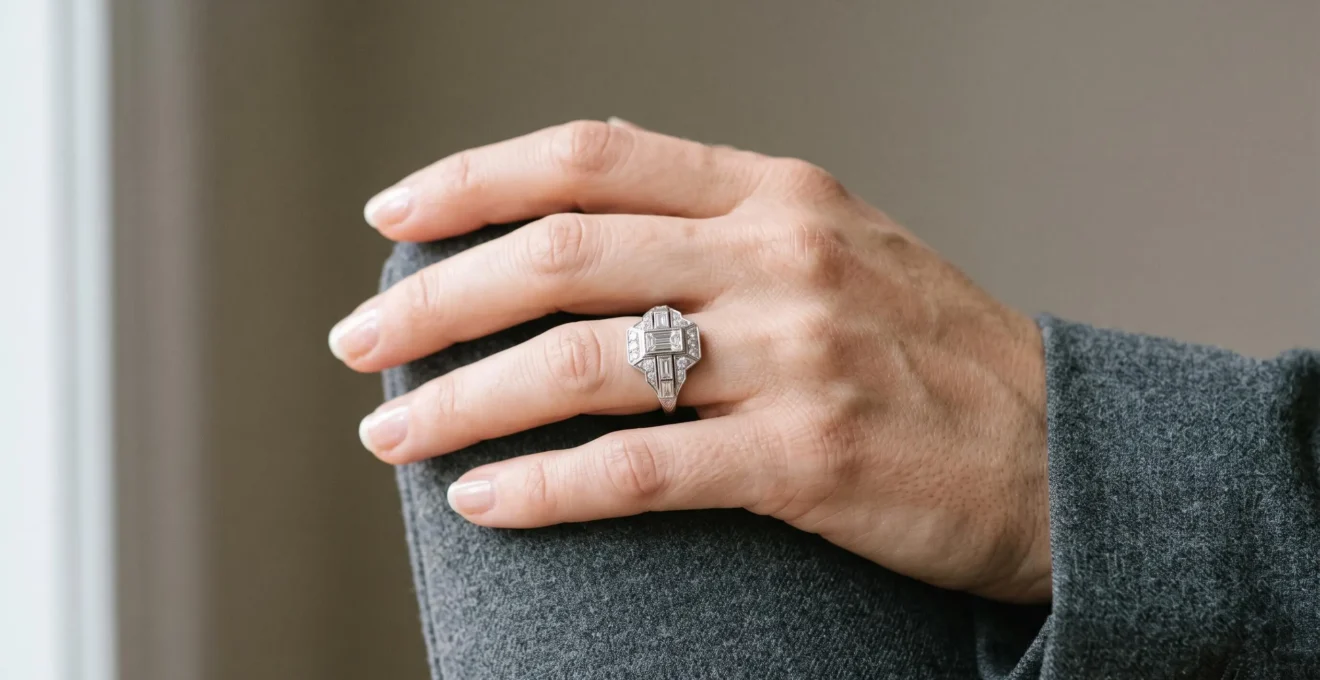
Art Deco jewellery still looks modern because its visual language was built around geometry, proportion and contrast rather than elaborate historical ornament. A diamond ring with stepped shoulders, a black onyx brooch or a platinum pendant with precise openwork can sit comfortably beside contemporary tailoring without looking like a period costume.
That appeal has a historical foundation. During the 1920s and 1930s, jewellers embraced architectural shapes, abstract compositions and increasingly sophisticated gemstone arrangements. Their designs anticipated many of the clean lines that contemporary jewellery buyers still appreciate.
For UK buyers, however, visual appeal is only the beginning. A convincing Art Deco silhouette does not prove a piece is original, a diamond does not guarantee a durable antique setting, and an attractive online photograph may conceal repairs that materially affect value.
The most rewarding approach combines design appreciation with practical scrutiny: understand why Deco works visually, identify period-consistent construction, examine condition and choose a purchase that suits how the jewellery will actually be worn.
Art Deco jewellery: what matters most
- Geometric symmetry, deliberate contrast and restrained metalwork make Art Deco jewellery particularly compatible with modern clothes and photography.
- Authenticity depends on construction, hallmarks, materials and alterations—not geometric styling alone.
- Buy according to setting condition and intended wear, and avoid unnecessary polishing that can erase original craftsmanship.
- Why Does Art Deco Design Photograph So Well Even in Simple Outfits?
- How to Check if a Piece Is Truly Art Deco Using 6 Design Clues?
- Diamond Art Deco or Onyx Art Deco: Which Holds Up Better for Weekly Wear?
- The Repair Mistake That Can Destroy Milgrain and Deco Detail in One Session
- When Is the Best Time to Shop for Art Deco Pieces Without Panic Buying?
- Why Do Some Vintage Pieces Look Costume-Like Even When They’re Authentic?
- How to Spot Period-Consistent Details in Antique Jewellery Without Being an Expert?
- How Do You Buy Antique Jewellery in the UK Without Getting Caught by Hidden Damage?
Why Does Art Deco Design Photograph So Well Even in Simple Outfits?
Art Deco jewellery photographs effectively because its symmetrical arrangements, strong outlines and contrasting materials create recognisable shapes even at small image sizes. A geometric ring or pendant can remain visually distinct against plain clothing, whereas finer ornamental details may disappear in ordinary smartphone photographs. This is a design advantage, not proof of superior resale value.
Deco designers frequently organised stones around central axes, rectangular borders, stepped patterns and repeated angular forms. These compositions guide the eye towards the principal stone or motif without requiring the viewer to recognise numerous decorative details.
The V&A‘s exploration of Art Deco fashion and jewellery documents the movement’s geometric and abstract vocabulary, including designs by Raymond Templier. It also describes the fashionable combination of diamonds, rock crystal and platinum during the late 1920s.
Platinum’s strength allowed jewellers to construct comparatively delicate metal frameworks, giving gemstones prominence within compositions that could appear almost architectural.
That structural clarity explains why a Deco ring can be visually successful with a white shirt, a plain black jumper or a charcoal suit. The jewellery provides the outfit’s principal pattern rather than competing with existing decoration.
A useful styling experiment is to photograph the same outfit twice:
- Wear one prominent Deco piece against a plain sleeve or neckline.
- Take a second photograph with additional geometric jewellery or layered accessories.
- Compare which composition directs attention more clearly towards the principal piece.
The single-piece arrangement often gives a statement ring or brooch greater visual space. Layering can work equally well when the accessories have a clear hierarchy of scale and detail.
For online shopping, photographic legibility offers a practical comparison between similar designs. Examine whether the profile, stone arrangement and proportions remain readable in ordinary photographs rather than relying exclusively on dramatic close-ups.
However, photographic appeal is not an established predictor of secondary-market demand. Rarity, maker, provenance, originality, condition and price can be more important to an eventual buyer.
A piece that looks convincing in natural light and works with clothes already in your wardrobe may be more satisfying than a spectacular photograph of jewellery that is difficult to wear.
How to Check if a Piece Is Truly Art Deco Using 6 Design Clues?
To assess whether jewellery is genuinely Art Deco, examine six characteristics together: geometric symmetry, period-appropriate white metals, linear gemstone cuts, contrasting materials, delicate openwork and fine edge detailing. These characteristics can establish stylistic consistency, but none individually proves a 1920s or 1930s manufacture date. Construction, hallmarks and any alterations must support the attribution.
Start by examining the complete object rather than focusing solely on its most striking gemstone. An original Deco design should make sense as an integrated piece of jewellery, even when individual components have been repaired.
The six design clues are:
- Geometric symmetry: Look for balanced rectangular, stepped, triangular or fan-shaped arrangements. Symmetry is characteristic of many Deco designs, although not universal.
- White-metal construction: Platinum and white gold are important period materials, especially in diamond jewellery. Yellow gold also appears in genuine Deco objects, so it cannot automatically exclude authenticity.
- Linear stone arrangements: Baguette diamonds and closely fitted calibre-cut gemstones may reinforce angular outlines. Check whether the cutting styles and settings are plausible for the proposed period.
- Deliberate contrast: Black onyx, diamonds and rock crystal can produce distinctive light-and-dark compositions. Ask whether contrasting elements appear original to the design.
- Openwork galleries: Pierced settings and fine platinum structures can create a light architectural effect. Examine the reverse for workmanship, repairs and structural weakness.
- Milgrain edging: Tiny bead-like metal details may frame stones or outlines. Their crispness can provide useful condition evidence, although milgrain was used before and after the Art Deco period.
These features make a useful initial checklist, not a definitive authentication test. A modern jeweller can reproduce all six, while a genuine period jewel may display only a few.
Next, distinguish an original Deco piece from an Art Deco Revival design or modern Deco-style production.
An original is attributed to the historical period. Revival jewellery was manufactured later using recognisable Deco influences. Contemporary Deco-style jewellery may be newly manufactured and still possess genuine design merit.
Later production can sometimes be suggested by casting characteristics, setting construction, gemstone cuts or manufacturing marks. Yet hand-finishing, casting and individual repair techniques vary, so these observations require specialist interpretation.
The most important complication is partial originality. A genuine period diamond might have been placed in a replacement mounting, or an original Deco ring head might have been attached to a newer shank.
A hallmark on the shank may therefore help date that component without authenticating the head or stones. Compare the character of the metalwork, the joining points and the overall design before accepting a seller’s description.
Ask for a written statement distinguishing original elements, known replacements and uncertain components. A responsible attribution might describe a ring as approximately 1930 with a later shank, rather than presenting the entire object as untouched.
When originality affects the asking price, professional examination is more dependable than visual familiarity alone. The next question is whether the design and its surviving materials can withstand the intended pattern of wear.
Diamond Art Deco or Onyx Art Deco: Which Holds Up Better for Weekly Wear?
Diamond Art Deco jewellery is generally more resistant to surface scratching than onyx jewellery, making a soundly mounted diamond piece a stronger candidate for frequent wear. Nevertheless, an antique diamond ring with worn prongs or delicate platinum openwork may be less suitable than a carefully protected onyx pendant. The setting and exposure to impact matter as much as the gemstone.
Diamond has a Mohs hardness of 10, but exceptional hardness does not mean that a diamond cannot chip. The Gemological Institute of America distinguishes hardness, toughness and stability as separate aspects of durability in the GIA’s explanation of gemstone durability.
This distinction is particularly useful with antiques. A hard stone in a worn setting can become loose, while a weaker gemstone with protected edges may survive occasional careful wear.
Onyx commonly used in jewellery is a variety of chalcedony, within the quartz family. It is less scratch-resistant than diamond, and sharp exposed corners can be vulnerable to damage through knocks.
Older onyx components may also have been polished, repaired or replaced. These changes can affect historical originality even when the piece remains visually attractive.
The comparison becomes clearer when the intended use is considered.
| Buying consideration | Diamond Art Deco | Onyx Art Deco |
|---|---|---|
| Surface scratching | Exceptionally resistant, although not immune to damage | More susceptible to scratches and abrasion |
| Impact exposure | Diamonds may chip, especially around vulnerable edges | Exposed corners and projecting details deserve particular care |
| Setting inspection | Check prongs, openwork, stone movement and worn metal | Check stone corners, joins, mounting security and replacements |
| Frequent-wear suitability | Potentially suitable with a sound, protective setting | Often better for less exposed jewellery or more controlled wear |
| Practical choice | Consider a structurally sound ring or pendant | Consider a brooch, pendant or protected geometric setting |
A diamond Art Deco ring worn throughout a working week should be assessed differently from a pendant worn over clothing. Rings experience more accidental contact with desks, doors and other hard surfaces.
Likewise, a diamond-and-onyx design can be a useful compromise when its darker decorative elements sit within protective metal boundaries rather than projecting above the mounting.
Before purchasing in the UK, request a written condition description addressing both gemstones and settings. Ask specifically whether onyx sections have chips or replacements and whether the jeweller has checked the security of diamond settings.
Clear photographs of the reverse, edges and galleries should complement that description rather than replace it.
The most wearable antique is not necessarily the one containing the hardest gemstone. It is the piece whose surviving structure remains appropriate for its intended use—and whose owner understands how to protect it.
The Repair Mistake That Can Destroy Milgrain and Deco Detail in One Session
One of the most damaging mistakes is authorising aggressive polishing of an antique Art Deco setting simply to make it look new. Excessive finishing can soften geometric edges, flatten delicate milgrain and remove original surface detail. Unnecessary plating may also obscure the metal’s natural appearance. Once original metalwork has been polished away, routine cleaning cannot restore it.
Milgrain consists of tiny raised beads along metal edges. In many antique settings, these beads help define stone boundaries and contribute to the precision of the design.
Repeated or overly forceful polishing removes small amounts of material. On fine antique workmanship, even modest material loss may soften details that were originally crisp.
The concern is not that every polishing operation inevitably destroys a piece. Rather, the desired finish must be balanced against the preservation of original craftsmanship.
Platinum and white gold also require different treatment decisions. Rhodium plating is commonly associated with white-gold finishing and should not automatically be applied to antique platinum merely to increase brightness.
High-street repair services are not inherently unsuitable, but a workshop specialising in modern commercial jewellery may use finishing procedures that are inappropriate for vulnerable antique surfaces.
Before resizing, stone tightening or surface restoration, choose someone who can demonstrate experience with period jewellery and explain the proposed intervention.
A specialist should be able to identify which surfaces need attention and which should remain untouched. The proposed work should also distinguish structural repairs from cosmetic improvements.
Use the following protocol before handing over a valuable or sentimental piece.
Five checks before approving an Art Deco repair
- Photograph the front, reverse, edges and milgrain under clear lighting. Keep a dated set of before-repair images.
- Request a written assessment identifying loose stones, damaged metal and existing alterations. Retain the condition report.
- Record explicit instructions against unapproved polishing, plating or replacement of components. Obtain written acknowledgement.
- Ask how adjacent stones and decorative edges will be protected during the proposed work. Keep the restorer’s explanation with the repair estimate.
- Agree the exact authorised work and inspection arrangements before collection. Retain a written work order and compare the finished piece with the original photographs.
A heavily worn piece intended for personal use may justify some sympathetic surface work when comfort or safety requires it. Such work should be assessed individually rather than rejected automatically.
Collector value and sentimental value are not identical. Preserving untouched detail may be the priority for a rare original, while stabilising a family ring for occasional wear may deliver greater personal benefit.
A careful restoration should solve a specific problem without unnecessarily rewriting the object’s history. That principle also helps determine which pieces are worth buying in the first place.
When Is the Best Time to Shop for Art Deco Pieces Without Panic Buying?
The best time to buy Art Deco jewellery is when you have established a realistic budget, understood typical condition issues and can inspect several comparable pieces without a deadline. UK auction previews and dealer exhibitions create useful opportunities for comparison, but no particular month guarantees better prices. Preparation matters more than attempts to predict the perfect buying season.
The UK antique jewellery market offers several shopping routes, including specialist dealers, jewellery fairs, established auction houses and online marketplaces.
Organisations such as Bonhams, Christie’s and Fellows hold jewellery sales, with opportunities to review catalogue descriptions and, where offered, examine lots before bidding. Individual sale dates, viewing arrangements and conditions should always be checked directly.
These events are useful because they encourage structured comparison. Rather than treating the first attractive ring as a unique opportunity, a buyer can investigate how different sellers describe comparable periods, stones, settings and restorations.
Shopping under pressure creates avoidable weaknesses in that process. Anniversary deadlines, a persuasive sales conversation or a social-media claim that a piece is exceptionally rare can encourage decisions before condition and pricing have been properly examined.
A more disciplined approach begins with three decisions:
- Set a maximum total budget, including any applicable auction charges, delivery and anticipated restoration costs.
- Define acceptable condition, including whether a later shank, replacement stone or historical repair would be tolerated.
- Identify non-negotiable reasons to walk away, such as insecure settings, unclear material descriptions or a seller refusing reasonable inspection requests.
Original Art Deco jewellery is a finite historical category, but pieces continue to circulate through private collections, estates, dealers and auctions. Missing an attractive example does not mean another suitable piece will never appear.
Tracking prices provides further perspective. Record pieces of similar material, size, age, condition and quality across several sellers over a few weeks. Distinguish dealer asking prices from completed auction results, as an unsold lot or reduced listing does not establish a universal market value.
Auction comparisons should incorporate relevant buyer’s charges, while dealer comparisons should consider inspection opportunities, descriptions and after-sales arrangements.
When a piece remains available or an auction lot goes unsold, that information may justify further research or a carefully framed offer. It does not automatically prove that the seller’s price was unreasonable.
Patience is especially valuable when evaluating visually unusual pieces. Some may look unfamiliar not because they are inauthentic, but because their original materials were never intended to imitate expensive modern fine jewellery.
Why Do Some Vintage Pieces Look Costume-Like Even When They’re Authentic?
Authentic vintage jewellery can look costume-like because historical designers used materials and proportions that differ from contemporary fine-jewellery expectations. Original Art Deco pieces may contain paste stones, silver, base metals or rolled gold. Their authenticity concerns when and how they were made, not whether their materials are precious or their appearance resembles modern luxury jewellery.
The Art Deco period encompassed both expensive fine jewellery and decorative accessories made for broader audiences. Geometric designs could be expressed through diamonds and platinum or through modest materials chosen for colour, reflectivity and visual impact.
A 1930s paste-set brooch can therefore be a genuine period object despite containing no diamonds. Describing it as costume jewellery identifies a material or market category; it does not necessarily question its historical authenticity.
The central mistake is treating three independent assessments as though they were interchangeable.
| Assessment | What it establishes | What it does not establish |
|---|---|---|
| Authenticity | Whether the item or relevant components genuinely belong to the claimed period | That the materials are intrinsically valuable |
| Material quality | Whether stones and metals are precious, plated, imitation or otherwise | That manufacture occurred during the claimed period |
| Condition | How well the object survives and whether repairs or replacements are present | That an attractive or unworn-looking item is original |
Contemporary jewellery can also shape expectations. Many buyers are familiar with highly polished surfaces, substantial mounts and uniform stone arrangements.
By comparison, a flat geometric brooch with older paste stones may appear visually restrained or surprisingly light. Such characteristics are not inherently evidence of poor workmanship.
Equally, historical authenticity should not be used to excuse weak construction or an inflated asking price. Genuine period jewellery varies considerably in craftsmanship, rarity and commercial value.
If the material is uncertain, ask the dealer to distinguish natural gemstones from imitation stones and solid precious metal from plated or rolled construction. The written description should communicate those differences explicitly.
The practical lesson is to establish the object’s category before judging its worth. Once authenticity and material quality are separated, the remaining task is to check whether its individual components belong together.
How to Spot Period-Consistent Details in Antique Jewellery Without Being an Expert?
Period consistency can be assessed by checking whether a jewellery item’s materials, stone cuts, settings, hallmarks, clasps and construction methods plausibly belong together. A single unusual feature does not prove alteration, but conflicting details warrant investigation. The goal is to recognise where further evidence is needed, not to date an antique conclusively from photographs.
This method extends beyond Art Deco. Victorian, Edwardian and later Retro jewellery each developed distinctive combinations of materials, decorative techniques and construction practices.
Rather than memorising every historical style, examine how the components relate to one another. Start with the overall design, then inspect the less visible areas where alterations may be easier to identify.
For example, imagine a geometrically styled brooch with a clasp that appears substantially older than its main body. This is a hypothetical comparison, not a documented historical example. The mismatch could indicate a reused component, repair or deliberate assembly—but a specialist would need to examine it before drawing a conclusion.
The same reasoning applies to a ring whose shank has a noticeably different surface finish from its head. A replacement shank may have been fitted for comfort or structural reasons, without making the original head inauthentic.
UK hallmarks offer a particularly useful starting point because they can provide evidence about precious-metal content and the origin or date of certain components.
According to Sheffield Assay Office‘s UK hallmark reference, the current hallmarking system identifies compulsory marks relating to the sponsor, fineness and assay office. Date letters became voluntary in 1999.
Historical date letters may help identify an assay year, with typography, letter case and shield shape contributing to their interpretation. A sponsor’s mark does not necessarily identify the individual person who made the jewellery.
A hallmark should therefore be read within its historical context, rather than interpreted using current rules alone.
The absence of a hallmark does not automatically prove that an antique is counterfeit. Older, imported and otherwise exempt pieces can require different approaches to identification.
Equally, a genuine hallmark on a shank cannot prove that every stone or component is original to the same period.
Further visual clues worth investigating include:
- Solder joints with a distinctly different colour or finish from surrounding metal.
- Clasps whose construction or markings appear inconsistent with the rest of a brooch.
- Bright newly finished areas beside visibly aged surfaces.
- Differences in workmanship between a ring’s head, gallery and shank.
- Stone arrangements that appear to have been adjusted to accommodate replacements.
None is conclusive on its own. A skilled historical jeweller could produce exceptionally precise work, while later repairs may be sympathetic and difficult to detect.
Machine-like symmetry is therefore not proof of modern manufacture, just as irregular hand-finishing does not establish antiquity.
Record questionable details and ask whether the seller can explain them through documentation, a condition report or professional examination.
The same cross-checking approach is useful across antique jewellery categories. It is also the foundation for identifying damage that polished photographs and reassuring descriptions may otherwise conceal.
What to establish before buying
- Clarify whether the purchase is from a professional dealer, a private seller or an auction, since the available protections and inspection opportunities may differ.
- Separate historical originality from physical condition: a genuine antique can still need substantial repairs.
- Obtain written evidence of disclosed alterations and specialist repair estimates before deciding whether the asking price is justified.
How Do You Buy Antique Jewellery in the UK Without Getting Caught by Hidden Damage?
To buy antique jewellery safely in the UK, examine vulnerable settings and metal joins, request a written condition description, identify previous restorations and understand the protections attached to the seller and sales channel. Photographs are useful for initial selection but cannot reliably exclude fine cracks, weakened shanks, insecure stones or concealed repairs. Uncertainty should affect the price or buying decision.
Art Deco jewellery can be especially demanding because visually delicate settings may contain narrow metal sections, complex galleries and gemstones that have undergone many decades of wear or alteration.
A ring that appears pristine from above can have a dangerously thin shank underneath. A brooch with crisp external lines can contain an old repair near its clasp. Bright finishing can also make changes in metalwork harder to assess.
Potential hidden problems include:
- Stone damage: Fine cracks, chips or fractures concealed by setting edges, especially in included gemstones.
- Structural fatigue: Thin shanks, stressed shoulders and joints weakened by previous resizing or repair.
- Gemstone treatments: Fillings or other treatments that affect durability, appearance or value. Lead-glass filling is one issue to investigate where relevant, rather than an assumption about every antique stone.
- Setting weakness: Worn prongs, loose stones, damaged galleries and previous repairs hidden beneath later finishing.
- Altered components: Replacement clasps, stones, shanks or decorative parts that affect claims of complete originality.
For an in-person viewing, use suitable magnification to examine prongs, gallery connections, shoulders and clasp mechanisms. Look for inconsistent surface colours or solder joins and ask a specialist to assess any suspicious areas.
The inside of a ring shank should also be checked for obvious thinning, sharpness or damage. Do not apply force to test flexibility, and do not attempt to loosen a stone to check its security.
Where possible, request photographs before cosmetic cleaning or restoration, alongside clear images of the reverse and internal construction.
For expensive purchases, an independent jeweller or qualified gemmologist can help assess condition. A gemstone report may assist with identification or treatment disclosure, but does not necessarily authenticate the historical mounting or guarantee its structural safety.
UK purchasing protections require particular attention. The section 2 of the Consumer Rights Act 2015 distinguishes traders from consumers and contains a specific qualification for second-hand goods sold at public auctions where individuals have the opportunity to attend in person.
Purchases from traders are generally subject to statutory consumer protections, including requirements relevant to the description and quality of goods. The practical remedies depend on the circumstances and applicable provisions.
Qualifying public-auction sales can be subject to a different legal position, although the exclusion is conditional and does not remove every protection. A purely online auction should not automatically be treated as legally identical to an in-person public auction.
Private sales also require separate scrutiny because the full trader-to-consumer framework does not necessarily apply. The seller’s identity, contractual terms and accuracy of representations all matter.
Before paying, obtain clarity about who is selling the item, whether the seller is acting as a trader, what defects have been disclosed and what rights or contractual remedies apply to the transaction.
Condition findings can also inform negotiation. If a jeweller identifies worn prongs, a weakened shank or a damaged stone, obtain an estimate for the necessary work and evaluate whether the defect changes the piece’s desirability.
A hypothetical example illustrates the calculation: two similarly styled Deco rings are offered at different prices, but the cheaper ring requires substantial structural work. Comparing only the listed prices would conceal the actual difference in ownership cost.
That does not mean every imperfect antique should be rejected. An original piece with a documented, stable repair may be a sensible purchase if its condition, price and intended use are aligned.
Conversely, unexplained damage, uncertain gemstone treatment or a seller who refuses to address reasonable concerns may justify walking away, regardless of visual appeal.
Before committing to an Art Deco purchase, ask for detailed photographs, a written account of condition and alterations, and specialist advice where the price or potential repair risk warrants it. Choose the piece whose authenticity, physical integrity and intended use can all be explained—not merely the one that looks most compelling in a photograph.
Does all genuine Art Deco jewellery date from the 1920s and 1930s?
The 1920s and 1930s are the principal decades associated with Art Deco jewellery, but stylistic boundaries are not perfectly fixed. Designs may have emerged earlier or continued later. A seller should distinguish historical period manufacture from later Revival or contemporary Deco-style jewellery rather than relying on appearance alone.
Is platinum always a sign that an Art Deco ring is authentic?
No. Platinum was an important material in period jewellery, but it has also been used in later production. Metal identification and hallmarks can support an attribution, while the setting, construction and evidence of alterations must be considered separately. A modern platinum ring can reproduce Deco geometry convincingly.
Can an Art Deco ring be resized without losing its value?
Some rings can be resized sympathetically, but the risk depends on the shank, gemstones, previous repairs and setting construction. Alterations may affect originality or collector appeal, especially when they disturb decorative details. A specialist should assess the piece and explain the proposed work before any resizing is authorised.
Should an antique Art Deco ring be professionally valued before purchase?
An independent assessment can be useful for a significant purchase, particularly when attribution, gemstone identity, originality or repairs affect the price. A valuation and a condition inspection serve different purposes, so the buyer should specify what needs checking. Neither should be mistaken for a guarantee of future resale value.
Is a missing hallmark a reason to avoid antique jewellery?
Not automatically. Hallmarks must be interpreted according to the object’s date, origin, material and applicable rules. Some genuine antique pieces may not carry the marks a modern UK buyer expects. However, a missing or illegible hallmark makes independent metal identification and a carefully qualified seller description more important.