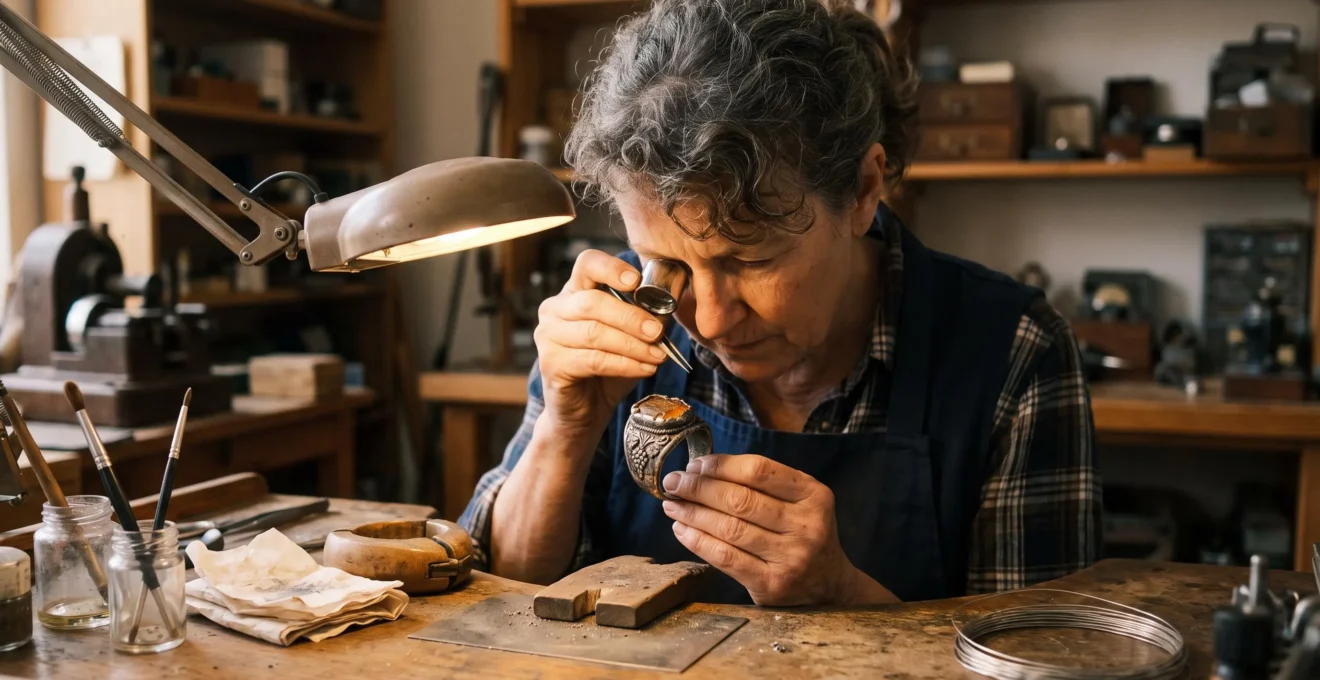
An inherited ring may carry more history in its worn engraving than in its gemstone. The darkened recesses, softened edges and traces of earlier repairs can reveal how it was made, handled and passed between generations. Restoring its original brilliance might make it more attractive to wear, but it could also remove evidence that cannot be recovered.
For UK families deciding whether to polish, repair or remodel heirloom jewellery, the safest starting point is to distinguish preservation from cosmetic improvement. A loose setting deserves attention because it threatens the gemstone. Stable patina, however, may deserve protection rather than removal.
The right decision depends on the materials, structural condition, historical significance and intended use of the piece. Before any work begins, document its condition, obtain specialist advice where necessary and establish exactly which changes are acceptable. Restoration should protect the jewellery’s future without unnecessarily erasing its past.
Heirloom restoration: the essential decisions
- Preserve stable patina and original finishes unless a qualified assessment identifies a sound reason for intervention.
- Prioritise secure settings, clasps and structural repairs over polishing or unnecessary remodelling.
- Photograph, value and document significant jewellery before approving work, and obtain written agreement on irreversible changes.
- Why Can Polishing an Heirloom Reduce Its Value More Than a Broken Clasp ?
- How to Assess an Heirloom Piece Before Restoration So You Don’t Regret It ?
- Repair the Original Setting or Re-Set the Stone: Which Preserves More Meaning ?
- The Restoration Agreement Mistake That Leads to Irreversible Changes
- When Should You Get an Heirloom Appraised and Insured Before Restoration ?
- Why Do Antique Pieces Look Fine Until You Wear Them for a Week ?
- Hand-Finished or Machine-Finished: Which Survives Daily Wear Better ?
- How Can You Tell When Artisanal Craftsmanship Actually Adds Value to a Piece ?
Why Can Polishing an Heirloom Reduce Its Value More Than a Broken Clasp ?
Polishing an heirloom can cause greater irreversible harm than replacing a broken clasp because it physically removes metal from the original surface. That surface may preserve historic finishes, engraving details and manufacturing evidence. A damaged clasp can sometimes be repaired or replaced while retaining the original component; lost surface material cannot simply be put back.
The crucial distinction is between patina and dirt. Patina describes changes to a material’s surface that develop through age, chemical reactions or deliberate finishing. On antique silver, darkening within engraved details may form part of the jewellery’s established appearance. Dirt, grease and other deposits are different and may be removable without stripping the underlying finish.
Not every dark surface is valuable patina. Active corrosion, harmful deposits or deterioration require assessment, while stable historic finishes often benefit from minimal intervention.
The Canadian Conservation Institute guidance on caring for historic metal objects explains that polishing is abrasive and removes some original material. This principle is especially important for plated jewellery, where excessive polishing may wear through a thin decorative layer.
Consider an inherited silver brooch with a broken fastening and deeply engraved flowers. Replacing or securing the fastening might restore usability while preserving the original design. Mechanically polishing the entire brooch could flatten delicate details and remove darkening that gives the engraving definition.
The distinction between resale value and sentimental usefulness also matters. Collectors may favour original surfaces, while an owner may place greater importance on wearing a family piece. Neither preference automatically determines its financial value; rarity, condition, provenance and market demand must also be considered.
A newer, mass-produced fashion piece may appeal to buyers in a bright, polished condition. That preference should not be assumed for historically significant jewellery.
Before approving polishing, photograph the piece under low-angle light, identify the original finishes and ask whether a structural repair or controlled surface cleaning would achieve the necessary result.
Preserving the surface does not mean ignoring damage. It means identifying the damage accurately before selecting a treatment that may affect the jewellery permanently.
How to Assess an Heirloom Piece Before Restoration So You Don’t Regret It ?
Assess an heirloom in four stages before restoration: establish its materials, inspect its structural integrity, examine its original surfaces and record its identifying marks. This creates a reliable basis for deciding what needs repair and what should remain untouched. Fragile gemstones or previous alterations may rule out treatments that would otherwise appear suitable.
A family photograph may help establish that a ring was worn decades ago, but it cannot confirm whether its gemstone is natural, synthetic or treated. Equally, a gold-coloured surface does not establish whether an item is solid gold, plated or made from another alloy.
A practical preliminary assessment should cover four areas:
- Material identification: Record any known gold fineness, silver markings, plating, gemstone types and possible treatments. Where identification is uncertain, request professional testing appropriate to the piece.
- Structural condition: Inspect settings, claws, hinges, clasps, links and previous solder joints for deformation or looseness. Avoid applying force to test weakened components.
- Surface condition: Note scratches, stable patina, worn finishes, damaged engraving and visible earlier repairs.
- Documentability: Photograph hallmarks, maker’s marks, inscriptions, monograms and distinctive construction details.
Earlier repairs deserve particular attention. A visible solder seam, mismatched replacement stone or shortened claw may indicate that the jewellery has already been altered. Such work can change the balance between conserving original material and correcting an existing weakness.
However, previous modification does not make further alteration automatically harmless. An old repair may itself belong to the family history of the object.
Documentation need not be complicated. Photograph the front, back and sides using consistent lighting, followed by close-ups of settings, marks and existing damage. Record the weight and dimensions where these can be measured safely. Keep the originals of the photographs and give the restorer a copy.
Material sensitivity can immediately limit the available techniques. Pearls, opals, emeralds with certain treatments and other fragile gemstones may react badly to heat, chemicals or unsuitable cleaning methods. Vintage settings can also be weakened by ultrasonic vibration.
The GIA advice on caring for jewellery and sensitive gemstones explains why cleaning techniques must be chosen according to gemstone properties, treatments and setting condition.
Your five-step pre-restoration checklist
- Photograph every side of the jewellery, including existing damage. Deliverable: a dated photographic record.
- Record identifying details, visible hallmarks and dimensions without damaging the piece. Deliverable: a written inventory.
- Ask a qualified jeweller to identify structural weaknesses and material uncertainties. Deliverable: a condition assessment.
- Separate essential safety work from optional cosmetic changes. Deliverable: two clearly distinguished lists of proposed treatments.
- Request a written estimate specifying approved techniques, restrictions and handling of original components. Deliverable: an agreed restoration brief.
Once the condition and materials are understood, the next decision is whether an ageing gemstone setting should be strengthened, replaced or retained without further wear.
Repair the Original Setting or Re-Set the Stone: Which Preserves More Meaning ?
Repairing an original setting usually preserves more of an heirloom’s historical identity than moving its gemstone into a new mount. However, conservation cannot justify an insecure setting when the owner intends to wear the jewellery. The preferred approach is to investigate whether a specialist can stabilise the existing construction before considering a complete reset.
An antique ring is more than its central stone. Its shoulders, gallery, claws, engraved details and proportions may reflect a particular period or maker. Transferring the stone into a contemporary mounting changes the identity of the object, even when the gemstone remains within the family.
Three different considerations influence the decision:
| Consideration | Repair original setting | Reset gemstone |
|---|---|---|
| Historical integrity | Retains more of the original construction and design. | Separates the gemstone from its original mounting. |
| Potential resale value | May benefit collectible pieces where originality is important. | May change collector appeal and shift value towards the individual stone. |
| Practical wear | Can restore security if sufficient sound material remains. | May provide a safer wearable setting when the original cannot be stabilised. |
| Future options | May preserve more opportunities for later conservation. | Can retain historical evidence if the original mount survives intact. |
A middle course is sometimes possible. A restoration specialist may be able to strengthen a weak area behind the setting, repair an individual claw or provide discreet support while retaining most of the visible construction.
Such work requires an assessment of metal thickness, previous soldering, stone sensitivity and the mechanical forces involved. A conventional modern repair technique may not be suitable for a delicate antique gallery.
For example, imagine an inherited ring holding a modestly valued gemstone that has substantial sentimental importance. If the setting is stable enough for occasional wear, preserving the original arrangement may matter more than modernising it.
Now consider a valuable stone in a severely weakened ring intended for regular use. If specialist repair cannot make the mounting sufficiently secure, a new setting may become a reasonable choice, provided the implications are understood beforehand.
Keep removed original components whenever practicable. A detached mounting can retain information about design, provenance and family history even when it is no longer wearable.
Reversibility should be considered realistically. Removing a stone, altering claws or applying heat can change an original setting permanently. A restorer should explain which steps can be reversed and which cannot.
The final decision should reflect how the jewellery will be used, not simply how attractive it appears in a workshop display. Whatever option is selected, the agreed treatment needs precise written instructions.
The Restoration Agreement Mistake That Leads to Irreversible Changes
The most consequential restoration agreement mistake is giving a jeweller an instruction such as “clean it up” or “make it look new” without defining the permitted work. These phrases may be interpreted as permission to polish, replace fittings or alter original surfaces. A written agreement should identify each authorised treatment and require further approval before irreversible changes.
A workshop may reasonably understand “restore” to mean returning a piece to a bright, wearable condition. An owner of an antique, however, may mean only securing a loose stone while retaining every mark of age.
Neither interpretation should be left to assumption, particularly when a piece carries historical or emotional significance.
A clear restoration agreement should identify:
- The jewellery’s condition when received, supported by photographs and a description.
- The exact repairs authorised, including the specific components involved.
- Prohibited treatments, such as machine polishing, refinishing, engraving removal or replacement of original parts without approval.
- Whether proposed work involves heat, solder, adhesives or irreversible metal removal.
- A requirement for written approval before additional work or material changes.
- Instructions for identifying, retaining and returning removed components.
- The agreed price, anticipated scope, custody arrangements and insurance responsibilities.
For an antique silver locket, an appropriately restricted instruction might authorise repair of a damaged hinge while specifically excluding polishing of the exterior and removal of its interior fittings.
The agreement should also distinguish between reversible and irreversible interventions. Certain stabilisation measures may be removable, while soldering, cutting and abrasive finishing permanently change original material.
When a truly reversible repair is impractical, documentation becomes especially important. Photographs of the affected area before and after treatment, together with an explanation of the materials and techniques used, help preserve knowledge of the original construction.
UK owners should assess a workshop’s relevant experience and professional credentials. Membership of a recognised organisation, such as Institute of Professional Goldsmiths, may be useful background information but does not replace evidence of competence in antique conservation.
Ask the workshop how the jewellery will be stored, transported and insured. Obtain written confirmation that its insurance arrangements and applicable limits are appropriate to the item’s value. Do not assume the owner’s home insurance automatically covers every stage of restoration.
A jeweller who welcomes detailed restrictions and explains alternatives is more useful for a sensitive commission than one who promises an unspecified complete transformation.
Even a carefully drafted agreement cannot replace financial documentation. The next safeguard is establishing what the piece is worth, what type of valuation is needed and who carries the risk while it is being repaired.
When Should You Get an Heirloom Appraised and Insured Before Restoration ?
Have a significant heirloom professionally valued before restoration, especially when its age, gemstone quality, maker or potential market value is uncertain. A pre-work valuation records the item’s condition and provides a reference if it is damaged or lost. Insurance must also be checked before the piece leaves your possession, because workshop and transit cover cannot be assumed.
An appraisal completed after polishing or resetting cannot fully recreate the original condition. Earlier photographs and valuations can therefore help establish which components existed before the intervention and what changes were made.
The purpose of the valuation matters as much as the amount recorded. Jewellery owners commonly encounter different bases of value that should not be treated as interchangeable.
| Valuation basis | Primary purpose | Important limitation |
|---|---|---|
| Insurance replacement valuation | Supports an appropriate replacement arrangement following an insured loss. | Does not necessarily equal the price obtainable from a buyer. |
| Open-market valuation | Estimates what the item might realise in a relevant market under specified assumptions. | Depends on market conditions, demand and the circumstances of sale. |
| Condition and identification report | Documents materials, identifying features and existing damage. | May not include a formal financial valuation unless requested. |
For a distinctive antique, an insurance replacement valuation may need to consider an appropriate comparable period piece rather than a newly manufactured equivalent.
The National Association of Jewellers advice on valuations and insurance explains the importance of appropriate valuation documentation, replacement arrangements and checking policy limitations. It also identifies the Institute of Registered Valuers as a professional route for jewellery valuation services in the UK.
Choose an assessor with relevant experience in antique jewellery and the specific materials involved. Where impartial market advice is important, ask about independence and potential financial interests in purchasing or selling the item.
Professional affiliation can support an initial credibility check, but it does not by itself guarantee independence or accuracy.
Before handing over the jewellery, ask your insurer:
- Is the item covered while travelling to and from the workshop?
- Does the policy cover it while in the jeweller’s custody?
- Are accidental damage, theft and loss covered in those circumstances?
- Are there individual-item limits, security conditions or valuation requirements?
- Should the insured value be reviewed after restoration?
Request written clarification where the wording is uncertain. General wear and tear is not ordinarily equivalent to accidental insured damage.
Restoration can affect market value positively, negatively or not materially at all, depending on the quality of the work and the significance of the changes. An insurance figure should not be used as a prediction of resale proceeds.
Financial protection is only part of responsible stewardship. Once the jewellery returns from the workshop, it must also be assessed for the stresses of actual wear.
Why Do Antique Pieces Look Fine Until You Wear Them for a Week ?
Antique jewellery may appear secure while stored but reveal weaknesses during ordinary wear. Repeated movement, minor impacts, moisture and contact with clothing can expose loose stones, weakened links and ageing solder joints. A recently repaired piece can also develop problems in an adjacent vulnerable area, so a cautious return to wear and professional follow-up are sensible.
Jewellery resting in a box experiences little repeated mechanical stress. A ring worn throughout the day, by contrast, is exposed to contact with hard surfaces and repeated changes in pressure. Bracelets and necklaces experience movement at their joints, while brooch fastenings may flex when attached to clothing.
These everyday stresses can reveal weaknesses that were not obvious during a stationary visual inspection.
Cosmetics, household cleaning products and moisture create additional risks. The effects depend on the metal, gemstone, treatment and construction; an antique piece should not be assumed to tolerate the same conditions as robust contemporary jewellery.
Following repair, start with brief periods of gentle wear only when the restorer has confirmed that the jewellery is safe to wear. Examine it afterwards in good light and compare its condition with the photographs taken before the work.
Look for visible changes around claws, hinges and solder joints. A new gap, unusual movement, clicking sound or change in how the fastening closes deserves attention. Do not deliberately push a potentially loose gemstone, shake the jewellery or probe fragile settings with a pointed implement. Those checks are safer in professional hands.
If movement is suspected, stop wearing the item and return it for inspection. Continuing to test a loose setting can increase the chance of gemstone loss.
A problem after restoration does not necessarily establish poor workmanship. Older constructions may contain adjacent weaknesses that were not apparent before the repaired area was returned to use. Nevertheless, the workshop should examine any new concern and explain its likely cause.
Daily habits also matter. Remove vulnerable jewellery before gardening, exercise, household cleaning and sleep. For particularly delicate or water-sensitive pieces, remove them before washing hands or using cosmetics.
Occasional ceremonial wear may be more compatible with preserving a fragile heirloom than using it every day. A piece that cannot be made sufficiently secure should remain unworn rather than subjected to repeated trial wear.
Preventing avoidable damage also depends on choosing suitable restoration techniques. Whether a tool is operated by hand or machine matters less than its effect on the original construction.
Hand-Finished or Machine-Finished: Which Survives Daily Wear Better ?
Neither hand-finishing nor machine-finishing is automatically better for antique jewellery. Durability depends on the technique, materials and condition of the original construction. For an heirloom, the central question is whether the proposed treatment preserves historically significant surfaces and produces a secure repair without unnecessary material removal or stress.
A hand-engraved pattern, manually formed claw or traditional closed-back setting may contain small variations that are characteristic of its manufacture. Modern equipment can achieve precise, repeatable finishes, but that precision does not necessarily make it appropriate for an old piece.
Mechanical polishing can remove metal from raised edges and fine details. Excessive hand polishing can do the same. A treatment should therefore be judged by the amount of original material disturbed, not simply by whether it is described as artisanal.
Antique construction also influences repair choices. An old solder joint, thin gallery or enclosed gemstone setting may react differently to heat and pressure than a modern mounting designed around contemporary production methods.
For instance, strengthening a delicate claw may require working within the limitations of the existing metal. Applying a standard modern setting procedure without assessing those limitations could distort adjacent components or place stress on the gemstone.
Ask prospective restorers about their experience with jewellery from the relevant period and their proposed working methods.
- Which original surfaces will the tools touch?
- Is any polishing necessary, and can it be avoided entirely?
- What material will be removed or added?
- How will fragile gemstones be protected during the work?
- Can the repair be limited to the damaged component?
- How will the finished work be inspected and documented?
A specialist should be willing to explain why a particular technique is suitable, what alternatives exist and what risks remain.
Preserving a handmade appearance does not require every repair to use historically identical tools. Carefully selected contemporary methods can sometimes support conservation goals. Conversely, a traditional-looking technique may still be inappropriate if it causes unnecessary alteration.
Original finishing and modern repair quality must be assessed separately. A secure, discreet intervention is valuable when it allows the historic piece to survive with minimal change.
This attention to technique leads to a broader question: which visible signs of craftsmanship actually establish historical or collectible significance?
Key takeaways before assessing craftsmanship
- An original surface may preserve evidence of how a piece was made, even where the finish appears uneven.
- A well-executed modern repair does not automatically add historical value to an antique.
- Maker identification, construction details and documented provenance should be examined before deciding which features to restore.
How Can You Tell When Artisanal Craftsmanship Actually Adds Value to a Piece ?
Artisanal craftsmanship can increase an heirloom’s historical or collectible value when its distinctive features demonstrate recognised skill, originality or a connection to an identifiable maker. Hand engraving, period-consistent tool marks and original settings may all contribute evidence. Their significance depends on authentication, condition, provenance and market interest, not on the handmade label alone.
Older jewellery often contains variations that reflect its manufacturing process. Delicate asymmetry in an engraved design, tool marks in concealed areas or individually formed setting components may help a specialist understand how the piece was produced.
Such signs require interpretation. Irregularity does not automatically establish quality or age, and precise workmanship is not evidence of machine manufacture. Traditional workshops and later reproductions can share visual characteristics.
A useful examination considers several features together:
- Original engraving: Whether the cutting technique, style and wear are consistent with the apparent period.
- Setting construction: Whether claws, bezels, galleries and stone arrangements appear consistent with the rest of the object.
- Tool marks: Whether surviving manufacturing traces provide meaningful evidence rather than merely indicating damage.
- Maker’s marks: Whether marks can be interpreted and associated with a relevant workshop, sponsor or manufacturer.
- Provenance: Whether family records, old photographs, receipts or other documentation support the object’s history.
Maker identification can be particularly useful, although it must be handled carefully. A sponsor’s mark may identify the organisation or person responsible for submitting an item for hallmarking, rather than the individual craftsperson who made it.
Sheffield Assay Office, for example, maintains historical registers of maker’s or sponsor’s marks extending back to 1773 and offers relevant identification and research services. This is a useful route for investigating certain marked pieces, not a guarantee that every inherited jewel can be attributed to a particular artisan.
The presence of a recognised mark does not automatically establish a financial premium. Collectors may value a documented connection with an important workshop, but the effect on price depends on the actual item and its market.
It is equally important to distinguish original craftsmanship from later additions. A beautifully executed contemporary engraving may enhance personal meaning while reducing the historical integrity of an otherwise untouched antique.
For example, adding a family inscription to an inherited locket may be emotionally appropriate. Before doing so, consider whether the new engraving would obscure a surviving maker’s mark, historic inscription or original decorative finish.
A professional assessment should distinguish what can reasonably be dated, what is uncertain and which features may be worth protecting. That assessment helps avoid presenting a later alteration as original period workmanship.
Before commissioning work on a meaningful heirloom, arrange a documented inspection with a jeweller experienced in antique restoration. Ask for the least invasive safe option, retain a written record of the agreed changes and give original craftsmanship the same consideration as the gemstones it supports.
Can an heirloom be cleaned safely at home without removing its patina?
Sometimes, but the correct method depends on the materials, finishes and construction. Gently removing loose dust with an appropriate soft, dry tool may be possible for a stable piece. Avoid abrasive polishing compounds, chemical dips, ultrasonic equipment and immersion until the gemstones and settings have been identified. Fragile or valuable antiques should be assessed professionally before cleaning.
Should you restore inherited jewellery before selling it?
Not automatically. Restoration can change the characteristics that attract antique collectors. Obtain an appropriate market valuation and discuss potential work with a specialist before altering the piece. A buyer interested in original condition may prefer an unrepaired item, whereas necessary structural work may improve its appeal to someone seeking wearable jewellery. The outcome depends on the particular market and proposed treatment.
What should you do if you discover a loose gemstone in an inherited ring?
Stop wearing the ring and store it securely until a jeweller can inspect the setting. Do not press the stone, tighten claws yourself or use household adhesive. The jeweller should examine the surrounding metal and explain whether the existing setting can be stabilised without unnecessary alteration.
Does a UK home insurance policy automatically cover jewellery sent for restoration?
No automatic assumption of cover is safe. Policies differ in their limits, exclusions and treatment of jewellery away from home. Ask your insurer specifically about transit, the workshop’s custody, accidental damage and theft. Confirm whether the restorer has suitable insurance and obtain written clarification before handing over a valuable piece.
Can a modern replacement clasp be fitted without destroying an antique necklace’s character?
In some cases, a discreet compatible clasp can improve security while leaving the main necklace substantially unchanged. The attachment method, metal compatibility and original construction determine what is appropriate. Ask the restorer to retain the original clasp where practicable and record the replacement so future owners can distinguish original components from later work.