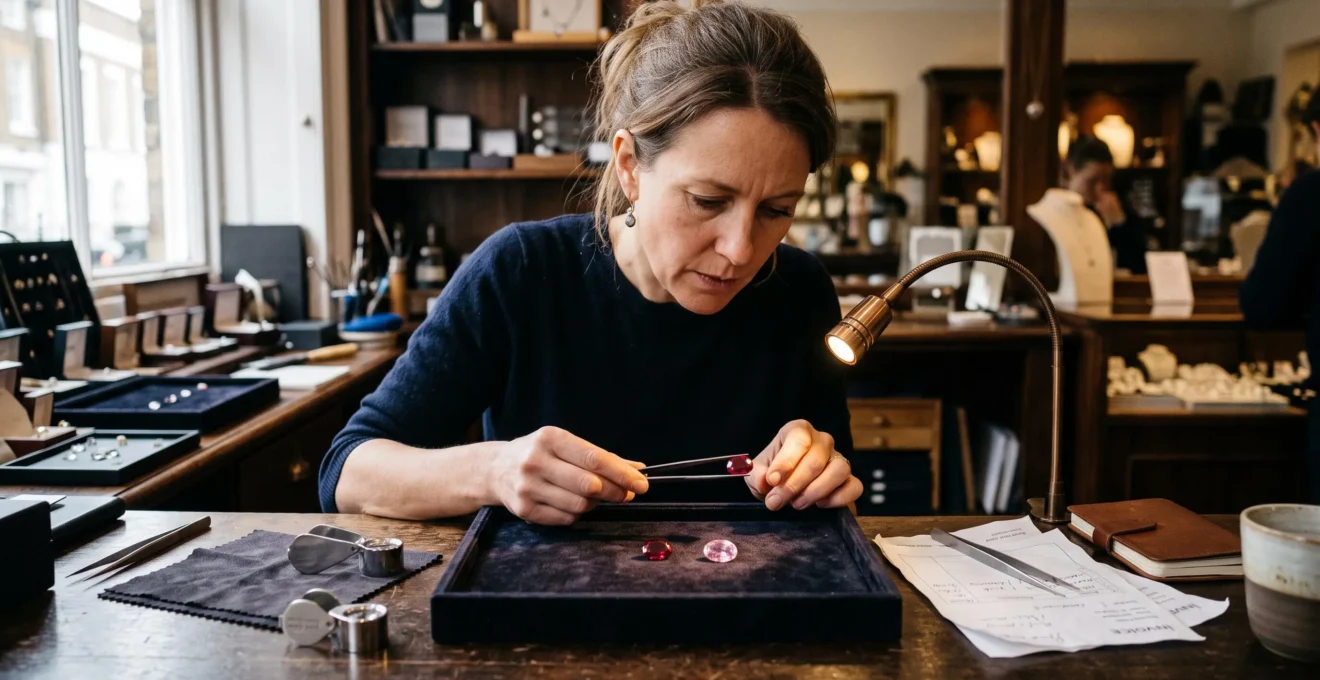
A ruby with a vivid red glow but a few visible inclusions can be more desirable than a nearly flawless ruby whose colour looks weak. For someone buying jewellery to wear, that distinction matters far more than chasing the highest possible clarity specification.
Unlike diamonds, coloured gemstones do not follow a single, universally applicable clarity grading hierarchy. Colour usually leads the buying decision, particularly for rubies and sapphires, while emeralds have their own expectations about natural inclusions. Yet clarity cannot simply be ignored: fractures, cloudy areas and poorly positioned inclusions can affect transparency, durability and everyday appearance.
The practical question is therefore not whether colour always beats clarity, but how much clarity a particular gemstone needs before further improvements stop making a meaningful visual difference. Cut quality, lighting, treatment history and budget all influence that answer.
For UK jewellery buyers comparing emeralds, rubies or sapphires, the most useful approach is to judge beauty under realistic conditions, verify the gemological facts and spend money on improvements that can actually be seen.
Colour or clarity: what matters when buying coloured gemstones?
- Prioritise attractive colour: hue, saturation, tone and evenness usually have a greater influence on the visual appeal of rubies and sapphires than minor inclusions.
- Judge clarity at wearing distance: inclusions that are harmless and barely noticeable without magnification may not justify paying substantially more for a cleaner stone.
- Verify more than appearance: inspect the cut, check treatment disclosures and compare gemstones outside flattering boutique spotlights before buying.
- Why Does Colour Matter More in Rubies Than Clarity for Most Buyers?
- How to Check Gem Colour in 3 Lighting Types Before You Buy?
- Eye-Clean or Included: Which Looks Better From 50 cm in Real Life?
- The Certification Mistake That Makes Buyers Misread Colour and Clarity Grades
- A Grading Priority Order That Stops You Chasing the Wrong Spec
- How to Inspect a Gemstone in a Boutique Using 4 Simple Checks Under Spotlights?
- Natural or Lab-Grown Coloured Gems: Which Choice Brings Fewer Surprises Later?
- How Can You Use Gemology Basics to Avoid Overpaying for Coloured Stones?
Why Does Colour Matter More in Rubies Than Clarity for Most Buyers?
Colour matters more than minor clarity differences in most ruby buying decisions because a ruby’s characteristic red appearance is its principal attraction and a leading factor in its value. Natural rubies commonly contain inclusions, so demanding diamond-like transparency can exclude beautiful stones unnecessarily. Nevertheless, prominent inclusions, cloudiness and significant fractures can still reduce a ruby’s appeal and durability.
According to GIA‘s ruby quality factors, colour is the most significant factor affecting ruby value. Particularly desirable rubies display a vibrant red to slightly purplish-red appearance, without excessive lightness or darkness.
Three colour properties deserve attention:
- Hue: the dominant colour and any secondary colour, such as purple or orange.
- Saturation: the strength or intensity of the colour, rather than its apparent paleness or greyness.
- Tone: how light or dark the gem appears.
A richly coloured ruby with a few fine inclusions may look much more attractive than a cleaner stone with weak saturation. However, saturation alone is not enough: a ruby that appears excessively dark may lose brightness and visible detail.
The presence of inclusions is not surprising. Ruby is the red variety of corundum, and its colour is associated with chromium. Natural crystal growth and geological conditions can also produce internal features, including mineral inclusions and rutile needles commonly described as silk. The colouring element itself should not be assumed to cause those inclusions.
Fine silk can sometimes soften the distribution of colour, while heavy inclusions may interfere with transparency. A conspicuous fracture extending to the surface is a different concern from harmless internal needles because it can compromise durability.
Expectations also change between gemstone varieties. In aquamarine and many varieties of topaz, buyers often encounter relatively clean-looking material, so obvious inclusions may be less acceptable. A white sapphire, lacking a strong body colour, depends particularly on transparency, brightness and cutting quality for visual appeal.
These differences explain why applying a single diamond-style clarity threshold across all coloured gemstones is misleading.
For a hypothetical comparison, consider two rubies offered at a similar price. The first displays lively, even red colour with minor inclusions that are difficult to notice while worn. The second is noticeably cleaner but looks pale and slightly brownish. For a colour-focused wearer, the first may be the stronger choice, provided its inclusions do not create durability problems.
That visual preference does not establish a guaranteed resale advantage. Future value depends on many other factors, including treatment, quality, documentation and market demand.
The practical lesson is to establish whether the stone has appealing red colour first, then determine whether its inclusions materially interfere with beauty, transparency or strength. Lighting is the next variable capable of changing that judgement.
How to Check Gem Colour in 3 Lighting Types Before You Buy?
Check a coloured gemstone under three conditions: indirect daylight near a window, warm indoor lighting and the boutique’s own spotlights. Compare its hue, brightness and colour consistency in each setting. A stone that looks exceptional only beneath a concentrated jewellery lamp may appear considerably less lively in everyday surroundings, making lighting comparisons essential before purchase.
Jewellery stores use lighting designed to showcase brilliance and sparkle. This is useful for examining reflections, but it is not necessarily representative of an office, restaurant or living room.
Use the following three-light comparison.
- Indirect daylight: hold the stone near a window, avoiding strong direct sunlight. Look for its dominant hue, any unwanted secondary colours and whether the colour remains reasonably even across the face.
- Warm indoor light: assess the stone beneath warm household-style lighting. Compare the red in a ruby or the blue in a sapphire with its appearance in daylight. Warm illumination can make some red stones appear more attractive while changing the balance of other colours.
- Boutique spotlights: examine how the gemstone reacts to concentrated illumination. Spotlights can produce appealing reflections but may make dark areas, pale zones or underlying colour weaknesses harder to assess consistently.
Do not expect every gemstone to look identical under all three light sources. The aim is to identify whether its appearance changes in ways you would enjoy or find disappointing.
Angle is equally important. Rotate and gently tilt a loose gemstone while observing its face-up colour. A sapphire may reveal a pale band on one side, while a ruby may show a darker patch that was not evident from its original position.
These variations can reflect colour zoning, where colour is distributed unevenly within the crystal, or optical effects associated with the cut. Dark areas may also result from extinction, where little light returns towards the viewer.
Fluorescence introduces another variable. Certain gemstones react to ultraviolet components of illumination, affecting their visible appearance. Some rubies, for example, can display a particularly lively red response under suitable lighting conditions.
Such behaviour is not automatically a defect or a quality guarantee. It simply reinforces the importance of observing a gemstone under conditions similar to those in which it will be worn.
If two stones appear equally attractive beneath the shop lights, comparing them near a window can reveal differences that are more relevant to everyday jewellery.
A stone that remains appealing across several environments is often a more satisfying wear purchase than one whose beauty depends heavily on a particular spotlight. Once the colour has passed that test, clarity should be judged at a realistic viewing distance.
Eye-Clean or Included: Which Looks Better From 50 cm in Real Life?
An eye-clean gemstone usually looks better than one with distracting visible inclusions when both have comparable colour, cut and transparency. However, eye-clean is a practical visual description, not a promise of microscopic perfection. At approximately 50 cm, small internal features may disappear from view, making additional clarity improvements difficult to appreciate in everyday jewellery.
The term eye-clean generally means that inclusions are not visible to the unaided eye under specified viewing conditions. It is not a universally fixed coloured-gemstone grade: viewing distance, lighting, eyesight and the observer’s experience can all influence the result.
Using 50 cm is a practical shopping exercise rather than an official international clarity standard. It approximates a distance at which another person might notice jewellery during a conversation or while sitting across a table.
Begin by assessing the stone without magnification. If its inclusions are invisible at this distance, ask whether a more expensive clarity upgrade would actually improve what you see.
The answer depends partly on the gemstone.
| Gemstone | Common clarity expectations | What deserves closer inspection |
|---|---|---|
| Ruby | Some natural inclusions are expected and may be acceptable. | Dark or prominent inclusions, cloudiness and fractures reaching the surface. |
| Emerald | Internal features, often called jardin, are commonly accepted. | Fractures, filling treatments, transparency and suitability for regular wear. |
| Sapphire | Clarity expectations vary with colour, quality and variety. | Visible inclusions, cloudy regions and features affecting brightness. |
| Aquamarine or topaz | Clean-looking stones are commonly available in many commercial qualities. | Inclusions that are conspicuous in an otherwise transparent gem. |
An emerald with attractive green colour and visible jardin can still be desirable. An emerald that appears exceptionally clean is not necessarily the better purchase if its colour is weak or its treatment history is unclear.
Inclusions also matter according to their location and nature, not merely their number. A dark crystal beneath the table facet can draw attention every time the stone is viewed face-up. A fine internal feature towards the edge may be far less noticeable.
Fractures near the girdle deserve particular attention, especially if they reach the surface or affect areas exposed to setting pressure and impacts. Their significance cannot reliably be determined through inclusion counting alone.
Try viewing the gemstone at a dinner-table distance, near ordinary indoor lighting and outdoors in indirect daylight. If an inclusion repeatedly catches your eye, it has a practical effect on appearance regardless of its technical description.
Conversely, a small feature that only becomes apparent under magnification may have little effect on wearing enjoyment.
Clarity premiums make the most sense when they improve visible transparency, appearance or structural confidence. A laboratory report can help establish what the gemstone is, but it should not be mistaken for a diamond-style clarity score.
The Certification Mistake That Makes Buyers Misread Colour and Clarity Grades
The most common certification misunderstanding is assuming that coloured gemstone reports work like diamond grading reports. They generally do not. A reputable coloured stone report principally identifies the material, assesses natural or laboratory origin, records detectable treatments and may provide an opinion on geographical origin. Colour descriptions can appear, but a universal diamond-style clarity grade is not normally the report’s purpose.
A buyer accustomed to diamond grades such as VS1 or SI1 may search for an equivalent label on a ruby or emerald report. Finding none does not make the document incomplete or the gemstone inferior.
According to GIA’s coloured stone report documentation, its reports identify the gemstone, distinguish natural from synthetic material and describe detectable treatments. Depending on the service and eligibility, they can also provide information on geographical origin.
Reports may record colour, weight, dimensions, shape and cutting style. Their purpose is not to guarantee market value or rank every aspect of beauty against an international numerical scale.
Consider three areas of the report separately:
- Identity: is the material actually ruby, sapphire or emerald, and is it natural or laboratory-grown?
- Treatment: has the laboratory detected heat treatment, filling or another relevant enhancement?
- Origin: where an origin opinion is offered, what does the laboratory actually conclude, and with what stated limitations?
These findings can matter significantly when comparing prices. Two visually similar rubies may be valued differently because one is described as heated and the other has no indications of heating, assuming other relevant characteristics are comparable.
That does not mean untreated stones are invariably better for wearing. Treatment status is one component of commercial value and buyer preference, not a substitute for judging appearance.
Another frequent misunderstanding involves descriptive trade names such as “pigeon’s blood” for certain rubies and “royal blue” for certain sapphires.
These terms are not universal colour grades equivalent to the standardised letter grades familiar from diamond reports. Some laboratories apply defined internal criteria when using them, while commercial descriptions may be less rigorously controlled.
Never assume that the same wording has identical technical requirements across GIA, SSEF, Gübelin and GRS. Check which laboratory issued the report and what its terminology means.
A report also has limits. Treatment conclusions concern what can be detected through the examination performed, and not every stone qualifies for a geographical origin determination.
For an expensive purchase, verify the report reference with the issuing laboratory where a verification service is available. Compare the document with the actual gemstone and ensure the seller’s invoice describes the same material and relevant treatments.
The report should confirm important facts about the gemstone; your eyes should judge its beauty. Both are necessary, but neither replaces the other when deciding how to allocate a fixed jewellery budget.
A Grading Priority Order That Stops You Chasing the Wrong Spec
For a coloured gemstone bought primarily to wear, a useful starting order is species and budget, followed by colour, cut, practical clarity and carat weight. This prioritises visible beauty rather than isolated technical specifications. It is a buying heuristic, not an official grading formula, and should change when durability, treatment status or a particular design requirement becomes decisive.
Begin by selecting the gemstone species appropriate to your jewellery and lifestyle. Emerald, ruby and sapphire differ in appearance, treatment practices and durability considerations. Your budget should then define which examples are realistic to compare.
Within that selection, evaluate the following factors in order.
- Colour: find a hue you genuinely like, with convincing saturation, appropriate tone and pleasing distribution.
- Cut: look for balanced proportions, useful light return, attractive shape and limited distracting windowing or extinction.
- Clarity: decide whether inclusions are visible, distracting or potentially damaging.
- Carat weight: choose a size that suits the jewellery without sacrificing the earlier qualities unnecessarily.
This sequence reflects appearance-focused decision-making. GIA’s analysis of coloured gemstone value factors explains how hue, saturation, tone, colour zoning and cutting influence visual quality and value.
Cut deserves particular attention because it changes how colour is perceived. A poorly proportioned gem can look paler in some areas or excessively dark in others, even when the underlying material has attractive colour.
Consider a hypothetical UK shopping budget of £2,000. One retailer offers a larger, relatively clean sapphire with uneven colour; another offers a slightly smaller sapphire with more appealing blue saturation, lively cutting and a minor inclusion that is difficult to notice without magnification.
Hypothetical purchase: deciding between two sapphires
Both gemstones fit the same illustrative £2,000 budget. Sapphire A is larger and cleaner but appears pale through part of its face. Sapphire B is smaller, has more consistent colour and contains a minor inclusion that is not distracting at normal viewing distance.
For an appearance-focused buyer, Sapphire B may deliver greater everyday satisfaction despite its smaller size and less impressive clarity description. This is a decision example, not a verified market comparison or a claim about future resale value.
The budget is not being allocated by a mathematical percentage to each quality factor. Rather, each candidate is judged according to whether the next available improvement would produce a noticeable benefit.
There are legitimate reasons to rearrange the order. A buyer choosing a gemstone for an important heirloom may give treatment status greater priority. Someone commissioning a replacement stone for an existing ring might need a particular size and shape before considering anything else.
A practical method is to select one non-negotiable requirement before entering the shop. It might be a specified treatment status, a minimum size for a setting or the absence of durability-threatening fractures. Apply that requirement first, then compare the remaining stones by visual quality.
Once priorities are established, the next challenge is applying them quickly and confidently in a jewellery boutique, where concentrated lighting can alter the impression of colour and cut.
How to Inspect a Gemstone in a Boutique Using 4 Simple Checks Under Spotlights?
Inspect a gemstone using four practical checks: tilt it to reveal cutting problems, examine the location of inclusions, move it into neutral light and compare it directly with another stone. These steps help expose weaknesses that concentrated spotlights can disguise. They do not replace professional gemological testing, but they make an ordinary boutique visit considerably more informative.
Start with the gemstone viewed face-up, as it would normally appear in jewellery. Ask the assistant whether it can be examined safely outside the display setting. Loose stones should be handled with appropriate tools, preferably by the jeweller.
Check 1 — Tilt for windowing and extinction. Gently rock the gemstone while watching its centre and edges. A window is a pale or transparent-looking area through which light escapes rather than returning towards the viewer. Extinction appears as a dark region with limited visible light return.
Some dark areas and changing reflections are normal in faceted stones. The concern is extensive, persistent windowing or darkness that diminishes the gem’s visual appeal in ordinary viewing positions.
Check 2 — Examine inclusion position. Request a jeweller’s loupe if available. Rather than simply counting inclusions, look for obvious features beneath the table facet and fractures approaching the girdle or surface.
A phone camera can help you record what is visible, but autofocus, reflections and digital processing make it unreliable for determining precise inclusion depth or structural risk. If a fracture seems important, request professional examination rather than drawing a durability conclusion from a photograph.
Check 3 — Leave the spotlights. Request to see the gem near a window or under relatively neutral, diffuse illumination. Observe the colour at normal viewing distance, then tilt it slightly to reveal uneven colour or patches of darkness.
Check 4 — Compare two similar stones. Ask to see another gemstone of the same variety and roughly comparable dimensions or price. Place them side by side under the same lighting conditions.
Direct comparison makes differences in tone, saturation, clarity and brightness easier to recognise. A sapphire that initially seemed vivid may look noticeably grey next to another example, while a slightly included emerald may appear more lively than a cleaner alternative.
Your five-action boutique inspection checklist
- View the gemstone face-up and tilt it gently. Record whether any prominent window or dark zone remains visible.
- Inspect the table and girdle areas with a loupe, with the jeweller’s assistance. Record the position of any potentially important inclusion or fracture.
- Check the gem in indirect daylight and ordinary indoor lighting. Write down how its hue, tone and brightness change.
- Compare it with a similar stone under identical lighting. Identify which one has the more appealing overall appearance and why.
- Request the report details and written treatment description. Keep a photograph or copy of the relevant documentation with the quoted price.
These observations give the buyer a practical record rather than a vague impression. They also make a later comparison between boutiques easier.
Do not force a purchase decision when inspection conditions are inadequate. A seller who cannot provide neutral-light viewing or meaningful documentation may leave important uncertainty unresolved, particularly for an expensive stone.
Appearance is only part of the buying decision. Natural and laboratory-grown gemstones can look remarkably similar, yet their origins, disclosures and potential future market behaviour introduce different considerations.
Natural or Lab-Grown Coloured Gems: Which Choice Brings Fewer Surprises Later?
Laboratory-grown coloured gemstones can offer a more predictable route to an attractive appearance at a given budget, while natural stones offer geological rarity and characteristics valued by many collectors. Neither category automatically prevents buying surprises. Natural stones require careful treatment verification, whereas laboratory-grown purchases require clear origin disclosure and realistic expectations about resale.
Natural ruby, sapphire and emerald form through geological processes. Laboratory-grown versions are produced through controlled manufacturing techniques and can share the essential mineral composition and many physical properties of their natural counterparts.
Laboratory-grown material can offer strong colour and an apparently clean appearance at a lower purchase price than many comparable natural examples. However, laboratory-grown gemstones are not necessarily inclusion-free or perfectly uniform; characteristics vary with the material and growth process.
Natural stones can contain distinctive growth features and colour variations. Some buyers appreciate those characteristics as evidence of individuality, while others prefer a cleaner, more consistent-looking gemstone.
The choice therefore depends on the buyer’s objective rather than a universal quality ranking.
| Buying consideration | Natural gemstone | Laboratory-grown gemstone |
|---|---|---|
| Origin | Formed naturally through geological processes. | Produced through a laboratory or industrial growth process. |
| Appearance | Colour and inclusions vary considerably between specimens. | Attractive colour and high apparent clarity may be available at a lower price. |
| Documentation priority | Natural identity, detectable treatments and possible origin findings. | Clear synthetic identification and any relevant growth or treatment information. |
| Market considerations | Rarity and treatment status may strongly influence value. | Purchase prices and resale expectations differ from natural material. |
| Main uncertainty | Undisclosed treatments, inclusions or misunderstood quality claims. | Misrepresented origin, insufficient product information or unrealistic resale assumptions. |
For UK buyers, clear written descriptions are important. Confirm whether the stone is natural or laboratory-grown, and do not rely solely on product photography, verbal assurances or a loosely worded sales label.
Where available, ask the seller to identify the laboratory growth method and provide supporting documentation. Such information may not be present on every standard report, so its availability should be confirmed rather than assumed.
With natural coloured gemstones, investigate treatments especially carefully. Heat treatment is relevant to many rubies and sapphires, while fracture filling is particularly important for emeralds. Other treatment methods, including diffusion, may also require consideration depending on the material.
A treatment may improve appearance without necessarily making the gemstone unsuitable for jewellery. However, treatments can change value, care requirements or the interpretation of a seller’s quality claims.
Resale expectations deserve similar caution. Natural material with desirable characteristics may have a stronger collector market than laboratory-grown alternatives, but appreciation is never guaranteed. Retail buying prices include commercial costs that may not be recovered when a jewellery item is resold.
Buyers choosing primarily for wearing enjoyment may prefer laboratory-grown material because it provides an appealing stone within budget. Buyers prioritising natural rarity may reasonably accept more inclusions or a smaller size.
The most predictable choice is the one whose origin, treatments, appearance and commercial terms are understood before payment. Those same principles help prevent overpaying, regardless of whether the stone is natural or laboratory-grown.
What to establish before comparing prices
- A gem’s quoted price should be judged alongside its colour, cut, visible clarity and treatment status, not carat weight alone.
- Descriptive trade labels and claims of exceptional clarity are not substitutes for direct visual comparison and appropriate documentation.
- A second independent quotation is most useful when the gemstones being compared have genuinely similar characteristics.
How Can You Use Gemology Basics to Avoid Overpaying for Coloured Stones?
Basic gemology helps buyers avoid overpaying by separating visible quality from marketing language. Understand how colour, cut, clarity, size and treatment affect desirability; check the claims made about the gemstone; and compare genuinely similar offers. The goal is not to predict a perfect market price, but to recognise which differences justify paying more and which do not.
Coloured gemstone prices do not increase in a simple, uniform way with carat weight. A larger stone can command a higher price per carat when desirable quality becomes increasingly scarce at that size.
GIA’s ruby guidance, for example, identifies the rarity of fine-quality rubies above one carat and explains that price per carat can increase considerably with size. That observation does not establish an identical pricing curve for every coloured gemstone.
Exceptional colour, desirable transparency, favourable treatment status and attractive cutting can also contribute to substantial differences between superficially similar stones.
In practice, a quoted price should be broken down into questions that can be answered independently.
- Does the colour remain attractive in ordinary light?
- Is the cut helping the gemstone appear bright and evenly coloured?
- Are inclusions merely present, or do they visibly affect beauty or structural confidence?
- What treatments have been identified or disclosed?
- Is a premium being charged for a documented characteristic, a commercial description or a claim that cannot be independently assessed?
Particular caution is warranted when a stone is advertised using a prestigious colour name. A term such as “pigeon’s blood” may have a defined meaning within a particular laboratory’s reporting system, but its use in a retailer’s description does not independently establish exceptional quality.
The same applies to clarity terminology. An apparently impressive clarity claim should not command a large premium unless it describes a meaningful improvement for that gemstone type and the buyer can verify the benefit.
For a buyer choosing jewellery to wear, colour and cut often produce more immediate visual differences than improvements from minor inclusions to an almost flawless interior.
Before payment, request an appropriate gemstone report when justified by the purchase value and circumstances. Review the species identification, natural or laboratory-grown status, detectable treatments and any origin opinion relevant to the seller’s claims.
Obtain a written invoice identifying the gemstone, its stated origin category, relevant treatments and the characteristics forming part of the sales description. A report and invoice serve different purposes: one records gemological findings, while the other documents the commercial transaction.
Then seek a comparison quotation from another seller. Compare stones of similar species, approximate size, colour quality, treatment status and overall appearance. A cheaper quote is not necessarily better value if the material or quality differs substantially.
For purchases involving significant sums, consider an independent qualified gemologist or valuer. Their role is particularly valuable when treatment findings, identity or pricing claims remain uncertain. No laboratory report alone guarantees the price that could be achieved on resale.
A useful final test is to ask what would actually improve if you spent more. If the additional money buys a noticeable improvement in colour, balanced cutting or important durability confidence, there may be a sound reason to consider it. If it buys only a microscopic clarity distinction invisible in normal wear, its practical value may be limited.
Before committing to a purchase, compare two or three suitable gemstones in neutral light, verify their documentation and select the one whose visible beauty, durability and disclosed characteristics best fit the budget. A carefully assessed gemstone is a better buying objective than an impressive specification that makes little difference when the jewellery is worn.
Can a gemstone with visible inclusions still be valuable?
Yes. Natural emeralds and rubies frequently contain inclusions, and some remain highly desirable because of their colour and other qualities. What matters is the inclusion’s visibility, type, position and effect on transparency or durability. However, prominent dark inclusions and significant fractures can reduce value.
Does an eye-clean gemstone have no inclusions?
No. Eye-clean generally means inclusions are not visible without magnification under the viewing conditions being used. Microscopic examination may reveal internal features. The description is also sensitive to lighting, viewing distance and eyesight, so it should not be interpreted as a promise of flawless material.
Should I always pay more for an unheated ruby or sapphire?
Not necessarily. An unheated stone may command a premium when its identity and treatment findings are properly documented, but colour, cut, transparency and overall appearance still matter. A well-coloured heated gemstone can be preferable for someone buying primarily to wear, particularly when the alternatives differ significantly in beauty or price.
Can a photograph accurately show a sapphire or emerald’s colour?
A photograph can provide an initial impression, but lighting, camera processing, exposure and screen settings may change the apparent hue and saturation. For a substantial purchase, request views under different lighting conditions and, where possible, inspect the gemstone in person. Photographs also cannot reliably establish treatment status or structural durability.
Is a gemstone laboratory report the same as an insurance valuation?
No. A gemological report documents findings such as gemstone identity, detectable treatments and sometimes geographical origin. An insurance valuation addresses replacement value for insurance purposes and is a separate assessment. Neither should be treated as a guarantee of the price a gemstone will achieve if resold.