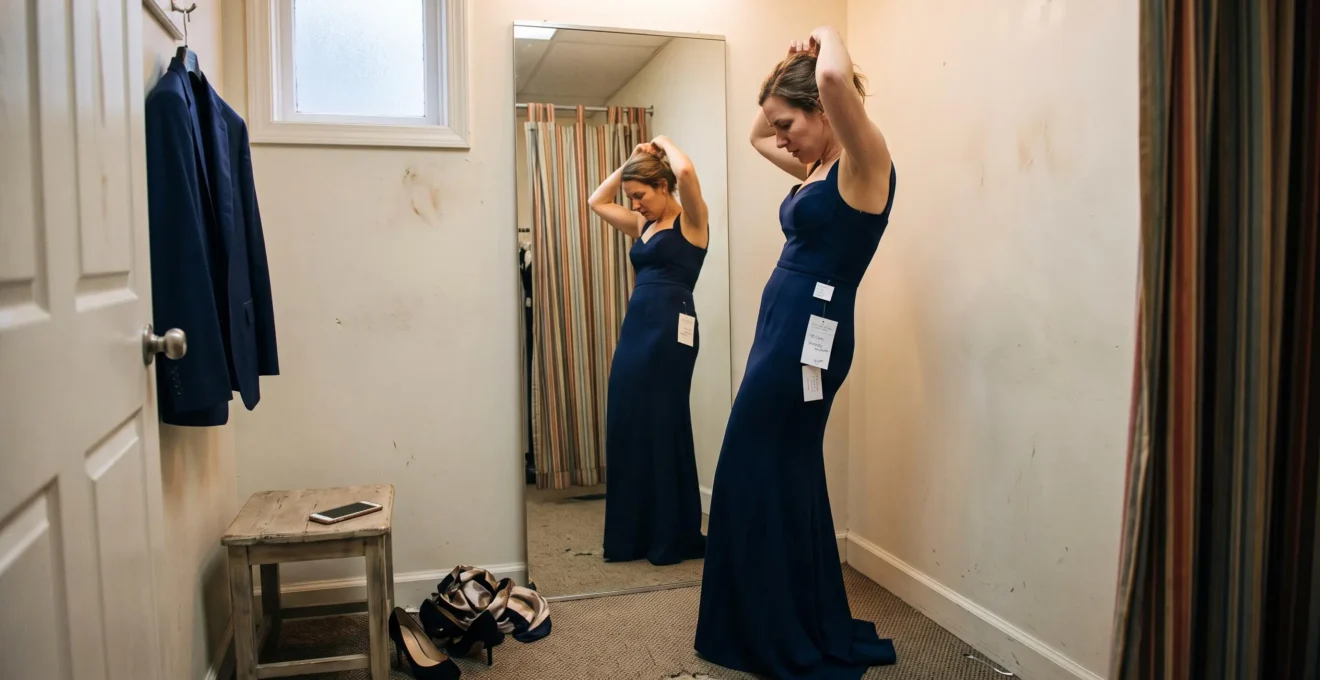
The most flattering evening gown is not necessarily the one that creates the smallest waist or the smoothest outline while you stand still. It is the one that follows your proportions, supports itself where needed and remains comfortable when you sit, walk, climb stairs and dance.
For UK galas, black-tie celebrations and formal weddings, an A-line gown is often a forgiving starting point because its skirt creates room around the hips without requiring compression. A well-fitted empire-waist dress can also offer freedom around the midsection, while a structured column creates a streamlined look without necessarily needing shapewear. Mermaid and body-skimming silhouettes can work beautifully too, provided their fabric, lining and fit accommodate movement.
The decisive details are less glamorous than a fitting-room photograph suggests: where the waist seam sits, how the fabric behaves over the hips, whether the bodice stays in place and how the hem meets your actual shoes. Checking these details before buying can prevent an expensive alteration or an uncomfortable evening.
Evening gown fit: the essentials
- Choose construction over compression: A-line skirts, properly positioned waist seams and supportive bodices can shape a gown without relying on restrictive underwear.
- Test movement before appearance alone: Sitting, stepping, raising your arms, hugging and walking reveal problems a mirror cannot.
- Protect your budget: Confirm the hem, alteration requirements, delivery timing and return rights before committing to a gown.
- Why Does the Same Evening Gown Silhouette Look Completely Different on Two People?
- How to Test an Evening Gown Fit in 5 Moves Before You Commit?
- Column Gown or A-Line: Which Is Easier for Stairs, Seats, and Dancing?
- The Hem-Length Mistake That Causes Falls and Ruins Photos All Night
- When Should You Buy an Evening Gown to Avoid Rush Alteration Fees and Stress?
- Statement Dress or Statement Accessories: Which Gives More Impact Under £300?
- Bodycon or Wrap: Which Cocktail Dress Works Best for Sitting and Eating Comfortably?
- What Should a Cocktail Dress Do for You at a UK Event Beyond Looking Pretty?
Why Does the Same Evening Gown Silhouette Look Completely Different on Two People?
The same evening gown can look different on two women because body proportions, fabric behaviour and garment construction interact. Sharing an hourglass, pear or rectangular body-shape label does not mean sharing shoulder width, waist height, torso length or hip placement. A silhouette that sits naturally on one frame may pull, bunch or require alterations on another.
Body shape describes a broad relationship between measurements. Proportions describe where those measurements occur. Two women with similar bust, waist and hip circumferences can have different distances between their shoulders, bust, natural waist and fullest hip point.
Consider a gown with a fixed waist seam. On a shorter torso, that seam might sit below the natural waist and make the bodice appear elongated. On a longer torso, the same seam might ride upward, creating tension beneath the bust. Neither result indicates a problem with the wearer’s body; the garment’s proportions simply do not correspond to hers.
Garment-making principles explain why these distinctions matter. Utah State University Extension‘s garment measurement instructions distinguish wearing ease, which provides room for comfortable wear, from design ease, which contributes to the intended fullness and outline. Waist position, hip measurement and finished garment length therefore need separate consideration.
Fabric adds another variable. A softly draped, bias-cut column can follow the natural contours of the stomach and hips, while a structured duchess satin A-line may maintain more of its own shape. A lightweight unlined fabric can reveal seams and underwear edges that a substantial lining makes less noticeable.
The Sewing & Craft Alliance’s fabric selection article
A useful self-assessment starts with two ordinary photographs taken in a comfortable, fitted base layer: one from the front and one from the side. Position the camera around waist height and avoid exaggerated poses. Examine three landmarks:
- Waist placement: Identify where your torso naturally narrows, rather than assuming the manufacturer’s waist seam will align with it.
- Fullest hip point: Note where the skirt needs enough room to fall without horizontal pulling.
- Shoulder-to-waist relationship: Check whether the bodice length and shoulder structure are likely to sit securely.
These photographs are personal fitting references, not a scientifically validated body-classification test. They help identify where to inspect a prospective gown, rather than predict precisely how it will fit.
If your priority is avoiding firm shapewear, begin with styles that create their intended outline through their cut, lining or internal support. Try an A-line with a well-positioned waist, an empire-waist gown with controlled bust support or a lined column with enough wearing ease.
Once you understand why a silhouette behaves differently on your frame, the next question is whether it stays comfortable when you move.
How to Test an Evening Gown Fit in 5 Moves Before You Commit?
Test an evening gown by sitting fully, climbing a step, raising both arms, hugging yourself and walking at two speeds. These movements expose restrictions, slipping bodices, back gaps and dangerous hems before purchase. A dress that looks flawless while standing still may be unsuitable for a seated wedding breakfast or an evening spent dancing.
Perform the test wearing the underwear and shoes you expect to use at the event, where possible. A different bra can change the bust fit, while heel height changes both posture and hem clearance.
Start by sitting fully back in a chair, ideally one similar to the venue’s seating. Check whether the skirt pulls across your thighs, the bodice presses into your ribs or the neckline changes position. A small amount of fabric movement is normal; persistent discomfort or a neckline requiring constant adjustment deserves attention.
Next, climb a step or a safe fitting-room platform. Notice whether you can raise your knee naturally and whether the skirt catches. Narrow column and mermaid gowns may need an appropriately positioned slit, sufficient ease or a different skirt construction.
Raise both arms overhead, then lower them. If the bodice slides upward, loses contact with the bust or drops when your arms return, investigate the strap length and bodice fit. Do not assume that tightening the waist will fix an incorrectly proportioned upper section.
Bring your arms forward in a self-hug. Excess fabric at the upper back may indicate a loose back panel, while severe pulling across the shoulder blades may indicate insufficient room. Either can be more difficult to correct than a simple strap adjustment.
Finally, walk at a normal pace, then a slightly brisker pace. Check whether your stride shortens, the dress twists or the hem slips beneath your shoes. Repeat on a clean, unobstructed surface where there is no risk of tripping.
A mirror cannot show every problem. With the shop’s permission, record a short phone video from the side and behind while walking. This can reveal uneven fabric movement, twisting seams and a dragging back hem that a front-facing mirror conceals.
The five-move fitting-room checklist
- Sit fully: Sit in the gown for a short period and record whether the waist, neckline and skirt remain comfortable. Deliverable: a clear pass or problem note for seated fit.
- Climb a step: Step up and down carefully without forcing a long stride. Deliverable: confirmation that the skirt allows safe stair movement.
- Raise both arms: Lift and lower your arms while watching the neckline and bodice. Deliverable: a note on slipping, gaping or secure support.
- Hug yourself: Bring your arms forward across your chest and check the back fit. Deliverable: confirmation of comfortable shoulder movement and back-panel stability.
- Walk at two speeds: Walk normally and briskly, then review the hem and back fit from a short video. Deliverable: a decision on whether the dress is wearable as sold, needs a straightforward alteration or should be rejected.
Use the results to distinguish a routine adjustment from a fundamental mismatch. Hemming or shortening straps may be manageable, subject to construction. Changing the placement of an entire bodice or adding substantial room through the hips can be much harder.
As a practical shopping rule, treat failure on two or more movements as a reason to reconsider the gown and obtain professional alteration advice, not as a validated threshold proving it cannot be fixed.
A gown that passes these tests gives you a stronger basis for choosing between similarly flattering silhouettes, especially when the event involves stairs, prolonged sitting or dancing.
Column Gown or A-Line: Which Is Easier for Stairs, Seats, and Dancing?
An A-line evening gown is generally the easier starting point for stairs, sitting and dancing because its skirt widens towards the hem, providing more room around the legs. A column gown can be equally practical when its fabric has sufficient give, its skirt contains enough ease and its lining moves comfortably. Construction matters more than the silhouette name alone.
Picture a formal event in an older UK venue: narrow stairs between the reception and dining room, chairs with arms and a crowded dance floor. Each movement asks something different of the dress.
An A-line provides space around the hips and thighs while maintaining a defined upper silhouette. This can reduce reliance on compression shapewear, particularly when the skirt holds its own shape rather than closely following the body.
A column creates a long, clean visual line. However, a narrow skirt in non-stretch woven fabric may restrict step length, especially around the knees. A properly designed slit, suitable lining and adequate skirt circumference can make a substantial difference.
Fabric can reverse your expectations. A softly knitted column with comfortable stretch may be easier to sit in than a stiff taffeta A-line with bulky skirt layers. Similarly, a bias-cut silk column may drape and move well, while extensive beading and a restrictive lining may reduce a gown’s flexibility.
The following comparison describes common construction tendencies, not guarantees for every garment.
| Practical requirement | Column gown | A-line gown |
|---|---|---|
| Climbing stairs | Depends heavily on skirt ease, fabric and slit design. | Usually offers more leg room, although excess length can catch. |
| Sitting for dinner | Check thigh room and whether the lining pulls. | Typically allows more room across the hips and upper legs. |
| Dancing | Fluid or stretch versions can work well; rigid narrow cuts may restrict steps. | Allows wider strides, but bulky skirts can occupy more space. |
| Minimal shapewear | Requires particular attention to fabric opacity, lining and personal comfort. | Flared construction can create its outline without compressing the hips. |
| Photographic effect | Creates an uninterrupted vertical line. | Emphasises waist placement and skirt movement. |
Match your decision to the event schedule. For a long seated dinner, prioritise comfortable waist support, thigh room and a bodice that stays aligned while sitting. For a reception involving standing, walking and dancing, prioritise natural stride length, skirt control and manageable fabric weight.
If you particularly like a column gown, do not dismiss it solely because you want to avoid shapewear. Instead, seek a version with substantial but comfortable lining, a fabric that falls smoothly and enough ease to move without dragging against the body.
Neither silhouette should require you to accept painful compression or a restricted stride as the price of looking elegant. The better choice is the garment whose fabric and construction support the effect you want while accommodating the movements you expect to make.
After choosing a shape that moves well, check its length. Even a generous A-line can become difficult to manage if its hem is unsuitable for your shoes and venue.
The Hem-Length Mistake That Causes Falls and Ruins Photos All Night
The most troublesome floor-length hem is one measured without the shoes you will actually wear. Fabric that trails too far can catch beneath a heel, obstruct steps and force you to lift the skirt repeatedly. The safest and most flattering hem should be assessed with your intended footwear, on level ground and while stepping.
Heel height changes the effective position of a gown’s hem. If you try a dress barefoot and later wear high heels, its finished length may look shorter than expected. If you have it fitted in high heels but switch to flats, excess fabric may gather around your feet.
The result is not merely cosmetic. A hem caught underneath a shoe can create a genuine trip hazard, especially on staircases and crowded dance floors. Constantly holding up the skirt can also change the way the gown hangs in photographs.
For a conventional floor-length gown, aim for the front hem to clear the floor slightly while you stand naturally in the intended shoes. The appropriate clearance depends on the design, fabric and wearer’s stride. A small train or longer back hem may be intentional, but it still needs to be manageable when walking.
Use this fitting method before accepting the final length:
- Put on the exact event shoes and intended hosiery.
- Stand naturally without lifting your shoulders or adjusting your posture to improve the hem.
- Check the front, sides and back while standing on a level surface.
- Walk forwards, turn and climb a safe step to check for catching.
- Ask the fitter whether the finished hem will remain practical if you need to change shoes during the event.
Hemming complexity is another reason to check early. A simple, unembellished hem may be relatively straightforward to alter. Multiple sheer layers, intricate lace, beading near the edge or unusual construction may require considerably more specialist work.
Ask an alterations specialist whether the hem can be adjusted cleanly before buying a heavily embellished gown. Do not assume that every decorative edge can be shortened without changing the original design.
There are also elegant alternatives to floor length. A tea-length dress can reduce the risk of stepping on the skirt and reveal carefully chosen shoes. An asymmetric high-low hem offers a longer visual line at the back while allowing more clearance at the front.
These alternatives still need to match the invitation’s dress code. At a strict black-tie event, a full-length gown may be the more conventional choice, while other formal occasions allow greater flexibility.
Once the length is correct, the next priority is securing enough time to complete any necessary adjustments without rushed decisions.
When Should You Buy an Evening Gown to Avoid Rush Alteration Fees and Stress?
Buy an evening gown early enough to allow for delivery, a complete movement test, professional alterations, a second fitting and a possible replacement. For a ready-to-wear gown, several weeks can provide useful flexibility, while made-to-order or custom garments may require substantially longer. Always confirm production and alteration deadlines with the retailer or dressmaker.
The best purchasing date is not simply the last day a dress could arrive before the event. It is the date that still leaves you options if the garment does not fit as expected.
For planning purposes, an illustrative ready-to-wear schedule might look like this:
| Stage | Suggested planning window | What to confirm |
|---|---|---|
| Choose and order | Approximately 6–8 weeks before the event | Availability, delivery date, return rules and initial alteration feasibility. |
| First fitting | As soon as the gown arrives | Full five-move test, hem requirements and any bodice concerns. |
| Alterations | Allow several weeks where possible | Written quotation and confirmed completion date from the seamstress. |
| Final fitting | Ideally before the final week | Movement, footwear, closures and finished hem. |
| Event preparation | During the final days | Garment condition, shoes, underwear and accessories. |
This is a suggested planning example, not an industry-standard turnaround time. A particular gown may need less or much more time depending on its construction and the specialist’s availability.
During busy UK wedding and prom periods, alteration appointments may become harder to secure. Rush work can also cost more if a business offers an expedited service. Ask about availability and any surcharge rather than assuming a seamstress can accommodate a late request.
Alterations also have different levels of complexity. Shortening a plain hem or adjusting straightforward straps may be feasible. Restructuring a bodice, changing the position of a waist seam or moving extensive beading could involve major work or be unsuitable for the available deadline.
When a gown needs significant reconstruction simply to sit correctly, reconsider its size or silhouette before paying for extensive changes. A replacement garment may be more predictable than an ambitious alteration.
Return rights matter particularly when ordering online. According to GOV.UK guidance on returns and refunds, qualifying distance purchases generally provide 14 days after delivery to notify the seller of cancellation, followed by another 14 days to send the item back. Personalised or custom-made goods may be excluded from ordinary change-of-mind cancellation rights.
An ordinary in-store purchase does not generally carry an automatic legal right to return an unwanted item simply because you change your mind. Legal remedies remain available for faulty goods or goods that fail applicable consumer requirements. Retailers may also offer more generous policies voluntarily.
Before arranging alterations, check the retailer’s applicable return conditions and whether changing the garment will affect eligibility for a discretionary return. For made-to-order dresses, confirm exactly which elements are personalised and whether ordinary cancellation rights apply.
With fit and timing secured, your remaining budget can go towards the details that create the greatest visual impact.
Statement Dress or Statement Accessories: Which Gives More Impact Under £300?
Under £300, a well-fitting gown with one distinctive accessory often delivers a more coherent formal look than an elaborate dress that consumes the entire budget. Prioritise silhouette, lining and any essential alterations first. Then decide whether the dress or the accessories should provide the main focal point, rather than making both compete for attention.
A high-impact outfit does not have to be heavily embellished. Colour, neckline, proportion and fabric texture can make an evening gown memorable without sequins or extravagant jewellery.
For example, consider this explicitly hypothetical £300 allocation:
| Expense | Illustrative allocation | Purpose |
|---|---|---|
| Evening gown | £220 | A well-fitting, appropriately lined dress with a flattering silhouette. |
| Basic alteration | £40 | Allowance towards a straightforward hem adjustment, if quoted at that price. |
| Accessories | £40 | Simple earrings and a clutch, potentially using pieces already owned. |
| Total | £300 | Complete illustrative outfit allocation. |
The amounts are a budgeting example, not verified current UK retail prices or alteration quotes. Actual costs vary, and shoes, underwear or delivery may require their own allowance.
A simple A-line or column gown in a strong colour can support a distinctive necklace, earrings or clutch. If the neckline already contains architectural detailing, bold jewellery may be unnecessary.
Conversely, a dress with intricate beading, strong shoulder details or substantial embroidery may already provide the visual statement. Adding oversized jewellery can create competing focal points, particularly in tightly framed photographs.
Choose one dominant feature. For a plain neckline, it might be earrings. For a dramatic neckline or sculptural sleeve, let the dress carry the look and keep accessories restrained.
Construction quality matters more than the number of decorative elements. Before buying, inspect the lining, seam finish, zip, hooks and bead attachment. Make sure the dress remains comfortable when sitting, especially around any embellishment near the waist or hips.
UK high-street retailers, second-hand sellers and formalwear rental services offer different ways to allocate a limited outfit budget. Rental can provide access to a distinctive garment without purchasing it, but fit, cleaning arrangements, return deadlines and permitted alterations should be checked carefully.
A lower-priced gown that fits correctly can be a better purchase than a more expensive one requiring extensive changes. Spending less on the label and more attention on construction can also help you avoid needing specialised shapewear to compensate for poor fit.
The same budget-first approach works for shorter formal dresses, where sitting comfort and secure construction can matter even more than dramatic presentation.
Bodycon or Wrap: Which Cocktail Dress Works Best for Sitting and Eating Comfortably?
A well-constructed wrap dress is often easier to adjust around the waist during a long meal, while a bodycon dress can be comfortable when its fabric stretches and recovers properly. Neither style automatically guarantees comfort. The key differences are waist construction, fabric weight, lining, crossover security and how the dress behaves when seated.
A bodycon dress follows the body’s contours closely, using its cut and often its fabric stretch to create a fitted outline. That closeness can look polished, but insufficient ease may cause the dress to ride up, pull across the stomach or become uncomfortable after prolonged sitting.
Not all bodycon fabrics behave alike. A substantial stretch jersey with good recovery may remain stable through sitting and standing. A thin fabric with poor recovery may wrinkle, become more transparent when stretched or require repeated adjustment.
The Museum at FIT’s Fabric In Fashion exhibition
A wrap dress offers a different fit mechanism. Its overlapping front panels and waist tie or fastening can allow some adjustment. However, the crossover may open when seated, a tie can shift and lightweight fabric may cling or slide out of place.
For a wrap dress, pay attention to three construction details:
- Crossover depth: Check whether the neckline and skirt remain appropriately covered when you sit, lean forward and turn sideways.
- Closure stability: Examine the tie, internal button, hook or concealed fastening. A decorative tie alone may not provide the security you expect.
- Lining and fabric weight: Check whether the skirt hangs consistently and whether the fabric clings, twists or becomes transparent under tension.
A structured crepe wrap may hold its shape more consistently than a slippery, lightweight satin version. Equally, a well-lined bodycon in resilient stretch fabric may be more comfortable than a wrap with a stiff, poorly positioned waist seam.
Do not assume a wrap dress will automatically accommodate a meal or that a bodycon dress must require compression underwear. Sit for several minutes in each option and check how easily you can breathe, move and return to standing.
The same five-move fitting method used for evening gowns can be applied at knee or midi length. Pay particular attention to the hem riding upward, neckline coverage and skirt movement when seated.
The best cocktail dress is ultimately the one that performs reliably throughout the occasion, not just during the first photograph.
Key takeaways before choosing your event dress
- Judge fit against the event itself: a dress must work through travel, seating, photographs and dancing, not merely while standing in front of a mirror.
- Prioritise secure construction and movement over compression. A comfortable lining, appropriate fabric and correctly placed waist can matter more than a silhouette label.
- Commit only when the fit, footwear, alteration requirements, return conditions and total outfit cost are clear.
What Should a Cocktail Dress Do for You at a UK Event Beyond Looking Pretty?
A cocktail dress should remain comfortable during sitting and eating, photograph well under changing light, move easily between different spaces and stay secure without repeated adjustment. Looking attractive is only the starting point. A successful event dress lets you concentrate on conversations, the occasion and enjoying yourself instead of constantly checking its fit.
At a typical UK celebration, you may move between outdoor arrival photographs, a drinks reception, a seated meal and a dance floor. Each setting exposes different weaknesses in garment construction.
A dress that looks elegant while standing may become restrictive in a dining chair. A neckline that appears secure in the mirror may shift when you lean forward. A skirt that hangs neatly in still photographs may twist or ride upward when walking.
Before shopping, write down the actual sequence of your event. Include transport, walking distances, stairs, seating, food, photographs and dancing where relevant. Then assess each candidate dress against those activities.
Use a simple decision score: pass if a dress remains comfortable and secure during an activity; adjustment needed if an identified, feasible alteration could improve it; and fail if the construction fundamentally restricts movement or requires repeated attention.
| Event phase | What the dress must do | Practical test |
|---|---|---|
| Arrival and travel | Permit comfortable walking and transitions between indoors and outdoors. | Walk, turn and climb a step. |
| Seated meal | Remain comfortable at the waist and allow suitable coverage. | Sit fully and lean forward naturally. |
| Photographs | Maintain its intended silhouette from front, side and back. | Take photographs in more than one position and lighting condition. |
| Standing reception | Keep the neckline, straps and skirt secure. | Raise your arms, reach forward and turn. |
| Dancing | Allow comfortable steps without constant adjustment. | Walk briskly and try a few controlled dance movements. |
A dress that performs poorly in two important phases deserves serious reconsideration, even if it photographs beautifully when stationary. This is a practical shopping heuristic rather than a measured industry standard.
Photographic performance also deserves attention. Shiny satin can reflect direct light, sheer panels may appear different under flash, and an unlined skirt may reveal more detail under strong venue lighting than it does in a softly lit fitting room. Check the garment in different lighting conditions where possible.
Consider how the dress feels without constant self-monitoring. If you repeatedly need to pull down the skirt, straighten the waist or close a moving neckline, the garment is demanding attention that could be spent enjoying the occasion.
Good construction reduces that distraction. Reliable fastenings, appropriate wearing ease, sufficient lining and a hem compatible with the venue all contribute to a dress that behaves predictably.
The decision framework remains consistent across cocktail and eveningwear: match the garment to your proportions, test movement, confirm a practical hem, leave enough alteration time and allocate your budget thoughtfully.
Choosing not to wear shapewear is entirely compatible with elegant formalwear. Choosing light support for personal comfort is equally valid. The important distinction is whether supportive underwear is a preference or an uncomfortable necessity imposed by poor garment fit.
Before purchasing, put on the complete outfit, perform the movement checks and make a clear decision: wear as fitted, obtain a confirmed minor alteration or choose a different garment. The right dress should support the evening you want to have.
Can a mermaid evening gown work without firm shapewear?
Yes. A mermaid gown can work without firm shapewear when its bodice fits securely, its lining provides suitable coverage and the fitted portion allows comfortable movement. The flare must begin at a position that permits walking and sitting. Test stairs and seated comfort carefully because a narrow section around the thighs or knees may restrict movement even when the gown looks well fitted.
Does an empire-waist gown suit someone with a shorter torso?
It can. An empire-waist gown places its defining seam beneath the bust, which may create a longer-looking skirt line and reduce dependence on a fitted natural waist. However, the seam must sit correctly beneath the bust and the bodice must provide adequate support. Check the actual bodice length rather than relying on the empire-waist label.
What should you wear under an evening gown if you dislike shapewear?
Start with comfortable, appropriately fitted underwear that works with the neckline and back design. Smooth finishes may be useful beneath lightweight fabrics, while a supportive bra or built-in bodice construction can provide the desired shape. If the gown only looks or feels acceptable with uncomfortable compression, reconsider the dress fit, lining or silhouette rather than treating firm shapewear as compulsory.
Should you buy a larger evening gown and have it taken in?
Sometimes, but only after checking the alteration feasibility. A gown that fits the bust and hips but needs limited waist adjustment may be a reasonable candidate for tailoring. A much larger gown may have misplaced shoulders, armholes, seams and decorative details that are difficult to correct. Ask an alterations specialist to assess the actual garment before buying it.
Is hiring an evening gown a good option if you need alterations?
Hiring can be practical if the gown already fits well and the rental terms suit your event. However, rental providers may restrict or prohibit alterations. Check the sizing information, fitting opportunities, return deadline, damage policy and whether temporary adjustments are permitted. A rental requiring substantial reconstruction is unlikely to be the most predictable choice.