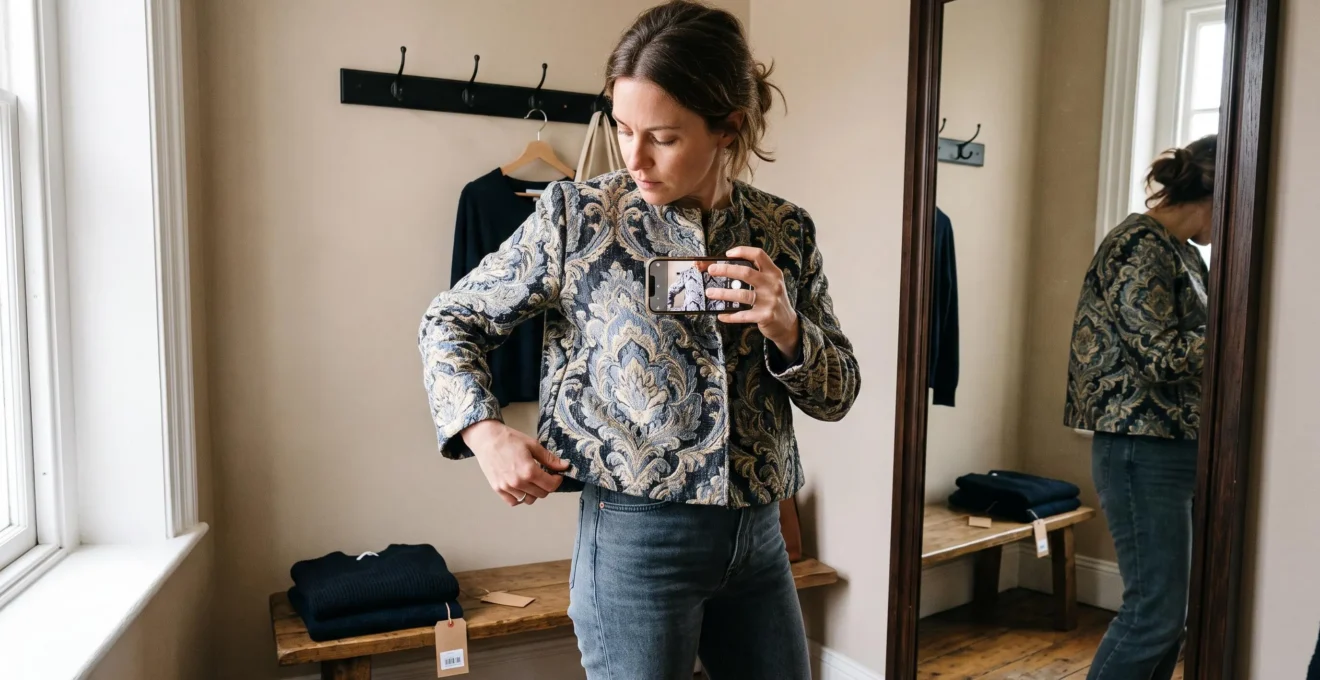
Complex jacquard can make an ordinary jacket, skirt or dress look exceptional. Its intricate motifs, shifting colours and interplay of texture and light create a sense of craftsmanship that simpler fabrics rarely communicate in the same way. Yet the very features that make jacquard appealing can also make it challenging to buy and wear.
A striking woven pattern may dominate your silhouette. A structured fabric might feel restrictive after an hour, while a delicate surface can catch on jewellery or a handbag. And a garment that looks beautiful under boutique lighting may behave differently in everyday daylight, rain or photographs.
Jacquard is not inherently impractical. The key is to understand that jacquard describes how a pattern is woven, not a guaranteed level of quality, softness or durability. A well-chosen piece can work in a modern UK wardrobe, provided its construction, proportions and care requirements suit the way you intend to wear it.
Jacquard: the essentials before you buy
- Judge the motif on your body, not only on a hanger: pattern placement, scale and fabric structure all affect the silhouette.
- Balance ornate jacquard with everyday textures, and inspect exposed yarns before wearing jewellery or carrying textured accessories.
- Choose according to lining, comfort and care requirements rather than assuming silk, cotton or organic certification guarantees better performance.
- Why Can a Jacquard Pattern Make You Look Wider Even in the Right Size?
- How to Style Jacquard With Modern Basics Without Looking Like Occasionwear
- Silk-Blend or Cotton-Blend Jacquard: Which Works Better in UK Humidity and Heat?
- The Jewellery Choice That Snags Jacquard and Ruins It in One Night
- When Should You Wear Jacquard to Avoid Over-Cleaning and Early Wear?
- Why Do Some Fabrics Look Stunning in Low Light but Awful in Flash Photos?
- Why Doesn’t Organic Cotton Automatically Mean Better Fabric Quality?
- Is Organic Cotton Worth Paying More For When You Want Clothes to Last?
Why Can a Jacquard Pattern Make You Look Wider Even in the Right Size?
A jacquard pattern can make a garment appear wider when large motifs, contrasting borders or horizontal arrangements draw attention across the body instead of along it. The effect is visual rather than a sizing fault, although a firm or bulky weave can also change the garment’s actual outline. Pattern placement and fabric structure therefore matter as much as the labelled size.
Consider a jacket with a wide floral motif positioned directly across the hips. Even if the shoulders, waist and sleeves fit correctly, the contrasting shapes may emphasise that area. A smaller, less contrasting repeat could create a quieter outline in exactly the same cut. Neither effect is universally flattering or unflattering: the result depends on the wearer’s proportions and the intended look.
Seams deserve particular attention. An abrupt interruption in a bold geometric motif at the waist or side seam may create a visual break. This is not automatically evidence of poor manufacturing, since some designs deliberately interrupt patterns, but it is worth checking whether the result looks balanced when worn.
Jacquard’s construction adds another variable. As the Science and Industry Museum‘s explanation of the Jacquard loom shows, complex patterns can be created during weaving rather than printed onto a finished surface. However, woven jacquard is not automatically thicker, more raised or stiffer than printed fabric. Yarn selection, weave design and finishing determine its actual handle.
To assess motif scale before buying, photograph the garment hanging flat, then try it on and photograph the shoulder-to-hip area from a consistent distance. Compare where the dominant shapes fall, whether seams interrupt them and how the garment moves when you turn sideways. This is a practical visual comparison, not a scientifically validated proportion test.
Check both the pattern and the physical silhouette. A flat printed imitation and a sculptural woven jacquard may produce very different results despite looking similar in an online photograph.
Once the pattern works with your proportions, the next challenge is making its decorative character feel appropriate for everyday dressing rather than reserved for formal occasions.
How to Style Jacquard With Modern Basics Without Looking Like Occasionwear
The simplest way to make jacquard look contemporary is to wear one ornate piece alongside understated everyday clothing. Plain denim, cotton jersey, unfussy knitwear and flat footwear reduce the formality of intricate woven patterns. The contrast should feel intentional: let the jacquard provide the decoration while the rest of the outfit supplies ease and familiarity.
Fabric pairing often changes the impression more effectively than colour coordination. A gold-and-black jacquard skirt with a black satin blouse may look dressed for an evening reception. Pair the same skirt with a charcoal cotton T-shirt, a relaxed cardigan and simple boots, and it becomes much easier to imagine wearing it to lunch or an informal gallery visit.
Texture matters because highly polished surfaces reinforce one another. Satin, glossy leather, metallic jewellery and sharply tailored separates can collectively push jacquard towards occasionwear. Raw denim, brushed wool and washed cotton introduce visual restraint without necessarily requiring neutral colours.
Garment type also influences how formal the fabric appears. These combinations offer useful starting points rather than strict dress codes.
| Jacquard piece | Relaxed styling | More formal styling |
|---|---|---|
| Bomber jacket | Plain tee, straight jeans and trainers | Tailored trousers and polished shoes |
| Midi skirt | Cotton knit and flat ankle boots | Silk blouse and heels |
| Blazer | Denim and a simple crew-neck top | Matching trousers or a satin skirt |
| Shift dress | Flat boots and a relaxed cardigan | Statement jewellery and formal shoes |
For UK weddings, Christmas gatherings or office celebrations, avoid assuming that decorative fabric automatically suits the dress code. A minimalist event can make a heavily embellished ensemble feel more formal than intended. Conversely, a jacquard jacket may be an effective way to dress up plain separates when the invitation is ambiguous.
The one ornate element principle is a styling tool, not a restriction. If you enjoy maximalist dressing, multiple patterns can be deliberate. For a low-effort wardrobe, however, keeping everything else simple makes the jacquard far easier to repeat.
Styling versatility is only half the decision. The fabric’s fibre composition, lining and weight must also feel comfortable through changing British temperatures.
Silk-Blend or Cotton-Blend Jacquard: Which Works Better in UK Humidity and Heat?
Cotton-blend jacquard is often a practical starting point for structured daytime clothing, while silk-blend jacquard can suit softer, more fluid or dressier pieces. But neither blend is automatically cooler, lighter or better for UK humidity. Comfort depends on yarn, weave density, thickness, lining and fit as well as the fibre percentages on the label.
Cotton is absorbent and can feel comfortable in warm conditions, although it is prone to creasing. Silk can be lightweight and absorbent too, but some silk fabrics are vulnerable to water spotting and require more cautious cleaning. These general characteristics are described in the University of Georgia Cooperative Extension‘s textile fibre reference. They do not establish a universal winner between finished jacquard blends.
In the UK, a garment may encounter humid public transport, sudden showers, warm indoor spaces and cooler evenings within the same day. A heavily lined cotton-blend jacket can feel warmer than an unlined silk-blend one. Similarly, a densely constructed silk-rich dress may offer less airflow than a lighter, more open cotton mixture.
The following distinctions can help narrow your choice.
| Consideration | Cotton-blend jacquard | Silk-blend jacquard |
|---|---|---|
| Typical appeal | Everyday feel and potential for structured shapes | Lustre, softness or fluidity, depending on construction |
| Creasing | Cotton content may increase visible creasing | Varies with the blend and fabric finish |
| Moisture | Absorbent, but drying and shape retention depend on construction | Some silk fabrics may develop water spots |
| Care | Follow the finished garment’s instructions | Often calls for more cautious handling |
| Best starting point | Structured daytime pieces | Special-occasion or drape-focused pieces |
The hidden deciding factor is frequently the lining. Polyester or another tightly constructed lining can change airflow and moisture comfort considerably, but its effect cannot be judged from the outer fabric label alone. Look inside the garment, feel both layers together and consider whether the lining is needed for comfort or structure.
Do not rely on a percentage such as 55% cotton to predict coolness. Ask for the fabric weight in grams per square metre if available, examine the lining and test movement and comfort while wearing the garment. Weight is useful context, but it is not a standalone measure of breathability.
The best blend is the one whose finished construction suits your body and conditions. Once comfort is established, inspect how easily the surface might catch during normal use.
The Jewellery Choice That Snags Jacquard and Ruins It in One Night
Rings with raised prongs, rough bracelet clasps and accessories with exposed edges can catch vulnerable jacquard yarns. A snag may create a visible loop or pull a thread out of position, sometimes leaving a difficult-to-hide mark. The risk is not universal to jacquard: it depends on the yarns, weave structure and exposed surfaces of the specific garment.
Snagging is a recognised textile-performance issue. The ISO 25086-1:2026 standard on fabric snagging resistance describes unwanted textile loops resulting from contact with catching objects and specifies a laboratory test using a spiked ball. It does not establish that all jacquards are delicate, nor does it validate any particular household snag test.
Jewellery is a sensible place to start because cuffs, collars and sleeves regularly brush against rings, bracelets and earrings. A claw-set gemstone ring can be especially awkward when pulling a close-fitting cuff over the hand. A chain bracelet with protruding links may catch repeatedly as the wrist moves.
Smooth bangles, simple rings and stud earrings are usually easier accessories to manage around a vulnerable surface. Also consider metal zips, rough bag straps and hook-and-loop fasteners: avoiding jewellery alone does not eliminate the risk.
As an informal precaution, you can gently pass a clean sheer stocking over a small, inconspicuous part of the cuff and check whether it catches. Stop immediately if resistance occurs, and never force the material across a delicate motif. This is a practical screening idea, not an ISO-equivalent test or a guarantee that jewellery will be safe.
If a snag occurs, do not pull the loose thread. Avoid cutting it immediately, too: depending on the construction, trimming the yarn may weaken or expose the weave further. Protect the affected area and consult a textile repair specialist if the snag is noticeable or structurally concerning.
Five checks before wearing delicate jacquard
- Inspect the cuffs, collars and seams under good light; note any visibly exposed or loose yarns.
- Try the garment with your intended accessories; identify any contact points involving rings, clasps or straps.
- Check a hidden fabric area cautiously with a clean sheer stocking; record whether it catches, without forcing the test.
- Replace accessories with raised or sharp details; set aside a smooth alternative outfit combination.
- Check the garment after trying it on; confirm that no new pulled loops or distorted areas have appeared.
Preventing friction and catching is usually easier than repairing damage. It also reduces the need for unnecessary interventions later in the garment’s life.
When Should You Wear Jacquard to Avoid Over-Cleaning and Early Wear?
Wear jacquard when its appearance suits the occasion and its construction can tolerate the expected activity, rather than following a fixed number of wears between cleans. Airing a clean garment after use and treating stains according to its care label can help avoid unnecessary cleaning. However, frequency and cleaning method must depend on the particular fabric, lining and garment condition.
Complex woven patterns can combine yarns with different responses to moisture, agitation and heat. If a garment shrinks unevenly, the pattern or silhouette may distort. This is one reason to follow the manufacturer’s care label instead of assuming that all cotton-rich jacquards are washable or all silk-rich versions require the same treatment.
For an evening jacket worn over a clean base layer, checking for odours and marks before deciding whether cleaning is necessary may be reasonable. A dress exposed to perspiration or a food spill needs a different assessment. Delaying treatment indefinitely can allow stains to become harder to remove.
Be cautious with damp-cloth spot treatment. Test compatibility only where the care instructions permit it, and avoid rubbing silk-rich, metallic or textured areas. Some water-sensitive fabrics can develop rings or altered finishes even from apparently gentle treatment.
Professional dry cleaning should not be treated as either harmless or inevitably damaging. Its effect depends on the fibre blend, finishing, cleaning process and handling. The goal is appropriate cleaning when needed, not avoiding professional care at all costs.
Storage should also match garment construction. Broad padded hangers can help support structured jackets and certain skirts, with closures fastened to maintain their shape. Heavy or easily stretched pieces may be better stored flat with suitable support. Folding is not universally harmful to jacquard, although prolonged pressure can mark some raised or sensitive finishes.
For frequent wear, select pieces whose surfaces and cleaning requirements can withstand your routine. Reserve particularly delicate constructions for circumstances where friction, spills and extended wear are less likely.
Even excellent maintenance cannot change how a garment reflects light, so consider the photographic environment before committing to a statement jacquard.
Why Do Some Fabrics Look Stunning in Low Light but Awful in Flash Photos?
Jacquard can appear especially rich in low, directional light because its woven textures and yarn finishes create subtle variations in shadow and reflection. Direct camera flash changes those relationships, sometimes making shiny threads look harsh or exposing irregularities in the fabric. The result depends on the lighting angle, weave, camera settings and garment construction.
In a softly lit restaurant, light passing across a woven motif can reveal its dimensional character. A direct flash close to the camera’s viewpoint may reduce visible shadows that normally define the surface, while creating bright reflections from lustrous yarns. The same fabric can therefore seem flatter or more reflective in photographs than it does in person.
Metallic and lurex-containing designs can show particularly conspicuous highlights, although this is not automatically a defect. A deliberate high-shine jacquard may work beautifully in evening settings, while an unevenly finished fabric can become more visibly inconsistent under strong light.
Before buying for a photographed event, examine the garment under daylight, indirect indoor light and flash where permitted. Photograph it both hanging and worn, since seams and motif placement may change with movement and body shape. Keep your distance and camera angle reasonably consistent so the comparison is meaningful.
For a wedding or group photographs, a matte or low-sheen jacquard may be easier to photograph predictably than a highly reflective metallic weave. For candlelit dinners or softly illuminated venues, lustrous yarns may provide exactly the visual effect you want.
Flash photography is a useful inspection condition, not an objective quality test. Exposure settings, reflections and camera processing can exaggerate flaws or create appearances that are not visible in normal wear.
Once appearance and wearability are settled, fabric labels may seem to offer a shortcut to quality. Organic cotton claims are a particularly common source of confusion.
Why Doesn’t Organic Cotton Automatically Mean Better Fabric Quality?
Organic cotton describes how cotton is produced and, depending on the certification scheme, how its origin and content are verified. It does not automatically establish stronger yarns, denser weaving, better seam finishing or a longer garment lifespan. In jacquard clothing, those construction details can be more relevant to performance than whether the cotton was organically grown.
Textile Exchange explains this distinction in its explanation of organic cotton certification. The Organic Content Standard addresses organically grown fibre content and traceability through the supply chain. It is not a garment-durability certification or a promise that finished textiles resist snagging.
Consider two hypothetical jacquard jackets. One uses certified organic cotton but has loosely secured surface yarns and uneven seam finishing. The other uses conventional cotton with a more stable weave, neatly secured seams and an appropriate lining. The second might prove more suitable for repeated wear, but the outcome would depend on actual performance rather than the cotton’s farming status alone.
Construction deserves a separate inspection:
- Yarn and weave: look for loose loops, unstable motifs or areas that seem easily displaced.
- Seams: check whether stitching, pattern transitions and seam allowances appear secure.
- Lining: assess comfort, attachment points and whether the lining pulls against the outer fabric.
- Finishing: inspect edges, closures and high-friction areas for visible weaknesses.
An organic label can be meaningful for fibre provenance and purchasing priorities, but it should not replace these checks. Conversely, conventional cotton is not inherently stronger; two garments cannot be ranked reliably without examining their materials and construction.
The final question is whether any additional price reflects benefits you actually value, particularly when an ornate jacquard may not be worn every week.
What to remember before paying more
- Separate fibre provenance from garment performance: a certification claim does not replace an inspection of the weave and seams.
- Assess realistic use rather than imagined versatility; a delicate occasion piece may have fewer opportunities to justify its price.
- Compare construction quality first, then decide how much extra you value independently verified organic content.
Is Organic Cotton Worth Paying More For When You Want Clothes to Last?
Organic cotton can be worth paying more for when verified fibre provenance and associated production standards matter to you, but it is not a reliable shortcut to longer-lasting clothing. If durability is your main objective, prioritise weave stability, seam construction, lining quality and suitability for regular wear. Consider the organic premium only after the garment passes those checks.
The distinction matters particularly with jacquard because much of its appeal comes from the finished textile rather than the cotton fibre alone. An elaborate motif may look expensive, yet its yarn arrangement, surface floats or finishing can make it vulnerable to friction. Organic status does not remove these potential weaknesses.
It also helps to distinguish different certification claims. The Organic Content Standard verifies organically grown fibre content and supports traceability, while other certification systems may apply additional production requirements. A label should be assessed against the actual scheme it names, rather than interpreted as a general guarantee of environmental superiority, skin comfort or garment durability.
Paying more makes sense when the premium buys something you genuinely value. If you care about verified organic content and the garment is also well constructed, the higher price may be justified. If the choice is between a flimsy organic jacquard and a better-made conventional cotton jacquard, prioritising construction is more consistent with a durability-first purchase.
Cost per wear provides a useful final perspective. This is simply the purchase price divided by the number of times the garment is actually worn, excluding cleaning, alterations and repairs unless you choose to include them.
Hypothetical example: comparing value through actual wear
Imagine two jacquard skirts. Skirt A costs £120 and is worn 12 times over its useful life, giving a purchase-only cost of £10 per wear. Skirt B costs £180 and is worn 36 times, giving a purchase-only cost of £5 per wear.
These figures are illustrative, not observed market prices or evidence that either organic or conventional cotton lasts longer. They show why paying more for a piece that receives substantially more use can provide better value, provided its construction supports that use.
For occasion-led jacquard, realistic wear frequency may be relatively low. Before paying a premium, consider whether the garment coordinates with existing clothing, suits several events and can be maintained without disproportionate expense. A beautiful piece worn twice does not automatically represent better value than a simpler garment worn regularly.
There is also no need to make durability and production standards competing priorities in every purchase. Where the budget allows, selecting a well-constructed garment with credible organic certification can satisfy both. Where compromises are necessary, identify whether longevity, traceability or appearance is the deciding factor.
When buying jacquard, start by trying it on, inspecting the weave and checking the care instructions. Then assess how often you will realistically wear it. Pay extra for organic content when its verified provenance matters to you, rather than expecting certification alone to make the fabric last longer.
Is jacquard always a luxury fabric?
No. Jacquard describes a method of creating woven patterns, not a specific fibre, price category or quality grade. It can be made using different materials and constructions. Luxury appearance often comes from intricate motifs, texture and lustre, while actual quality depends on yarns, weaving, finishing and garment construction.
Can you wear jacquard in the rain?
It depends on the fibres, finishes and care instructions. Some silk-rich fabrics can develop water spots, while other jacquard constructions may tolerate occasional moisture better. Jacquard should not be assumed to be water-resistant. Check the garment label, avoid unnecessary exposure and follow the recommended care procedure if it becomes wet.
How can you tell whether jacquard is woven or printed?
Inspect both sides of the fabric when possible. A genuine woven jacquard incorporates the motif into the weave and may reveal a related pattern or different yarn arrangements on the reverse. A printed jacquard-look textile typically has a design applied to the surface. However, backing, linings and finishing can make identification difficult, so confirm the construction with the retailer when necessary.
Can a pulled thread in jacquard be repaired?
Some snags can be improved, depending on the yarn, weave and extent of the damage. Avoid pulling or cutting a loose yarn without understanding its role in the structure. For visible or valuable garments, a professional textile repair specialist can assess whether the thread can be repositioned or the affected area stabilised.
Should you buy jacquard online without trying it on?
Buying online is possible, but photographs and fibre percentages cannot fully communicate stiffness, drape, texture or motif placement on the body. Look for close-up photographs, fabric composition, lining details, garment measurements and care instructions. Check the retailer’s return policy before ordering, especially when purchasing expensive or delicate occasionwear.