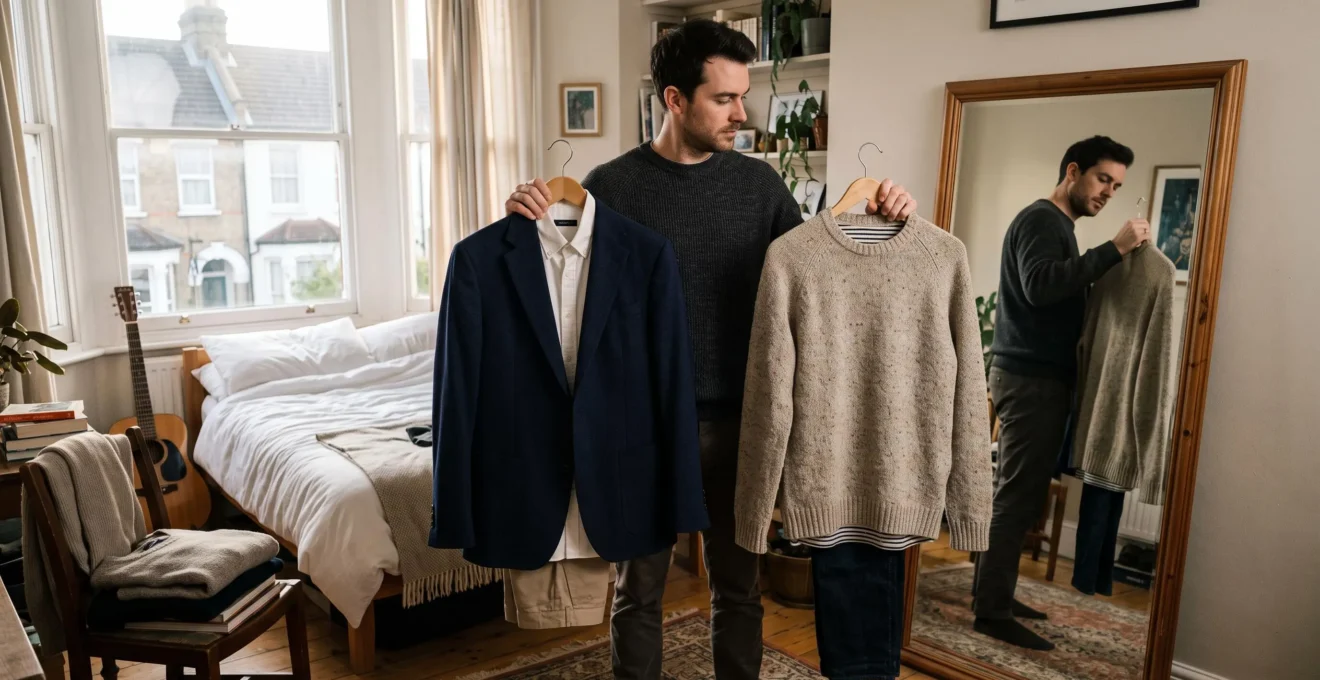
Two people can make equally valuable contributions in a meeting yet receive different initial reactions. Sometimes, part of that difference comes from how they present themselves. Clothing provides visible information before anyone has heard an explanation of their abilities, personality or intentions.
What you wear can affect how others initially judge your professionalism, approachability and confidence. It may also influence how comfortable and attentive you feel. Neither effect is automatic: workplace expectations, individual preferences, cultural norms and other people’s biases all shape the outcome.
For UK professionals who feel overlooked, this distinction matters. Dressing more formally is not necessarily the answer. A sharply tailored jacket may support authority in one environment and create distance in another. An understated outfit can communicate assurance without attracting unnecessary attention.
The useful skill is learning to choose clothing that supports your behaviour, fits the situation and expresses something recognisable about you. That creates a more coherent first impression without requiring a new personality or an expensive wardrobe.
How clothing influences confidence and social treatment
- Clothes can influence both self-perception and others’ impressions, but appearance alone cannot guarantee respect, confidence or career success.
- Match the formality of your environment before using small, deliberate details to communicate authority or individuality.
- Build a few reliable outfit combinations that feel physically comfortable, reflect your identity and reduce unnecessary decisions.
- Why Do You Feel More Confident in Certain Outfits Even Without Compliments?
- How to Dress for the Outcome You Need in a Meeting Without Overthinking Style
- Blend In or Stand Out: Which Strategy Works Better When You’re New at Work?
- The Dressing Mistake People Make When They’re Anxious That Backfires Socially
- When Should You Plan Outfits to Stop Morning Panic Without Living Like a Robot?
- Why Do People Think You’re Stylish When You Repeat Similar Outfits?
- How to Translate Your Personality Into Professional Outfit Cues Without Guesswork
- How Can You Improve Self-Presentation With Clothes Without Feeling Fake?
Why Do You Feel More Confident in Certain Outfits Even Without Compliments?
Certain outfits make you feel more confident because they combine physical comfort with a sense of personal identity. When clothes fit comfortably and represent how you want to present yourself, they may reduce self-consciousness and help you concentrate on the situation. The feeling does not require compliments, expensive labels or other people’s approval.
Psychologists have investigated how clothing can affect the wearer through a concept called enclothed cognition. In research by Hajo Adam and Adam D. Galinsky, the meaning associated with a garment and the physical experience of wearing it both mattered.
The original experiments involved laboratory coats and attention-related tasks. Participants’ performance varied with whether they wore the coat and what the coat represented. The findings are described in the University of Bath research record on enclothed cognition.
Importantly, those experiments did not establish that wearing smarter clothes automatically produces confidence or makes other people behave more favourably. They demonstrate a narrower psychological effect involving attention and symbolic meaning.
For everyday dressing, it is useful to distinguish between two forms of confidence:
- Comfort confidence: Your clothes fit, move naturally and remain comfortable throughout the day. You can forget about them and focus on what you are doing.
- Identity confidence: Your appearance feels consistent with the person you are or the qualities you want to express. You recognise yourself in the outfit.
Try remembering a day when an outfit felt wrong. Were you repeatedly adjusting the waistband, collar or sleeves? That suggests a practical comfort problem. Or did the outfit feel perfectly comfortable but strangely unlike you? That points towards an identity mismatch. Both problems can exist simultaneously.
A useful wardrobe does not need to be expensive. An older jacket that fits properly, a familiar pair of trousers or one distinctive accessory may serve you better than several fashionable purchases that feel unfamiliar. This is a practical possibility, not a scientifically established ranking of wardrobe choices.
There is also a limit to dressing up. Wearing a formal suit in a markedly casual workplace may draw attention to the difference between you and everyone else. If that contrast makes you self-conscious, the intended confidence benefit can disappear.
Once you understand how clothes affect your own experience, you can consider the second question: what message should they send in a specific professional situation?
How to Dress for the Outcome You Need in a Meeting Without Overthinking Style
Dress for a meeting by identifying the impression you need to support, then selecting an outfit that fits the room’s expectations. Choose slightly more structure when appropriate for authority, familiar team conventions for collaboration, and restrained individuality when proposing change. Your clothes should help you participate comfortably rather than become another decision to manage.
Professional clothing can provide cues about competence and approachability, but these cues are interpreted alongside posture, communication and context. An integrative review of clothing in the workplace discusses how characteristics such as formality and fashionability may influence perceptions of warmth and competence.
The review also highlights the danger of clothing-related bias. A colleague’s appearance is not reliable evidence of their actual capabilities, even when observers respond to it as though it were.
Instead of asking what looks most impressive, decide what the meeting requires.
| Meeting objective | Clothing approach | What to check |
|---|---|---|
| Be taken seriously | Choose polished, well-fitting pieces within the room’s accepted formality range. | Does your outfit support the role you are taking without creating an obvious mismatch? |
| Appear collaborative | Stay close to familiar team conventions. | Do you look comfortable participating alongside colleagues? |
| Project authority | Consider slightly more structure or formality than your everyday outfit. | Is the difference subtle enough to suit the organisation? |
| Signal change | Introduce one purposeful contrast, such as a distinctive colour or accessory. | Does the contrast appear intentional rather than distracting? |
These are practical styling options, not tested rules that guarantee particular reactions.
The familiar advice to dress one level above your current role can be useful when interpreted carefully. In a UK workplace where senior colleagues generally wear smart separates, choosing a similar level of polish may feel appropriate. Copying a highly formal executive outfit in a team where everyone wears trainers and knitwear could instead seem disconnected.
Stay within the organisation’s real dress range. The aim is not to look more senior than everyone else, but to appear prepared for the responsibility you want to demonstrate.
Decide on the outfit the previous evening, especially before interviews, presentations or important discussions. Confirm that it is clean, comfortable and suitable for the expected temperature. Removing a minor morning decision leaves more attention available for your preparation.
After the meeting, make a brief note of any clothing-related distractions. Did you pull at your sleeves, avoid sitting comfortably or feel unusually warm? Repeated problems are useful evidence that the outfit needs adjustment, regardless of how impressive it looks in a mirror.
This approach becomes especially important when entering an unfamiliar organisation, where the unwritten dress code may differ from the official one.
Blend In or Stand Out: Which Strategy Works Better When You’re New at Work?
When starting a new job, blending into the team’s usual dress range is generally a sensible initial strategy. It reduces unnecessary uncertainty while you learn the workplace culture. Once you understand the environment and have established working relationships, introducing a consistent personal detail can make your appearance more distinctive without appearing disconnected from colleagues.
The first challenge is identifying what people actually wear. A workplace might describe its dress code as smart casual, yet employees could interpret that phrase differently across departments and seniority levels.
Observe ordinary working days rather than relying on a single company event or the most formally dressed person in the office. Notice the general level of structure, footwear, colour and grooming.
As a starting point, consider an outfit towards the polished end of the team’s normal range. This provides room to look prepared without assuming that greater formality always communicates greater competence.
Deliberate distinction is different from accidental mismatch. Someone wearing a familiar office outfit with an unusual watch, distinctive glasses or consistently sharp fit may develop a recognisable personal style. Someone arriving in a completely different category of clothing may simply leave colleagues unsure about their interpretation of the environment.
Consider a hypothetical employee joining a creative agency where most colleagues wear relaxed shirts and trainers. A well-fitted overshirt, tailored trousers and understated shoes could provide a polished starting point. A full formal suit might create an unnecessary contrast, unless the employee’s responsibilities or a particular event justify it.
It is tempting to imitate the most senior person immediately. That can be misleading. Their wardrobe may reflect client responsibilities, years of organisational credibility or personal preferences that are not relevant to a newcomer.
As the weeks progress, look for practical signs that you understand the culture: colleagues interact comfortably with you, you recognise how clothing changes between ordinary and client-facing days, and you no longer need to guess which level of formality is expected.
That is a reasonable point to experiment gradually with a recognisable detail. There is no universal number of weeks after which more expressive clothing becomes appropriate.
Even when the dress code becomes familiar, however, anxiety can make otherwise straightforward clothing decisions unexpectedly difficult.
The Dressing Mistake People Make When They’re Anxious That Backfires Socially
One common dressing mistake under social pressure is choosing clothes mainly to manage fear rather than practical needs. Some people overdress to compensate for insecurity; others hide in garments that feel excessively anonymous. Either choice may increase self-monitoring if the outfit feels uncomfortable or inconsistent with how they want to present themselves.
Imagine preparing for a networking event where you know few people. You may feel tempted to wear something unusually formal because you want to appear successful. Alternatively, you may choose the least noticeable outfit possible to avoid attracting attention.
Neither choice is inherently wrong. The problem arises when the clothing increases your awareness of being observed.
A jacket that restricts your movements might make you repeatedly adjust your shoulders. Shoes that feel unfamiliar may affect how comfortably you stand. An outfit that feels unlike you could draw attention away from the conversation and towards questions about your appearance.
Other people cannot necessarily recognise the reason for these behaviours. Averted attention or withdrawn participation may be interpreted as discomfort, disinterest or reserve, although many explanations are possible.
This proposed feedback loop is a practical way to understand self-conscious dressing, not a proven causal sequence that occurs in every social interaction.
A useful response is the pre-committed outfit method. Choose one combination that you have already worn successfully in a comparable setting. Check that it fits, permits easy movement and does not require constant attention.
On a particularly demanding day, wear that combination without introducing several unfamiliar pieces at once. Familiarity can make the experience easier to manage, even though clothing alone cannot resolve underlying anxiety.
The opposite tendency deserves attention too. Some people gradually rely on clothing chosen only to avoid notice. If that habit conflicts with their wish to be recognised or remembered, they may begin to feel that their appearance does not represent them.
There is no evidence that anonymous clothing necessarily teaches others to overlook someone. Still, a small, purposeful change can provide a manageable way to test a different form of self-presentation.
Consider adding a colour you genuinely enjoy, a better-fitting layer or one accessory that feels personal. Change one element rather than replacing your entire appearance.
The next step is making that reliable choice easy to access before the pressure of the morning begins.
When Should You Plan Outfits to Stop Morning Panic Without Living Like a Robot?
Plan outfits according to how demanding and unpredictable your schedule is. A quick check the night before works for most ordinary workdays, while planning several days ahead can help during unusually busy periods. For relaxed days, a simple familiar combination may be sufficient. The goal is fewer unnecessary decisions, not eliminating personal choice.
Outfit planning becomes restrictive when every choice is fixed regardless of your mood, circumstances or comfort. A useful system should create flexibility rather than remove it.
There are three practical levels of preparation:
| Planning level | Best situation | Practical approach |
|---|---|---|
| Full-week planning | Several important meetings, travel days or different dress requirements | Prepare adaptable combinations for the week’s key commitments. |
| Night-before check | Ordinary professional routines | Select an outfit and verify comfort, condition and suitability. |
| Two-minute formula | Low-stakes or familiar days | Choose a known combination of interchangeable pieces. |
A small set of outfit formulas can support all three approaches. For instance, you might create three to five combinations suited to your usual work environment, with separate options for social occasions and relaxed days.
Think in terms of clothing units rather than individual garments. A pair of trousers, a comfortable top and a suitable outer layer form one unit. Interchangeable colours and fabrics allow the same pieces to support different situations.
Keeping a record of outfits that work can help, especially when you are tired or under time pressure.
Build a reliable outfit system in five steps
- Identify your recurring situations. Write a short list covering ordinary workdays, important meetings and social occasions.
- Select proven combinations. Photograph three to five outfits you have already worn comfortably, creating a small visual reference library.
- Check physical comfort. Sit, stand and walk in each combination, then record any adjustments needed.
- Assign a practical use. Label each photograph with a suitable context, such as everyday office, client meeting or informal dinner.
- Test and revise. After using the system, identify one outfit that consistently works and one that needs changing, producing a short revision list.
Planning also has a psychological limit. If all your combinations become purely mechanical, they may stop expressing the aspects of your personality that matter to you. Repetition does not automatically cause this problem, but it is worth noticing when a practical routine starts to feel impersonal.
If a planned outfit repeatedly feels wrong, change the formula rather than forcing yourself to tolerate it. Convenience is valuable only when it still leaves room for comfort and identity.
Interestingly, that balance between repetition and individuality may also explain why some people develop a recognisable style without constantly changing their wardrobes.
Why Do People Think You’re Stylish When You Repeat Similar Outfits?
Repeating similar outfits can make your style appear more coherent because other people begin to recognise consistent choices in shape, colour and detail. A recurring visual formula may communicate intentionality without requiring frequent changes. However, observers do not universally equate repetition with good taste; the impression depends on fit, context and individual preferences.
A consistent wardrobe gives people an identifiable pattern to remember. Someone who regularly wears well-fitting dark trousers, structured knitwear and a distinctive accessory may develop a recognisable appearance even when individual garments change.
That differs from wearing the same combination simply because alternatives are unavailable or unsuitable. A personal style signature is a flexible formula rather than necessarily a fixed uniform.
Consider a practical distinction:
- Formula: Similar silhouettes recur, but fabrics, proportions or accessories change intentionally.
- Rut: Outfits repeat despite recurring discomfort, poor condition or a mismatch with current needs.
- Useful consistency: The overall appearance remains recognisable while still accommodating different settings.
The psychological idea of cognitive ease offers one possible explanation for why familiar patterns can feel coherent. People often make rapid judgements using incomplete information. A recognisable appearance may be easier to categorise than an entirely different look each day.
However, this is a plausible interpretation, not direct evidence that repeating outfits causes people to rate someone as more stylish.
To evaluate your own repetition, examine several recent outfits together. Is there a clear thread connecting them? Do they fit the settings in which you wore them? Do the details appear chosen, rather than simply repeated because they were available?
If the answer is yes, you may already have a useful signature style. Maintaining it could require only small adjustments to fabric, fit or accessories.
In British professional environments, restrained repetition can be a comfortable option, particularly where conspicuous fashion choices are uncommon. But there is no single British preference: industry, organisation, location and individual expectations vary considerably.
International workplaces may involve different approaches to visible variety and status. Observe the local context rather than assuming that understatement or conspicuous change will always communicate confidence.
The most useful formula is one that does more than look consistent: it also communicates the professional qualities you genuinely want people to recognise.
How to Translate Your Personality Into Professional Outfit Cues Without Guesswork
Translate your personality into professional clothing by choosing two or three qualities you want to communicate, then connecting each one to a manageable visual decision. Fit, colour, structure and accessories can provide useful cues. Test those choices with real feedback, because what you intend to express may differ from what other people perceive.
Begin with qualities relevant to your work rather than trying to represent your entire personality through one outfit.
You might want colleagues to experience you as detail-oriented, approachable and decisive. Each quality can inform a styling decision, although no particular garment communicates a trait reliably to every observer.
| Quality to express | Possible clothing cue | Important limitation |
|---|---|---|
| Detail-oriented | Careful fit, garment condition and coordinated details | Neat clothing does not demonstrate actual attention to detail at work. |
| Approachable | Comfortable shapes, familiar workplace styling and personally suitable colours | Approachability also depends heavily on behaviour and communication. |
| Decisive | Clear silhouettes and restrained, intentional combinations | Structured clothing cannot establish someone’s decision-making ability. |
| Creative | An individual accessory, distinctive texture or considered colour contrast | Creative expression must fit the practical and cultural expectations of the role. |
In conservative professional environments, the one deliberate signal rule is a useful starting experiment. Keep the overall outfit within familiar conventions and choose one visible detail that expresses personality.
That could be a scarf, an unusual fabric texture, distinctive frames or a carefully chosen accent colour. Multiple expressive details are not inherently confusing, but introducing just one makes it easier to evaluate how the choice works.
There is research support for considering several visual cues together. A British Journal of Psychology study on clothing and posture examined how photographed models were judged on qualities including confidence, professionalism and approachability.
Its findings indicated that clothing and posture interacted in people’s assessments, with differences across conditions and gender. The study does not establish that a particular colour or accessory reliably communicates a personality trait in real workplaces.
That limitation matters because intention is not the same as interpretation.
Try photographing an outfit in the setting where you expect to wear it. Consider its overall impression rather than examining isolated garments. You can also ask a trusted colleague what qualities the appearance suggests, without telling them the intended answer first.
One person’s response is useful feedback, not a universal verdict. Compare it with your own experience and the workplace context before making changes.
Some parts of your personality may be difficult to express through clothing in a restrictive environment. If overt experimentation is unsuitable, look towards fabric, fit, grooming or subtle details. You do not have to communicate every personal quality visually.
Ultimately, the purpose is not to manufacture an impression unrelated to your character. It is to make your existing qualities easier to recognise without feeling that you are playing a role.
What to remember before changing your style
- Choose clothing that supports your comfort and intended behaviour rather than trying to control every judgement other people make.
- Respect the environment’s practical expectations, then personalise your appearance within boundaries that feel reasonable.
- Evaluate changes through repeated everyday experience, not one compliment, awkward interaction or photograph.
How Can You Improve Self-Presentation With Clothes Without Feeling Fake?
Improve self-presentation without feeling fake by making your existing qualities more visible rather than adopting an entirely different identity. Choose clothes that suit your responsibilities, feel physically comfortable and reflect personal preferences you genuinely recognise. Strategic dressing becomes more sustainable when it supports how you behave instead of requiring you to perform a personality that is not yours.
The concern about authenticity is understandable. When you consciously adjust your appearance to influence how others see you, the process may initially feel calculated.
Yet most clothing decisions involve some degree of impression management. Choosing interview clothes, dressing appropriately for a wedding or wearing a familiar outfit to meet new people all involve considering social expectations.
Impression management is not necessarily deception. The important distinction is whether you are presenting qualities you genuinely possess or are working towards, rather than suggesting abilities or credentials you do not have.
Consider a hypothetical professional who wants to appear more confident when leading meetings. They might begin wearing a better-fitting jacket and choosing clothing that allows comfortable movement. If those adjustments help them focus on speaking clearly, the clothes are supporting an authentic professional goal.
By contrast, dressing to imply a qualification, position or authority that the person does not hold would raise a different ethical concern.
Two questions can help assess a new outfit:
- Does this outfit express a quality that genuinely belongs to me or reflects a role I am legitimately developing?
- Can I behave naturally in these clothes without feeling compelled to act like someone else?
These questions are a practical reflection exercise, not a validated psychological assessment.
Research into personal style supports treating clothing as an expression of identity rather than merely a tool for influencing observers. A qualitative study by Justina Vingilyte and Ameerah Khadaroo explored the relationship between clothing and the true, ideal and creative self.
The researchers interviewed seven women and identified themes connecting personal style with self-knowledge, consistency and comfort. The small qualitative sample cannot establish how everyone experiences authenticity or whether particular clothing choices improve workplace outcomes.
Nevertheless, the distinction between an existing identity and an aspirational identity offers a useful way to think about professional development. You can choose an appearance that supports a direction you genuinely want to pursue without pretending you have already achieved it.
New clothes may initially feel unfamiliar even when they reflect an appropriate change. Give yourself several opportunities to wear a revised combination in ordinary situations before deciding whether it suits you. There is no established universal adjustment period, and persistent discomfort should not be dismissed as something you must overcome.
The central principle connects three decisions: choose clothes that make you comfortable, calibrate them to the situation and retain enough personal meaning to recognise yourself in the result.
This can make your appearance clearer and more consistent. It cannot guarantee fair treatment. Colleagues’ perceptions are shaped by many factors, including biases that should not be treated as your responsibility to correct through clothing.
For your next important workday, choose one familiar outfit and improve just one element: fit, comfort, formality or personal expression. Wear it in context, notice how naturally you move and communicate, and keep the change only if it genuinely helps. The aim is to dress as a clearer version of yourself, not to become someone else.
Can people judge your competence from your clothes alone?
People may form initial impressions of competence from clothing, but those impressions are not reliable measurements of ability. Research on workplace dress and visual judgements shows that clothing can influence perceptions, while context and other cues also matter. Actual professional competence is better assessed through relevant skills, decisions and performance.
Does wearing expensive clothing make people respect you more?
Expensive clothing does not guarantee respect or better treatment. Price is only one possible signal, and observers may not recognise it. Appropriate fit, condition, comfort and consistency with the setting are more practical factors to consider. Social treatment also depends on behaviour, relationships and the observer’s assumptions.
What should you wear when your workplace has no clear dress code?
Observe what colleagues wear during ordinary working days, including differences between internal and client-facing situations. Begin with comfortable, polished clothing within the team’s usual range, then adjust as expectations become clearer. Where practical, asking a colleague or manager about event-specific expectations can remove unnecessary guesswork.
Can changing your outfit help when colleagues regularly overlook you?
A clothing change may help you feel more comfortable or communicate a more deliberate professional image, but it cannot ensure that colleagues recognise your contributions. Consider appearance alongside more direct actions, such as making your work visible, contributing in meetings, requesting feedback and addressing unfair treatment when necessary.
How can you tell whether your professional wardrobe really suits you?
Assess three things over several ordinary workdays: whether the clothes are physically comfortable, whether they suit the situations you encounter, and whether they feel consistent with your identity. Notice repeated adjustments or feelings of mismatch. Trusted external feedback can add perspective, but one person’s opinion should not override your practical needs or sense of authenticity.