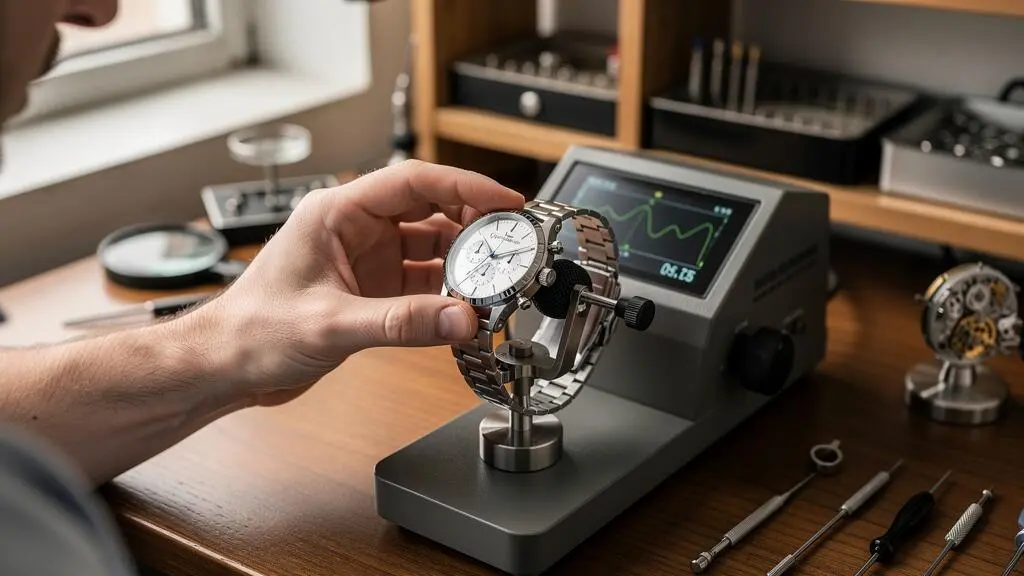
A Swiss movement is not an automatic guarantee of superior accuracy or reliability. It establishes a particular manufacturing origin under Swiss regulations, but it does not tell buyers how accurately an individual watch runs, how consistently it performs on the wrist or how expensive it will be to maintain.
That distinction matters when shopping for watches in the UK. A relatively affordable automatic may advertise a Swiss movement, while a considerably more expensive model makes the same claim. Both descriptions can be accurate, yet their regulation, construction, testing and ownership costs may differ substantially.
Independent chronometer certification provides stronger evidence of measured performance, but even certification is not a promise that a mechanical watch will maintain its original accuracy indefinitely.
For buyers comparing Swiss and Japanese movements, mechanical and quartz watches, or prestige brands and lesser-known manufacturers, the useful question is not simply where the movement originated. It is what the complete watch demonstrably delivers for its price and how well that performance fits everyday use.
Swiss movement accuracy: the essential facts
- Swiss movement and Swiss Made are origin designations. Neither automatically establishes a universal daily accuracy tolerance or exceptional durability.
- Independent testing offers stronger evidence. COSC and METAS assess specified performance criteria, although their certification programmes differ in scope.
- The complete watch determines practical value. Regulation, case construction, comfort, repairability and UK after-sales support deserve attention alongside movement provenance.
- Why Can Two Swiss-Movement Watches Perform Completely Differently?
- How to Judge Movement Quality Without Opening the Caseback?
- Swiss or Japanese Movement: Which Is Easier to Live With for 10 Years in the UK?
- Column Wheel or Cam Chronograph: Which Makes More Sense for Daily Wear?
- A Fine Watch or Fine Jewellery: Which Is Easier to Wear Every Day?
- How Do You Judge Craftsmanship in Horology and Fine Jewellery Without Being an Expert?
- The Watch Buying Mistake: Overpaying for Swiss While Ignoring Everything Else
- The Watch Buying Mistake: Overpaying for Swiss While Ignoring Everything Else
Why Can Two Swiss-Movement Watches Perform Completely Differently?
Two watches with Swiss movements can perform very differently because movement origin does not determine movement regulation, component specification or finished-watch quality control. Even watches sharing the same base calibre may have different accuracy characteristics. The difference depends on how the movement is configured, assembled, adjusted and tested, as well as how its owner wears it.
The first distinction is legal rather than mechanical. A Swiss movement must satisfy Swiss-origin requirements, including applicable development, manufacturing, assembly and inspection conditions. A Swiss Made watch must additionally meet requirements governing the complete watch.
The FH explanation of stricter Swiss made criteria identifies a minimum 60% Swiss-value requirement for the watch and its movement, alongside Swiss casing-up and final inspection requirements for the finished watch. The strengthened rules entered into force on 1 January 2017.
These provisions establish provenance. They do not impose a universal daily accuracy figure on every watch described as containing a Swiss movement.
Identical origins, different mechanical results
Consider two hypothetical watches using the same Swiss base movement. One manufacturer chooses a standard configuration with basic factory adjustment. The other specifies a different movement grade, selects or modifies certain components and invests additional time in regulating the assembled watch across several positions.
The second watch may deliver more consistent performance, but that outcome cannot be assumed without testing. A premium grade or elaborate finishing also does not automatically prove that the complete watch will last longer.
Three concepts should remain separate:
- Accuracy: How closely the indicated time agrees with a reference over a defined period.
- Precision: How consistently measurements or rates behave under specified conditions.
- Reliability: Whether the watch continues functioning as intended over time and under expected conditions.
For example, a hypothetical watch that consistently gains time each day could be comparatively straightforward to regulate. Another might show a smaller average error because its gains and losses in different positions cancel out. The second result does not necessarily mean more stable performance across changing routines.
What chronometer certification actually tests
The COSC’s comparison of its certifications distinguishes traditional Chronometer Certified testing, generally performed on movements, from Excellence Chronometer Certified testing of finished watches.
| Certification | Testing scope | Published accuracy criterion |
|---|---|---|
| COSC Chronometer Certified | Generally the uncased movement, tested across five positions and three temperatures | −4 to +6 seconds per day |
| COSC Excellence Chronometer Certified | Finished watch, including six semi-dynamic positions and magnetic-resistance testing | −2 to +4 seconds per day |
| METAS Master Chronometer | Finished watch, including timekeeping under several influences, power reserve and water resistance | 0 to +5 seconds per day |
These figures describe certification criteria, not unconditional daily guarantees for every owner. They should not be transferred to watches that lack the relevant certification.
The METAS watch certification requirements specify that Master Chronometer certification involves a Swiss Made watch, a movement meeting chronometer criteria and finished-watch testing under METAS-N001.
On the wrist, mechanical performance also responds to the watch’s remaining power reserve, resting position, shocks and magnetic exposure. A certification provides evidence under defined conditions, not a lifetime durability prediction.
That distinction makes the next buying question more practical: which qualities can be checked before purchasing, particularly when the movement remains concealed behind a closed caseback?
How to Judge Movement Quality Without Opening the Caseback?
Movement quality can be assessed without opening a watch by combining exact calibre identification, documented performance specifications, independent certification and careful external inspection. None provides a complete view of the internal mechanism, but together they reveal more than a generic Swiss automatic description. A short, controlled accuracy observation can add useful evidence when a retailer permits it.
Start with the precise movement reference, not just the country of origin or the number of jewels. The calibre designation should allow the buyer to establish whether the mechanism is mechanical, automatic, hand-wound or quartz, and identify its basic architecture and manufacturer.
For a mechanical watch, useful specifications include the stated power reserve, beat rate, manufacturer accuracy expectations and any adjustments or modifications claimed by the brand. A retailer’s statement that a movement is highly accurate should be treated differently from a documented technical tolerance or individually verified certification.
A manufacturer may describe a movement as regulated in multiple positions. Ask whether that refers to the movement alone, the completed watch or an individually tested unit. The distinction affects how much confidence the claim deserves.
Practical checks before purchase
Where the retailer allows handling, carefully operate the winding crown and permitted setting functions. Winding resistance, crown engagement and date-change behaviour can reveal possible problems, but they must be interpreted against the normal characteristics of that calibre.
Unusual resistance, repeated slipping, inconsistent setting or abnormal rotor sounds justify a professional inspection. Conversely, a smooth sweep of the seconds hand is not proof of superior accuracy: its visual appearance depends partly on the movement’s operating frequency.
For a watch already owned, or during an agreed retailer trial, a basic timekeeping log can be informative. Synchronise the watch with a reliable time reference, note the starting conditions and record how much time it gains or loses over several days.
Keep observations consistent, then repeat them under a different normal wearing pattern. An individual reading may be distorted by a particular resting position or an unusual day of activity. A multi-day record is more useful, although it cannot replicate laboratory temperature, position or magnetic-resistance protocols.
Five checks to document before buying a mechanical watch
- Identify the exact calibre. Request its manufacturer and reference number; keep a copy of the official specification or seller’s written identification.
- Record the performance claim. Obtain the stated accuracy range, power reserve and any claimed positional adjustment in writing.
- Verify certification. Record the exact certification programme and ask the manufacturer or retailer for model-specific confirmation.
- Inspect external operation. With permission, check winding, setting and date operation; create a short list of any irregularities requiring inspection.
- Establish purchase protection. Save the warranty terms, seller identity, service arrangements and any available condition or timekeeping report.
When comparing evidence, prioritise independently verified performance and documented tests of the specific model. Manufacturer specifications follow. Promotional descriptions and unsupported seller assurances belong last.
This hierarchy matters particularly for pre-owned watches. A calibre may have been independently certified when new, but previous servicing, damage, magnetisation or component replacement can affect its present condition.
A credible evaluation ends with clear limits: external checks can identify concerns, but only appropriate inspection and testing can establish deeper mechanical condition. For long-term owners, service access becomes the next essential consideration.
Swiss or Japanese Movement: Which Is Easier to Live With for 10 Years in the UK?
Neither Swiss nor Japanese movements are automatically easier to own over ten years in the UK. Long-term convenience depends on the exact calibre, spare-parts access, service arrangements and ownership habits. A widely used Swiss movement may be straightforward for an independent watchmaker to maintain, while a Japanese movement may offer a practical replacement option. National origin alone cannot predict either outcome.
A meaningful comparison starts with movement families rather than broad reputations. Swiss ETA and Sellita calibres are encountered in many mechanical watches, while Miyota and Seiko offer widely used Japanese alternatives.
However, identifying a familiar movement family is only the beginning. A watchmaker still needs to establish its precise version, component compatibility and any manufacturer-specific modifications.
Servicing a Swiss or Japanese movement
A relatively standard ETA or Sellita calibre may be familiar to an independent watchmaker. That can be advantageous where compatible components and servicing information remain accessible.
But a proprietary Swiss calibre, or a heavily modified movement, may require a brand-approved service route. Swiss origin does not guarantee independent repairability.
Likewise, some Japanese-powered watches can be economically repaired by replacing a complete movement rather than performing an extensive component-level overhaul. Whether that is appropriate depends on the exact mechanism, parts supply, case construction and value of the watch.
For an owner who values preserving original components, movement replacement may be less desirable than traditional servicing. For an inexpensive daily watch, it may be a sensible practical solution.
The relevant distinction is therefore between serviceable configurations and restricted configurations, not simply between Switzerland and Japan.
Planning ten years of ownership in the UK
A ten-year cost comparison should include more than the initial retail price. The following categories deserve separate estimates:
| Cost or service factor | Swiss movement | Japanese movement |
|---|---|---|
| Purchase premium | Check the actual movement, brand and finished-watch specifications | Compare the complete product rather than assuming a lower cost |
| Routine maintenance | Use the manufacturer’s interval and a UK service quotation | Use the manufacturer’s interval and a UK service quotation |
| Repairs | Check independent servicing, spare parts and manufacturer restrictions | Check whether repair or complete movement replacement is supported |
| Water-resistance checks | Confirm testing requirements following maintenance or case opening | Confirm the same requirements for the specific watch |
| Shipping and turnaround | Determine whether service is domestic or requires overseas handling | Determine whether service is domestic or requires overseas handling |
There is no defensible universal ten-year service price for either origin. Quotations depend on the watch, service scope, condition and provider. Unexpected damage should be treated as a separate risk rather than disguised as routine maintenance.
Ownership patterns also affect the calculation. A watch worn every day may justify prioritising dependable local servicing and minimal downtime. A watch used occasionally may spend long periods in storage, requiring attention to storage conditions, seals and the manufacturer’s instructions before returning to regular use.
Frequent exposure to moisture introduces another consideration: water resistance belongs to the complete case-and-seal system, not to the national origin of its movement.
Before buying in the UK, establish whether an authorised service centre handles the exact model domestically, whether independent repair is possible and how the brand deals with discontinued components. Ask for its current service policy rather than assuming that a prestigious name means a faster repair.
A ten-year ownership plan is stronger when it accounts for inconvenience as well as cost. That becomes particularly relevant for complicated watches, where additional mechanical functions introduce more components and decisions.
Column Wheel or Cam Chronograph: Which Makes More Sense for Daily Wear?
A column-wheel chronograph is not inherently better for daily wear than a cam-operated chronograph. Both systems control the stopwatch functions of a mechanical watch, and their practical quality depends on design and adjustment. A well-executed cam mechanism can feel more dependable in use than a poorly adjusted column wheel, regardless of the latter’s premium reputation.
The first distinction is between a chronograph and a chronometer. A chronograph measures elapsed intervals, generally using additional hands or counters. A chronometer is a timekeeping instrument that meets defined precision certification criteria.
A watch can be both, but its stopwatch switching mechanism does not independently establish the accuracy of its ordinary timekeeping function.
How the two switching mechanisms differ
A column wheel uses a rotating component with shaped columns to coordinate chronograph operations. Its design can produce distinct, carefully controlled pusher feedback.
A cam-operated system uses shaped levers and cams to manage the switching sequence. It can be robust and effective, and it should not automatically be interpreted as inferior engineering.
When inspecting a chronograph, test the start, stop and reset functions with the retailer’s permission. Note whether the pushers operate consistently, whether the stopwatch hand engages as expected and whether it returns accurately to its zero marker.
These observations provide information about the complete mechanism. They do not establish component durability or justify assuming that every column-wheel model has lighter pushers than every cam model.
Why clutch design also matters
Chronograph switching and clutch coupling are separate aspects of the mechanism.
Vertical clutches and horizontal coupling systems connect the chronograph to its driving mechanism differently. Depending on the design and adjustment, a buyer may notice differences in how the stopwatch hand starts, whether visible engagement irregularities occur and how the mechanism behaves during extended operation.
A vertical clutch is often valued for smooth engagement, but neither clutch arrangement should be judged without considering the complete movement and the manufacturer’s operating guidance.
For occasional stopwatch use, pusher feel, legibility and overall comfort may matter more than the mechanism’s prestige. For frequent timing, consistent engagement, readable counters and dependable reset operation deserve closer scrutiny.
Mechanical chronographs also introduce more components requiring potential attention during servicing. They may contribute to greater case thickness, although the final dimensions depend on the complete movement and case design.
An everyday watch that spends almost all its time displaying hours and minutes may be better served by a simpler movement. This is a matter of matching complexity to actual use, not dismissing chronographs as impractical.
A chronograph is worthwhile when its function or mechanical character creates genuine satisfaction. Otherwise, extra complexity can become an ownership obligation without offering a useful advantage.
A Fine Watch or Fine Jewellery: Which Is Easier to Wear Every Day?
Fine jewellery may be easier to wear every day when it requires little adjustment and fits securely, while a fine watch offers the practical function of telling time. Neither category is universally more convenient. Daily wearability depends on fit, construction, activity and maintenance tolerance, not on whether the watch contains a prestigious Swiss movement.
A mechanical watch combines a functional instrument with an object of design. Its wearer may need to wind it, set its time or date, and consider its remaining power reserve after periods of inactivity.
A ring, necklace or bracelet generally avoids timekeeping-related tasks but raises different concerns. Fit, snagging, movement against clothing, clasp security and gemstone settings may affect whether a piece is comfortable throughout the day.
Mechanical sophistication is not physical durability
A sophisticated movement can sit inside a watch whose overall construction is poorly suited to the owner’s routine.
Case dimensions, crown protection, bracelet security and water-resistance provisions influence practical durability. A Swiss calibre cannot compensate for an unsuitable case, an uncomfortable bracelet or inadequate protection against moisture.
Fine jewellery has its own vulnerabilities. Gemstone settings can loosen, delicate components can deform and clasps can wear. The relevant risks depend on the materials, construction and activities involved.
A technically impressive watch and an intricately crafted jewellery piece can therefore both be inappropriate for rough daily use.
Different routines make the comparison clearer:
| Routine | Fine mechanical watch | Fine jewellery |
|---|---|---|
| Desk work | Case height and clasp comfort may matter against a desk surface | Rings and bracelets may contact keyboards or desk surfaces |
| Commuting | Secure fastening and practical case dimensions matter | Clasp security and resistance to snagging matter |
| Travel | Time setting, moisture exposure and security deserve attention | Fit, fastening and secure storage deserve attention |
| Formal occasions | Thickness and compatibility with sleeves influence comfort | Profile, movement and clothing compatibility influence comfort |
| Active routines | Shock exposure and the watch’s stated water resistance are important | Impact, deformation and the security of settings are important |
Preserving a fine watch may involve specialist mechanical servicing, seal replacement and performance checks. Fine jewellery may instead require inspection of settings, clasps, joints and surface condition.
Neither category is maintenance-free. The difference is the type of attention required and the consequences of neglecting it.
A buyer choosing between a luxury watch and jewellery should consider how frequently each would actually be worn. The most technically impressive object offers limited practical value if it remains uncomfortable, inconvenient or unsuitable for normal activities.
The same distinction applies to craftsmanship itself. Attractive finishing is worth appreciating, but it should not be mistaken for evidence of functional quality that has never been tested.
How Do You Judge Craftsmanship in Horology and Fine Jewellery Without Being an Expert?
Craftsmanship can be assessed without specialist training by examining alignment, finishing consistency, component junctions and the operation of accessible controls. These observations reveal aspects of visible execution, although they cannot establish the internal accuracy of a watch or the long-term strength of every jewellery component. Good craftsmanship combines appearance, construction and function rather than decoration alone.
For watches, examine dial printing, hour-marker alignment, hand positioning, case finishing and bracelet articulation. Under changing light, differences between brushed and polished surfaces can reveal whether transitions appear deliberate and consistent.
Bracelet links should move as intended, while clasps should engage securely without requiring unreasonable force. Sharp or uncomfortable edges deserve attention, particularly where the bracelet contacts the wrist.
For jewellery, inspect the symmetry of stone settings, the smoothness of exposed edges, soldered connections and the construction of clasps. An intricate design may be visually impressive yet contain practical weaknesses at high-contact points.
A practical inspection without opening the watch
Begin by viewing the piece under ordinary lighting from several angles. Reflections can expose inconsistent surface finishing, asymmetry or unexpected gaps between components.
Next, examine the areas where materials or components meet. On a watch, this may include the bezel, case, bracelet and crown. On jewellery, pay attention to settings, joints and fastening mechanisms.
With permission, gently operate accessible controls. A watch crown should behave consistently with the calibre’s intended design; a jewellery clasp should engage securely and release as designed.
Visible inspection cannot reveal every defect. Internal wear, component tolerances, lubrication and the quality of hidden joints may require specialist equipment or partial disassembly to assess.
Decoration and engineering are different forms of value
Hypothetical comparison: decorative refinement versus measured performance
Watch A features extensive visible movement decoration, polished screws and elaborate finishing, but its manufacturer supplies only modest accuracy expectations. Watch B has a comparatively plain movement, yet comes with documented independent timekeeping certification.
Watch A may offer greater artistic appeal. Watch B provides stronger evidence of performance against defined criteria. Neither fact alone establishes superior longevity, and a buyer may legitimately value decoration more than additional accuracy.
The jewellery equivalent is a highly ornate setting compared with a simpler piece whose construction is particularly secure and carefully finished. Decorative complexity and structural execution should be assessed independently.
Terms such as hand-finished, in-house and Swiss craftsmanship require clarification. A component may receive some manual finishing without every production stage being performed by hand. An in-house movement may reflect a manufacturer’s development or production arrangements without establishing a particular accuracy standard.
Ask the seller which processes were performed manually, what quality-control evidence exists, which characteristics were independently tested and what repairs are supported. Specific answers carry more weight than broad declarations of artisanal excellence.
This approach also guards against paying for impressive descriptions without understanding their practical benefits. It becomes especially important when Swiss origin itself is used to justify a large price premium.
The Watch Buying Mistake: Overpaying for Swiss While Ignoring Everything Else
The most expensive mistake is treating a Swiss movement label as proof that the entire watch is mechanically superior. Swiss-origin manufacturing may contribute to production cost and brand positioning, but it does not establish that the buyer receives proportionally better accuracy, comfort or durability. A higher price should be evaluated against identifiable product benefits, not provenance alone.
Two watches may use the same base Swiss calibre and still occupy very different retail price categories. The difference may reflect case materials, finishing, brand identity, distribution, movement adjustments, testing or after-sales arrangements.
Some of these differences are functional. Others concern aesthetics, exclusivity and subjective appeal. Both can have value, but they should not be presented as interchangeable forms of mechanical performance.
Allocate the premium to benefits that matter
Rather than asking whether a watch is worth its price in the abstract, identify what the extra expenditure actually provides.
- Documented performance: Does the more expensive watch offer stronger testing evidence or better stated accuracy?
- Construction: Are the case, crown, crystal, bracelet and fastening systems better suited to the intended use?
- Comfort: Do thickness, weight, proportions and articulation make the watch easier to wear?
- Ownership support: Are service arrangements, parts access and warranty terms materially more useful?
- Personal appeal: Does the buyer genuinely value the design, history or exclusivity enough to pay for it?
A hypothetical comparison illustrates the danger. Watch A uses a Swiss mechanical movement but has an uncomfortable bracelet, an unsuitable case size and poorly documented servicing arrangements. Watch B uses a less prestigious movement, fits comfortably, has appropriate water resistance and comes with clearer support information.
Watch B could be the better purchase despite Watch A’s more prominent movement designation. This does not prove anything about national manufacturing quality; it shows why complete-product suitability matters.
Why UK warranty claims require separate scrutiny
For UK buyers, manufacturer warranties and statutory rights are different matters. A commercial warranty specifies the manufacturer’s contractual commitments and exclusions. Consumer remedies for faulty goods arise separately under the applicable consumer law.
The GOV.UK guidance on returns, repairs and warranties explains that rights to repair or replacement do not depend on possessing a manufacturer’s warranty. It also explains the importance of evidence about when a fault existed, particularly after six months.
Under the Consumer Rights Act 2015, remedies depend on the circumstances of the purchase and fault. A costly Swiss watch does not automatically attract a long-term entitlement to replacement, and rules applicable to purchases from traders should not be assumed to apply identically to private sales.
Ask the retailer to identify the contracting seller, applicable warranty provider, accuracy commitments and process for resolving faults. For online and pre-owned purchases, preserve written descriptions and condition reports.
Paying more for a Swiss watch can be entirely reasonable. The mistake is paying more without knowing whether the additional cost supports measurable performance, better ownership conditions or simply a feature the buyer enjoys.
Key takeaways before making a purchase
- Compare the exact calibre and the complete watch, not just the presence of a Swiss-origin label.
- Separate measurable benefits from subjective premiums for design, heritage and exclusivity.
- Obtain written information about accuracy expectations, service arrangements and seller obligations before committing to a purchase.
The Watch Buying Mistake: Overpaying for Swiss While Ignoring Everything Else
Overpaying for Swiss becomes a purchasing mistake when origin replaces evidence in the final decision. A Swiss movement can be a legitimate reason to prefer one watch, but it cannot compensate automatically for poor ergonomics, unsuitable specifications or limited repair support. The most defensible purchase is the watch whose documented capabilities and ownership requirements match the buyer’s needs.
Before accepting a premium, make a direct comparison between the shortlisted watches. Ideally, each should have an identifiable calibre, clear performance information and enough after-sales documentation to evaluate likely ownership obligations.
Do not assume that more expensive movement finishing necessarily produces greater accuracy. Equally, do not dismiss a price difference that reflects demonstrably better case construction, a more secure bracelet or independently tested finished-watch performance.
The essential distinction is between a benefit that can be demonstrated, a preference that can be explained and a claim that remains unsupported.
A buyer prioritising accurate everyday timekeeping might prefer a watch with stronger measurement evidence and lower maintenance requirements. Someone purchasing for mechanical interest may instead reasonably choose a traditionally constructed movement, even if another option offers better practical accuracy.
Neither decision is inherently wrong. The problem arises when personal preferences are disguised as universal technical advantages.
A final comparison can be organised around three questions: what is known about the movement, what is known about the finished watch and what is known about keeping it serviceable?
| Decision area | Useful evidence | Warning sign |
|---|---|---|
| Movement performance | Exact calibre, documented tolerances and relevant certification | Swiss precision claimed without measurable details |
| Finished-watch suitability | Comfortable fit, appropriate construction and usable functions | Movement prestige used to overlook basic shortcomings |
| Long-term ownership | Written service arrangements, repair access and warranty terms | Unclear support or reliance on verbal assurances |
| Price premium | Specific advantages or a consciously valued aesthetic preference | Assumption that higher price means proportionally greater accuracy |
Where a seller cannot establish what a watch contains or how it is supported, uncertainty should influence the purchasing decision. A reputable movement designation is not a substitute for a credible product description.
The same principle applies to certification. An independently certified watch has demonstrated compliance with defined criteria at the time of testing, but continued performance depends on condition and subsequent treatment.
A pre-owned certified watch deserves the same scrutiny as any other used mechanical object. Its original specification is relevant, but its present condition also matters.
There is no need to reject Swiss movements or treat them as inherently overpriced. Their manufacturing origin can be part of a compelling product. It simply should not carry more evidential weight than it deserves.
For the next purchase, shortlist the watches that genuinely fit the intended routine, request their precise movement and service specifications, then compare the evidence alongside an in-person fit assessment where possible. Choose the watch that earns its price through demonstrable qualities or clearly understood personal preferences, rather than an unsupported assumption about Swiss accuracy.
Does Swiss Made mean every component of a watch is manufactured in Switzerland?
No. Swiss Made is governed by specific origin, manufacturing-value, development, assembly and inspection requirements. It does not require every individual component to originate in Switzerland. The relevant rules must be satisfied for the finished watch, including its Swiss movement, but the designation alone does not verify a particular daily accuracy level.
Can a Japanese quartz watch be more accurate than a Swiss automatic watch?
Yes. Quartz and mechanical movements use different timekeeping technologies, and many quartz watches can achieve better everyday timekeeping accuracy than mechanical automatics. Actual performance depends on the specific movement and its documented specifications. Swiss origin does not override the practical differences between these technologies.
Does a COSC certificate mean a watch will remain accurate forever?
No. COSC certification confirms that a movement or finished watch met the criteria of the relevant certification programme during testing. Wear, shocks, magnetism, maintenance condition and other factors can affect later performance. The certificate is evidence of tested capability, not a lifetime guarantee against mechanical changes.
Should a second-hand Swiss watch be tested before purchase?
Where practical, yes. A current timekeeping assessment and professional condition inspection can reveal concerns that the original movement specification cannot. Buyers should also request service history, any available water-resistance testing documentation and a written description of known faults. No single test can rule out every hidden problem.
Is a Swiss movement worth paying extra for if the watch will only be worn occasionally?
It can be, particularly when the buyer values its construction, mechanical character or association with Swiss watchmaking. However, occasional use does not automatically justify a premium for accuracy or reliability. Ease of setting, storage requirements, maintenance arrangements and the watch’s actual design may be more relevant to long-term satisfaction.