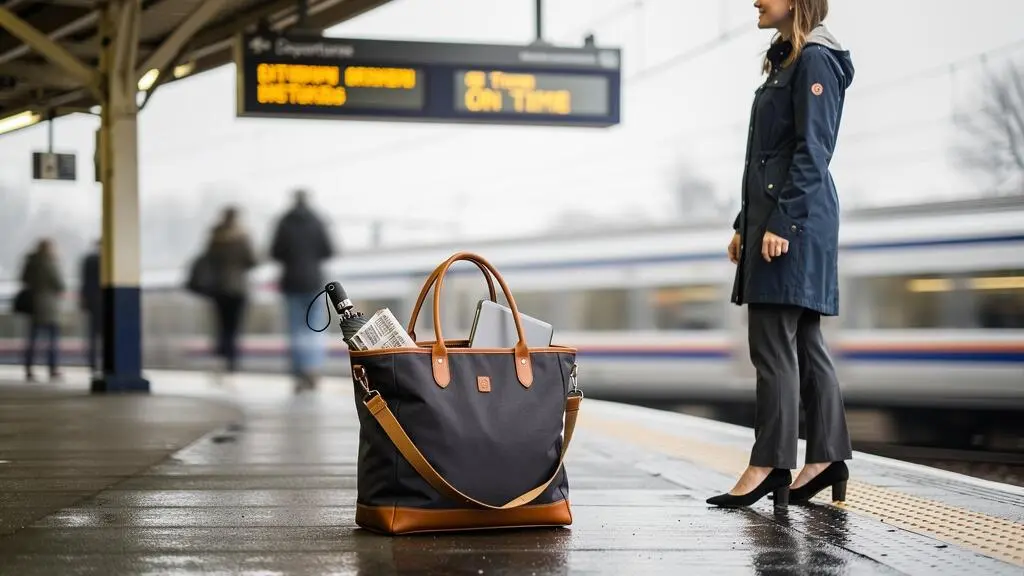
A versatile tote bag should do more than accommodate a laptop and look appropriate at the office. For UK commuters, it needs to remain comfortable through station walks, protect essentials during unpredictable weather, keep valuables accessible without exposing them, and adapt to weekend errands without requiring a complete repack.
The difference becomes obvious during an ordinary journey. A soft tote collapses when placed beside a train seat. A narrow strap digs into the shoulder after walking to the station. An unprotected opening leaves a laptop vulnerable to rain, while loose belongings turn a simple ticket-gate interaction into a frustrating search.
True versatility comes from the interaction between structure, usable capacity, carrying comfort, weather resistance and organisation. A bag does not need to be rigid, oversized or covered in technical features. It needs the right features for the situations in which it will actually be used.
Evaluating those details before purchasing is more useful than relying on a product’s appearance or a vague description such as “everyday essential”.
What makes a tote genuinely versatile?
- Structure and fit: Choose a stable base, usable laptop compartment and straps designed for the weight you actually carry.
- Weather and security: Match the material and closure to UK journeys, keeping valuables in secured compartments.
- Everyday efficiency: Give essentials fixed locations and use removable pouches to move easily between work and weekend activities.
- Why Do Some Totes Collapse and Become Impossible to Use After 2 Weeks?
- How to Choose a Tote That Fits a 13-Inch or 15-Inch Laptop Without Shoulder Pain?
- Canvas, Leather, or Nylon Tote: Which Handles UK Rain Best Without Looking Cheap?
- The Tote Security Mistake That Makes You an Easy Target on Public Transport
- A Tote Organisation Setup That Saves You 10 Minutes a Day
- Why Can a “Light” Handbag Still Hurt Your Shoulder After 20 Minutes?
- Why Do Beautiful Clothes Become Annoying the Moment You Start Moving?
- What Does Functional Beauty Look Like When You Walk, Sit, Commute, and Live in It?
Why Do Some Totes Collapse and Become Impossible to Use After 2 Weeks?
Some tote bags become frustrating within weeks because their soft construction cannot maintain an accessible shape without the contents supporting it. When belongings shift or the bag is placed on the floor, the sides fold inward, the opening narrows and smaller items disappear beneath larger ones. This is primarily a structural limitation, not necessarily evidence of premature wear.
An unstructured tote behaves differently depending on what is inside. A laptop may temporarily hold one side upright, while a water bottle or lunch container pulls the opposite panel down. Remove the laptop and the entire bag may slump. Even when the fabric remains intact, the bag becomes less predictable to use.
Three design details can make a meaningful difference:
- Reinforced base panel: A firmer bottom helps distribute the contents and gives the bag a more stable surface when placed down.
- Stiffened top rim: Reinforcement around the opening helps prevent the sides from folding over one another.
- Gusseted sides: Constructed side panels create depth and help preserve the bag’s usable internal volume.
These features work together. A reinforced base alone cannot guarantee that a tall, flexible tote will remain upright, particularly when heavily loaded or placed on an uneven surface. Material thickness, stitching and weight distribution also influence the result.
The simplest practical assessment takes approximately 30 seconds. Place the empty tote on a flat floor, release both handles and observe whether its base and opening remain usable. Then add the items you normally carry and repeat the test. This is a useful screening method rather than a guarantee of long-term durability.
For commuters, the consequences extend beyond appearance. A collapsing tote is awkward to open with one hand while holding a rail, harder to position neatly beneath a seat and more likely to tip when placed beside a ticket machine.
Repeatedly searching through shifting contents can also place unnecessary pulling and twisting forces on internal pockets, linings and zips. Whether that causes accelerated wear depends on the construction; it should not be assumed for every soft bag.
Structure is valuable because it makes capacity predictable. Once a tote can hold and present its contents reliably, the next question is whether those contents can be carried comfortably.
How to Choose a Tote That Fits a 13-Inch or 15-Inch Laptop Without Shoulder Pain?
A laptop-friendly tote needs enough usable interior space for the actual device and its protective sleeve, a stable compartment that keeps the laptop close to the body, and straps that distribute pressure comfortably. The advertised laptop size is only a starting point. Interior dimensions, weight distribution and the fully packed load determine whether the bag works for everyday commuting.
Start with the device rather than the manufacturer’s capacity claim. A 13-inch or 15-inch laptop designation refers to a screen measurement, not the width of the entire device. Two laptops with the same advertised screen size can have different physical dimensions.
Measure the laptop inside its intended sleeve, including thickness. Compare those measurements with the tote’s usable interior width, depth and height. Check the width at the narrowest point of entry, particularly beneath a curved zip, and verify that any divider is tall and wide enough to support the laptop properly.
A bag described as fitting a 15-inch laptop might have sufficient external dimensions but inadequate internal clearance once padding, seams and the closure are considered.
Position matters almost as much as fit. A padded compartment against the side worn closest to the body can reduce uncontrolled movement and keep the heavier item nearer the carrier. In an open, unstructured tote, a laptop may slide away from the body and make the load feel less stable.
The UK’s Health and Safety Executive advises keeping heavier parts of carried loads close to the body and stabilising shifting contents in its HSE guidance on controlling risks during carrying tasks. This is occupational manual-handling guidance, not a handbag-specific comfort standard, but its general load-positioning principles are useful when assessing a commuting tote.
Strap construction deserves equally close attention. Narrow handles focus the load on a smaller area of the shoulder. Wider straps distribute contact pressure across a larger surface, while moderate padding can improve comfort when the bag is heavy.
A strap width of approximately 4 cm or more is a useful feature to try, not a scientifically established threshold for preventing shoulder pain. Shape, stiffness, spacing, shoulder fit and the way a person carries the bag all matter.
Finally, consider the weight budget. A leather tote may already feel substantial when empty. Add a laptop, charger, water bottle, lunch and personal items, and the combined load can become uncomfortable during a long walk to the station.
Weigh the empty bag and then the fully packed version. If the loaded weight exceeds what you personally find comfortable, consider a detachable crossbody strap, a two-strap alternative or a trolley sleeve for journeys involving wheeled luggage. There is no universal safe tote weight established by the HSE guidance cited above.
A well-fitted laptop compartment makes carrying more predictable. However, the contents also need to stay protected when a dry morning turns into a wet journey home.
Canvas, Leather, or Nylon Tote: Which Handles UK Rain Best Without Looking Cheap?
For frequent exposure to UK rain, a coated or suitably treated nylon tote is often the most practical option, while waxed canvas offers a more traditional appearance with useful resistance to light showers. Leather can look polished but requires greater care when wet. No material guarantees protection: finish, stitching, closure and construction determine how well the bag protects its contents.
Rain is a realistic consideration for commuters, not an unusual edge case. The Met Office explanation of rainfall and drizzle in the UK describes drizzle as a familiar form of precipitation and explains the weather conditions that produce different types of rainfall.
The choice between canvas, leather and nylon is therefore less about finding a universally superior material and more about matching performance and appearance to the journeys you make.
| Criterion | Canvas | Leather | Nylon |
|---|---|---|---|
| Light drizzle | Waxed or treated versions may shed light rain; untreated canvas can absorb moisture. | Protected finishes may tolerate brief exposure; untreated leather requires caution. | Suitable coated or water-repellent versions generally handle light rain well. |
| Prolonged rain | Protection depends on treatment, seams and closure. | Extended wetting can affect appearance and finish. | Often the more practical choice when construction and closure are appropriate. |
| Office appearance | Relaxed, understated and potentially smart. | Traditionally polished and formal. | Clean, structured designs can look suitably professional. |
| Maintenance | Some finishes require refreshing according to care instructions. | Conditioning and careful drying may be necessary. | Often comparatively straightforward, subject to coating and care requirements. |
| Key limitation | Untreated fabric can become saturated. | Water exposure may affect the surface. | Water-resistant fabric does not make the entire bag waterproof. |
Product descriptions deserve close reading. Waxed canvas behaves differently from untreated cotton canvas, just as coated leather differs from unprotected leather. Durable water-repellent finishes on nylon can reduce surface wetting, but performance may deteriorate with use and cleaning. Follow the specific manufacturer’s maintenance guidance rather than assuming a universal reproofing schedule.
The closure is the critical second decision. An open-top tote offers convenient access but provides a direct route for rainwater to reach documents and electronics. A magnetic snap improves containment without sealing the opening. A properly constructed zip top offers more coverage, although water can still enter through stitching, zip teeth or other openings unless the design provides additional protection.
Consider how often you actually walk outdoors. Someone travelling between a car park and office entrance may reasonably prioritise leather and its refined appearance. A commuter regularly walking between stations, bus stops and buildings will generally benefit more from lighter construction and dependable weather protection.
Nylon need not look like sports equipment. Structured sides, restrained hardware and muted shades such as charcoal, navy or black can make it suitable for work. Similarly, canvas can look refined when its silhouette and detailing are carefully considered.
Once the weather question is settled, that same closure becomes important for another reason: controlling access to valuables during crowded journeys.
The Tote Security Mistake That Makes You an Easy Target on Public Transport
The main security mistake is carrying an open-top tote with a phone, wallet or keys exposed near the opening or in an easily reached external pocket. On crowded transport, that arrangement makes belongings more accessible to opportunistic theft. A secured internal compartment and keeping the bag in view reduce unnecessary exposure, although no bag design can eliminate theft risk.
A spacious tote makes it tempting to drop a phone on top of a jumper or leave a wallet in a convenient outer pocket. That convenience becomes a weakness when standing in a crowded train carriage, navigating a busy platform or waiting near a carriage door.
Accessibility is the issue. A small, exposed pocket may be easier to reach than a larger, properly secured interior compartment. However, there is no basis for claiming that every open tote is more likely to be targeted than every other type of bag.
For railway journeys, the British Transport Police guidance on protecting belongings during rail journeys identifies distraction and opportunistic theft as concerns and recommends keeping luggage nearby, checking stored bags and zipping valuables away after use.
A practical arrangement separates the tote into two access zones:
- Secure zone: Keep the wallet, phone when not in use, keys and other valuables inside an internal zipped pocket or secured pouch.
- Quick-access zone: Store frequently needed items such as a travel pass, tissues or headphones in a convenient compartment that can be closed between uses.
If the tote lacks an internal zipped pocket, a small crossbody pouch worn securely against the body can provide a separate place for essential valuables. This is an optional carrying arrangement, not a substitute for awareness.
Carrying position also matters. On a packed Tube train or busy bus, a tote hanging behind the hip is difficult to monitor. Positioning it in front of the torso, with a hand or forearm through the straps where comfortable, keeps the opening more visible and within easier reach.
This does not mean gripping the bag so tightly that balance or safe use of handrails is compromised. During sudden stops or crowded boarding, maintaining a stable stance takes priority.
There is a genuine compromise between security and speed. A bag with several zipped compartments may be well suited to protecting valuables but frustrating when retrieving a travel pass at every barrier.
The more workable solution is to secure what matters most while leaving a dedicated, reasonably accessible place for routine items. This avoids treating every object as though it needs the same level of protection.
Security becomes easier when everything has a predictable location. That makes the next improvement less about purchasing another bag and more about organising the one you already own.
A Tote Organisation Setup That Saves You 10 Minutes a Day
An efficient tote organisation system gives every regularly used item a permanent location and groups smaller belongings into a few removable pouches. This reduces repeated searching and makes switching between work and weekend use easier. Saving ten minutes a day is a practical goal, not a measured or guaranteed outcome; the benefit depends on how disorganised the bag was initially.
Organisation should begin with daily behaviour rather than the number of compartments available. If keys move between the coat pocket, laptop sleeve and bottom of the tote, even an expensive organiser cannot make access predictable.
The simplest rule is to assign each essential one location and return it there after every use. Put keys in the same secured pocket, the travel pass in its dedicated holder and the laptop against the appropriate padded panel.
For objects that are not needed individually throughout the journey, use two or three modular pouches:
- Technology pouch: Charger, cables, adapter and small accessories.
- Personal-care pouch: Tissues, lip balm, hand sanitiser and other small essentials.
- Documents pouch: Papers, receipts and items that should remain flat and separate from food or liquids.
Grouping items by purpose makes transfers between bags straightforward. Instead of rebuilding your everyday essentials each time you change from a work tote to a weekend bag, move the relevant pouches as complete units.
The system should stay proportionate to the bag. Too many organisers consume usable space, add weight and create additional zips to navigate. A small tote may work best with one pouch and two internal pockets.
Before adding organisers, perform a full contents audit. Empty the tote and remove belongings that have not been needed in the previous two weeks, while retaining important emergency or occasional-use items. Weigh the remaining contents if carrying comfort is a concern.
A foldable secondary shopping bag is useful for keeping groceries, gym clothing or unexpected purchases separate from your laptop and everyday essentials. That boundary prevents the main tote from gradually becoming an unpredictable storage space.
Build a reliable five-step tote organisation system
- Empty the bag completely. Create a visible inventory of everything normally carried.
- Remove unnecessary contents. Produce a reduced daily-carry selection, setting aside anything not needed routinely or for a specific contingency.
- Assign fixed locations. Write down or remember a simple pocket map for keys, travel pass, wallet, laptop and charger.
- Prepare removable pouches. Assemble two or three labelled or easily recognisable groups of items that can transfer between bags.
- Complete a commute rehearsal. Retrieve the travel pass, keys and phone without searching, then check that the fully packed bag closes and remains comfortable to carry.
Once these steps are complete, evaluate the result during a normal working week. Notice which items still require searching and whether the extra organisation genuinely makes access easier.
Less clutter improves access and can reduce unnecessary weight. Yet a lighter bag is not automatically a comfortable one, especially when its full load rests on a single shoulder.
Why Can a “Light” Handbag Still Hurt Your Shoulder After 20 Minutes?
A light handbag can still cause shoulder discomfort because the load is concentrated on one side of the body for a sustained period. Narrow straps, poor weight distribution and repeatedly raising the shoulder to keep the bag in place can increase discomfort. Twenty minutes is an illustrative commuting duration, not a universal threshold at which pain begins.
When a tote is carried over one shoulder, the strap transfers its load through a relatively limited contact area. The narrower that area, the more concentrated the pressure can feel.
The body may compensate for a slipping strap by lifting the shoulder or changing posture. Over a long walk, this can create sustained muscular effort even when the bag initially feels manageable.
A second problem is the difference between empty and loaded weight. Someone may choose a tote because it feels light in a shop, then fill it with a laptop, charger, water bottle, lunch and other belongings. The original impression no longer reflects the everyday carrying load.
To assess comfort more realistically, pack the bag as you would for a full working day. Weigh it if possible, then carry it for a walk comparable to your route between home, station and office.
Pay attention to several warning signs:
- The strap repeatedly slips unless you raise your shoulder.
- A narrow handle creates a concentrated pressure point.
- The tote swings or shifts noticeably as you walk.
- You repeatedly change posture or grip to relieve discomfort.
Changing shoulders during longer walks can reduce continuous loading on one side. Wider or moderately padded straps may improve pressure distribution, while a detachable crossbody option can provide more carrying flexibility.
Crossbody straps are not automatically comfortable for everyone, however. Their effectiveness depends on strap design, load weight, fit and carrying position. Persistent pain should not be treated as a problem that a different handbag alone is guaranteed to solve.
The most useful purchase criterion is not whether the bag feels pleasant for a few seconds. It is whether it remains manageable during the longest ordinary stretch of your journey.
Comfort also depends on how a bag moves with its owner. That highlights a broader weakness in accessories selected mainly because they look attractive while standing still.
Why Do Beautiful Clothes Become Annoying the Moment You Start Moving?
Attractive clothes and accessories can become impractical in motion because their design may prioritise appearance over movement, fit and everyday access. The same applies to tote bags: a sleek silhouette can look excellent on display but slip from the shoulder, swing during fast walking or become awkward when sitting down. Functional suitability only becomes clear through use.
A garment that looks beautiful in front of a mirror may restrict movement when its wearer walks, sits or reaches. An attractive tote can create the same mismatch between static appearance and daily function.
Consider a slim leather bag with a carefully defined silhouette. Its shape may look elegant beside an outfit, yet a rigid opening could make retrieving a laptop difficult. Similarly, delicate surface finishes may demand more attention in wet weather than a commuter can reasonably provide.
Some compromises are more subtle. A narrow profile may reduce room for lunch or gym essentials. Short handles may look proportionate but make the bag difficult to wear over a winter coat. A stiff base may support the contents while making the bag less convenient to position beneath a train seat.
These are design trade-offs rather than evidence that elegance and function are incompatible.
A day-in-the-life test makes the differences easier to identify. Before buying, imagine using the bag through a complete working day:
- Leaving home: Can the laptop, keys, lunch and water bottle fit without distorting the opening?
- Approaching the station: Can you walk briskly while carrying the bag securely?
- Passing through a ticket gate: Is your travel pass accessible without exposing valuables?
- Sitting on the train: Can the bag rest safely and compactly without its contents spilling?
- Arriving at work: Can it sit beside a desk without collapsing or obstructing movement?
- Running evening errands: Is there room for an additional item without compromising comfort?
A tote that performs well throughout these situations offers more than visual appeal. Its useful details are integrated into the overall design instead of becoming inconvenient additions.
Functional beauty does not require every bag to be waterproof, rigid or especially large. It means choosing characteristics that work with the owner’s activities rather than constantly demanding adjustments.
The strongest everyday accessories maintain their appeal precisely because they remain easy to use. That provides a practical basis for deciding whether one tote can genuinely serve both working days and weekends.
Key takeaways before choosing your tote
- Assess how the bag behaves when empty, fully packed and in motion; appearance alone cannot reveal practical limitations.
- Prioritise features according to your longest and most demanding regular journey rather than an idealised day.
- Choose versatility deliberately: one well-balanced bag may cover multiple situations, but the right compromises depend on your routine.
What Does Functional Beauty Look Like When You Walk, Sit, Commute, and Live in It?
Functional beauty in a versatile tote means combining an attractive everyday silhouette with dependable structure, appropriate capacity, comfortable straps, weather-conscious materials and secure organisation. The bag should work naturally while walking, sitting, commuting and running errands, without demanding constant rearrangement. Its quality lies in meeting real needs consistently, not in offering the greatest number of features.
For a UK commuter, the best starting point is the most demanding regular use case. A tote that comfortably handles a laptop, a wet walk to the station and a crowded return journey has already solved many of the practical challenges that carry over into weekends.
However, work and leisure are not identical. Commuting often rewards secure closures, internal structure and stable laptop placement. Weekend use may benefit from easier access, additional flexible capacity and a less formal appearance.
One bag can accommodate both modes, but usually through carefully chosen compromises.
| Feature | Weekday commuting benefit | Weekend benefit or compromise |
|---|---|---|
| Reinforced base | Helps the bag stand and protects usable space. | Keeps shopping and personal belongings organised, although it may reduce flexibility. |
| Padded laptop section | Provides a dedicated place for a working device. | Can hold documents or flat items but occupies some interior capacity. |
| Zipped top closure | Helps secure belongings and limit exposure to rain. | Useful in busy areas, although slower than an open top for frequent access. |
| Detachable crossbody strap | Offers an alternative carrying position for station walks. | Leaves the hands freer for errands or sightseeing. |
| Flexible main compartment | Accommodates lunch and changing daily essentials. | Makes room for occasional purchases or leisure items. |
| Removable pouches | Keep work accessories in predictable locations. | Allow quick changes of contents without reorganising everything. |
The trade-off is clearest when considering two separate bags. A highly structured laptop tote may be excellent for commuting but less convenient for carrying bulky weekend items. A soft shopper may be ideal for casual activities yet less protective or stable when carrying electronics.
If those needs are dramatically different, owning two purpose-built bags may be more practical than forcing one design to do everything. For someone whose weekday and weekend loads are similar, a carefully selected tote can reduce unnecessary switching.
Before purchasing, use this final buying checklist as a compact decision filter:
- Empty-bag stability: Does the tote remain sufficiently upright and accessible when placed on a flat surface?
- Actual laptop fit: Do the device and sleeve fit through the opening and inside the intended compartment?
- Strap comfort: Are the handles sufficiently wide, comfortable and long enough for the clothes you normally wear?
- Weather protection: Do the fabric finish, seams and closure suit your likely rain exposure?
- Secure organisation: Is there a closable place for valuables and a practical location for frequently used items?
- Empty and loaded weight: Is the bag comfortable once filled with your realistic daily essentials?
Beyond these immediate checks, inspect the quality of stitching around strap attachments, the feel of the hardware and the accessibility of any components that might need maintenance or repair. These details do not guarantee longevity, but they help distinguish a thoughtfully constructed accessory from one designed mainly for display.
A bag used regularly and maintained appropriately can provide better long-term value than repeated purchases that satisfy appearance preferences but fail practical needs. Longevity depends on material quality, construction, care and how the bag is used; it cannot be established from styling alone.
Pack the essentials you actually carry, check the interior dimensions and try the bag through a realistic walking and access routine before deciding. The most versatile tote is the one that makes an ordinary working day and an ordinary weekend easier without needing special treatment.
Is a tote bag suitable as the only bag for a daily UK commute?
Yes, provided it fits your usual belongings, offers adequate closure and organisation, and remains comfortable for the journey. A padded laptop compartment, stable base and suitable weather resistance are particularly useful. If you regularly carry unusually heavy or bulky items, a backpack or separate bag may be more practical.
Can a removable bag organiser make an unstructured tote suitable for commuting?
A suitably fitted organiser can improve compartment separation and help stabilise contents, especially if it has a firm base. It will not necessarily reinforce weak straps, improve an unsuitable closure or correct poor overall construction. Check that the organiser does not significantly reduce laptop space or add uncomfortable weight.
Should a commuting tote be waterproof or is water resistance enough?
Water resistance may be adequate for brief exposure to light rain, but it does not guarantee protection during prolonged rainfall. If you regularly carry electronics outdoors, assess the entire bag, including the zip, seams and opening. A separate protective laptop sleeve or waterproof internal pouch offers an additional precaution, although its own protection level should also be checked.
How can you tell whether a tote will fit over a winter coat?
Measure the usable handle drop from the top of the bag to the underside of the handle at its highest point, and compare it with a bag that fits comfortably over your usual coat. When possible, try the tote while wearing similarly bulky clothing. Check that it can be put on and removed without awkward twisting and that the straps remain stable while walking.
How often should you reassess what you carry in your tote?
A brief review whenever your routine changes is sensible, particularly after changing jobs, equipment or commuting arrangements. Remove accumulated clutter, confirm that frequently used items remain accessible and reassess the packed weight. The aim is to maintain a predictable daily load rather than follow a rigid cleaning schedule.