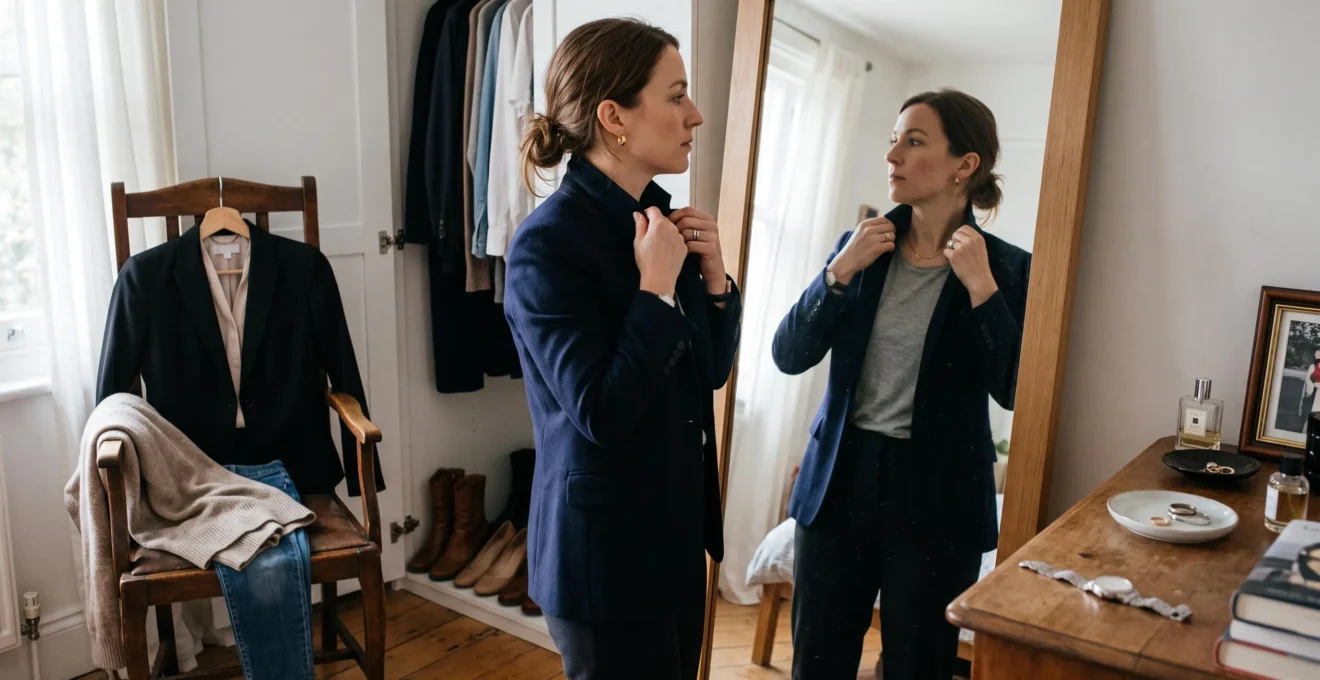
Improving self-presentation through clothes does not mean inventing a professional persona. It means making deliberate choices about which aspects of your personality, experience and intentions become visible before you speak.
In a job interview, client presentation or leadership meeting, your clothing communicates alongside your words, posture and behaviour. A structured jacket might suggest seriousness, while softer textures or a more relaxed combination can make the same person appear approachable. Neither impression guarantees competence or trustworthiness, but both can influence how an interaction begins.
The challenge is to use those signals without feeling as though you are performing someone else’s identity. Dressing strategically becomes much easier when you understand the context, identify the impression you want to create and retain enough of your personal preferences to feel comfortable.
For UK professionals and job seekers, the objective is not to follow an imaginary universal dress code. It is to develop a consistent, adaptable approach that communicates credibility, warmth and authority without unnecessary spending or self-consciousness.
Self-presentation through clothing: the essentials
- Authenticity is deliberate consistency. Choose clothing that reflects your personality while making sense to the people and situations you encounter.
- Fit, condition and context matter more than constant novelty. Improve the clothes you already wear before buying a completely different wardrobe.
- Build recognisable patterns. Repeat a few personal styling cues, test how others interpret them and adapt them to different professional settings.
- Why Does “Just Be Yourself” Fail When You Need Strong Self-Presentation?
- How to Translate Your Personality Into Professional Outfit Cues Without Guesswork?
- Tailoring or Colour Contrast: Which Builds Presence Faster on a Tight Budget?
- The Small Detail That Makes You Look Less Credible Even in a Good Outfit
- When Should You Trial a New Look Before a High-Stakes Day?
- How to Dress for the Outcome You Need in a Meeting Without Overthinking Style?
- Why Do People Think You’re Stylish When You Repeat Similar Outfits?
- How Do You Build a Signature Look People Remember Without Wearing a “Uniform”?
Why Does “Just Be Yourself” Fail When You Need Strong Self-Presentation?
“Just be yourself” is incomplete advice because professional self-presentation involves an audience as well as an individual. Clothes that feel authentic to you may communicate something different to a recruiter, colleague or client. Effective self-presentation preserves your identity while translating it into signals appropriate to the situation, without requiring you to imitate someone else.
The distinction is between authenticity and spontaneity. Authenticity means your outward presentation is consistent with your values and personality. Spontaneity means presenting yourself without deliberately considering the circumstances. These are not interchangeable.
A naturally informal person might prefer trainers and oversized knitwear outside work. That preference can be entirely genuine. However, wearing the same combination to an interview for a traditionally formal professional position may communicate a level of informality the employer did not expect.
This does not make the person’s preference wrong. It means that clothing has different meanings depending on the environment and the observer.
The University of Hertfordshire study on clothing, posture and professional impressions, published in the British Journal of Psychology, examined how photographs of people in different clothing and postures influenced judgements of confidence, professionalism, approachability and salary expectations. The results showed that the effects of posture on impressions varied with clothing, demonstrating why isolated styling rules cannot reliably predict every response.
Practical authenticity therefore requires a simple congruence test:
- Personal fit: Do these clothes reflect something recognisable about your preferences or character?
- Contextual fit: Are other people likely to understand the message you intend to send?
- Practical fit: Can you wear the outfit without continuously thinking about or adjusting it?
Consider a hypothetical designer attending an interview with a corporate client. A softly structured jacket, restrained colours and distinctive patterned scarf might retain an expressive personality while showing respect for the client’s expectations.
The opposite mistake is over-adjustment. Copying every feature of an unfamiliar dress code can make someone feel restricted and visually indistinguishable. Appropriateness should provide a foundation, not erase individuality.
Once that distinction is clear, the next challenge is identifying which specific clothes can communicate your personality effectively.
How to Translate Your Personality Into Professional Outfit Cues Without Guesswork?
Translate personality into professional clothing by identifying three to five qualities you want others to recognise, then assigning each quality an observable styling cue. Structure, colour, texture and formality provide a practical vocabulary. Choose one dominant message per outfit, and test whether other people interpret it as intended rather than relying entirely on your own judgement.
Start with qualities relevant to your role. Words such as dependable, creative, analytical, approachable and decisive are more useful than vague ambitions such as “look impressive”.
The following examples are styling hypotheses to test, not scientifically established connections between personality and clothing.
| Quality to communicate | Potential clothing cues | What to avoid |
|---|---|---|
| Reliability | Consistent proportions, neat finishes, restrained palette | Unnecessary variation that obscures the intended impression |
| Creativity | One distinctive accessory, texture or colour combination | Multiple competing statement pieces |
| Authority | Well-fitting structured garments and deliberate proportions | Uncomfortable formality that affects natural movement |
| Warmth | Softer textures, approachable combinations, familiar silhouettes | Assuming casual clothing automatically creates trust |
| Precision | Clean lines, coordinated details and careful garment maintenance | Visible distractions unrelated to the intended message |
These associations depend on the workplace, audience and personal styling. They should guide experimentation rather than become rigid rules.
Choose one dominant signal. A professional outfit can contain several personal qualities, but it should have a clear emphasis. If the main objective is credibility, a sharply fitting base can establish the direction while one expressive accessory adds personality.
To identify conflicting signals, look at the complete outfit rather than individual garments. Ask whether each visible element supports, softens or distracts from the main message.
A useful calibration exercise is to photograph three possible outfits under similar lighting, using the same posture and framing. Show the photographs separately to two people whose judgement you trust, ideally people familiar with the professional environment you are targeting.
Ask each person to describe the impression in three words before revealing your intended qualities. Compare their independent descriptions with your original objectives.
If you want to appear approachable and decisive but both observers describe an outfit as distant or overly formal, change one variable and repeat the test. For example, keep the structured jacket but replace a particularly formal shirt with a simpler top.
This approach does not provide an objective personality score. It produces useful feedback about how a small group interprets visible signals, making wardrobe decisions less dependent on guesswork.
With a clearer visual direction, improving individual garments becomes more purposeful, especially when money is limited.
Tailoring or Colour Contrast: Which Builds Presence Faster on a Tight Budget?
Tailoring is usually the more sensible first investment when frequently worn clothes fit poorly, while colour contrast can create a noticeable change without alterations when fit is already satisfactory. Neither is universally superior. Tailoring influences proportion and movement; contrast changes visual emphasis. The best budget decision depends on the garments you own, their condition and your professional context.
Consider the difference between improving a jacket’s sleeve length and introducing a contrasting top beneath it. The alteration changes how the jacket sits on your body whenever you wear it. The contrasting top affects which parts of the outfit attract attention.
Both can contribute to presence, but they solve different problems.
| Decision factor | Tailoring | Colour contrast |
|---|---|---|
| Main purpose | Improve garment fit, proportions and movement | Create visual definition and a recognisable accent |
| Potential cost efficiency | Strong when alterations extend the use of frequently worn pieces | Strong when existing garments can be recombined |
| Ease of execution | May require a fitting and specialist alterations | Can often be tested immediately at home |
| Duration of benefit | Continues while the altered garment remains suitable | Continues while the colour combination remains useful |
| Common mistake | Paying to alter a garment with fundamental construction or sizing problems | Introducing harsh or distracting contrasts that overwhelm the outfit |
A practical approach begins with an audit of the clothing you wear most often. Check whether trousers bunch noticeably at the hem, sleeves obscure your hands or jackets pull when buttoned. These observations help identify alterations worth discussing with a tailor.
Prioritise relatively straightforward work such as shortening hems, suitable waist adjustments or replacing damaged buttons. Ask for an assessment before assuming every problem is economical or technically possible to correct.
Next, experiment with colours you already own. A navy jacket over a lighter top, for instance, may create a more defined visual contrast than two similarly dark garments. Whether that distinction is helpful depends on your colouring, preferences and the expectations of your workplace.
Calculate value through expected wear, not simply the initial amount spent. An alteration to trousers worn several times each week may offer more practical benefit than a distinctive new garment worn only occasionally.
Body proportions, mobility needs and clothing construction also matter. Someone who struggles to find jackets that sit comfortably across the shoulders may need to prioritise appropriate fit over colour experiments. Likewise, in a particularly formal environment, an obviously ill-fitting outfit may attract more attention than a carefully selected accent colour.
There is no reliable universal percentage by which tailoring or contrast improves professional credibility. The practical objective is to remove the most noticeable limitation while keeping the wardrobe useful.
Even well-fitted, coordinated clothing can lose its effectiveness when a small maintenance issue changes the overall impression.
The Small Detail That Makes You Look Less Credible Even in a Good Outfit
The detail most likely to undermine an otherwise effective outfit is an obvious sign of neglected maintenance, such as a stain, loose thread, damaged fastening or heavily creased garment. Such details can distract from an intended professional impression. Their significance depends on the setting, however, and ordinary wear should not automatically be confused with carelessness.
Professional clothing does not need to look new. It needs to look considered and suitable for the work being done.
In a formal interview, a visible food stain or unfastened button may interrupt an otherwise coherent appearance. In a creative workplace or practical trade, worn materials can be entirely appropriate, particularly when they reflect the nature of the work.
The important distinction is between character and neglect. Natural patina on well-maintained leather shoes can appear intentional. A detached sole creates a different impression because it suggests a functional problem rather than a stylistic preference.
There is also a reverse risk: excessive visual emphasis can distract from the person. An oversized watch, highly conspicuous branding or elaborate accessories might work in one professional environment and appear out of place in another.
A quick inspection before an important interaction is more useful than attempting absolute perfection. Focus on visible cleanliness, the condition of key details and whether the outfit remains comfortable and functional.
The two-minute professional outfit check
- Inspect the main garment. Check the front, collar and cuffs for stains or prominent creases; finish with a visibly clean, presentable surface.
- Check fastenings and seams. Look for loose buttons, open seams or visible hanging threads; identify anything requiring repair before wearing it.
- Review footwear. Check for obvious dirt or damage and clean what can be addressed immediately; leave with shoes suitable for the setting.
- Check accessories. Remove or reposition anything distracting, damaged or uncomfortable; retain only items that support the intended appearance.
- Complete a movement test. Sit, stand and walk briefly; confirm that the outfit stays in place without repeated adjustments.
Use this inspection as a practical safeguard, not as a reason to scrutinise every minor imperfection. Other people may not notice the details that concern you most, and appearance should never replace evidence of professional ability.
For a particularly important occasion, the most effective preparation happens earlier than this final inspection.
When Should You Trial a New Look Before a High-Stakes Day?
Trial a new professional outfit before the day you need it, preferably during an ordinary activity that reproduces the movement, duration and conditions of the important event. For unfamiliar formal clothing or pieces requiring alterations, allow several days rather than relying on a last-minute fitting. The goal is to discover discomfort, practical problems or unwanted signals while there is time to make changes.
A mirror check shows how clothing looks when you are standing still. It cannot tell you whether a waistband becomes uncomfortable after sitting, shoes rub during a journey or a jacket restricts movement when reaching across a table.
Wear the complete outfit for a realistic trial, including footwear, accessories and any layers you expect to use. Move between standing and sitting, walk for a meaningful period and perform ordinary work-related gestures.
For an interview, this might include sitting at a desk, carrying a bag and walking between rooms. For a presentation, test reaching, turning and gesturing while speaking.
Use three practical validation criteria:
- Extended comfort: The outfit remains physically comfortable throughout an activity comparable to the planned event.
- Minimal corrective gestures: You do not repeatedly pull at sleeves, reposition a neckline or adjust clothing while speaking.
- Message alignment: The complete outfit still communicates the intended professional impression when photographed or viewed by someone else.
There is a psychological argument for reducing unfamiliar distractions, but the evidence should not be overstated. The original Journal of Experimental Social Psychology study on enclothed cognition proposed that clothing could influence psychological processes through its symbolic meaning and the experience of wearing it.
However, a 2019 preregistered replication study on enclothed cognition did not reproduce the original selective-attention result. It would therefore be misleading to claim that a particular outfit, or testing it beforehand, is scientifically proven to improve workplace concentration or performance.
The case for a trial is more straightforward: it lets you discover observable problems before they become inconvenient.
If you have never worn a suit or other formal garment for an extended period, conduct the trial early enough to arrange alterations or choose an alternative. Testing everything the evening before may leave too little opportunity to fix a genuine problem.
Once the outfit has passed those practical checks, selecting what to wear for individual meetings can become a quick decision instead of a stressful one.
How to Dress for the Outcome You Need in a Meeting Without Overthinking Style?
Choose meeting clothes by defining the impression that supports your objective, identifying what the audience expects and making one deliberate adjustment to that baseline. This reverses the usual question of what looks stylish. A useful outfit should help you appear appropriate for the conversation while retaining a recognisable element of your professional identity.
Consider three hypothetical situations. A candidate meeting a conservative financial services employer might prioritise credibility and reliability. A creative consultant pitching an original concept may want to balance competence with individuality. A newly appointed manager meeting senior colleagues may wish to communicate authority without appearing inaccessible.
None of these objectives automatically requires a particular garment. They influence the level of formality, structure and distinctiveness worth choosing.
A fast decision method uses three questions:
- What outcome matters? Identify the professional impression most relevant to the meeting: reliability, creative judgement, approachability or leadership presence.
- What does the audience expect? Consider the organisation’s established dress norms, the formality of the occasion and anything you already know about the participants.
- What difference should remain visible? Decide whether to move closer to the expected dress code or introduce a modest personal distinction.
This creates a calibrated gap between conformity and individual expression. You can respect the setting without reproducing every feature of somebody else’s appearance.
Research on academic attire illustrates the importance of trade-offs. In three controlled experiments involving 1,361 participants, researchers studying how students evaluated instructors found that greater clothing formality increased perceived competence but reduced perceived warmth. The findings concern higher education and should not be treated as universal predictions for every business meeting.
In practical terms, a structured jacket can communicate a more formal intention, while a softer texture or less rigid combination may help avoid an unnecessarily severe overall effect. The right balance varies by audience.
Video meetings require a slightly different approach. Because participants often see only your head and upper body, the neckline, collar, shoulders and colours near your face become more prominent than footwear or trouser details.
Check how the garment looks in the actual camera frame. A plain top with an appropriate neckline may communicate more clearly than an elaborate outfit whose distinguishing details are outside the shot. Lighting, camera position and background also affect the overall impression.
Finally, remember that cultural and organisational differences can outweigh generic styling assumptions. A UK technology start-up, government department and creative studio may all interpret the same outfit differently.
Once your choices consistently support your objectives, repeating successful combinations can make getting dressed easier and establish a recognisable professional style.
Why Do People Think You’re Stylish When You Repeat Similar Outfits?
Repeated outfit structures can create the impression of a coherent personal style because people encounter familiar visual patterns rather than an unrelated collection of looks. The key is consistency with variation: keeping similar proportions, colours or signature elements while changing individual garments. Repetition alone does not guarantee that observers will judge someone as stylish.
Imagine a professional who regularly wears straight-leg trousers, an unstructured jacket and a restrained palette. One day the jacket is navy; another day it is charcoal. The tops and accessories change, but the overall proportions remain recognisable.
The result is a consistent visual identity rather than a single repeated outfit.
Structure creates continuity, while variations help the wardrobe remain practical and appropriate to changing situations. The distinction matters because repeating every item without adaptation can feel restrictive, whereas changing the basic structure constantly may make it harder to identify a personal preference.
A modular wardrobe offers a useful compromise. Begin with a formula such as:
- One preferred silhouette that feels comfortable and suits your work.
- A compact set of colours that combine easily.
- One optional accent that adds individuality without competing with the overall outfit.
For example, someone who prefers relaxed tailoring might combine wide-leg trousers with a fitted top and a softly structured jacket. Several trousers, tops and jackets can then be interchanged while preserving broadly similar proportions.
There is no requirement to minimise your wardrobe aggressively. The purpose of a modular system is to reduce unnecessary decisions and make existing pieces work together.
It also helps to distinguish recognition from novelty. An outfit does not need to contain a new visual idea every day to be effective. A consistent combination can support a familiar impression, especially among people who see you regularly.
However, the amount of repetition other people notice, and how they interpret it, varies. There is no established universal frequency at which repeating a silhouette creates perceived style or stronger credibility.
When a familiar formula starts to feel dull, change the texture, accessory or seasonal fabric before abandoning the underlying proportions. An effective wardrobe can evolve without requiring constant reinvention.
That consistency becomes even more useful when a few identifiable details form a signature look that can adapt across roles and occasions.
Key takeaways before building your signature look
- Select the personal styling elements you genuinely enjoy wearing, rather than choosing something distinctive only because it attracts attention.
- Keep the foundation adaptable enough for different levels of workplace formality, including interviews, meetings and everyday work.
- Build recognition gradually through repeated use, while allowing your visual identity to evolve with your professional responsibilities.
How Do You Build a Signature Look People Remember Without Wearing a “Uniform”?
Build a signature look by choosing two or three styling elements that feel natural, support your professional identity and can appear across several different outfits. Keep these elements consistent while changing garments according to the occasion. Unlike a uniform, a signature look creates recognisable continuity without requiring the same complete combination every day.
A signature might consist of a particular colour family, a recurring fabric texture and a preferred jacket shape. Another person might be recognisable through minimal jewellery, softly tailored separates and a distinctive scarf.
The important point is that your signature is a pattern, not an exact outfit.
A practical four-stage method helps prevent the process from becoming artificial.
- Identify existing preferences. Review photographs of outfits you have worn comfortably and repeatedly. Look for colours, proportions and accessories that appear without deliberate effort.
- Select two or three recurring elements. Choose details that fit your personality and the image you want to communicate professionally.
- Use them consistently. Introduce these elements into several outfits across different work situations, adjusting their formality when necessary.
- Vary everything else. Change fabrics, layers, footwear or individual garments while keeping enough continuity for the combination to remain recognisable.
As a hypothetical example, a project manager might favour navy and cream, textured knitwear and a simple silver accessory. During an ordinary office day, those elements could appear in a knit and tailored trousers. At a formal presentation, they could be incorporated into a jacket, shirt and restrained accessory.
The appearance changes to suit the context, but the underlying personal preferences remain visible.
Consistency over time makes the signature easier for regular contacts to recognise. It does not guarantee memorability, favourable judgements or professional success. Clothing is only one element of how people experience and remember someone.
A signature also needs room to evolve. A job change, greater leadership responsibility, new work environment or changing physical comfort needs may alter which elements remain useful.
Review your wardrobe periodically rather than treating an earlier styling decision as permanent. If a preferred fitted silhouette no longer feels comfortable, for example, you might retain the same colour palette and accessories while introducing softer tailoring.
This preserves continuity without making clothing a constraint on your identity.
A successful signature look should also be easy to maintain. If a particular accessory requires constant replacement or a garment is too delicate for your working routine, it may not be a suitable foundation for everyday professional self-presentation.
Above all, avoid creating a recognisable image that demands more attention than the work itself. Distinctiveness can help people identify your preferences, but professional credibility still depends on your conduct, judgement and competence.
Choose one recurring styling element from clothes you already own, wear it across three different professional situations and assess whether it feels natural, appropriate and easy to maintain. That small experiment is a practical first step towards a personal style that communicates deliberately without feeling fake.
Can you look professional without wearing a suit?
Yes. Professional appearance depends on the workplace, occasion and expectations of the people involved. Well-maintained separates, knitwear, shirts or tailored casual clothing can be appropriate in many environments. Check the specific dress expectations first, particularly for interviews and formal client-facing work.
How can you improve your professional appearance without buying new clothes?
Start by improving the combinations, condition and fit of existing garments. Clean and press appropriate items, repair visible damage, experiment with different layers and identify outfits that already make you comfortable. Consider alterations only where they offer practical value. New purchases are not a prerequisite for more deliberate self-presentation.
Should you dress differently for an interview and your everyday job?
Sometimes. An interview may require a more deliberate level of formality because you are meeting people unfamiliar with your work. Everyday clothing can often be adapted to the practical demands and established norms of the role. Aim for continuity between the two rather than creating an interview persona you could never comfortably maintain.
Does clothing really change how competent people think you are?
Experimental research indicates that clothing can affect perceived competence, professionalism and warmth under particular conditions. For example, studies of academic attire found trade-offs between formality, competence and warmth. These findings concern perceptions, not proof of actual ability, and cannot predict how every person will respond in every professional environment.
What if your workplace dress code conflicts with your personality?
Identify which requirements are genuinely necessary and where personal choice remains possible. Colour combinations, fabric textures, fit and subtle accessories may allow individuality within an established dress code. Where clothing rules create genuine discomfort or conflict with practical needs, consider discussing suitable alternatives rather than assuming that professionalism requires suppressing your identity.