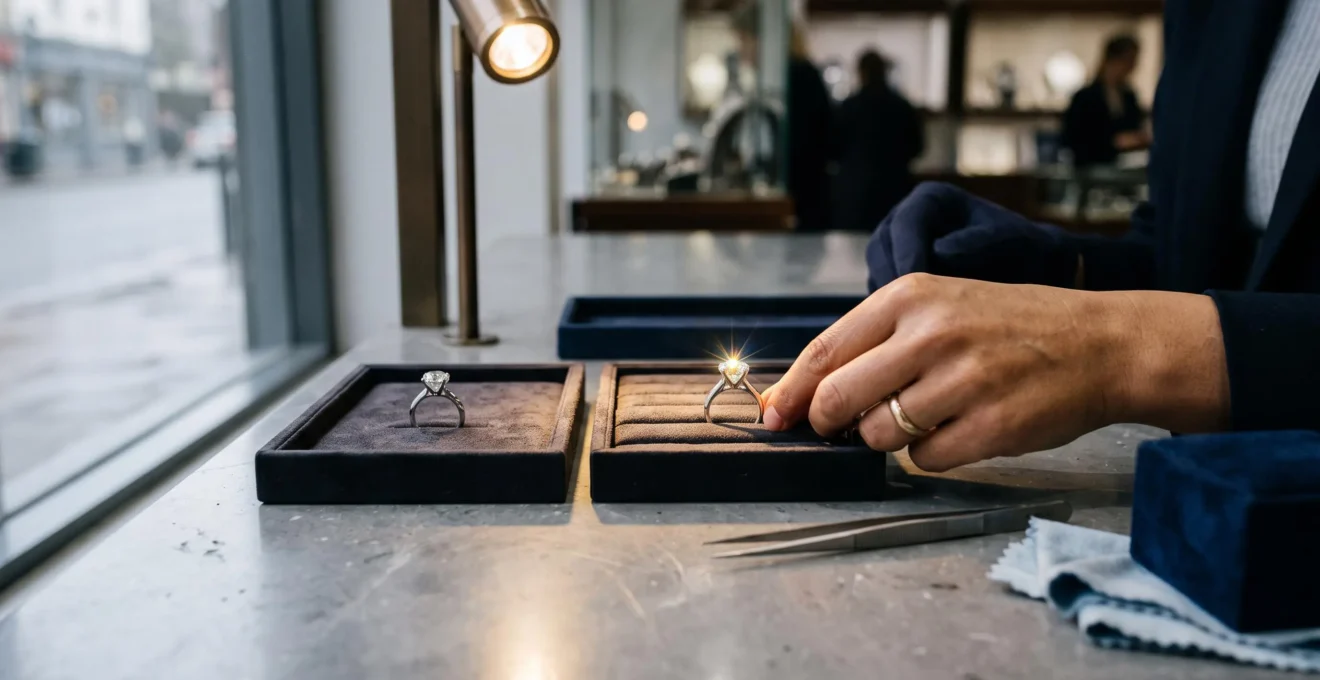
A solitaire diamond ring can look spectacular beneath a jeweller’s spotlights, then surprisingly restrained on the way home. That difference does not necessarily mean the diamond is poor quality. Diamond appearance changes with its lighting environment, the angle of observation and the way its facets return light.
For UK couples choosing an engagement ring, the challenge is separating impressive showroom sparkle from the qualities that remain attractive during everyday wear. An excellent cut grade is valuable information, but it cannot replace looking at the diamond. Equally, a beautiful stone needs a setting that suits the wearer’s activities, protects its edges and feels comfortable on the hand.
The most reliable buying approach combines three checks: how the diamond performs in different lighting, how securely the setting holds it, and how comfortably the finished ring fits into daily life. Understanding these factors makes it easier to compare stones without becoming overwhelmed by certificates, carat weights or sales claims.
What matters most when choosing a solitaire diamond ring
- Judge the diamond in several lighting conditions. Compare its brightness, coloured flashes and contrast pattern rather than relying on showroom spotlights.
- Match the setting to everyday activities. Prongs, bezels and ring height affect security, snagging risk and maintenance.
- Check the complete ring before purchasing. Cut performance, proportions, metal finish, sizing and future repairs all influence long-term satisfaction.
- Why Does a Diamond Look Incredible in the Shop but Dull in Daylight?
- How to Judge Diamond Cut With Your Eyes Without Memorising Certificate Jargon?
- 4-Prong, 6-Prong, or Bezel: Which Solitaire Setting Is Safest for Daily Wear?
- The Ring Profile Mistake That Causes Snagging and Scratches Within Weeks
- When Should You Resize an Engagement Ring So You Don’t Need to Do It Twice?
- How to Judge Diamond Cut With Your Eyes Without Memorising Certificate Jargon? (Reading Light Performance Beyond the Grade)
- Polished or Brushed Gold: Which Shows Fewer Scratches in Daily Wear?
- How Do Minimalist Gold Pieces Look Luxurious Instead of Plain?
Why Does a Diamond Look Incredible in the Shop but Dull in Daylight?
A diamond looks different in a jewellery shop because concentrated spotlights create intense reflections and flashes of colour. In softer daylight, the same diamond may display fewer dramatic flashes but reveal a more continuous pattern of brightness and contrast. Neither environment tells the whole story, so compare the stone under several lighting conditions before deciding.
Diamond sparkle is not a single optical property. It combines three related effects:
- Brightness, also called brilliance: the white light seen returning from the diamond towards the observer.
- Fire: flashes of spectral colours produced when white light is dispersed.
- Scintillation: flashes and changing patterns of bright and dark areas, especially when the diamond, light or observer moves.
According to GIA’s explanation of how lighting affects diamond appearance, a diamond’s appearance depends on its surroundings, viewing distance and lighting conditions. Facet patterns can also look different when the observer moves closer or further away.
This explains why a sparkling display case can be misleading. Multiple small, directional lights may produce striking flashes, while a bright, overcast sky provides broader, more diffuse illumination. A diamond that performs beautifully under one arrangement may look less compelling under another.
Contrast is particularly important. Dark reflections are not automatically flaws: they help define the bright areas that give a diamond its lively appearance. A stone with little discernible contrast can appear flat or glassy, although that impression alone does not prove optical leakage.
Before purchasing, ask to view the diamond under three conditions:
- Overcast daylight: inspect its overall face-up brightness and the balance of light and dark facets near a window.
- Ordinary indoor lighting: observe how the stone appears in the type of environment where it will regularly be worn.
- Direct spotlighting: look for attractive flashes without allowing them to dominate the decision.
Hold the ring at a natural viewing distance, rather than judging every detail through magnification. A diamond should be appealing on a moving hand, not merely under ideal inspection conditions.
Once lighting has been considered, the next question is whether the diamond’s cut produces a pleasing pattern consistently, regardless of the grade printed on its report.
How to Judge Diamond Cut With Your Eyes Without Memorising Certificate Jargon?
You can assess diamond cut visually by comparing face-up brightness, the distribution of bright and dark facets, and how the pattern changes as the stone moves. A grading report helps narrow the options, but stones sharing the same cut grade can still have different appearances. Compare similar diamonds under identical lighting before choosing.
The easiest starting point is a side-by-side comparison of round brilliant diamonds with similar carat weights. This reduces the temptation to mistake greater size for better optical performance.
Look directly at each diamond from above. Does brightness appear reasonably well distributed, including towards the outer facets? Is there a pleasing mixture of light and dark areas, or does a large region remain visually inactive?
Next, turn the stone slightly. Observe whether its facet reflections form an organised, lively pattern. A round brilliant should generally appear balanced, but this does not mean every facet must look equally bright at once.
A GIA Excellent cut grade is a useful indicator, not a promise that every diamond in the category will look identical. The grading system accommodates different combinations of proportions and visual characteristics. The expression “Triple Excellent” usually refers to Excellent grades for cut, polish and symmetry; it is not a separate guarantee of maximum sparkle.
Use the report to confirm the diamond’s identity, grading characteristics and any relevant comments. Then let direct observation decide between suitable candidates.
For a more meaningful comparison, ask the jeweller to show several options on the same neutral surface, without switching the lighting between stones. Keep the viewing distance similar and compare each diamond in turn.
Do not reject a diamond simply because some facets appear dark during movement. Well-cut diamonds naturally display changing contrast. The concern is a persistently unappealing area that remains conspicuous when compared with other stones under the same conditions.
A diamond’s beauty matters, but its setting determines how confidently that beauty can be worn during ordinary activities.
4-Prong, 6-Prong, or Bezel: Which Solitaire Setting Is Safest for Daily Wear?
A well-made bezel generally offers greater protection around a diamond’s edge and a smoother profile, making it appealing for active daily wear. Four-prong and six-prong settings offer a more exposed solitaire appearance, but their security depends on construction, metal condition and workmanship. No setting is completely protected against damage or stone loss.
The setting deserves as much attention as the diamond because the ring will encounter clothing, desks, bags, door handles and occasional knocks. The position of the stone and the amount of exposed edge affect these everyday risks.
The following comparison helps distinguish the practical advantages and limitations of each style.
| Everyday consideration | 4-prong | 6-prong | Bezel |
|---|---|---|---|
| Diamond edge exposure | More edge exposed between supports | More contact points around the edge | Metal surrounds much or all of the edge |
| Snagging potential | Depends on prong shape and finishing | Depends on prong shape and finishing | Usually smoother around the stone |
| Visual appearance | Open, minimal metal around the diamond | Traditional, more visible supports | Defined metal outline around the diamond |
| Maintenance | Prongs require condition checks | Prongs require condition checks | Bezel and stone security still require checks |
| Potential drawback | Greater exposed girdle | Additional metal around the diamond | Less access around some parts of the stone |
It is tempting to assume that four prongs automatically produce greater diamond brightness because they cover less of the stone. This is not a reliable rule. A diamond’s cut governs much of its light performance, and a well-designed bezel can still display impressive brightness.
For someone who spends most of the day working at a desk, a carefully finished prong setting may be entirely suitable. Someone frequently handling equipment, putting on gloves or working with their hands may prefer a lower-profile bezel, while still removing the ring during activities that could damage it.
GIA’s guide to engagement ring settings explains how setting construction contributes to appearance, durability and wearability. Basket supports, prong workmanship and the height of the centre stone all influence the final design.
Maintenance matters regardless of setting. A jeweller should examine worn, bent or damaged prongs before they become a security risk. A bezel also needs inspection if its rim is damaged or the stone begins to move.
An at-home warning check is to listen for unusual rattling and look for visible movement without deliberately pushing or twisting the diamond. If anything seems loose, stop wearing the ring and arrange a professional inspection. Avoid ultrasonic cleaning when stone security is uncertain.
Before buying in the UK, ask the retailer how setting inspections, prong repairs, retipping and warranty exclusions are handled. Terms and recommended inspection intervals differ, so obtain the applicable details for the actual ring.
Even a secure setting can become frustrating if the diamond sits too high above the finger, which makes the ring’s overall profile the next detail to examine.
The Ring Profile Mistake That Causes Snagging and Scratches Within Weeks
A solitaire ring with a high-set diamond, exposed basket details or unfinished protruding edges may catch on clothing and encounter more knocks during daily wear. Choosing a lower, smoother profile can reduce these problems. However, ring height is only part of the decision: construction, comfort, cleaning access and the wearer’s routines also matter.
The profile is the ring’s side silhouette. Two solitaires may look almost identical from above while behaving very differently when someone pulls on a jumper, reaches into a handbag or grips a door handle.
A raised head increases the distance between the diamond and the finger. This can create a dramatic appearance and sometimes leave room for another band beneath the setting, but it also exposes the stone to surrounding objects.
Basket edges and gallery rails can introduce further contact points. These structural details are not necessarily poorly designed; the issue is whether they protrude, have rough finishing or sit where fabrics regularly touch them.
During a fitting, test ordinary movements with the jeweller’s permission. Gently pull a coat sleeve over the hand, close the fingers into a comfortable grip and imitate typing. Notice whether the ring turns, digs into neighbouring fingers or catches on fabric.
Try a low-set basket or a smooth bezel if snagging is a concern. A cathedral setting can provide additional structural support through its rising shoulders, but cathedral designs are not automatically low-profile. The height of the actual stone must still be checked.
Cleaning access is another consideration. Compact settings can leave less room beneath a diamond, so ask the jeweller to demonstrate how the finished ring should be cleaned without damaging its components.
Surface scratches are a separate issue. Highly polished gold often makes fine marks more visible because scratches interrupt its reflective surface. Brushed textures may disguise small marks better, but neither finish prevents them.
A ring that feels comfortable and remains clear of clothing during a realistic fitting is generally a better practical choice than one selected solely for its appearance in the display case.
Once the ring’s physical design feels right, the next priority is ensuring that its size remains comfortable and secure as finger dimensions change.
When Should You Resize an Engagement Ring So You Don’t Need to Do It Twice?
Resize an engagement ring after confirming that the fit problem persists under ordinary conditions, rather than reacting to one unusually hot or cold day. Fingers change size with temperature, humidity and time of day. Professional measurement on more than one occasion can improve the decision, although no method guarantees that future resizing will never be necessary.
A correctly sized ring should slide over the knuckle with some resistance, sit comfortably at the base of the finger and remain secure during normal movement. It should not cause pain or persistent indentation.
Finger measurements are not completely fixed. Cold conditions can make a ring feel loose, while warmth and temporary swelling may make the same ring feel tight.
GIA’s ring sizing advice and international size chart recommends professional measurement and explains why improvised string or paper measurements can be inaccurate, particularly when knuckle size is not properly considered.
For UK buyers, request the ring size in the customary UK letter-based system. If comparing rings from international retailers, confirm the conversion with the seller rather than assuming that similarly numbered sizes are equivalent.
Before resizing a ring that has already been purchased, arrange measurements under reasonably representative conditions. If the fit varies noticeably, explain those changes to the jeweller. A temporary sizing aid or trial ring may help in some circumstances, but there is no evidence-based requirement to wear one throughout an entire season.
Construction also determines what is possible. Plain solitaire bands are often easier to alter than designs carrying diamonds along a substantial part of the shank. Full eternity settings and certain tension settings may be difficult or impossible to resize conventionally.
A significant adjustment can also require a jeweller to inspect the alignment of the setting and the security of the stone. Whether this poses a problem depends on the ring’s actual construction.
Before committing to a purchase, confirm the retailer’s resizing policy, any size limits and the costs of alterations that are not included in the original purchase.
A comfortable fit protects everyday enjoyment; a final visual comparison then helps confirm that the chosen diamond remains appealing when it moves naturally on the hand.
How to Judge Diamond Cut With Your Eyes Without Memorising Certificate Jargon? (Reading Light Performance Beyond the Grade)
To judge light performance beyond a diamond’s cut grade, observe it face-up and then tilt it slowly under consistent lighting. Look for appealing brightness, recognisable contrast and lively changes in facet reflections. Compare several stones using the same conditions, and treat an unusually dark or flat-looking region as a reason to investigate rather than an automatic defect.
Certificates describe important characteristics, but they do not replace seeing how a diamond behaves as the hand moves. A stone that looks convincing in a fixed photograph may create a different impression when viewed from another angle.
Start with the face-up view. Check whether brightness is pleasing across the stone, including near the perimeter. Look for patterns of contrast that enhance rather than overwhelm its appearance.
Next, rotate the diamond gently through small angles under one light source. Watch the changing flashes and how the bright and dark facets respond. Some areas will naturally become darker while others brighten; that changing pattern is part of scintillation.
If a large area repeatedly appears lifeless, compare it with another stone under identical conditions. This observation can justify further examination, but it does not identify a specific cutting defect by itself.
For round brilliant diamonds, avoid automatically describing every dark area as a bow-tie defect. The prominent bow-tie pattern is more typically discussed in certain elongated fancy shapes. In a round diamond, assess the overall face-up pattern and any persistent dark regions in context.
Some proportion combinations may produce less attractive light performance than others, but visual impressions alone cannot establish whether weight retention, steep facets or optical leakage caused the result. Specialist assessment tools may help if there is uncertainty.
When shopping online, request consistent videos of shortlisted diamonds, preferably including movement under ordinary lighting. Videos are useful for narrowing the selection, but differences in exposure, camera settings and lighting can make direct comparisons unreliable.
Use the following checklist at an appointment. Each step should leave you with something observable or recorded, rather than another marketing claim.
Five practical checks before choosing your diamond
- Compare face-up brightness: place similar stones under the same lighting and record which appears most evenly bright at a normal viewing distance.
- Inspect contrast: identify any persistent, distracting dark region and note whether it remains noticeable when the viewing angle changes.
- Perform a slow tilt test: watch how the bright and dark facet pattern changes and record which stone produces the most pleasing movement.
- Repeat under everyday lighting: compare your favourites away from concentrated spotlights and make a short note of the differences.
- Check the grading report: match each shortlisted diamond to its report and record the final reason for choosing it, independently of the grade label.
The most useful outcome is a clear comparison between a few suitable diamonds, supported by their reports and your own observations.
Once the diamond has been selected, metal finish becomes important because it determines how the surrounding band will look as the ring acquires ordinary signs of wear.
Polished or Brushed Gold: Which Shows Fewer Scratches in Daily Wear?
Brushed gold often makes fine everyday scratches less noticeable because its textured surface disguises small marks. Polished gold reflects light more evenly when new, but scratches interrupt that mirror-like finish. Neither surface treatment makes the metal scratch-proof, and actual durability also depends on the gold alloy and how the ring is worn.
The difference is primarily visual. Polishing produces a reflective surface, while brushing introduces a controlled pattern of fine lines. When additional scratches appear, they may blend into the brushed texture rather than standing out against a smooth reflective background.
However, a noticeable scratch crossing the direction of the brushed grain can still be visible. Brushed jewellery may also develop shinier contact areas over time as the texture is gradually worn down.
Polished gold can be professionally refinished, although material is removed during polishing. Brushed finishes can also be restored, but the jeweller must recreate a reasonably consistent texture.
UK buyers should distinguish metal composition from surface appearance. Gold fineness is expressed through recognised marks such as 375 for 9ct gold and 750 for 18ct gold.
Birmingham Assay Office’s explanation of UK gold hallmarks identifies these fineness marks as measures of gold content, not evidence of scratch resistance.
A 9ct gold ring contains a lower proportion of pure gold than an 18ct ring, but this does not prove that every 9ct alloy is harder or more scratch-resistant than every 18ct alloy. Alloy composition and manufacturing conditions matter. Colour also varies with the metals used in the alloy.
For an engagement ring that will eventually sit beside a wedding band, consider the two pieces together. A highly polished solitaire beside a brushed band may acquire a visibly different patina, even when both are worn every day.
Mixed-finish designs can be attractive, but maintaining the boundaries between finishes may make future refinishing more involved. Ask whether the retailer can restore the chosen surface and what that work entails.
The finish contributes to the overall impression of the ring, but in a minimalist solitaire, proportions and craftsmanship often matter even more than surface shine.
Key takeaways before choosing the final design
- Prioritise balance: a visually harmonious relationship between diamond size, band width and setting height can be more appealing than maximising any one feature.
- Inspect craftsmanship: precise symmetry, comfortable edges and well-finished settings are especially noticeable on simple rings.
- Consider future wear: select band proportions, metal finish and construction with comfort, maintenance and possible resizing in mind.
How Do Minimalist Gold Pieces Look Luxurious Instead of Plain?
Minimalist gold jewellery looks luxurious when its proportions, symmetry, finishing and construction are carefully resolved. In a solitaire ring, the diamond and plain band carry the entire design, so awkward proportions or rough details become more noticeable. A refined minimalist ring does not need an unusually large stone; it needs visual balance and sound craftsmanship.
Without decorative elements to distract the eye, the relationship between the diamond and the band becomes particularly important. A slender shank may make the centre stone appear larger, while a broader shank can create a more substantial and balanced appearance.
Neither proportion is universally better. The right choice depends on the diamond’s dimensions, the wearer’s finger and the strength of the ring’s construction.
Very thin bands deserve particular attention. Reducing the amount of metal can affect resistance to bending or deformation, depending on the alloy, cross-sectional shape and overall design. Rather than relying on a universal minimum width, ask the jeweller whether the chosen dimensions are suitable for long-term daily wear.
Look closely at the connection between the shank and setting. The head should appear properly aligned, and the transition between components should feel deliberate rather than awkward. On a well-finished ring, exposed edges should be smooth and any prongs should be neatly formed.
Metal choice influences the character of the design. Warm yellow gold with a polished surface creates a different effect from softly brushed rose gold. White gold, platinum and other metals offer further possibilities, but colour and finish should complement the stone rather than conceal poor execution.
To assess minimalist craftsmanship, inspect the ring both closely and at normal wearing distance. Look for:
- Balanced proportions between the diamond, band and setting.
- A centred stone and visually consistent setting details.
- Smooth surfaces and comfortable edges against the finger.
- A finish that appears deliberate and consistent.
- A construction that feels suitable for the intended daily activities.
Natural light is especially useful for examining the relationship between the polished or textured metal and the diamond. Rotate the ring slowly to check that its appearance remains pleasing from the side as well as from above.
The most successful minimalist design is not necessarily the one with the least metal. It is the one in which every visible element has an appropriate purpose, including structural support and comfort.
Ask the jeweller to show the shortlisted solitaire on the hand, under ordinary lighting, and explain how its setting, dimensions, finish and sizing can be maintained. Choose the ring that remains convincing both visually and practically, rather than the one that produces the most dramatic moment under a showroom spotlight.
Does a larger diamond always look brighter than a smaller one?
No. A larger diamond may have a greater visible surface area, but size alone does not establish superior light performance. Cut proportions, lighting and viewing conditions all influence perceived brightness. Comparing diamonds of similar size makes it easier to identify differences in optical appearance.
Can a bezel-set solitaire diamond still sparkle beautifully?
Yes. A bezel surrounds the diamond’s edge with metal, but this does not automatically prevent attractive brightness, fire or scintillation. The diamond’s cut and the design of the setting remain important. A bezel may also offer a smoother profile and additional edge protection.
Should an engagement ring feel slightly tight when first purchased?
A properly fitted ring should pass over the knuckle with some resistance while remaining comfortable and secure at the base of the finger. It should not cause pain or persistent pressure. Because finger size changes with temperature and other conditions, professional fitting is preferable to judging the size from a single quick try-on.
Can a jeweller restore the original appearance of a scratched gold band?
Many superficial marks can be reduced through professional refinishing. Polished bands may be repolished, while brushed bands may need their texture recreated. Refinishing can remove small amounts of metal, and the appropriate treatment depends on the ring’s condition, design and finish.
What should UK buyers confirm before ordering a solitaire ring online?
Confirm the diamond’s grading report and identity, ask for representative photographs or videos, and check the ring’s dimensions, setting profile and UK size. Review hallmarking information where applicable, together with the retailer’s returns, resizing, warranty and repair conditions. These checks help distinguish the quality of the actual ring from the appeal of its product images.