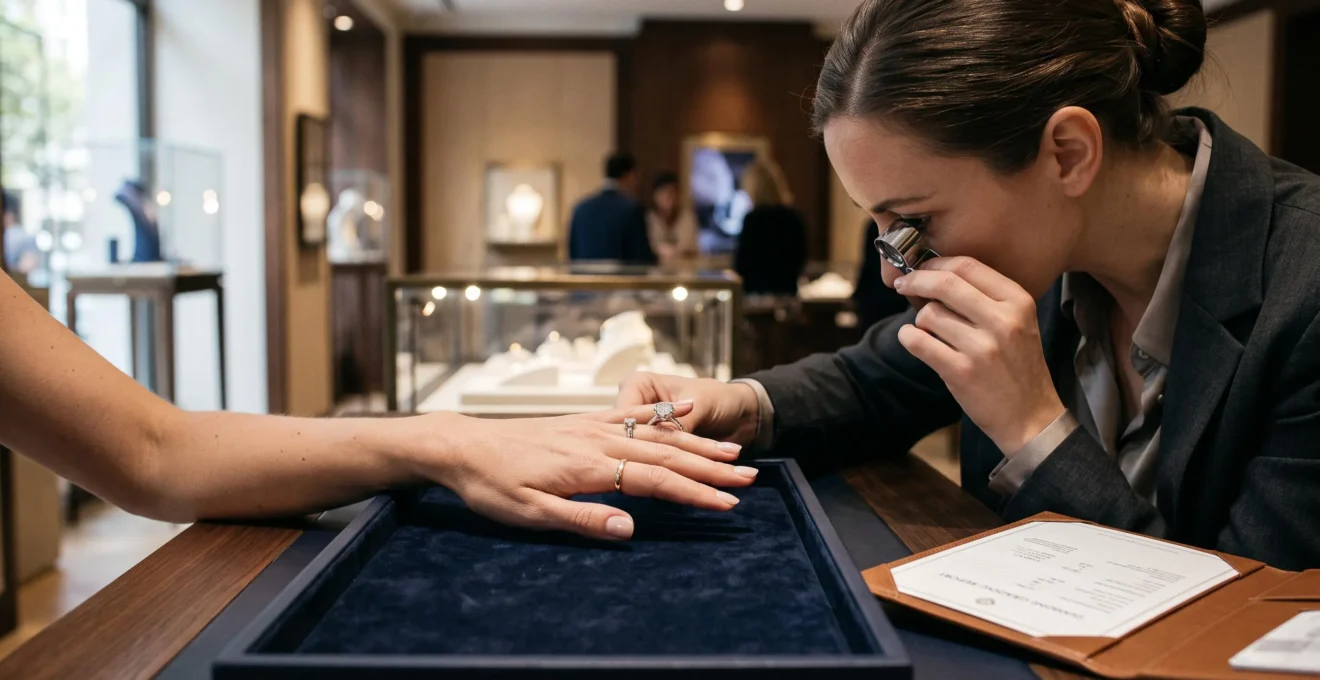
A magnificent gemstone can command attention in a display case yet disappoint when worn. Another, considerably smaller, may reveal extraordinary precision, balanced proportions and an ease of movement that makes it more compelling. Understanding the difference is central to buying high jewellery intelligently.
Carat weight describes mass, not beauty. Price reflects a combination of factors that may include gemstone characteristics, sourcing, design complexity, craftsmanship and the reputation of the maison. Neither figure tells a buyer whether the stone performs beautifully in ordinary light, whether the mounting is structurally convincing or whether the finished piece suits its intended wearer.
For UK buyers considering a significant acquisition, the most revealing questions concern the relationship between stone and setting, the quality of the execution and the likelihood that the jewel will actually be worn. Rarity deserves attention too, but it should be examined through documented gemstone characteristics and provenance rather than marketing language alone.
The objective is not simply to recognise an expensive jewel. It is to understand what makes a particular piece exceptional, what compromises its design entails and whether its qualities will remain meaningful long after the purchase.
High jewellery: what matters beyond the price tag
- Judge a gemstone through cutting quality, visual proportions, colour and performance under different lighting conditions, not carat weight alone.
- Examine construction, setting protection, balance and comfort; an impressive jewel should also be practical for its intended use.
- Choose between bespoke and established designs according to personal meaning, long-term wearability, documentation and maintenance requirements.
- Why Can a Smaller Stone Look More Impressive in High Jewellery?
- How to Check a High Jewellery Setting for Comfort and Security in 2 Minutes?
- Bespoke High Jewellery or Iconic Collection: Which Feels More Personal After 5 Years?
- The High Jewellery Buying Mistake That Leaves It in a Safe for Years
- When Should You Start a High Jewellery Commission if You Need It for a Major Event?
- How to Inspect a Gemstone in a Boutique Using 4 Simple Checks Under Spotlights?
- Bezel or Prong Setting: Which Works Better if You’re Hard on Your Hands?
- How Do You Design a Custom Jewellery Setting That’s Secure and Comfortable for Daily Wear?
Why Can a Smaller Stone Look More Impressive in High Jewellery?
A smaller gemstone can look more impressive when its cut, proportions and surrounding design create greater visual presence than a larger stone of less considered execution. Effective light return, balanced metalwork and carefully positioned supporting stones can make a modest centre stone visually commanding. Carat weight alone cannot describe these qualities.
The distinction begins with weight versus face-up appearance. Two diamonds of similar weight need not display identical visible dimensions. A cutter may preserve weight in areas that contribute relatively little to the stone’s apparent size, while another cutting arrangement may present a broader visible surface. Greater spread, however, is not automatically preferable: reducing depth excessively can compromise optical performance.
Research in GIA research on diamond cut quality establishes that proportions, brightness, fire, scintillation, polish and symmetry contribute to the assessment of standard round brilliant diamonds. The research also considers the relationship between weight and visible dimensions. Its conclusions should not be treated as a universal formula for fancy-shaped stones.
In high jewellery, the mounting extends this visual calculation. A well-proportioned centre stone can appear substantial when framed by carefully graduated side stones. Open gallery work and negative space may give the composition a lighter character, while metal contours direct attention towards the gem.
Consider a hypothetical comparison: one ring carries a large solitary stone in a heavy mounting, while another uses a smaller centre stone surrounded by tapered diamonds and restrained metalwork. The second may appear more sophisticated and visually cohesive, even though its centre gem weighs less.
The wearer’s anatomy matters as well. A stone that looks restrained on one hand may dominate another. Proportion is therefore a design judgement, not an absolute relationship between finger size and carats.
In a boutique, compare round and oval stones of comparable weight, then examine their visible dimensions and optical behaviour. A longer outline may create the impression of greater coverage without proving superior cutting quality. Ask to see each stone in diffuse light as well as under directed lighting.
A beautifully cut gem becomes genuinely exceptional when its proportions support the composition rather than compete with it. The next question is whether that composition is as successful against the skin as it is under glass.
How to Check a High Jewellery Setting for Comfort and Security in 2 Minutes?
A two-minute boutique check can reveal obvious comfort and wearability problems by combining a careful visual inspection with simple movement tests. Examine the edges, look for uneven or catching prongs, gently flex the hand and observe whether the jewel moves or snags. This preliminary assessment cannot certify gemstone security or replace a professional inspection.
Begin by examining the metalwork with the piece supported securely over the boutique counter. Look for sharp edges, rough finishing or irregular prong tips. With the consultant’s permission, gently feel the accessible edges using a fingertip, avoiding pressure on the gemstone or setting.
A well-finished ring should feel smooth against the skin. Prongs should appear properly formed and positioned against the stone, although visual neatness alone does not establish whether the gem is mechanically secure.
Next, assess the piece in motion. Make a relaxed fist, straighten the fingers and move the hand naturally. Notice any pressure where the head meets neighbouring fingers and whether the mounting repeatedly rotates away from its intended position.
Balance matters as much as total weight. A substantial ring can feel remarkably comfortable when its weight is distributed appropriately. Conversely, a relatively light design with a disproportionately prominent head may turn on the finger and require constant adjustment. Fit and finger shape also influence rotation.
With the boutique’s permission, move the ring lightly against a soft scarf or sleeve. This may expose protruding elements that catch fabric. Stop immediately if anything snags; pulling could damage the textile or disturb a delicate setting.
The GIA’s guide to engagement ring settings explains how prong and bezel constructions affect gemstone protection, appearance and maintenance. It also makes clear why construction quality matters beyond the setting’s general style.
Ask when the piece was last checked by a qualified jeweller and what the maison’s after-sales inspections include. Hidden fractures, fatigue in fine metalwork and inadequate stone seating may remain invisible during a short trial.
A piece that feels secure and comfortable during the trial has passed a useful preliminary test, not a technical certification. Once its construction is convincing, its long-term personal relevance becomes the next consideration.
Bespoke High Jewellery or Iconic Collection: Which Feels More Personal After 5 Years?
Bespoke high jewellery may become more personal over five years because its design preserves individual choices and memories of the commissioning process. An iconic collection piece can develop equally strong meaning through repeated wear, recognisable design and association with a particular maison. Neither route guarantees a deeper attachment; longevity depends on the wearer’s relationship with the jewel.
A bespoke commission begins with a conversation. The client may influence the stone selection, proportions, metal, symbolic details and final silhouette. Drawings and design decisions become part of the object’s history.
That process can be especially meaningful when the piece represents an individual story rather than a passing fashion preference. Yet personalisation alone does not make a design timeless.
An established collection offers a different attraction: the opportunity to own a recognisable expression of a jewellery house’s design language. A collection piece may feel increasingly personal through familiar styling, shared experiences and the occasions on which it is worn.
The choice also raises practical questions about documentation, insurance and potential resale.
| Consideration | Bespoke commission | Iconic collection |
|---|---|---|
| Personal expression | Developed through individual design choices | Developed through selection, styling and repeated wear |
| Design history | Commission records, drawings and approvals | Established collection identity and maison documentation |
| Potential resale | May require a more individual assessment and specialist buyer | Recognisability may help comparison with other market examples |
| Insurance valuation | Detailed specifications and a suitable valuation may be particularly important | Documentation and a current valuation remain essential |
| Future adaptability | Can be incorporated into the original design brief | Depends on the collection’s construction and available services |
An iconic design is not automatically a better investment, nor is bespoke jewellery necessarily difficult to insure. Market demand, gemstone quality, provenance, condition and documentation can substantially influence an individual piece’s value. Buyers should distinguish an insurance replacement valuation from an estimate of resale proceeds.
The most important long-term question is whether the jewel was designed for a life or merely for an event. A commission that perfectly matches one dress may feel inappropriate with everything else. Conversely, a design conceived around the wearer’s everyday aesthetic has more opportunities to acquire personal meaning.
A useful decision is to imagine the piece five years from now, away from the excitement of the original purchase. Would its appearance still feel relevant? Would the wearer choose it without being reminded of its brand or bespoke origins?
Personal attachment grows through experience as much as ownership. That makes actual opportunities to wear the jewel a vital part of the buying decision.
The High Jewellery Buying Mistake That Leaves It in a Safe for Years
The mistake is buying for the display case rather than the life the jewel will inhabit. A piece can be visually extraordinary yet so delicate, elaborate or occasion-specific that its owner rarely feels comfortable wearing it. The result is an acquisition admired in theory but largely absent from the experiences that might give it lasting personal value.
Boutique presentation naturally concentrates attention on the jewel’s most dramatic qualities. Directional lighting highlights gemstones, mirrors reinforce their visual impact and specialist displays allow the design to be appreciated in isolation.
None of these conditions necessarily resembles ordinary wear.
A tall ring head may catch sleeves. An elaborate necklace may demand a particular neckline. Delicate gemstones or exposed settings may make an owner reluctant to wear a piece during travel or crowded occasions.
Over time, the perceived risk of damage may outweigh the pleasure of wearing the jewellery. This does not mean the jewel has lost its material value. Rather, its intended role as a wearable object has become disconnected from its owner’s life.
The three-occasion test offers a straightforward preventive measure: before committing, identify three realistic occasions within the next twelve months when the piece would be worn. Describe the setting, outfit and likely activities rather than imagining a vaguely glamorous future event.
If no convincing occasions emerge, examine whether the design is too formal, too fragile or simply incompatible with the buyer’s preferences.
Wearability can sometimes be improved through deliberate engineering. Depending on the design, a maison may offer detachable elements, convertible arrangements, more protective gemstone settings or fastening systems suited to different modes of wear.
These features should be evaluated for structural reliability and convenience, not accepted merely because they sound versatile. A complicated conversion mechanism may be less attractive if it is difficult to operate or requires repeated professional assistance.
For collectors who deliberately acquire jewellery as art rather than for frequent wear, occasional use may be entirely appropriate. The distinction is whether that outcome was intentional.
High jewellery need not be worn every day to justify its place in a collection. Its intended purpose should nevertheless be clear before commissioning begins, especially when a fixed occasion is approaching.
When Should You Start a High Jewellery Commission if You Need It for a Major Event?
Start a high jewellery commission as soon as the event date, desired design and essential gemstone requirements are known. There is no reliable universal lead time: sourcing an unusual stone, developing the design, manufacturing the mounting and arranging fittings can create different schedules. For a fixed date, feasibility should be established before detailed aesthetic decisions are made.
A commission involves several interdependent stages. Initial discussions establish the brief, design sketches translate that brief into a proposed jewel, and digital or physical models may help clarify dimensions and construction.
Stone selection may run alongside design development or determine what can realistically be made. Rare combinations of colour, size, shape and quality can constrain the choices available. However, sourcing is not necessarily the longest phase in every project; workshop capacity and design complexity may be equally significant.
Once the principal decisions are approved, the mounting must be produced, gemstones set and surfaces finished. Depending on the piece, fitting and final adjustments may follow.
For a commission tied to a wedding, anniversary or formal occasion, it is useful to plan backwards from the date on which the jewel must be ready, including any final inspection and collection arrangements.
The critical question is not simply when the workshop expects completion, but which decisions must be approved by which dates to protect that delivery schedule.
Five actions before confirming a high jewellery commission
- Confirm the event deadline. Record the required collection date, leaving room for a final fitting and any agreed adjustments.
- Define the essential requirements. Prepare a written brief distinguishing non-negotiable gemstone and design characteristics from flexible preferences.
- Request the production sequence. Obtain a proposed schedule identifying design approval, stone selection, manufacturing and fitting stages.
- Agree on decision milestones. Record the dates by which the client must approve the design, gemstone and any subsequent changes.
- Clarify contingency options. Ask what could be changed if sourcing or production is delayed, and obtain written confirmation of the agreed approach.
Schedule estimates should come from the maison responsible for the actual work, not from generic assumptions about how long bespoke jewellery takes. A simple design using an available gem and an elaborate commission requiring an exceptionally specific stone may have entirely different constraints.
Deadline pressure can also compromise judgement. A client may accept a stone with less desirable proportions or abandon an important design feature simply because there is insufficient time to explore alternatives.
Where the event date cannot move, an honest discussion about flexibility is more valuable than an ambitious delivery promise. It may be preferable to choose an existing piece or a less complex design rather than rush an important commission.
A successful schedule protects the quality of the decisions as well as the delivery date. Chief among those decisions is whether the selected gemstone deserves its place at the centre of the design.
How to Inspect a Gemstone in a Boutique Using 4 Simple Checks Under Spotlights?
Inspect a gemstone through four complementary checks: examine its colour against a neutral background, compare its appearance under directed and diffuse lighting, request magnification and assess it near natural light. These observations reveal aspects that boutique spotlights can conceal or exaggerate. They support informed questions but cannot replace professional identification or laboratory assessment.
Check 1: Look at colour against a neutral surface. Ask the consultant to show the gemstone, where practical, against a plain white or neutral background. Observe the colour face-up and as the stone is carefully tilted. Look for changes in saturation, areas of different colour intensity and the general consistency of its appearance.
Some colour variation is characteristic of particular gemstones. A neutral background may help observation, but background colour alone cannot establish an objective colour grade.
Check 2: Compare directed and diffuse light. Boutique spotlights can produce striking flashes that make a diamond particularly lively. Examine whether the stone remains visually appealing when the lighting is softer and less directional.
Brightness, fire and scintillation describe different aspects of diamond appearance. A coloured gemstone may instead be appreciated primarily for its hue, saturation and the way its cut displays colour. The same lighting judgement should not be imposed indiscriminately on every material.
Check 3: Request a loupe or magnified view. Ask the consultant to identify visible inclusions, surface-reaching features or possible damage. Particular attention may be warranted around the girdle and exposed edges.
A buyer should not assume that an unfamiliar inclusion is harmless or dangerous simply because of how it appears under magnification. Its significance depends on the material, location, nature and extent of the feature.
Check 4: Observe the gemstone near daylight. If the boutique permits, compare its appearance near a window with its appearance beneath the display lighting. This can reveal whether the colour or sparkle that initially attracted attention remains satisfying in a more familiar environment.
The point is not that daylight is universally the ideal light for every gemstone, but that a serious purchase deserves observation under more than one condition.
The GIA’s coloured gemstone examination procedures explain how laboratory gemologists use controlled lighting, microscopy and specialised techniques to investigate colour, inclusions, treatments and identity.
These procedures are more sophisticated than a consumer boutique check. Their value for buyers lies in demonstrating why optical conditions and professional examination matter.
Ask for any available independent laboratory report and confirm that its identifying information corresponds to the gemstone offered. Depending on the material and report, it may document identity, treatments and geographic origin where determinable. Not every report contains the same conclusions, and a report does not establish the security of the jewellery mounting.
Gemstone beauty should survive changes in lighting, while claims about identity and treatment deserve appropriate documentation. Once the stone has been evaluated, attention can turn to the metalwork that must protect it.
Bezel or Prong Setting: Which Works Better if You’re Hard on Your Hands?
A bezel setting is often worth considering for someone whose hands regularly encounter knocks because its metal rim surrounds and protects the gemstone’s edge. Prong settings expose more of the stone and can create a lighter appearance, but protruding claws may catch or become damaged. Neither design guarantees security; construction quality and lifestyle remain decisive.
A bezel uses a continuous or substantially surrounding metal rim to hold the gem. This can help shield vulnerable edges from direct contact, particularly in a relatively low-profile design.
Prongs secure a stone at individual contact points. This arrangement leaves more of the gemstone visible and can give the composition an open, delicate character. Its exposed elements, however, require attention to shape, positioning and maintenance.
The difference becomes practical when the wearer’s hands frequently encounter doorframes, luggage, work surfaces or equipment. A raised head may be knocked regardless of setting type, while projecting prongs may catch on textiles or hair.
Setting choice should therefore consider the types of contact most likely to occur rather than treating one construction as universally superior.
| Criterion | Bezel setting | Prong setting |
|---|---|---|
| Gemstone edge protection | Metal surrounds much or all of the edge | Protection is concentrated at contact points |
| Stone visibility | More of the outline may be covered | More of the stone generally remains exposed |
| Snagging potential | A smooth, low-profile rim can reduce catching | Protruding or damaged prongs may catch fabric |
| Appearance | Defined metal outline, potentially more substantial | Open appearance with less surrounding metal |
| Maintenance | Requires examination of rim condition and stone security | Requires attention to prong wear, shape and tightness |
Bezels also involve compromises. Their surrounding metal can alter the apparent outline of a gem, and certain designs may restrict access for cleaning or require specialist work for repairs. The precise implications depend on construction and gemstone characteristics.
Prong settings may be preferable where the design relies on an unobstructed view of the stone. The relevant question is whether their exposure is acceptable for the intended frequency and circumstances of wear.
Hybrid approaches can provide an alternative. Partial bezels protect selected portions of a gemstone while leaving other areas visible. V-shaped prongs may help protect vulnerable pointed tips on pear or marquise cuts, while gallery rails can contribute to a mounting’s structural arrangement.
Start by identifying the two most frequent hazards in everyday life. Someone regularly handling fabrics may prioritise snag resistance; someone exposed to frequent impacts may place greater emphasis on a low-profile, protective construction.
Physical activities that create significant impact or pressure may still require removing the jewellery, whatever its setting. No design should be presented as damage-proof.
Once these risks are understood, the setting can be engineered around the wearer instead of forcing the wearer to adapt unnecessarily to the jewel.
What to establish before designing a setting
- Identify the wearer’s most frequent physical risks and agree which ones the design should minimise.
- Evaluate gemstone fragility and exposed edges before choosing a mounting for visual reasons.
- Use a three-dimensional model and physical fitting to assess profile, balance and practical comfort before final production.
How Do You Design a Custom Jewellery Setting That’s Secure and Comfortable for Daily Wear?
A secure, comfortable custom jewellery setting begins with the wearer’s lifestyle rather than the gemstone’s appearance. The designer should consider hand movements, occupation, daily activities, sensitivities and the stone’s physical characteristics. Sketches, three-dimensional modelling and fittings then help refine height, proportions, weight distribution and protective details before the piece is completed.
The first stage is a detailed brief. A designer should understand whether the ring will be worn during desk work, frequent travel or other activities involving repetitive contact. Handedness, finger shape, fit preferences and any relevant metal sensitivities can inform the discussion.
Next comes the translation of those requirements into a design. Initial sketches establish the visual concept, while CAD modelling can help assess dimensions, the relationship between head and shank and the feasibility of different construction approaches.
Physical prototypes or wax models may make the proposed form easier to judge. A design that looks perfectly balanced in a rendering may feel disproportionately tall, broad or intrusive when tried against the hand.
Comfort must be designed into the structure. Rounded inner edges can reduce irritating contact, while suitable band proportions and an appropriately balanced head can help limit unwanted rotation. The fit, overall weight and geometry should be considered together rather than independently.
For someone working regularly at a desk, a lower-profile head may be preferable to a dramatically elevated mounting. For an especially substantial stone, the designer may need to reconcile visual openness with adequate support and a comfortable shank.
Gemstone properties are equally important. Diamond and sapphire offer comparatively strong resistance to scratching, but this does not make them immune to chipping or impact damage. Emeralds may require particular consideration because of inclusions and fractures, while materials such as opal and tanzanite can impose different durability constraints.
A knowledgeable jeweller should explain how those characteristics influence the appropriate setting and wearing advice. A mounting suitable for one gemstone should not automatically be reproduced for another.
The design process also requires manufacturing judgement. The GIA jewellery design education framework describes the use of CAD, physical prototyping, proportion, balance and engineering principles in developing durable and comfortable jewellery. These are useful design disciplines, although they do not guarantee that any particular commission will perform successfully.
Before final production, request a fitting or suitable model review when the maison’s process allows it. Evaluate the ring from the side as well as face-up, check neighbouring finger clearance and discuss how the mounting will be inspected, cleaned and maintained.
The finished piece should bring together the qualities considered throughout the buying process: a gemstone selected for beauty rather than weight alone, a proportionate composition, convincing construction and a level of wearability appropriate to the owner’s actual life.
Before approving a commission, ask the jeweller to explain the reasoning behind the stone selection, setting geometry, fitting decisions and maintenance recommendations. The ability to explain these choices clearly is one of the most useful signs that craftsmanship, rather than spectacle alone, is guiding the design.
Does a higher price always indicate better high jewellery craftsmanship?
No. Price can reflect gemstone rarity, design complexity, materials, brand positioning and other commercial considerations. Craftsmanship should be assessed through finishing quality, precision of setting, structural design, comfort and the consistency of execution. A higher price does not by itself establish superiority in each of those areas.
How can you assess gemstone rarity without relying on a salesperson’s description?
Request precise gemstone specifications and available independent laboratory documentation. Depending on the gemstone, relevant characteristics may include size, colour, clarity, treatments and origin where determinable. Rarity should be considered in relation to a clearly defined combination of characteristics, not accepted as an unsupported general claim. Laboratory identification does not automatically establish market rarity or monetary value.
Should you request an independent valuation before insuring an expensive jewel?
For a significant acquisition, a suitably qualified independent valuation may help establish the information required for insurance. Confirm the insurer’s documentation and valuation requirements, including any need for periodic updates. An insurance replacement valuation serves a different purpose from an estimate of what the jewel might achieve on resale.
Can a high jewellery piece be altered after purchase?
Some pieces permit resizing, fastening adjustments or modifications to particular components, but feasibility depends on the construction, gemstone arrangement and design. Alterations may affect appearance or structural integrity. Consult the original maison or a suitably qualified specialist before authorising work, and establish whether the modification has implications for servicing or any applicable warranty.
What documentation should accompany a significant high jewellery purchase?
Useful records include a detailed invoice, a description of the gemstones and materials, available laboratory reports, provenance information where substantiated, and the maison’s care and servicing terms. For bespoke work, retain approved specifications and relevant commissioning documentation. Keep the records securely and separately from the jewellery where practical, so they remain accessible for future insurance, maintenance or resale enquiries.