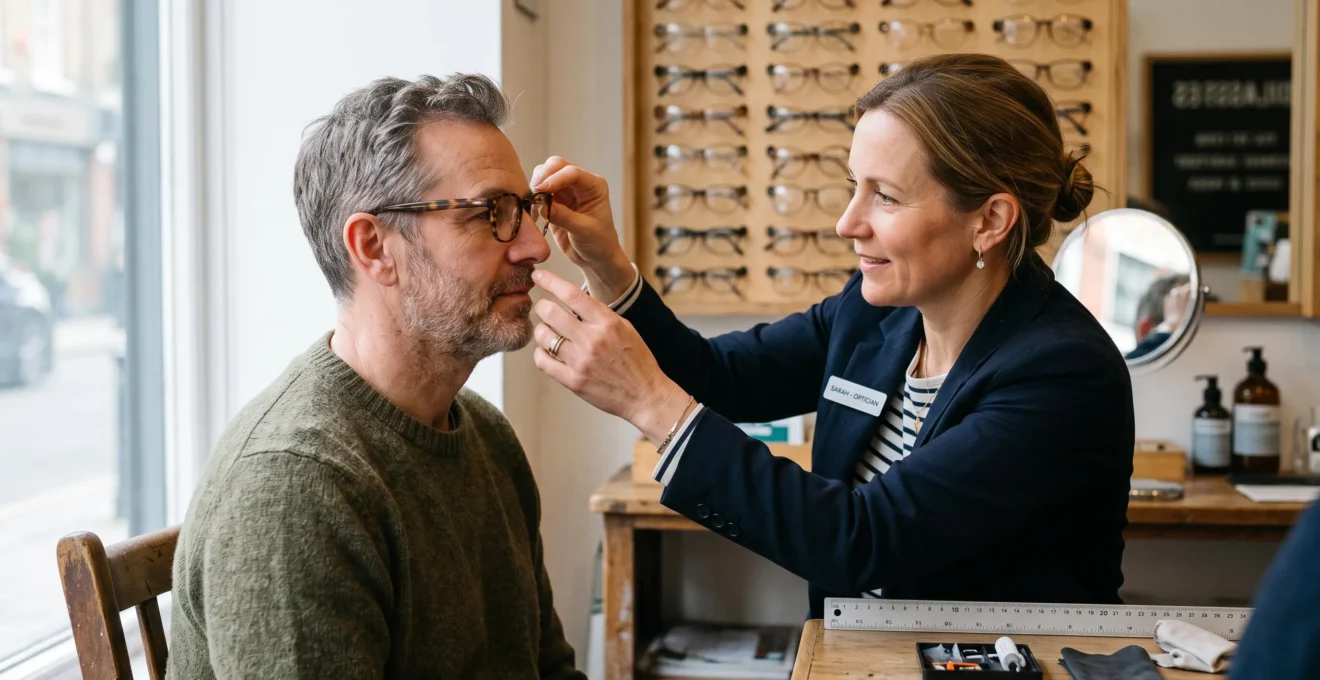
Designer eyewear should do more than carry a recognisable name. The right frames balance your facial proportions, distribute their weight comfortably and position your prescription lenses correctly. A beautifully finished pair that slides down your nose, presses behind your ears or makes your face look disproportionately wide is not a successful purchase, however prestigious the label.
For UK buyers, choosing glasses becomes easier when the process starts with fit rather than fashion. Frame width, bridge shape, temple length, lens depth and material all influence what happens after several hours of wear. Even two frames with identical measurements can feel noticeably different.
The most reliable approach is to assess facial proportions, test comfort while moving and have the chosen frame professionally fitted before prescription lenses are ordered. This turns designer eyewear into a practical investment in appearance and everyday usability, rather than a purchase based on a photograph or logo.
Designer eyewear: the essentials
- Choose frame proportions that balance your face, then verify their appearance in a mirror and photographs taken from a realistic distance.
- Check pressure, bridge contact, temple grip, stability and eye alignment before committing to prescription lenses.
- Prioritise durable construction, professional adjustability and lens compatibility over the brand name or frame material alone.
- Why Can the Wrong Glasses Make Your Face Look Wider in Photos?
- How to Test Eyewear Fit in 5 Checks So You Don’t Get Headaches?
- Acetate or Metal Frames: Which Last Longer for Everyday Use?
- The Eyewear Buying Mistake That Costs You Twice at the Optician
- When Should You Replace Lenses Instead of Buying New Frames?
- Why Can a £200 Outfit Look Cheap When the Proportions Are Wrong?
- Comfort or Clean Lines: Which Fit Priority Matters Most for All-Day Wear?
- How Can Bespoke Fit Solve Comfort Issues That Standard Sizes Never Fix?
Why Can the Wrong Glasses Make Your Face Look Wider in Photos?
Glasses can make your face appear wider when their outer edges extend too far beyond your temples, creating a broader visual outline than your natural facial proportions. An unsuitable lens shape can produce a similar impression even when the frame width is correct. Close-up photographs may further distort facial proportions, making a single selfie an unreliable styling test.
The first consideration is the relationship between the frame’s widest point and the widest part of your face. If the outer frame corners sit noticeably beyond your temples, they can visually extend your facial silhouette. Frames that are excessively narrow may instead create compression or emphasise facial width through contrast.
Assess proportions using three reference lines: the eyebrows, cheekbones and jaw. A frame should relate coherently to these features rather than being judged as an isolated object. Its upper edge influences the brow line, while its lens depth and lower contour affect the visual balance of the cheeks.
According to ABDO’s advice on choosing and fitting spectacle frames, frame width should broadly match face width, with the spectacles sitting level and without excessive pressure at the temples. This is practical fitting guidance, not a universal rule that everyone must wear one particular shape.
A frame that appears too wide is not always physically oversized. For example, a correctly sized rectangular frame with strongly projecting corners may create a wider appearance on a face that looks more harmonious with softer contours. The correction may be a different lens shape, rather than a narrower bridge or smaller overall frame.
Photography adds another variable. A study published in Laryngoscope, involving 12 subjects, found that short camera-to-face distances distorted midfacial proportions. Smartphone photographs taken at eight inches showed an 18% increase in the study’s measured midfacial distortion compared with its reference condition. That result concerns facial landmarks, not an 18% increase in face width or a demonstrated effect of glasses.
The Laryngoscope study on facial distortion in digital photography therefore supports a useful precaution: avoid evaluating eyewear solely through an arm’s-length selfie.
Instead, ask someone to photograph you from several steps away, with the camera approximately at eye level. Compare two frames using similar lighting, distance and head position. Then confirm the result in a mirror, where you can also assess the frame’s actual fit.
Once the shape looks balanced, the next test is whether that same frame remains comfortable and stable throughout the day.
How to Test Eyewear Fit in 5 Checks So You Don’t Get Headaches?
Test eyewear fit by checking pressure behind the ears, contact at the nose, temple-arm tension, stability during movement and the position of your eyes within the lenses. These five checks can identify common mechanical fitting problems before purchase. They cannot, however, establish the cause of every headache, particularly when prescription lenses are involved.
A frame should rest securely without depending on uncomfortable pressure. Excessively tight temples may cause soreness around the sides of the head or behind the ears. Conversely, temples that barely contact the head may allow the glasses to move whenever you look down.
The bridge deserves equal attention. Plastic frames need an appropriate contact area on the nose, while adjustable nose pads on many metal designs allow more targeted positioning. Persistent sliding can suggest a bridge mismatch, inadequate grip or unsuitable weight distribution; it does not automatically mean the entire frame is too large.
Temple length also matters. Arms should follow the sides of the head comfortably and curve appropriately behind the ears. A frame can have a suitable front width yet remain uncomfortable because its arms are too short, incorrectly curved or excessively tight.
Eye alignment provides the fifth assessment. Your pupils should sit in appropriate positions within the selected frame, although the required optical centration depends on the prescription and lens design. An optician must verify these measurements rather than relying solely on appearance.
The five-check eyewear fitting test
- Check pressure behind your ears. Wear the frame and note any pinching or soreness. Record which side is affected and its exact location.
- Inspect nose contact. Check whether the bridge or pads sit evenly. After removal, note persistent, painful pressure or pronounced marks rather than assuming every temporary impression indicates a poor fit.
- Observe temple grip. Look in a mirror for arms that visibly flare out or press inwards. Record whether they feel secure, excessively tight or loose.
- Test stability in motion. Look down at your phone, turn your head and walk normally. Note whether the frame slips, tips forward or needs repeated repositioning.
- Verify eye positioning. Check that the frame sits level, then ask the optician to confirm pupil positioning and the measurements needed for your prescribed lenses. Record whether the optical fit is approved.
As an additional practical trial, wear the frames for approximately 15 minutes while performing ordinary movements. This is a proposed shopping test, not a clinically validated diagnostic protocol. It helps reveal problems that may be invisible during a quick mirror check, although longer-term comfort cannot be guaranteed by a short trial.
Importantly, new-glasses headaches are not necessarily caused by the frame. Prescription changes, progressive lens adaptation, incorrect lens positioning or other vision-related issues can contribute to symptoms. If discomfort persists, have both the frame fit and prescription lenses checked by an appropriate eye-care professional.
A successful fit also depends on construction. Materials influence the frame’s weight, flexibility and ability to retain adjustments over time.
Acetate or Metal Frames: Which Last Longer for Everyday Use?
Neither acetate nor metal frames automatically last longer. Durability depends on construction quality, hinge design, adjustment, maintenance and everyday handling. Acetate offers substantial styling possibilities and can often be professionally reshaped, while metal designs may offer a lighter profile and adjustable nose pads. Both can fail through wear, bending or damage at structural weak points.
Acetate is widely used for substantial, sculpted frames. Its thickness allows designers to create pronounced colours, patterns and contours. Some acetate frames can also be professionally polished or heat-adjusted, although the appropriate procedure depends on their construction and condition.
Metal frames generally offer slimmer profiles and can be lighter, depending on the alloy and overall design. Adjustable nose pads may make them especially useful when a fixed plastic bridge does not contact the nose appropriately.
The longevity question is better understood through potential failure points. Acetate can crack around stressed areas, particularly after damage or inappropriate adjustment. Metal frames can bend, develop loose connections or suffer damage at joints. Neither observation establishes a universal lifespan advantage for one material.
Before comparing brands, inspect the hinges, their attachment to the frame and the consistency of the finish. Ask whether the chosen design can be professionally adjusted and what repair options are available if a component becomes damaged.
The following comparison helps connect material choice with practical daily needs.
| Consideration | Acetate | Metal |
|---|---|---|
| Appearance | Often thicker, sculptural and visually prominent | Often finer, lighter-looking and understated |
| Weight | Depends on frame thickness and lens size | Can be lighter, depending on alloy and construction |
| Adjustment | May require controlled heating by an optician | Many designs permit targeted mechanical adjustment |
| Nose contact | Often uses an integrated bridge | Many models have adjustable nose pads |
| Skin sensitivity | A non-metal alternative for some wearers | Alloy composition matters, particularly with nickel sensitivity |
| Potential damage | Cracking, hinge-related damage or deformation | Bending, joint damage or metal fatigue |
Material composition becomes especially important for people with sensitive skin. DermNet‘s medical information on nickel allergy identifies spectacle frames as a possible source of nickel exposure. People with nickel contact allergy may need suitable non-metal or verified nickel-free alternatives. Not every metal frame contains nickel, and the word “hypoallergenic” alone does not identify a product’s complete composition.
Climate and habits matter too. Frames regularly exposed to heat, moisture, perspiration or rough handling need appropriate care. Avoid leaving spectacles in unusually hot environments, and have adjustments performed by someone familiar with the material.
Once you understand the material, the next financial consideration is whether the frame has been properly fitted before the lenses are manufactured.
The Eyewear Buying Mistake That Costs You Twice at the Optician
The costly mistake is ordering prescription lenses before confirming that the chosen frame fits properly and suits the prescription. If the frame later proves unsuitable, the buyer may face extra adjustment costs, replacement lenses or another frame purchase. These expenses are not inevitable, but resolving fit and optical compatibility before lens manufacture reduces avoidable risk.
Consider a hypothetical buyer who orders an attractive designer frame online without checking the bridge, temples or lens depth. Once prescription lenses are fitted, the glasses repeatedly slide down the nose. The optician discovers that the bridge shape cannot be adjusted sufficiently for a secure fit.
The customer may then need a different frame. Whether the existing prescription lenses can be transferred depends on the new frame’s size, shape, mounting system and optical requirements. A lens cut for one design is not necessarily reusable in another.
This is particularly relevant for progressive lenses. Varifocals contain multiple viewing zones, so the frame’s dimensions and the position of the lenses relative to the eyes matter. Changing the frame after fitting can affect how those zones align with the wearer.
ABDO‘s guidance on spectacle lenses explains that personalised optical fitting may involve measurements of eye position, frame geometry and how the glasses sit in front of the eyes. The chosen frame is adjusted before measurements are taken for certain lens designs, and the completed spectacles are subsequently checked for correct positioning.
Before approving a purchase, confirm the following with the dispensing optician:
- Whether the frame can be returned or exchanged before and after prescription lenses are fitted.
- Whether professional fitting adjustments are included or charged separately.
- Whether existing lenses could be reused if the frame needed changing.
- Whether pupillary distance, fitting height and any other necessary measurements will be taken using the actual selected frame.
- What happens if the finished spectacles require a lens or fitting correction.
Do not assume every lens adjustment requires remanufacture. Minor frame adjustments are routine, and some lenses can be reused when the replacement frame is compatible. The financial outcome depends on the particular lenses, frame and retailer’s terms.
There is also an optical consideration beyond the initial purchase price. If the frame sits in a different position from the one used for its measurements, the wearer’s experience may change, particularly with more individually specified lenses. A cheap replacement frame is not necessarily an economical solution if it compromises lens positioning.
When a well-fitting frame is already available, replacing only its lenses may offer a more economical and sustainable alternative.
When Should You Replace Lenses Instead of Buying New Frames?
Replace the lenses rather than the entire glasses when the frame remains structurally sound, fits comfortably and can safely accommodate the required prescription. Lens replacement may be appropriate after a prescription change, significant scratching, coating deterioration or a useful lens upgrade. Replace the frame when structural damage, worn components or an uncorrectable fit problem makes continued use unreliable.
The first question is whether the frame still performs its basic job. Check for cracks around the bridge, loose hinges, deformation, excessive wear and persistent sliding. A frame that once fitted perfectly may gradually lose its adjustment after repeated handling.
Next, establish whether the proposed lenses are compatible. Prescription strength, lens thickness, frame dimensions, curvature and mounting construction can influence what is practical.
Full-rim frames may offer more straightforward options in some situations, while rimless or tension-mounted designs can require additional care. However, mounting style alone cannot establish whether a particular frame is suitable for reglazing.
The decision becomes clearer when the causes are separated.
| Situation | Preferred assessment | Reason |
|---|---|---|
| Prescription has changed | Assess lens replacement | The existing frame may remain suitable |
| Scratches interfere with vision | Assess lens replacement | The issue may be limited to the lenses |
| Lens coatings have deteriorated | Assess lens replacement | New lenses may restore clarity |
| Frame bridge is cracked | Assess repair or frame replacement | The frame may no longer support lenses safely |
| Hinges are worn or unstable | Assess repairability first | New lenses may be wasted if the frame fails |
| Frame cannot be adjusted to fit | Consider a different frame | Changing lenses does not correct dimensional mismatch |
For cost, compare an actual reglazing quotation with the cost of a complete replacement pair offering equivalent lens specifications. Include fitting services and any relevant guarantees rather than comparing frame prices alone.
Reglazing can become false economy when the original frame is near the end of its usable life. A damaged hinge or weakened bridge may create a risk of future failure, even if the new lenses themselves are excellent.
Keeping a comfortable, serviceable frame also avoids treating spectacles as disposable fashion. The most sustainable option is not always buying a new product: maintaining a frame that fits well and replacing only what is necessary can extend its useful life.
The same principle applies to clothing and accessories: long-term value often comes from proportion, fit and continued usability rather than the prestige of the original purchase.
Why Can a £200 Outfit Look Cheap When the Proportions Are Wrong?
A £200 outfit can look less polished than a modestly priced alternative when its proportions work against the wearer’s body shape. Oversized shoulders, unsuitable lengths or accessories that dominate the silhouette can disrupt visual balance. Eyewear follows the same principle: a designer frame may be expensive yet look awkward if its size and lines do not complement the face.
Clothing and eyewear both influence the outlines by which people perceive proportion. A jacket’s shoulder line affects how broad the upper body appears; similarly, a spectacle frame’s outer corners can influence the perceived width of the face.
Because glasses sit close to the eyes, they occupy a visually important position during conversations and portraits. The frame’s colour, thickness, upper edge and lens shape can all affect the overall impression.
This is not evidence that observers universally judge expensive clothing as cheap when it fits poorly. Style assessments are subjective and culturally influenced. The practical lesson is that a product’s price does not guarantee harmony with the individual wearing it.
Try assessing eyewear as a tailor might assess a garment. Rather than concentrating on decorative details, look at the main structural lines:
- Brow line: Does the frame’s upper edge visually complement the eyebrows?
- Cheekbone line: Does the lens depth balance the middle of the face without appearing disproportionate?
- Jaw line: Does the overall frame shape work with the face’s angularity or softness?
- Overall scale: Is the frame proportionate to the wearer rather than merely fashionable in isolation?
Imagine two hypothetical outfits. One combines a premium oversized jacket with spectacles that extend considerably beyond the face. The other uses simpler clothing, appropriately fitted shoulders and frames that align comfortably with the face. The second combination may appear more coherent despite having less expensive individual components.
Apply this transfer test to your wardrobe as well. Compare shoulder width, garment length and accessory scale rather than judging each item independently. The aim is consistency of proportion, not rigid rules about which face shapes must wear particular glasses.
However, visual harmony is only one part of everyday style. A pair of glasses must also remain wearable throughout the activities for which it was purchased.
Comfort or Clean Lines: Which Fit Priority Matters Most for All-Day Wear?
Comfort should take priority when choosing eyewear for all-day use, provided the frame also meets the necessary optical requirements. Clean lines matter aesthetically, but a frame that causes pain or needs constant repositioning is poorly suited to daily life. Fortunately, correctly fitted glasses often look more balanced because they sit level, remain stable and avoid visible distortion from excessive tension.
The apparent conflict between appearance and comfort is frequently created by treating a frame as a static fashion object. Glasses are worn while walking, reading, working, speaking and looking down. A design that appears elegant in a showroom may behave very differently during an ordinary working day.
Pressure can also become more noticeable with prolonged wear. A small contact problem at the bridge or behind the ears may initially seem manageable, yet become increasingly distracting during extended use.
Instead of making a final decision based on the most attractive frame in a photograph, use a two-stage filter.
- Establish fit and optical suitability. Exclude frames that remain painful, unstable or incompatible with the required lenses after appropriate assessment.
- Choose the preferred appearance. Among suitable frames, compare lens shape, colour, thickness and visual balance.
This method makes style an informed choice rather than an excuse for discomfort. It also avoids the mistaken assumption that all slim metal frames are comfortable or that all substantial acetate designs are heavy.
Wear duration changes the decision. Someone choosing glasses for occasional photographs or brief events may reasonably place greater emphasis on dramatic design. A person wearing prescription spectacles throughout a full working day has different practical requirements.
That exception should not justify pain, poor optical positioning or unsafe fit. Even occasionally worn frames should remain appropriate for the wearer’s prescription and intended activities.
Where two designs fit equally well, clean lines can become the deciding factor. For example, one frame might follow the eyebrow line more naturally, while another adds more contrast and visual character. Neither is automatically superior; the choice depends on the desired effect.
If repeated adjustments still fail to deliver that combination of comfort and stability, the problem may lie with the limits of standard frame sizing rather than the styling choice.
Key takeaways before considering bespoke eyewear
- Identify the exact fit problem before paying for a different or custom-made frame; discomfort has multiple possible causes.
- Ask which measurements and adjustments the proposed solution can actually change, rather than assuming a custom label guarantees comfort.
- Separate mechanical fit from prescription and lens-positioning problems, because each requires a different type of correction.
How Can Bespoke Fit Solve Comfort Issues That Standard Sizes Never Fix?
Bespoke eyewear can help when standard frames repeatedly fail to accommodate a person’s particular combination of facial dimensions. Custom sizing or targeted professional adjustments may improve bridge contact, temple positioning, frame angle and stability. However, made-to-measure frames cannot correct an inaccurate prescription, inappropriate lens design or every cosmetic mismatch between a frame shape and the face.
Mass-produced eyewear is manufactured in predetermined dimensions. Frame labels commonly show lens width, bridge measurement and temple length, yet those figures describe only part of how the glasses interact with the wearer’s face.
People do not all have the same relationship between head width, ear position, nose shape and cheekbone structure. Someone may find that one frame fits at the bridge but presses against the temples, while a larger model feels comfortable at the sides but slides down the nose.
Professional adjustment can resolve many such issues without full bespoke manufacture. Depending on the frame, an optician may be able to modify nose-pad positions, temple curvature, arm alignment and the angle at which the frame sits relative to the face.
When those changes are insufficient, a made-to-measure design may offer more control over the underlying geometry. The relevant dimensions can include the bridge shape, temple length and curve, lens positioning and the relationship between frame front and head width.
The distinction between adjustment and bespoke manufacture matters. Heating and reshaping an existing acetate temple is a professional fitting intervention, not the same as producing a new frame to an individual’s measurements. Both may be useful, but their capabilities and costs differ.
Before requesting a custom solution, document your experience. Record which part of the frame causes discomfort, whether it happens on one side or both, how long the glasses can be worn before symptoms begin and whether the problem changes with movement.
For example, a hypothetical wearer might report that several standard frames remain stable while seated but slip whenever they look down, despite repeated adjustments. This points the fitting discussion towards bridge support, frame balance and temple stability. It does not establish in advance that a bespoke frame is necessary.
A dispensing optician can assess which modifications are realistic and whether an alternative standard frame might already offer a better fit. For persistent headaches, blurred vision or difficulty using particular viewing zones, the prescription and optical fitting should also be reviewed rather than assuming the solution is entirely mechanical.
Bespoke eyewear is most valuable when its design responds to a documented problem. Customisation for its own sake does not guarantee better comfort, durability or appearance.
Take those observations, together with your current glasses and prescription details, to a qualified dispensing optician. Ask for a fit assessment and a comparison of adjustment, alternative standard frames and bespoke options. The right designer eyewear is the pair whose proportions, construction and optical positioning work for your face throughout its intended use.
Can expensive designer glasses still fit badly?
Yes. A premium brand does not guarantee that its frame width, bridge shape or temple length will suit your face. Materials and workmanship may be excellent, but the frame must still be individually assessed and adjusted. Prioritise fit and lens compatibility before considering the label.
Do the numbers printed inside spectacle arms guarantee the correct fit?
No. The three common measurements identify lens width, bridge size and temple length. They do not fully describe bridge contour, frame curvature, nose contact or how the arms sit against your head. Two frames displaying identical measurements can fit differently.
Should new glasses feel tight before they loosen?
New glasses should feel secure without painful pressure. Do not rely on discomfort disappearing as the frame ages. If the arms pinch, the bridge hurts or the glasses leave persistent pressure marks, ask the optician to assess and adjust them. Some optical adaptation can be normal with new prescriptions, but mechanical pain should not be treated as a necessary adjustment period.
Can a UK dispensing optician adjust frames bought online?
An optician may be able to adjust online-purchased frames, depending on their material, design and condition. Acceptance, charges and responsibility for possible damage depend on the individual practice’s policy. Contact the practice before attending, and bring the frame and relevant prescription information if optical fitting is also required.
Are lighter glasses always more comfortable for all-day wear?
Not necessarily. Overall weight matters, but so does how it is distributed across the nose and ears. A lightweight frame with a poorly fitted bridge can be less comfortable than a slightly heavier design with better support. Lens size, prescription and frame balance should be assessed together.