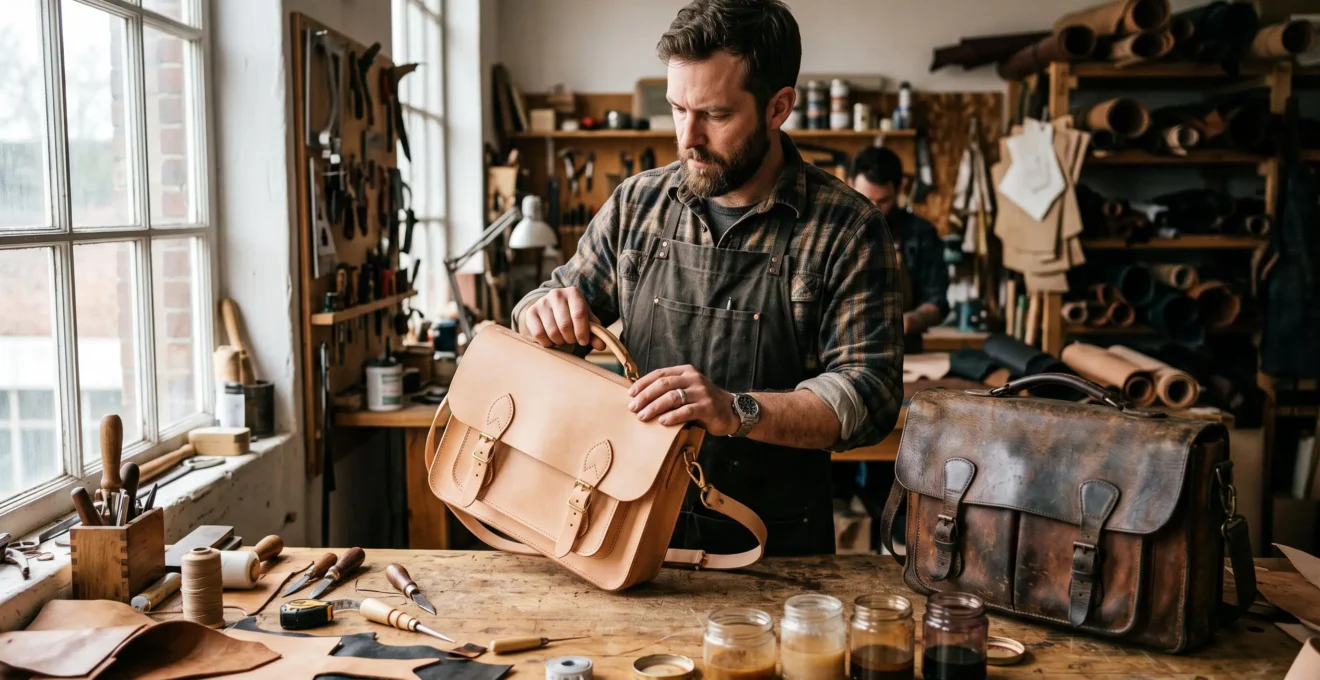
A leather bag can look immaculate under shop lighting and still develop cracked edges, damaged corners or peeling surfaces within a few years. Another can pick up scratches, darken noticeably and remain attractive after years of commuting. The difference is rarely explained by the price tag alone.
To judge whether crafted leather goods will still look good after five years, examine the leather’s grain, tanning method, surface finish and construction. Then consider how the item will be carried, exposed to British weather and maintained. A beautiful material cannot compensate for weak stitching, and careful construction cannot protect an unsuitable finish from repeated soaking.
There is no reliable five-year guarantee based on a quick shop inspection. However, visible construction details, accurate material descriptions and sensible care requirements can reveal avoidable risks before purchase.
The most useful question is not whether leather will change. It is whether those changes will be attractive, manageable and consistent with how the item is used.
How to choose leather goods that age well
- Check grain, finish and construction together. Full-grain leather is not automatically durable, and vegetable tanning does not prevent poor finishing.
- Expect natural leather to change colour and acquire marks. Patina is different from a coating that cracks, separates or flakes.
- Match the material to daily exposure, avoid excessive conditioning and treat rain protection as water resistance rather than waterproofing.
- Why Does Vegetable-Tanned Leather Age Beautifully While Others Peel?
- How to Inspect Leather Quality in 90 Seconds Without Any Tools?
- Smooth or Grained Leather: Which Shows Fewer Scratches for Everyday Use?
- The Leather-Care Mistake That Makes Bags Greasy and Dark in Weeks
- When Should You Waterproof Leather in the UK So It Doesn’t Stain in Heavy Rain?
- How to Check Luxury Accessory Quality in 8 Points Before You Leave the Shop?
- Canvas, Leather, or Nylon Tote: Which Handles UK Rain Best Without Looking Cheap?
- What Makes a Tote Bag Truly Versatile for UK Commuting and Weekends?
Why Does Vegetable-Tanned Leather Age Beautifully While Others Peel?
Vegetable-tanned leather can develop an attractive patina because its colour and surface appearance change with handling, light and use. Peeling, by contrast, usually involves the deterioration or separation of a surface layer. The crucial distinction is not vegetable tanning versus every other method, but how the hide’s grain, finishing system and construction behave together over time.
Vegetable tanning uses tannins derived from plant materials, including bark and leaves, to stabilise animal hide. Depending on subsequent processing, the resulting leather may retain visible grain, accept dyes differently and respond noticeably to handling and moisture.
Full-grain leather retains its original grain surface. Corrected-grain leather has undergone mechanical surface alteration, commonly followed by finishing intended to create a more consistent appearance. These are manufacturing classifications, not guarantees of performance.
The Leather Working Group‘s leather-industry terminology distinguishes full-grain, corrected-grain, split and other leather categories. Its definitions also make clear why buyers should ask about processing rather than relying on loosely used terms such as genuine or premium leather.
A well-made vegetable-tanned bag may gradually darken around handles, corners and frequently touched surfaces. Those changes can create visual depth without destroying the underlying grain. This is the appeal of patina, although it is not necessarily uniform or attractive to every owner.
A heavily pigmented or polymer-coated leather behaves differently. If its finish loses adhesion, cracks or wears through, a contrasting substrate may appear beneath it. That damage is not the same as patina. However, appropriately manufactured pigmented leather can perform very well, and corrected grain does not inevitably peel.
| What to inspect | Natural ageing | Potential finish failure |
|---|---|---|
| Colour | Gradual deepening or variation linked to handling | Irregular loss of surface colour exposing a different layer |
| Grain | Texture remains continuous beneath visible marks | Cracking, lifting or flaking at the surface |
| High-contact areas | Polishing, softening and gradual colour development | Separating coatings or persistent abrasion through the finish |
| Response to wear | Some minor marks blend into the material’s appearance | Damage remains conspicuous or requires refinishing |
The counterintuitive detail is that fresh, lightly finished vegetable-tanned leather can mark faster than a coated alternative. Early darkening is not itself evidence of poor quality. It may simply mean the bag is beginning to develop the appearance its owner chose.
Vegetable-tanned leather is not indestructible. Moisture, excessive heat and unsuitable treatment can cause deterioration. A durable result still depends on leather selection, tanning execution, finishing and storage.
Once the expected ageing behaviour is understood, the next step is to look for physical evidence of quality while the item is still on the shop counter.
How to Inspect Leather Quality in 90 Seconds Without Any Tools?
A 90-second leather inspection should combine a gentle grain check, an examination of edges and underside, and a look at the finish around stress points. These observations can reveal inconsistencies, weak finishing and visible construction problems. They cannot conclusively identify tanning chemistry, prove full-grain leather or predict five-year durability without supporting product information.
Start by handling the bag with clean, dry hands, provided the retailer allows it. Observe the surface under ordinary light rather than relying on a glossy display photograph.
- First 20 seconds: examine the grain. Look for texture variation, pores, scars or other natural characteristics. A perfectly uniform embossed pattern may indicate intentional finishing rather than a defect.
- Next 20 seconds: press gently. On an appropriate smooth panel, light thumb pressure may reveal fine wrinkles or grain movement. Avoid pressing fragile, delicate or display-sensitive leather.
- Next 20 seconds: inspect edges. Follow the handle edges, flap and corners with your eyes and fingertips. Look for gaps, lifting edge paint, rough joins or areas where the finish appears poorly attached.
- Final 30 seconds: check the underside and openings. Inspect accessible strap backs, interior seams and raw edges for loose fibres, questionable bonding and exposed construction layers. Ask what material was used where the structure is concealed.
These are useful screening observations rather than scientifically validated tests. Genuine full-grain leather can have a relatively smooth finish, while mechanically corrected leather may display an embossed texture that appears natural. Neither thumb pressure nor visual uniformity provides definitive identification.
Edges deserve particular attention because they expose workmanship that broad, attractive front panels can conceal. Both painted and burnished edges can be professionally executed. The relevant question is whether the chosen treatment is even, adherent and appropriate to the leather.
Likewise, a fuzzy underside does not automatically mean poor quality. Some genuine leather constructions deliberately expose the flesh side, and suede has a fibrous surface by design. A fabric backing may be part of an intentional laminated construction. Problems arise when layers are poorly bonded or a product’s description misrepresents its composition.
Smell and stiffness are especially unreliable shortcuts. A strong leather aroma does not establish leather grade, and a chemical smell does not independently prove inferior material. Stiffness may come from thickness, reinforcement or finishing; softness may come from processing rather than superior durability.
When the material passes this first inspection, consider how its surface texture will behave under the scratches and knocks of ordinary use.
Smooth or Grained Leather: Which Shows Fewer Scratches for Everyday Use?
Grained or pebbled leather generally makes small everyday scratches less noticeable because its texture visually breaks up surface marks. Smooth leather exposes fine abrasions more readily, but some lightly finished smooth leathers allow superficial marks to blend back with gentle handling. The better choice depends on finish, scratch depth and how much visible ageing the owner accepts.
A commute creates repeated contact with keys, coat fasteners, desks, train barriers and other hard surfaces. Each contact can leave a mark, even when the leather itself remains structurally sound.
Pebbled grain conceals small abrasions by interrupting reflections and making minor irregularities harder to distinguish. A carefully made pebbled bag can therefore retain a more consistent appearance with relatively little cosmetic attention.
Smooth leather offers a different advantage. On some waxed or oiled finishes, shallow marks can become less obvious after gentle rubbing. Certain pull-up leathers lighten when stretched or marked because oils and waxes shift within the material.
That behaviour should not be generalised to every smooth leather. A delicate aniline finish can absorb moisture and stain easily, while scratches that penetrate a pigmented coating may require specialist colour repair rather than simple buffing.
Grained leather is not necessarily more resistant to deep damage. Its texture primarily changes the visibility of minor scratches. Deep cuts, broken fibres and damaged coatings can remain conspicuous on either material.
| Decision factor | Smooth leather | Grained or pebbled leather |
|---|---|---|
| Small scratches | Usually more visible | Often less noticeable |
| Patina | Can develop visible colour and sheen variation | May maintain a more consistent textured appearance |
| Cosmetic repair | Some superficial marks respond to suitable gentle treatment | Repairs must respect the original texture |
| Daily commuting | Suited to careful handling and owners who accept marks | Practical when frequent contact is unavoidable |
| Five-year appearance | More visibly individual | Often visually steadier, depending on finish |
For a bag carried against railings and crowded train seats, a grained surface is often the lower-maintenance choice. For meetings, occasional commuting and weekend use, smooth leather can be worthwhile when its owner likes the appearance of gradually developing wear.
Inspect the finish alongside the texture. An attractive grain pattern does not compensate for poorly adhered coating or weak handle attachment.
The surface that appears easiest to maintain may still deteriorate prematurely if it receives too much conditioner or an unsuitable care product.
The Leather-Care Mistake That Makes Bags Greasy and Dark in Weeks
Over-conditioning is a common avoidable cause of greasy-looking leather. Repeatedly applying oils, waxes or rich dressings can leave unwanted residue, darken absorbent finishes and attract dust. A bag does not need conditioning simply because another month has passed. The appropriate product and frequency depend on the leather’s finish, exposure and actual condition.
Conditioners are not interchangeable. Products designed for robust footwear or saddlery may be unsuitable for delicate handbags, especially lightly finished vegetable-tanned or aniline leather.
Oil-rich products can change colour and handling characteristics. Excess may leave an uneven sheen or make certain areas appear permanently darker. Whether the change is reversible depends on the material and treatment; there is no universal home remedy.
The Canadian Conservation Institute‘s advice on caring for tanned leather discusses the risks associated with dressings, moisture fluctuations and heat. Its recommendations focus on museum conservation rather than routinely used handbags, but they reinforce why indiscriminate application of oils and waxes is risky.
For contemporary bags, follow the maker’s care guidance and assess the surface before applying anything. Dryness, stiffness or visible changes may justify investigation, but not necessarily immediate conditioning. A pale mark might be a water stain or an abrasion rather than evidence that the leather needs oil.
If a bag already feels greasy, stop applying products. Where safe for the finish, gently blot superficial residue with a clean, dry cloth without rubbing aggressively. Allow the bag to rest in a ventilated area away from direct sunlight and radiators.
Do not try to reverse excessive conditioner by adding another cleaner, solvent or absorbent powder without checking compatibility. These attempts can create additional marks. Persistent darkening or residue warrants advice from a qualified leather-care specialist.
Some smooth leather-care instructions suggest sparse treatment at intervals measured in months rather than weeks. Such schedules are product- and material-specific, not universal rules. A lightly used bag may need little intervention; a frequently handled bag may require cleaning sooner without needing conditioning.
The more reliable approach is to keep leather reasonably clean, use appropriate products sparingly and stop when the material does not require further treatment.
Product restraint matters even more before applying water-repellent treatments, particularly to the absorbent leathers most susceptible to rain marks.
When Should You Waterproof Leather in the UK So It Doesn’t Stain in Heavy Rain?
Assess leather protection before periods of frequent rain, especially ahead of autumn commuting, and reassess after thorough cleaning or sustained use. Choose a treatment specifically compatible with the bag’s leather and finish. Water-repellent products may reduce absorption and provide time to dry the surface, but they do not make an ordinary leather handbag waterproof during heavy rain.
UK conditions make this a practical consideration rather than a cosmetic extra. The national meteorological service’s historical records show that the wetter part of the year can bring substantial rainfall, although exposure varies considerably by region and daily routine.
122.52 mm
Average UK rainfall in October during the 1991–2020 reference period. This is a historical national average, not a forecast or a measure of how wet an individual bag becomes.
Timing alone does not determine the outcome. Untreated aniline leather absorbs moisture relatively easily, while an intact pigmented finish can provide greater initial resistance. Suede, nubuck, waxed leather and smooth finished leather require different products and methods.
For certain leathers, a suitable spray can provide water repellency with less obvious visual change than a heavy wax. Waxes may darken, alter the feel or change the appearance of the surface. Neither format should be assumed safe without checking the maker’s recommendations and testing compatibility in an inconspicuous area where appropriate.
New vegetable-tanned leather presents a genuine choice. An owner who wants the pale original tone preserved may prefer cautious protection, while someone seeking a pronounced natural patina may accept gradual darkening and occasional marks. Protection can change the way that patina develops.
After exposure to rain, remove surface droplets gently and allow the bag to dry naturally in a ventilated space. Avoid radiators, hairdryers and prolonged direct heat. If the bag is soaked, empty it where practical, support its shape and consult the maker’s instructions before further treatment.
A heavy downpour can still cause water marks, finish damage or moisture entering seams and openings. A suitable waterproof cover or more weather-resistant everyday bag is a safer option when prolonged exposure is likely.
Protecting the leather is only part of durability. The next inspection concerns the stitching, hardware, lining and structure that hold the accessory together.
How to Check Luxury Accessory Quality in 8 Points Before You Leave the Shop?
Inspect eight construction details before buying a luxury leather accessory: stitching, edges, hardware, lining, zip, interior odour, base and leather-panel consistency. Together, they reveal whether the maker has paid attention to areas that bear weight, receive friction or are difficult to repair. These checks are more informative than a logo or price, although none independently guarantees longevity.
A well-chosen hide can still become an unsatisfactory bag if its handles loosen, zip fails or lining pulls away. Construction quality determines whether the material can perform under repeated carrying loads.
Apply the inspection after the quicker grain and edge assessment, preferably with the bag opened and its moving parts accessible. Ask staff before loading, bending or repeatedly testing display merchandise.
Five shop-floor checks to complete before paying
- Examine the stitching. Look at the handles, strap anchors and corners. Record whether stitches are evenly placed, firmly seated and free from visibly loose ends.
- Inspect the edges and leather panels. Identify lifting coatings, exposed layers, inconsistent finishing or unexpected differences in material. Record any questionable area.
- Operate the hardware. With permission, open and close the zip, clasp and other fastenings. Confirm that movement is smooth and the finish is visibly intact.
- Check the interior and base. Inspect the lining attachment, base structure and feet, if fitted. Note any loose sections, distortion or unstable support.
- Confirm the product information. Ask about leather type, lining, hardware, care instructions and available repair services. Leave with a clear specification and any unresolved questions answered.
There are important distinctions within each category. Stitch density alone is not a quality ranking: overly close stitching can weaken some leather by creating perforations, while spacing that is too wide may provide insufficient support. The appropriate construction depends on material thickness, thread and expected load.
Edges should be consistent and securely finished. Quality edge paint can be durable, while a burnished edge can also fail if poorly executed. The type of finish is less informative than its workmanship.
Hardware requires similar caution. Solid-feeling parts, a consistent surface finish and secure attachment are useful observations, but weight alone cannot prove metal composition or plating quality. Hollow components are not automatically defective, and heavy hardware is not automatically superior.
The lining should sit securely without significant loose folds or unfinished seams. Zips should move without catching, and their teeth and stitching should appear aligned. A recognised component manufacturer can provide useful context, but a branded zip does not guarantee the quality of the complete bag.
Interior odour can flag something worth investigating, particularly if it is unusually strong, but smell does not establish whether a lining adhesive or finish will deteriorate. Base feet can reduce direct contact with surfaces, yet their absence may be an intentional design decision rather than a defect.
Finally, compare leather panels. Deliberate variation is normal in natural materials, but unexpected changes in thickness, surface finish or flexibility around stressed areas deserve questions.
A luxury bag with excellent leather and poorly attached handles may be a worse long-term purchase than a modestly priced bag with carefully engineered stress points.
For buyers regularly exposed to UK rain, the next decision is whether leather is even the most practical material for the bag’s intended role.
Canvas, Leather, or Nylon Tote: Which Handles UK Rain Best Without Looking Cheap?
Nylon is often the most practical choice for frequent wet-weather commuting because suitable fabrics can resist moisture and dry relatively quickly. Waxed canvas offers a more traditional appearance with useful resistance to light rain, while leather can look more refined but requires greater care when wet. Construction, coatings and finishing determine whether any of these materials retains an attractive appearance.
Untreated cotton canvas readily absorbs moisture, while waxed canvas uses a water-repellent finish that can reduce wetting. As wax wears unevenly, the fabric may develop lighter marks, folds or changes in surface appearance.
Nylon is generally quick-drying as a fibre, but a nylon bag is not automatically waterproof. Fabric density, coatings, seam construction, zip design and openings all affect how much water enters. Some coated fabrics may also develop visible surface deterioration if their coatings age poorly.
Leather usually tolerates brief incidental wetting better when it has a suitable intact finish, but more absorbent types can stain or darken. Its main visual advantage is the potential for attractive long-term character; its disadvantage is that water damage may become part of that appearance whether wanted or not.
| Material | Behaviour in rain | Likely appearance over time |
|---|---|---|
| Untreated canvas | Absorbs moisture readily | Can soften, fade and show stains |
| Waxed canvas | Repels some rain while finish remains effective | Develops creases, wax marks and worn areas |
| Finished leather | May resist short showers; vulnerable at seams and exposed areas | Can develop patina, scratches or moisture marks |
| Nylon | Often dries quickly; resistance depends on fabric and construction | May stay visually consistent, though coatings can deteriorate |
| Hybrid construction | Depends on the body fabric, leather trim and joins | Different materials may age at different rates |
Looking inexpensive is not inherent to a material. A shiny, poorly supported nylon tote may appear less refined than a densely woven structured version. Similarly, thin sagging canvas or leather with flaking edges can look worn prematurely despite a higher original price.
Construction determines much of the effect: a well-defined base, balanced proportions, neatly attached handles and restrained hardware can make a practical fabric look appropriate for both work and weekends.
Hybrid bags deserve consideration. A canvas-bodied tote with leather handles may offer a useful balance between appearance and material weight, while a nylon-lined leather bag can make interior cleaning easier. However, leather handles remain exposed to water, and seams connecting different materials can become stress points.
The five-year comparison therefore depends on what kind of ageing is acceptable. Leather may become more individual, canvas may soften and fade, and nylon may preserve a more uniform appearance unless its finish or components deteriorate.
Once the material is chosen, practical versatility depends on whether the bag can carry an ordinary week’s belongings without losing its shape or becoming uncomfortable.
Key takeaways before choosing your everyday tote
- Choose the material for the conditions it will encounter most frequently, not the most flattering product photograph.
- Prioritise load-bearing seams, secure openings and a base that supports the contents over decorative details.
- Think about the bag after an hour of carrying a laptop, lunch and daily essentials, not just while it is empty.
What Makes a Tote Bag Truly Versatile for UK Commuting and Weekends?
A versatile tote must carry its usual contents comfortably, keep them reasonably secure and retain a practical shape across different activities. For UK commuting and weekends, the strongest design combines suitable material, stable construction, accessible storage and handles that work over seasonal clothing. A tote that only looks elegant while empty is not necessarily a useful long-term purchase.
The first test is the base. Set the empty bag on a flat surface and observe whether it stands independently or collapses. Neither behaviour automatically indicates poor quality: a soft weekend tote may intentionally fold, while an office bag may benefit from greater structure.
What matters is how the chosen design performs when loaded. A reinforced base helps distribute contents, but its attachments and stitching must tolerate repeated weight. A removable base insert can also improve shape retention, depending on the design.
Handle length is equally important. A shoulder strap comfortable over a summer shirt may become awkward over a thick winter coat. Check the handle drop with clothing similar to what will be worn during commuting.
A secure fastening deserves particular attention in crowded transport. A full zip offers more containment than an open top, though it may reduce immediate access. Magnetic closures can be convenient but should not be treated as equivalent to a fully enclosed compartment.
Weight should be evaluated with the intended load, not by lifting the empty tote once. A beautiful leather bag can become uncomfortable when its own weight is combined with a laptop, water bottle, charger and lunch. Wide, well-supported handles can help distribute the load, but their shape and attachment points still matter.
Consider a hypothetical weekday test: place the usual laptop, notebook, water bottle, compact umbrella and lunch container inside a shortlisted tote, provided the retailer permits it. Close the bag, lift it and observe the base, handle attachment points and opening. Walk a short distance in the shop if appropriate.
If the mouth cannot close, the base distorts substantially or the handles dig uncomfortably into the shoulder, the bag may be poorly suited to that particular load even if its materials and workmanship are sound.
Weekend use creates a different set of priorities. Flexible capacity, a softer silhouette and easy access may become more useful than a structured laptop compartment. For some shoppers, this trade-off makes a hybrid design or a slightly less formal finish preferable.
Long-term appearance also depends on choosing a bag that is not routinely overloaded. Repeated stress can affect seams, handles and panels. Storage habits matter too: empty the bag when appropriate, avoid prolonged crushing and keep it away from excessive heat or moisture.
Choose the tote that performs well with the belongings, clothing and weather conditions of a normal week. Confirm its material specification, inspect the construction and follow finish-specific care guidance. Those decisions cannot guarantee a flawless bag in five years, but they make a satisfying long-term outcome considerably more plausible.
Can genuine leather peel after a few years?
Yes. Genuine leather can have a surface coating that cracks, wears or separates. Peeling does not automatically mean the entire material is synthetic, although certain synthetic and bonded materials can also develop peeling surfaces. The relevant distinction is between the underlying substrate and the finish applied to it.
Does an expensive leather bag necessarily last longer?
No. Price can reflect design, branding, craftsmanship and materials without proving durability. Examine leather specification, seam construction, hardware attachment, finishing and available repairs. An expensive bag with unsuitable delicate leather may be less practical for daily commuting than a carefully constructed lower-priced alternative.
Should a new leather bag be conditioned before its first use?
Not automatically. Many new leather goods have already been finished and prepared during manufacture. Additional conditioning may be unnecessary or incompatible with the surface. Follow the manufacturer’s instructions, identify whether the leather is absorbent or finished, and avoid applying heavy products simply as a preventive routine.
Can a leather bag recover completely after getting soaked?
Sometimes it can dry without obvious lasting damage, but complete recovery cannot be promised. Water may leave marks, affect colour, alter shape or damage certain finishes. Remove excess surface moisture gently, support the bag’s shape and allow natural drying away from direct heat. Seek specialist advice for severe saturation or valuable items.
Is full-grain leather always better than corrected-grain leather?
No. Full-grain describes leather retaining its natural grain surface, while corrected-grain describes surface processing. Neither designation alone establishes the finished product’s durability. A well-manufactured corrected-grain bag with an appropriate finish and sound construction may suit an everyday commuter better than a delicate, lightly finished full-grain bag.