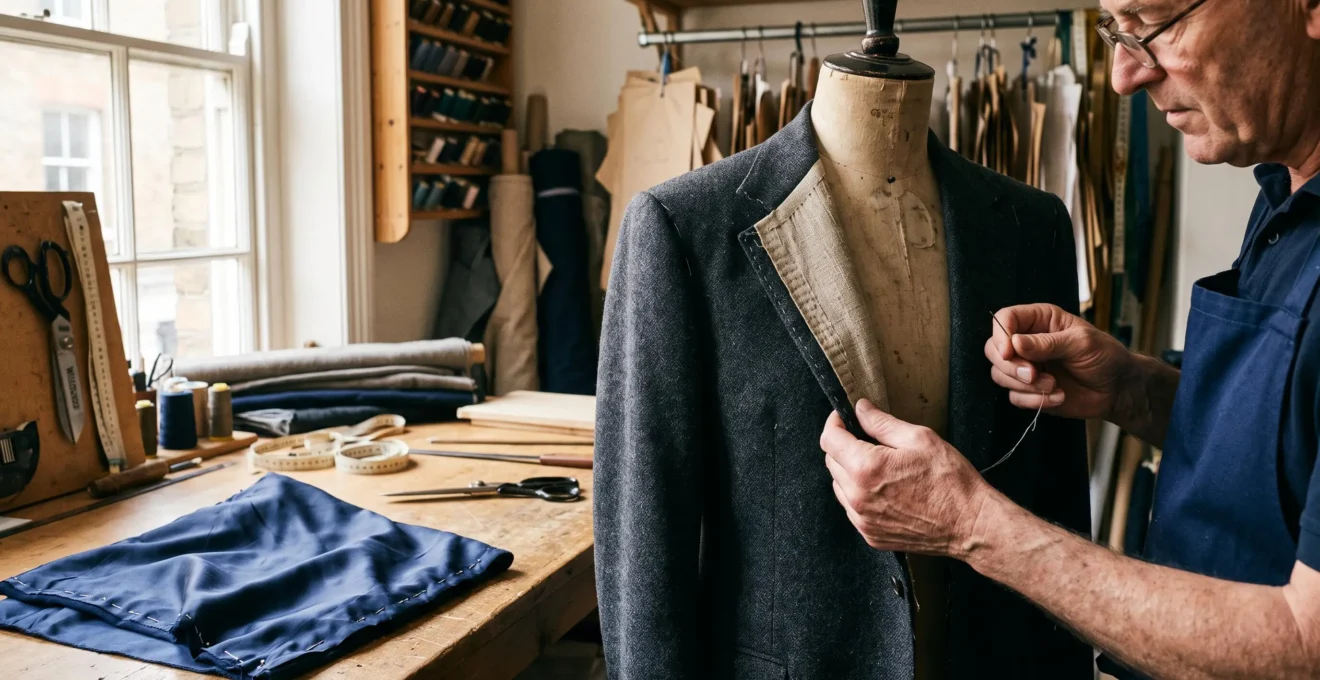
Hand-finished buttonholes, carefully shaped lapels and hand-set sleeves can justify a higher clothing price, but the presence of visible hand stitching does not automatically mean a garment will last longer or feel better. The meaningful difference lies in what the construction achieves: freedom of movement, controlled fabric tension, secure joining, comfortable fit and compatibility with regular care.
A beautifully finished jacket may accommodate shoulder movement more comfortably than a poorly constructed alternative, yet an accurately engineered machine-made jacket can perform equally well. Likewise, an expensive hand-rolled hem adds little practical value if the fabric itself is unsuitable for the intended use.
The useful question is not whether a garment was made by hand. It is which construction choices improve performance under the conditions in which the garment will actually be worn and cleaned. A few practical inspections can distinguish functional craftsmanship from decorative details without requiring specialist equipment.
What matters most when evaluating artisanal clothing
- Judge performance, not the method alone. Hand finishing is valuable when it improves movement, shape, comfort or repairability.
- Inspect structural details. Seams, buttonholes, hems, linings and stress points provide stronger evidence than branding or visible decorative stitches.
- Consider maintenance before paying more. Fabric, interfacing and finishing must tolerate the cleaning methods the garment will realistically need.
- Why Does Hand-Finishing Change How Fabric Moves When You Walk?
- How to Inspect Seams and Finishing in 60 Seconds While Shopping In-Store?
- Hand-Finished or Machine-Finished: Which Survives Dry Cleaning Better?
- The Cleaning Mistake That Can Shrink or Distort Crafted Pieces After One Visit
- A Wardrobe Mix That Keeps Craft Pieces Special Without Making Laundry a Nightmare
- How to Spot Artisan-Level Work Using 7 Visual Checks in Good Lighting?
- How to Spot High-Quality Cotton Using 5 Touch-and-Look Tests?
- Is Organic Cotton Worth Paying More For When You Want Clothes to Last?
Why Does Hand-Finishing Change How Fabric Moves When You Walk?
Hand finishing can influence fabric movement because certain techniques allow a tailor to adjust stitch placement, tension and shaping across different parts of a garment. A carefully constructed lapel or sleeve may therefore move more comfortably than a rigidly assembled equivalent. However, this advantage depends on the technique, fabric and fit rather than hand stitching itself.
Consider a tailored jacket with a hand-padded lapel. Pad stitching can help shape the relationship between the outer fabric and its supporting canvas. The stitches, their spacing and the shaping applied during construction contribute to the lapel’s three-dimensional roll. The result can be a softly curved structure rather than a front panel that appears excessively flat.
Hand-set sleeves offer another example. When properly executed, the sleeve head can be eased into the armhole to accommodate differences in shape and distribute fullness. This may contribute to a smooth shoulder line and comfortable movement. Machine setting can achieve similar results, however, and neither method compensates for an incorrectly designed armhole.
A hand-rolled hem serves a different purpose. On suitable lightweight fabric, the technique creates a narrow, flexible edge with relatively little visible bulk. Its benefit is mainly in edge appearance, weight and flexibility, not in automatically making the whole garment more fluid.
Fabric drape and construction-driven movement are separate properties. Silk, viscose and lightweight wool can fall fluidly because of their material and fabric structures. Tailoring determines how that fabric is supported, constrained and shaped around the body.
Try a movement test in front of a mirror:
- Walk naturally and observe whether the hem swings without persistent twisting or catching.
- Sit down, then stand up, watching for excessive pulling around the hips, shoulders or button closure.
- Raise both arms gently and notice whether the armholes permit the intended range of movement without uncomfortable restriction.
Some movement of the entire jacket is normal. A tailored garment should not be expected to behave like stretch sportswear. The test instead helps identify disproportionate pulling, discomfort and distortion.
According to New Mexico State University’s clothing construction standards, quality includes functional construction, appropriate ease, secure stitching and smooth finishing. These criteria assess what the garment does rather than assuming that a particular sewing method is inherently superior.
Movement reveals possible benefits of craftsmanship, but the seams carrying those movements must also withstand repeated wear. That makes internal construction the next useful inspection point.
How to Inspect Seams and Finishing in 60 Seconds While Shopping In-Store?
A useful 60-second garment inspection starts inside the clothing rather than on its decorative exterior. Check seam security, stress points, buttonholes and finishing before evaluating pattern alignment. Look for loose threads, damaged stitching, puckering or inadequate support. This quick examination cannot establish lifetime durability, but it can reveal obvious construction weaknesses before purchase.
A structured sequence helps prioritise the areas most likely to experience strain.
| Time | What to inspect | What to look for |
|---|---|---|
| 0–15 seconds | Inside seams and seam allowances | Secure edges, consistent construction and enough allowance for the fabric and garment design. |
| 15–30 seconds | Armholes, crotch and side seams | No visible gaps, broken threads or obvious puckering at major stress points. |
| 30–45 seconds | Buttonholes and closures | Secure stitching, neat openings, suitable reinforcement and buttons that fasten without excessive strain. |
| 45–60 seconds | Hems, lining and pattern alignment | Smooth hanging, secure finishing, adequate lining ease and appropriate matching of prominent stripes or checks. |
Seam allowance width should be appropriate, not simply as wide as possible. A narrow allowance may be intentional in a specialist seam, while an unnecessarily bulky allowance can create ridges. Compare both sides of the garment and look for consistent execution.
Stitch density also requires context. Excessively long stitches may reduce security in some applications, whereas excessively dense stitches can perforate delicate fabrics. Consistency, suitable thread and correct stitch formation matter more than a universal stitches-per-centimetre rule.
Buttonhole appearance offers another useful clue. The stitching should reinforce the opening, and the cut edges should be properly contained. Some machine buttonhole processes stitch before cutting, but cutting order alone does not determine quality. The finished result must suit the material and function securely.
Do not be distracted by a heavy lining, expensive-looking label or deliberately visible hand stitching. These may convey a particular aesthetic without demonstrating stronger seams or more comfortable construction. Likewise, matching patterns at prominent seams can demonstrate careful cutting, but a mismatch on its own does not quantify durability.
Your five-point in-store quality checklist
- Inspect the inside. Identify and record one observation about seam security or finishing.
- Check a stress point. Examine an armhole, crotch or side seam and note whether any gaps, loose threads or puckering appear.
- Test a closure. Fasten and release one button or zip and record whether it operates smoothly without pulling.
- Assess the shape. Wear the garment through a normal movement and note any uncomfortable restriction or twisting.
- Read the care label. Record the cleaning method and decide whether it matches your normal wardrobe maintenance.
A piece that passes these checks may still have weaknesses that become apparent only after cleaning. Construction quality and care compatibility therefore need to be considered together.
Hand-Finished or Machine-Finished: Which Survives Dry Cleaning Better?
Neither hand-finished nor machine-finished garments universally survive dry cleaning better. Durability depends on stitch construction, thread, fabric, interfacing and the actual cleaning process. A well-made machine seam can be exceptionally secure, while suitable hand finishing can provide flexibility in selected areas. Professional cleaning introduces additional risks through mechanical action, moisture, drying and pressing.
Machine lockstitches interlock two threads within the material. When correctly formed with suitable tension, they provide secure, repeatable seams. Their performance depends on the fabric and thread as well as the stitching pattern. A rigid or poorly selected stitch can contribute to localised strain, although machine stitching is not inherently inflexible.
Hand stitching permits different forms of construction. Slip stitching may produce an unobtrusive hem, while pad stitching can help build three-dimensional structure. Each technique serves a distinct function. Weak thread, unsuitable stitch length or poor execution can undermine either method.
Dry-cleaning performance becomes especially important in structured clothing. A jacket may combine wool outer fabric, canvas or fusible interfacing, lining, shoulder components and specialist stitching. These elements must remain compatible with the selected treatment.
Interfacing deserves particular attention because it influences the garment’s shape even though it may be hidden. Bubbling, separation or distortion can compromise appearance without an obvious failure of the visible seams.
Pressing is another relevant stage. Excessive pressure, steam or inappropriate shaping may alter sensitive areas such as lapels and shoulders. That does not establish that pressing is always more damaging than cleaning solvents; the dominant risk depends on the materials and process.
The following comparison is a practical decision framework rather than a laboratory ranking of stitching methods.
| Garment and care pattern | Hand-finished construction | Machine-finished construction |
|---|---|---|
| Frequently cleaned everyday trousers | Can work well, provided critical seams and hems are securely constructed. | Offers repeatable seam construction; still requires suitable fabric, thread and care. |
| Occasionally cleaned tailored jacket | May offer advantages in shaping, lapels and selected internal details. | Can provide comparable functional quality when properly engineered. |
| Delicate occasion garment | May allow discreet, low-bulk finishing but needs careful maintenance. | Can be suitable with appropriate stitches and fabric handling. |
| Highly structured coat | Specialist construction may require experienced cleaning and finishing. | Internal components still determine appropriate cleaning conditions. |
The US Federal Trade Commission‘s guidance on garment care labeling explains why care recommendations must consider the complete garment, including components and necessary process modifications. It is US regulatory guidance, not a statement of UK clothing-labelling law or proof that one stitching method outlasts another.
For a carefully shaped jacket, ask whether the cleaner can assess its construction and use appropriate finishing methods, including hand pressing where suitable. The recommendation should reflect the garment’s documented care requirements.
The method used to make a garment is only part of its maintenance risk. A single unsuitable treatment can affect several interconnected materials at once.
The Cleaning Mistake That Can Shrink or Distort Crafted Pieces After One Visit
The most consequential cleaning mistake is treating a complex, hand-finished garment as though its outer fabric were its only material. Standard washing or dry cleaning may be unsuitable for an internal canvas, lining, trim or decorative component. When different materials react differently, the garment can shrink unevenly, lose shape or develop permanent-looking distortion.
Consider a hypothetical structured wool jacket containing an outer fabric, lining and internal support material. If one component changes dimension more than another during cleaning, the layers may no longer sit together smoothly. The jacket could develop pulling, puckering or a distorted front.
This effect is known as differential shrinkage. Its severity depends on fibre composition, fabric preparation, internal construction, moisture exposure, temperature and mechanical handling. Some incompatible treatments may cause visible damage after a single cycle, although that outcome cannot be predicted for every garment.
Traditional tailoring materials can introduce additional considerations. Horsehair canvas, silk components, fusible interfacings and other internal structures may have care requirements that differ from the garment’s outer fabric.
A label stating that an item should be professionally dry cleaned is useful, but it does not mean every machine, solvent or finishing process is equally appropriate. Professional dry cleaning may involve different procedures and controlled adjustments according to the garment.
Before handing over an artisanal or structured piece:
- Read the complete care label and identify any restrictions on washing, dry cleaning, drying or ironing.
- Examine the garment for construction features that may need special attention, including structured lapels, delicate trims and unsupported areas.
- Tell the cleaner about those features and ask whether they regularly handle similarly constructed garments.
- Discuss suitable temperature, moisture, agitation and finishing arrangements rather than requesting a generic treatment.
- Inspect the garment after collection for changes in shape, bubbling, puckering or unusual tension.
Low heat and hand finishing are not universal prescriptions. They may be sensible options for certain structured garments, but the correct method should be based on material compatibility and professional assessment.
For UK shoppers, care symbols and manufacturers’ instructions should guide the initial decision. Where a construction detail appears inconsistent with the stated care process, ask the retailer or manufacturer for clarification instead of experimenting at home.
Maintenance also has a financial and practical cost. A garment that demands specialist treatment after every outing may be poorly suited to an otherwise low-maintenance wardrobe.
A Wardrobe Mix That Keeps Craft Pieces Special Without Making Laundry a Nightmare
A manageable wardrobe reserves demanding artisanal construction for garments whose wear patterns justify the additional maintenance. Structured jackets, coats and occasion pieces may benefit from specialist finishing without needing frequent cleaning. Everyday basics, especially items worn close to the skin, are often more practical when their materials and construction tolerate regular laundering.
The distinction is not between expensive handmade clothing and cheap machine-made clothing. It is between construction appropriate to the intended use and construction that introduces unnecessary care requirements.
One approach is to create a flexible wardrobe allocation rather than enforce a fixed percentage of handmade pieces. The useful proportion will depend on work, climate, commuting, personal style and laundry habits.
For example, a hypothetical wardrobe could prioritise easy-care cotton shirts and regularly washed trousers, while selecting a carefully tailored jacket for repeated wear over those layers. The jacket’s construction may contribute more to appearance and fit because it is worn in contexts where frequent laundering is unnecessary.
The essential purchase question is simple: How frequently will this garment need cleaning, and can its construction tolerate that frequency?
Answering it requires considering not just visible stains but also perspiration, contact with skin, odours, weather exposure and the role of protective layers.
Cleaning clusters offer a useful organisational strategy. Group clothes by their documented care compatibility, not merely by appearance or perceived luxury:
- Regular washable basics: garments with compatible machine-washing and drying instructions.
- Delicate home-care items: garments requiring gentler handling or specific drying arrangements.
- Professional-care garments: tailored, structured or decorated pieces whose instructions call for specialist treatment.
Within each cluster, follow individual instructions. Two garments labelled for professional cleaning may still require different methods. Similarly, two machine-washable fabrics may not tolerate the same temperature or drying conditions.
Grouping maintenance decisions can reduce repeated trips and prevent careless mixing of incompatible garments. It does not establish a guaranteed saving: professional cleaning costs and garment-specific requirements vary.
Also consider repair access. A garment with accessible seams, replaceable buttons and repairable hems may remain useful even after minor damage. These practical benefits can matter more than whether its original finishing was performed by hand.
Once the wardrobe role is clear, a more detailed visual inspection can help determine whether a particular piece actually demonstrates the craftsmanship its price suggests.
How to Spot Artisan-Level Work Using 7 Visual Checks in Good Lighting?
Artisan-level workmanship is easier to assess under clear, angled lighting that reveals stitching, shaping and surface defects. Examine seven areas: buttonholes, hems, seam matching, collar and lapel roll, lining attachment, edge stitching and pattern alignment. The strongest evidence is consistent functional execution, not deliberate irregularity or visible hand stitches alone.
Start with a well-lit area and change the viewing angle. Direct overhead light can make a garment appear uniformly smooth, while light travelling obliquely across the surface may reveal raised seams, puckering, uneven topstitching or bubbling beneath the fabric.
The seven checks should be performed in a consistent order.
- Buttonholes: Look for secure, appropriately dense stitching, a neatly finished opening and accurate positioning. Hand-worked buttonholes may show subtle individual stitch variation, but this is not sufficient proof of superior strength.
- Hems: Check whether the hem hangs smoothly and whether stitches are secure and suitably discreet. Genuine hand finishing may permit small adjustments to delicate edges; an accurately finished machine hem can also perform well.
- Seam matching: Observe whether neighbouring pieces meet without unexpected steps, twisting or puckering. Distinguish purposeful tailoring ease from careless joining.
- Collar and lapel roll: Examine whether shaped areas follow a controlled curve and remain smooth. Hand pad stitching can contribute to this result, but excellent shaping is not exclusive to hand construction.
- Lining attachment: Look for sufficient ease and secure connections at hems and openings. A lining that pulls tightly can interfere with movement regardless of whether it was attached manually or by machine.
- Edge stitching: Examine consistency, thread security and the relationship between the stitching and fabric edge. Perfectly regular decorative stitching does not establish inferior workmanship.
- Pattern alignment: On prominent stripes, checks or plaids, look for thoughtful matching where construction permits. Curved seams and design decisions may make exact alignment impractical in some locations.
Hand stitching can display slight differences between stitches. Such variation may be consistent with manual work, but it is not a dependable authenticity test. High-quality hand stitching should still be secure, controlled and suitable for its purpose. Poorly spaced or loose stitching should not be excused as evidence of authenticity.
A machine may reproduce the appearance of certain traditional finishing details. The important distinction is whether those details perform a structural or functional role. For example, decorative stitching along a lapel edge is not equivalent to internal pad stitching that helps shape the lapel.
Lighting can reveal construction problems, but it cannot identify every hidden technique. When workmanship affects a purchasing decision, ask the retailer what is actually hand sewn, which components are fused or canvassed, and whether alterations are supported.
The construction principles in New Mexico State University’s educational standards provide a useful foundation for this approach: suitable materials, secure stitching, smooth finishing and functional fit remain more important than visual claims of craftsmanship.
Even excellent workmanship cannot completely compensate for weak or unsuitable fabric. Cotton provides a useful example because everyday shoppers can compare several material characteristics before inspecting construction.
How to Spot High-Quality Cotton Using 5 Touch-and-Look Tests?
High-quality cotton is best assessed through several observations rather than weight, softness or thread count alone. Five practical checks examine wrinkle recovery, fabric structure, surface fuzz, seam behaviour and the relationship between weight and drape. These tests can identify visible differences between garments, but they cannot reliably measure fibre strength, abrasion resistance or eventual lifespan.
Start by comparing cotton garments intended for similar uses. A crisp shirt poplin, soft jersey T-shirt and heavy cotton twill are engineered to behave differently. Judging all three against a single standard would be misleading.
The following tests serve as consumer screening tools, not laboratory procedures.
- Crush test: Gently compress a small area of fabric, release it and observe how the wrinkles settle. Compare similar fabrics. Cotton naturally creases, so poor wrinkle recovery alone does not establish inferior fibre quality.
- Light hold-up test: Hold a single fabric layer towards a light source and observe its uniformity, opacity and any unexpected thin patches. A lightweight fabric may be intentionally translucent without being defective.
- Rub test: Gently rub a discreet surface area and check for loose fuzz or obvious disturbance. This can reveal an immediate surface response, but it does not reliably predict long-term pilling.
- Seam stretch test: Apply gentle, normal handling tension near a seam and observe whether stitches open or the fabric distorts. Do not force the material. The aim is to identify obvious incompatibility between fabric, stitching and intended use.
- Weight-to-drape test: Lift the garment and watch how it falls. Check whether its weight, flexibility and structure suit the intended design rather than assuming heavier cotton must be stronger.
Fibre quality, yarn construction, fabric structure and finishing interact. A soft surface can result from finishing treatments rather than longer cotton fibres. Mercerisation, for example, can change cotton’s lustre and other properties; shine is not a standalone durability guarantee.
Likewise, a high thread count does not prove that longer-staple cotton was used. The number of threads or the perceived density of a fabric cannot independently establish fibre length, yarn strength or resistance to repeated wear.
The CottonWorks technical resource on garment durability identifies strength, abrasion resistance and pilling as important performance dimensions. These are subject to formal textile testing, and the source does not establish universal durability thresholds for all clothing uses.
That distinction matters when shopping. A fabric that feels substantial may still develop premature surface wear, while a lighter, well-engineered cotton garment may perform appropriately for its intended purpose.
After assessing the fabric, inspect its seams, edges and closures. A promising cotton textile combined with insecure construction is still a questionable purchase.
Cotton quality also raises a purchasing question that is often misunderstood: whether an organic label itself indicates better strength or longer garment life.
Key takeaways before paying a premium
- Separate farming and certification claims from measurable textile performance.
- Evaluate fibre characteristics, yarn and fabric construction, sewing quality and realistic care requirements together.
- Pay for demonstrable garment benefits or clearly valued production standards, rather than assuming one label guarantees longevity.
Is Organic Cotton Worth Paying More For When You Want Clothes to Last?
Organic cotton can be worth a premium when its production standards matter to you and the finished garment also meets your durability expectations. However, organic certification does not automatically mean stronger fibres, better seams or a longer lifespan. To assess value for money, separate the agricultural claim from the garment’s actual material, construction and care performance.
Organic cotton describes cotton produced under applicable organic farming requirements. These concern cultivation practices and certification criteria rather than guaranteeing a particular staple length, yarn structure or finished-fabric strength.
Staple length refers to the length of the cotton fibres used to make yarn. Fibre length and strength can influence spinning possibilities and yarn characteristics, but they are only part of the final fabric’s performance. Yarn twist, fabric construction, finishing and garment assembly also matter.
Cotton Incorporated‘s CottonWorks comparison of organic and conventional cotton distinguishes organic production methods from fibre quality and performance. It explains why the agricultural category should not be treated as a direct durability measurement.
“Organic cotton refers to the production methods and farm management practices, not the fibers’ characteristics, classing, or performance.”
This distinction helps avoid two opposing mistakes: dismissing organic cotton as irrelevant to a purchase, and assuming the certification guarantees superior physical performance.
A shopper may reasonably value the production requirements associated with organic certification regardless of durability. That is a separate purchasing objective, and it does not require claiming that every organically produced garment lasts longer.
Some brands offering organic cotton may also invest in carefully selected fibres, stronger fabrics or improved construction. However, that association is not guaranteed. An organic label is therefore not dependable evidence that a particular garment uses long-staple fibres or superior sewing methods.
Before paying more, compare the specific attributes that affect the item you intend to wear:
- Fibre information: Check whether claims such as long-staple or extra-long-staple cotton are provided and supported by meaningful product information.
- Fabric suitability: Consider the weave or knit structure, weight, surface condition and intended wearing conditions.
- Construction: Inspect stress points, seam security, hems and closures using the same standards as for conventional cotton.
- Care compatibility: Confirm that the cleaning instructions suit the garment’s expected use.
- Price difference: Decide whether the extra cost reflects production standards you value, identifiable garment-quality improvements or both.
A hypothetical comparison illustrates the decision. Suppose two cotton shirts have similar construction, fit and care requirements, but one costs more because it uses certified organic cotton. Paying the premium may support your production-related preferences; it would not establish that the more expensive shirt has a longer expected lifespan.
Alternatively, if one shirt also has demonstrably better stitching, a fabric suited to repeated wear and a more comfortable fit, those features offer independent reasons to consider its price worthwhile. They should not be attributed to organic certification without evidence.
For durability-focused shoppers, the most defensible purchasing decision combines material information with direct inspection and realistic maintenance expectations. Neither certification nor price removes the need to evaluate the finished product.
At your next clothing purchase, compare two garments serving the same purpose, inspect their construction, assess the fabric and read both care labels. Then decide which benefits are visible or verifiable, which production standards you value and whether the price difference is justified for your wardrobe.
Can an expensive handmade garment still be poorly constructed?
Yes. Handwork and price do not guarantee suitable materials, secure seams or accurate fit. A garment can contain labour-intensive details while still having weak stress points, unsuitable interfacing or inadequate lining ease. Evaluate workmanship using functional construction criteria rather than price or manufacturing claims alone.
Does visible hand stitching prove that a garment was made by an artisan?
No. Some decorative stitching can imitate handwork, while genuinely hand-finished garments may contain extensive machine construction. Visible stitch variation is not reliable proof of either authenticity or quality. Ask which components were hand finished and what those techniques contribute to the garment’s performance.
Is fully canvassed tailoring always better than fused construction?
Not necessarily. Canvas construction can support particular forms of shaping and lapel structure, while suitable fused interfacing can provide effective support for other garments. Material compatibility, execution, design requirements and long-term care determine whether either approach performs well. The supplied construction references do not establish a universal durability ranking between these methods.
Can a tailor repair hand-finished areas after cleaning damage?
Some damage to hems, stitching or attachments may be repairable. Distorted internal structures, adhesive failure or substantial differential shrinkage may be more difficult to correct. A specialist tailor should inspect the materials and construction before estimating repair possibilities. Repairability should never be assumed solely because a garment contains hand sewing.
Should cotton feel heavy to be considered high quality?
No. Fabric weight needs to suit the clothing’s intended function. Lightweight cotton can be appropriate for breathable summer shirts, while heavier fabrics may suit structured trousers or outerwear. Strength, abrasion resistance, yarn quality, construction and care compatibility are more meaningful than weight alone.